12 Play Console app testers for Android app testing in Azerbaijan
Hire 12 Play Console app testers in Azerbaijan. Pass Google Play closed testing in 14 days with real Android testers and unlock Play Store production access.
Why Closed Testing Is a Roadblock for Azerbaijani Developers
The modern startup ecosystem in Azerbaijan is expanding rapidly, with teams creating high-utility tools for fintech, logistics, delivery, e-commerce, and Caspian regional services. However, when Azerbaijani software creators push their release to Play Console, they face the strict 14-day continuous evaluation period. Google Play's review algorithms monitor daily active telemetry, crash ratios, session duration, and network diversity. If your tester cohort drops below the required active threshold or exhibits artificial usage patterns, your 14-day clock resets back to day zero.
Local peer networks are rarely equipped to deliver the discipline required for Play Store Closed Testing. A cousin testing your app on an outdated budget phone might fail to install updates, while university colleagues often test enthusiastically on day one and abandon the app by day four. To secure production clearance on your first attempt, you need a dedicated testing group of verified human users operating on real physical devices who generate authentic logs, leave constructive in-console feedback, and keep your telemetry green throughout the entire testing window.
Google's Strict 14-Day Closed Testing Mandate
Google introduced the 12 testers for 14 days rule to eliminate low-quality, buggy, or abandoned apps from flooding the Play Store. Under this policy, developers with personal developer accounts must recruit at least 12 opt-in testers who maintain access to the closed track for 14 consecutive calendar days.
The key nuance many developers miss is that recruitment alone is not enough. Play Console tracks whether those 12 opted-in users actually download the build, keep it installed, open it across different days, and trigger user events. If your analytics show zero active sessions between days 5 and 10, Google's automated production review will flag your application as having insufficient testing engagement, forcing you to start another 14-day cycle from scratch.
Real Human Managed Testing
- Physical Android Hardware: Testers run your app on genuine smartphones spanning Android 10 through Android 15.
- Consistent Daily Telemetry: Users trigger real touch events, screen transitions, and authentic background sessions.
- Zero IP Clustering: Testing occurs across diverse, residential network addresses without VPN or proxy masking.
- Genuine In-Console Feedback: Testers submit constructive usability bug reports directly via Google Play feedback channels.
- Guaranteed 14-Day Retention: Testers never uninstall your build until production approval is officially granted.
Emulator Farms & Reciprocal Groups
- Synthetic Emulator Signatures: Bots run on virtual devices that Google's SafetyNet and Play Integrity easily detect.
- Clustered IP Subnets: Automated scripts generate simultaneous hits from data center IP blocks, triggering fraud flags.
- High Churn & Dropouts: Reciprocal swap participants stop opening your app after earning their own quick review.
- Copy-Paste Generic Comments: Low-effort or bot-generated text alerts Google's spam filters and harms account reputation.
- High Risk of Account Bans: Repeated closed testing rejections put your developer account under manual audit risk.
Comparing Android App Testing Solutions
Developers in Azerbaijan have three main paths to fulfill the 12 testers for 14 days requirement: coordinating a do-it-yourself (DIY) group of acquaintances, purchasing cheap bot-driven traffic from freelance marketplaces, or partnering with a dedicated professional testing service. Evaluating these approaches side by side reveals why professional managed testing provides the safest and most cost-effective path to Play Store deployment.
| Feature & Assessment Metric | Dedicated Managed Testing | DIY Friends & Peer Network | Automated Bot / Swap Services |
|---|---|---|---|
| Real Physical Hardware | 100% Guaranteed Real Devices | Mixed (Limited Device Variety) | Emulators & Virtual Machines |
| 14-Day Consecutive Activity | Continuous & Monitored Daily | High Dropout Rate (70%+) | Scripted Spikes (Easily Flagged) |
| IP & Network Diversity | Broad Global Residential IPs | Localized Single City IPs | Data Center / Cloud IPs |
| Meaningful Private Feedback | Actionable Bug & UI Reports | Minimal / "Looks Good" | Robotic / Identical Spam Reviews |
| Play Integrity Compatibility | Fully Compliant & Safe | Fully Compliant | High Risk of Integrity Failure |
| Production Access Approval | 99%+ First-Attempt Success Rate | Unpredictable (Frequent Resets) | High Rejection & Account Penalty |
| Time & Management Overhead | Zero Management Required | 15 - 20 Hours Chasing Testers | Low Effort, Catastrophic Risk |
DIY testing sounds straightforward until you spend two weeks sending daily reminder messages on WhatsApp and Telegram, pleading with friends to keep the app installed. When just two people delete the app to make room for photos, your closed testing cycle quietly breaks. On the other end of the spectrum, automated bot networks and cheap swap gigs might look like an easy bargain, but Google's sophisticated telemetry analyzers catch robotic click routines and identical device models instantly. Choosing managed human testing gives you complete peace of mind, allowing you to focus on building features while seasoned testers fulfill your Google Play Closed Testing requirements smoothly.
Struggling with the 14-Day Testing Requirement?
Skip the hassle of recruiting unreliable testers. Our professional fleet of real Android devices guarantees Google Play compliance in exactly 14 days. Zero bots. Zero emulators. 100% production approval guarantee.
The Hidden Technical Traps of Play Console Telemetry
Passing Google Play Closed Testing is not a simple checkbox; it is an ongoing automated audit of your application's operational health. Google's review system evaluates deep telemetry data sent back to the Play Console dashboard throughout the 14-day window. Understanding these metrics helps you prevent silent rejections before applying for production.
+-------------------------------------------------------------------------+
|                  PLAY CONSOLE CLOSED TESTING PIPELINE                   |
+-------------------------------------------------------------------------+
                                     |
                                     v
         +-------------------------------------------------------+
         | 1. Build Verification & Internal Track Pre-Flight     |
         |    - Target API level compliance & Play App Signing   |
         |    - ProGuard/R8 obfuscation & symbol mapping files   |
         |    - Multi-architecture APK/AAB compatibility         |
         +-------------------------------------------------------+
                                     |
                                     v
         +-------------------------------------------------------+
         | 2. Closed Track Launch (12+ Opt-In Testers)           |
         |    - Email opt-in via Google Groups or Email List     |
         |    - Direct Play Store link download & install        |
         |    - Initial crash & ANR telemetry baseline setup     |
         +-------------------------------------------------------+
                                     |
                                     v
         +-------------------------------------------------------+
         | 3. 14 Days of Continuous Human Engagement             |
         |    - Organic session durations & lifecycle navigation |
         |    - Network diversity across residential connections |
         |    - Incremental patch testing (v1.0.1 -> v1.0.2)     |
         +-------------------------------------------------------+
                                     |
                                     v
         +-------------------------------------------------------+
         | 4. Production Access Evaluation & Questionnaire       |
         |    - Crash rate under 1.09% / ANR rate under 0.47%    |
         |    - Detailed answers on feedback & bug resolution    |
         |    - Final Play Store clearance & global rollout      |
         +-------------------------------------------------------+
1. Crash Rates and Application Not Responding (ANR) Thresholds
Google enforces strict Android Vitals benchmarks. Your user-perceived crash rate must remain well below the 1.09% threshold, and your ANR rate must not exceed 0.47%. During the closed test, if unhandled background exceptions occur on specific screen resolutions or vendor-specific Android skins like Xiaomi's MIUI, Samsung's One UI, or Transsion's HiOS, Google records these stability drops. Real testers testing on diverse physical hardware catch these edge-case crashes early, allowing you to push hotfixes and maintain clean vitals.
2. Opt-in Engagement vs. Download Abandonment
When you add email addresses to your Closed Testing track, Google generates private web and Android opt-in links. A major trap occurs when testers click the web link to join the program but never actually install the APK from the Play Store on their physical device. Google's dashboard distinguishes between opted-in accounts and installed devices. If you have 14 opt-ins but only 7 active installs, your 14-day timer will fail to satisfy the requirement.
3. Network Variety and Device Fingerprint Dispersion
Google tracks device hardware identifiers, kernel versions, GPU renderers, and IP geolocations. If 12 test accounts connect from the exact same residential Wi-Fi router in Baku or the same VPN exit node in Frankfurt, Google's fraud detection treats the traffic as a single entity manipulating metrics. Authentic closed testing requires a distributed cohort of real testers connecting through independent internet providers, simulating real-world global user behavior.
Pre-Launch Closed Testing Preparation Checklist
Before deploying your build to the closed testing track, you must verify your APK configuration, Play Console setup, and policy disclosures to prevent unexpected review delays.
Technical Build & Core Configuration
Play Console & Policy Compliance
Step-by-Step Roadmap: From Closed Track to Production Approval
Transitioning your Android app from a local development environment to an approved, publicly accessible Play Store listing follows a structured, milestone-driven workflow.
Step 1: Release Build to Closed Testing Track
Create a new release within the Closed Testing track in Play Console. Assign your tester list via Google Group or individual email invitations, set your release notes, and submit the track for Google's initial automated safety review.
Step 2: Onboard 12+ Real Verified Testers
Distribute the opt-in link to your cohort of dedicated human testers. Ensure that each tester accepts the invitation, opens the Play Store listing, downloads the application, and completes an initial onboarding session.
Step 3: Maintain 14 Days of Continuous Daily Interaction
Keep your testers actively engaged across the full 14-day window. Testers explore core user journeys, trigger in-app events, test UI responsiveness, and test edge-case network conditions on real hardware.
Step 4: Monitor Android Vitals & Ship Updates
Review your Play Console vitals dashboard for any crash logs, ANRs, or UI freezes. If bugs appear, push update builds (e.g., v1.0.1) directly to the closed track. Continuous updates demonstrate active development to Google.
Step 5: Complete Production Access Application
Once the 14-day requirement is fulfilled, the Apply for Production button unlocks in Play Console. Fill out Google's mandatory questionnaire detailing what feedback you received and how your app was polished.
Step 6: Public Launch on Google Play
Upon receiving Google's formal production approval, activate your Production track. Your app becomes discoverable, indexable, and ready for worldwide downloads on the Google Play Store.
Best Practices for Azerbaijan Mobile Startups
For tech startups, digital agencies, and independent creators in Azerbaijan, expanding beyond regional borders starts with pristine mobile compliance. Whether you are building an innovative ride-hailing app, an Azerbaijani-language educational platform, or a global SaaS utility, following disciplined release practices ensures long-term store health.
First, treat closed testing as an authentic quality assurance sprint rather than an arbitrary hurdle. When real users test your application, pay close attention to localization nuances - such as Azerbaijani font rendering (e.g., characters like Ə, ə, Ğ, ğ, İ, ı, Ş, ş, Ç, ç), right-to-left layout edge cases if supporting multilingual audiences, and graceful offline handling for variable mobile network coverage outside major urban centers.
Second, document every single tester comment and patch you deploy during the 14-day period. When you submit your application for production access, Google requires developers to answer specific questions: What feedback did you receive from testers? How did you find your testers? What changes did you make to your app during closed testing? Having a concrete list of resolved bugs and UI refinements proves to Google's human evaluation team that your testing phase was legitimate and thorough.
Finally, protect your Google Play developer reputation at all costs. Never attempt to buy fake five-star reviews or cut corners with emulator click farms. Partnering with authentic, managed human testers guarantees that your Play Store Closed Testing process passes without incident, securing your production approval and paving the way for sustainable global growth.
Why does Google require 12 testers for 14 days for personal Play Console accounts?
Google introduced this policy in November 2023 to combat the surge of low-quality, buggy, and malicious apps appearing on the Play Store. By mandating that personal developer accounts test their apps with at least 12 real users for 14 consecutive days before gaining production access, Google ensures that developers have thoroughly validated stability, performance, and policy compliance across diverse Android devices.
Can I use emulator farms or automated testing scripts to satisfy the 14-day requirement?
No. Google Play Console tracks advanced device telemetry, hardware sensors, battery status, and network routing. Automated emulator scripts and bot traffic are easily detected by Google's automated integrity systems. Using bots or emulator networks will result in the immediate rejection of your production application and can lead to severe penalties or permanent suspension of your Google Play developer account.
What happens if a tester uninstalls the app on day 8 of the closed test?
If your active tester count drops below the mandatory 12 testers during the 14-day window, your testing progress may stall or reset entirely. Google's review algorithm requires continuous active participation. This is why our managed testing service provides a buffer of additional testers (e.g., 20+ testers) to ensure your active install count remains well above 12 every single day without interruption.
Can I publish updates or bug fixes to my app during the 14-day closed testing period?
Yes, absolutely. In fact, releasing bug fixes and incremental version updates (such as v1.0.1 to v1.0.2) during closed testing is considered a strong positive signal by Google. It demonstrates that you are actively processing tester feedback and improving app quality. Updating your build does not reset your 14-day timer as long as your closed testing track remains active.
How should I answer Google's questionnaire when applying for production access?
When applying for production access after completing the 14 days, Google asks detailed questions about your testing process, including how you recruited testers, what feedback you collected, and what technical changes you made. You should provide clear, transparent, and detailed answers highlighting specific bug fixes, UI adjustments, and stability improvements implemented during the test. Our managed service provides comprehensive feedback logs that make completing this questionnaire straightforward and stress-free.
Is this closed testing service suitable for developers located in Azerbaijan?
Yes. Our managed testing service is designed for Android developers worldwide, including software engineers, indie creators, and startup studios across Azerbaijan. We handle the entire recruitment, daily testing, and feedback coordination across genuine physical Android devices, ensuring your application fully complies with Google Play's strict testing standards regardless of where you are based.
The Testing Pipeline
Your journey to Google Play production access, simplified and automated.
Sign In
Authenticate your account to initialize the 14-day QA fleet for your Android release.
Opt-In URL
Upload your testing link. We assign 12 verified users with real Android devices to download and test your Android release.
Testing Begins
A dedicated testing supervisor is assigned to monitor progress while testers engage with your Android app and provide feedback throughout the testing period.
Compliance Complete
Our lab maintains active installations for two weeks straight, ensuring a clean track record and providing a QA compliance log for your release.
Why Developers Trust Us
Satisfy your Play Store Console testing obligations with our managed physical device fleet tailored for Android builds.
The 14-Day Production Guarantee
We complete the required 14-day closed testing process with real human testers and physical Android devices, while providing clear testing evidence and documentation throughout the process.
If Google specifically rejects production access due to insufficient testing engagement, you are covered by our free re-run or 100% refund guarantee, subject to our Refund Policy.
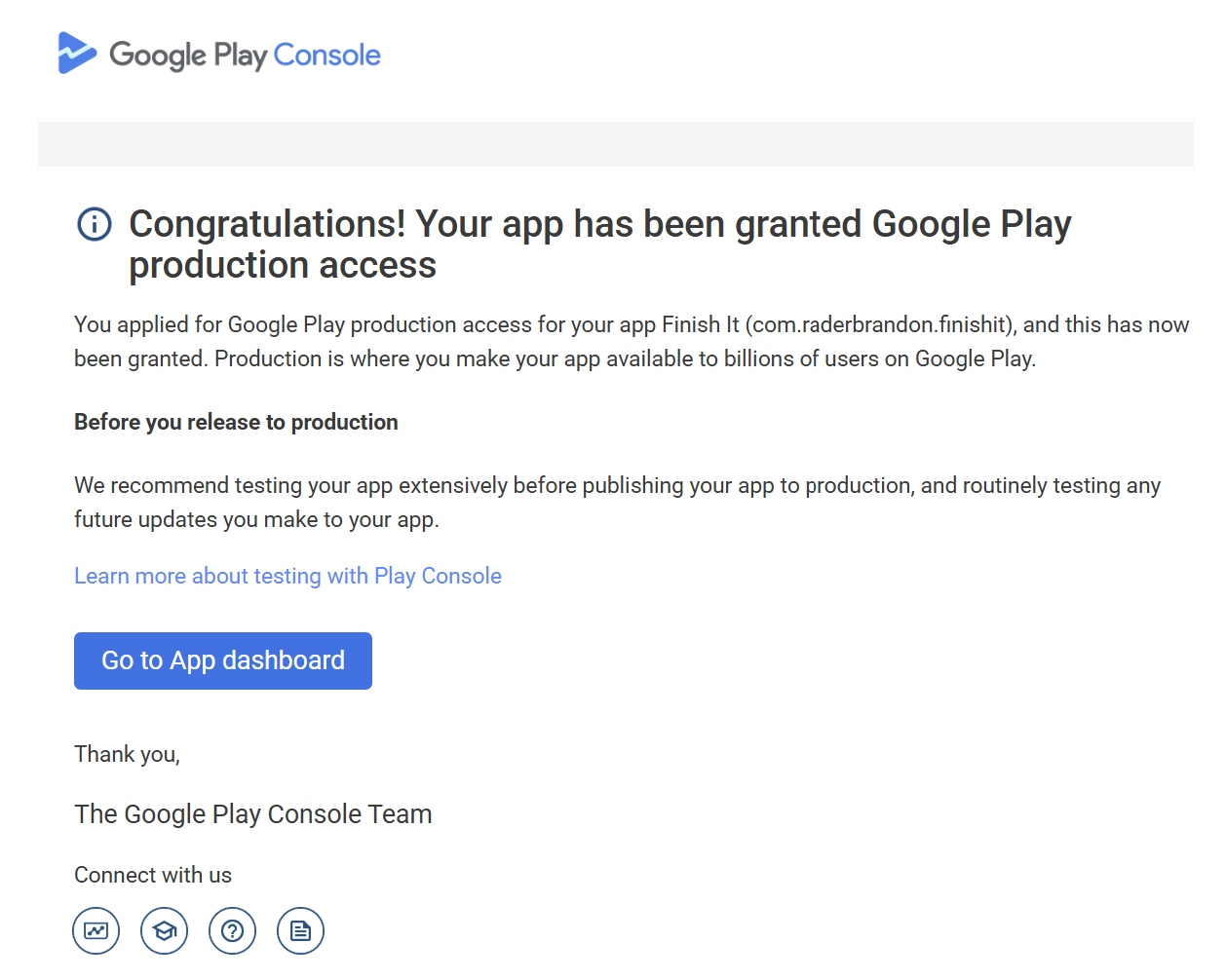
Verified Production Access
Quality QA Testing Reports
Clear, actionable reports with screenshots and evidence for every important issue found during testing.
Real Device Testing & Diagnostics
Real human testers use physical Android devices to test your app, verify real user flows, and provide clear testing evidence and professional QA reports.
Guaranteed App Approval
Our structured 14-day closed testing process is designed to meet Google Play's production requirements for your Android release.
Simple Closed Testing Pricing
Select the plan that fits your Android app complexity.
Loading Packages
Please wait while we fetch the best options for your region...
Frequently Asked Questions
Everything you need to know about passing your closed testing requirements.