12 Play Console app testers for Android app testing in Bolivia
Hire 12 Play Console app testers in Bolivia. Pass Google Play closed testing in 14 days with real Android testers and unlock Play Store production access.
Why the Bolivian Mobile Ecosystem Requires Thorough Pre-Launch Testing
Smartphone adoption across Bolivia has expanded rapidly across diverse demographics, powering everything from local fintech wallets to logistics platforms and educational tools. Bolivian smartphone users rely heavily on mobile data packages across telecommunications networks like Entel, Tigo, and Viva, making efficient data caching, low memory consumption, and stable offline behavior essential.
If your Android package stutters on budget hardware, drains cellular data excessively, or crashes during intermittent high-altitude cell handovers, users will promptly remove it. In an emerging digital economy, first impressions determine whether your app gains lasting traction or gets buried under negative initial reviews.
Standard automated test scripts and remote cloud emulators cannot accurately replicate how an app performs across Bolivia's varied physical geography and heterogeneous device landscape. Real hardware operated by real human users under authentic network conditions is indispensable.
Google recognized these real-world quality gaps across international markets, which is why Play Store Closed Testing is now a mandatory milestone for all personal developer accounts. The review team demands verifiable data proving your application has undergone rigorous, human-driven evaluation before reaching open production.
Understanding the Real Mechanics of Google Play Closed Testing
Many independent creators and startup teams mistakenly treat closed testing as a superficial administrative checkbox. In reality, Google Play Closed Testing is an algorithmic and human audit designed to filter out unvetted, unstable, or abandoned software.
The policy requires individual developers to recruit at least 20 opted-in testers who maintain active installations and generate periodic engagement over a continuous 14-day testing track. Any disruption in tester retention or sudden drops below the required active threshold can halt your progress and reset your review timeline.
Organizing and sustaining an organic testing group solely from personal contacts often leads to frustration. Casual acquaintances frequently disable notifications, clear app storage, or uninstall the build within the first few days, causing your active tester metric in Play Console to fall below compliance levels.
When organic outreach falls short, partnering with a dependable testing service to provide exactly 12 Testers for 14 Days gives you the structured reliability needed to keep your testing track completely stable, transparent, and fully compliant with Google's production access criteria.
Struggling with the 14-Day Testing Requirement?
Skip the hassle of recruiting unreliable testers. Our professional fleet of real Android devices guarantees Google Play compliance in exactly 14 days. Zero bots. Zero emulators. 100% production approval guarantee.
Navigating the Testing Landscape: Real Human Evaluators vs. Bot Farms
Under time pressure to unlock production access, developers are sometimes tempted by black-hat services promising instant, automated test completions. Utilizing artificial bots or emulator farms is one of the quickest ways to jeopardize your developer profile. Google's automated abuse detection systems continuously scrutinize telemetry patterns, account age, and device signals. Here is why authentic human testing is the only secure approach for your Bolivian app launch.
Authentic Human Testing
Legitimate testing relies on real individuals downloading your Android App Bundle (AAB) directly through their personal Google Play accounts onto genuine mobile devices. These devices carry authentic Google Play Services histories, diverse hardware chipsets, varying screen densities, and realistic battery and memory constraints. Real users interact with your software naturally and unpredictably. They pause on confusing checkout screens, trigger edge-case input errors in Spanish, test push notification reliability, and test offline fallback states. This organic, non-linear interaction generates genuine telemetry and crash logs in Play Console, exactly matching what Google's evaluation systems look for. Furthermore, real evaluators provide qualitative feedback on localization, layout responsiveness, and usability quirks, helping you refine your product into a polished, market-ready Android application.
Automated Script Farms & Bots
Bot farms and illicit testing networks use automated testing frameworks running on rooted server clusters, virtual emulators, or throwaway Google accounts created in bulk. These setups exhibit rigid, repetitive behavior, such as launching an app at precise automated intervals, tapping identical screen coordinates, and idling for preset seconds before shutting down. Google Play Protect and account verification algorithms easily detect these unnatural patterns, identifying mismatched sensor data, nonexistent carrier signals, and cloned device fingerprints. If your closed track is flagged for synthetic engagement, the penalties are immediate and severe. Google will reject your production request, nullify your testing streak, and potentially issue a permanent ban across your Google Play Console developer account without recourse.
Testing Strategy Comparison: Finding the Right Path for Your App
Choosing how to satisfy the mandatory testing requirements is a strategic engineering decision. The table below outlines how managed professional testing compares against informal DIY circles and risky bot alternatives.
| Feature | Professional Managed Testing | DIY Friends & Family Network | Automated Bot / Emulator Farms |
|---|---|---|---|
| Account Authenticity | 100% Real, Established Google Accounts | Real Personal Google Accounts | Flagged, Fresh, or Virtual Accounts |
| Device Diversity | Varied Android OS Versions & Chipsets | Limited to Personal Circle Hardware | Emulated or Cloned Identifiers |
| 14-Day Retention Rate | Guaranteed Constant Daily Retention | Highly Volatile (High Dropout Rate) | Artificial & Detectable Activity |
| Compliance & Account Safety | Fully Compliant with Google Policies | Compliant but Prone to Resets | Critical Risk of Developer Account Ban |
| Actionable User Feedback | Structured Usability & Bug Reports | Casual, Vague, or Non-Technical | Zero Real Feedback Generated |
| Developer Time Overhead | Minimal (Completely Handled) | High (Constant Manual Follow-ups) | Low (Until Penalties Occur) |
| Network & OS Variability | Diverse Real-World Environments | Narrow Geographic & Device Range | Synthetic Server Environment |
Pre-Launch Prep: Bolivian Market Android Deployment Checklist
Before opening your closed testing track, ensure your build has met key technical baselines. Delivering an optimized, stable build to your testers prevents unnecessary crashes and generates meaningful feedback during your mandatory evaluation window.
Technical Architecture & Localization Readiness
Audit all string resources to ensure accurate Latin American Spanish terminology, date formats, and Bolivian Boliviano (BOB / Bs.) currency formatting. Avoid literal machine translations that sound unnatural to native speakers in La Paz, Santa Cruz, or Cochabamba.
Implement aggressive caching using Room database or SQLite and optimize network requests with Brotli or GZIP compression. Ensure the app degrades gracefully when mobile network coverage fluctuates across regional transportation corridors.
Validate UI rendering across multiple screen resolutions, DPI settings, and font scaling configurations. Many Bolivian users utilize entry-level and mid-range devices from Xiaomi, Samsung Galaxy A-series, Motorola, and Tecno that require responsive constraints.
Integrate Firebase Crashlytics and custom performance traces before distributing the initial closed build. Capture detailed ANR (Application Not Responding) rates, memory allocation spikes, and unhandled exceptions across all test sessions.
Google Play Console Track Configuration
Accurately map all SDK data collection, third-party trackers, location permissions, and user identifier handling in the Play Console Data Safety questionnaire. Mismatched privacy disclosures are a leading cause of initial submission delays.
Configure your Closed Testing track under the Release management section, generate your opt-in web and Android join links, and assign your verified tester email lists before initiating release rollout.
Provide clear step-by-step guidance within Play Console detailing the primary user workflows to test, valid test credentials if authentication is required, and direct feedback submission pathways.
The Step-by-Step Roadmap to Production Access
Navigating from code completion to public distribution on Google Play demands an organized release strategy. Follow this tested milestone roadmap to guide your application through closed testing into production availability.
Phase 1: Internal QA & Bundle Verification
Conduct thorough automated unit tests, lint checks, and internal test tracks within your development team. Verify that your signed Android App Bundle (AAB) satisfies target API level requirements, includes 64-bit native libraries, and operates cleanly without severe memory leaks.
Phase 2: Roster Recruitment & Track Invitation
Assemble your verified pool of participants. Whether supplementing an existing community with 12 Play Console app testers or deploying a fully managed cohort, ensure all participants have confirmed access to Google Play on genuine Android devices and understand the daily engagement protocol.
Phase 3: The 14-Day Continuous Testing Window
Deploy your build to the closed track. Testers accept the opt-in invitation, install the application, and interact with features across the full two-week window. Keep a close watch on your Play Console dashboard to confirm that active device installs stay above the minimum threshold every single day.
Phase 4: Iterative Patching & Feedback Resolution
Monitor user bug reports, review crash logs, and publish at least one maintenance update during the testing cycle. Pushing an updated build through closed testing demonstrates to Google's evaluation team that you are actively maintaining code quality and responding to user feedback.
Phase 5: Production Access Application & Launch
Once the 14 continuous days are successfully completed, the Apply for Production button unlocks in Play Console. Submit comprehensive responses regarding your testing methodology, feedback collected, and optimizations made, paving the way for public rollout across Bolivia and international storefronts.
Frequently Asked Questions About Google Play Closed Testing
Navigating Google Play compliance can be complex, especially when preparing an application for a specific market like Bolivia. Below are detailed, technical answers to the most common questions developers encounter regarding closed testing rules and best practices.
Why does Google Play require 20 testers for 14 days, and how does hiring 12 testers help?
Google introduced the mandatory 20-tester, 14-day closed testing rule for personal developer accounts created after November 2023 to raise software standards and prevent low-quality, buggy, or unsafe apps from reaching the public store. Under this policy, developers must prove that real humans have installed, retained, and tested their application continuously for at least two weeks before production access is granted. For many indie developers, solo engineers, and small teams, finding 20 dedicated individuals who own Android devices and remember to keep the app installed every single day is extremely difficult. Most developers can easily recruit 5 to 8 friends or colleagues, but they inevitably stall out before hitting the mandatory mark. Sourcing 12 Play Console app testers bridges this exact numerical gap, giving you a fully compliant, verified cohort that guarantees your active install numbers remain well above the policy threshold for the entire testing period without dropping unexpectedly.
Do testers need to be physically located in Bolivia to test a Bolivian-focused app?
From a strict Google Play Console compliance perspective, Google does not require your closed track testers to be physically residing within Bolivia. You can satisfy the mandatory closed testing verification using real, verified Google accounts and Android devices located anywhere in the world, as long as your closed testing track is configured to include their respective countries or set to worldwide availability. However, from a practical product development standpoint, having localized evaluation is a huge asset. Real testers familiar with Latin American Spanish and regional expectations can identify confusing linguistic nuances, verify whether regional telephone number formatting works as expected, and test payment UI flows relevant to the Bolivian market. Using a dependable testing service allows you to satisfy the algorithmic 14-day testing requirements while you focus your internal resources on refining market-specific features.
What specific user engagement signals does Google monitor during the 14-day testing track?
While Google does not publicly disclose the exact mathematical formula behind its closed testing evaluation, Play Console telemetry monitors several distinct engagement signals during the 14-day window. These include active device installations (whether the app remains installed on the device), daily session starts, background app refresh events, user-generated crash reports, and feedback submitted directly through the Play Store closed testing channel. Google's review team looks for natural, human patterns of usage rather than synthetic bursts. If an app is downloaded on day 1 and never opened again by all testers, or if 10 testers uninstall the app on day 4, the testing track may be deemed insufficient, resulting in a rejected production application. Maintaining steady, recurring engagement across genuine hardware ensures your telemetry reflects genuine, high-quality testing activity.
Why are bot farms, automated scripts, and emulators dangerous for Play Console compliance?
Attempting to bypass Google Play Closed Testing requirements using automated scripts, virtual cloud emulators, or bot services poses an extreme risk to your developer credentials. Google's automated security mechanisms, powered by Google Play Protect and sophisticated fraud detection models, analyze low-level hardware attributes such as battery discharge profiles, accelerometer sensors, authentic Google account age, network routing, and touch gesture coordinates. Automated bot farms run uniform scripts that generate identical telemetry, instantly triggering anti-abuse flags. When Google detects artificial testing manipulation, they do not just reject the pending app submission; they frequently terminate the developer account permanently for policy violations and blacklist associated payment profiles, phone numbers, and identity documents. Investing in genuine, human-operated Android devices is the only safe and compliant route to publishing.
What happens if an active tester uninstalls the app before the 14 days are finished?
If a tester uninstalls your application during the closed testing period, Play Console registers the removal and decreases your count of active installed devices. If your total number of active testers drops below the mandatory minimum threshold of 20 at any point during the 14-day cycle, the continuous tracking streak is compromised. In many cases, this resets the 14-day timer, forcing you to recruit replacement testers, push a new release, and restart the full two-week countdown from day one. This fragility is why relying exclusively on personal acquaintances is risky, as casual testers often clear phone storage or delete test apps without warning. To protect your project timeline, developers commonly recruit a safety buffer of 22 to 25 testers, ensuring that even if one or two individuals disconnect, your active tester count remains safely above the compliance threshold throughout the entire 14 days.
What detailed information must I provide when applying for production access after completing the 14 days?
After successfully fulfilling the 14-day closed testing requirement, the 'Apply for Production' button becomes active within your Google Play Console dashboard. Clicking this button opens an extensive questionnaire where you must provide detailed, honest explanations about your testing phase. You will be asked to describe your recruitment process (how you sourced your testers), the primary feedback and bug reports you received during the 14 days, what specific architectural or UI improvements you made in response to that feedback, and why you believe your application is now ready for public distribution. Google's human review team evaluates these written responses alongside your telemetry data. Providing clear, concrete details about user feedback and showing that you published iterative updates during closed testing significantly increases your likelihood of immediate production approval.
How We Deliver 12 Testers
A straightforward 4-step process to get your Android app approved.
Connect Account
Connect your Google account and choose your preferred closed testing package for your Android app.
Assign Testers
Share your Play Store opt-in URL. We immediately deploy 12 real testers to launch and review your Android app daily.
Daily QA Runs
Our crew initiates daily launch sessions on physical devices, verifying usability and logging crashes for your Android app.
Launch Ready
We continuously perform closed app testing for 14 days to help you meet Google Play production requirements. We also provide a compliance report.
Our Testing Infrastructure
Deploy your Android app onto real retail-grade handsets using our secure laboratory environment.
The 14-Day Production Guarantee
We complete the required 14-day closed testing process with real human testers and physical Android devices, while providing clear testing evidence and documentation throughout the process.
If Google specifically rejects production access due to insufficient testing engagement, you are covered by our free re-run or 100% refund guarantee, subject to our Refund Policy.
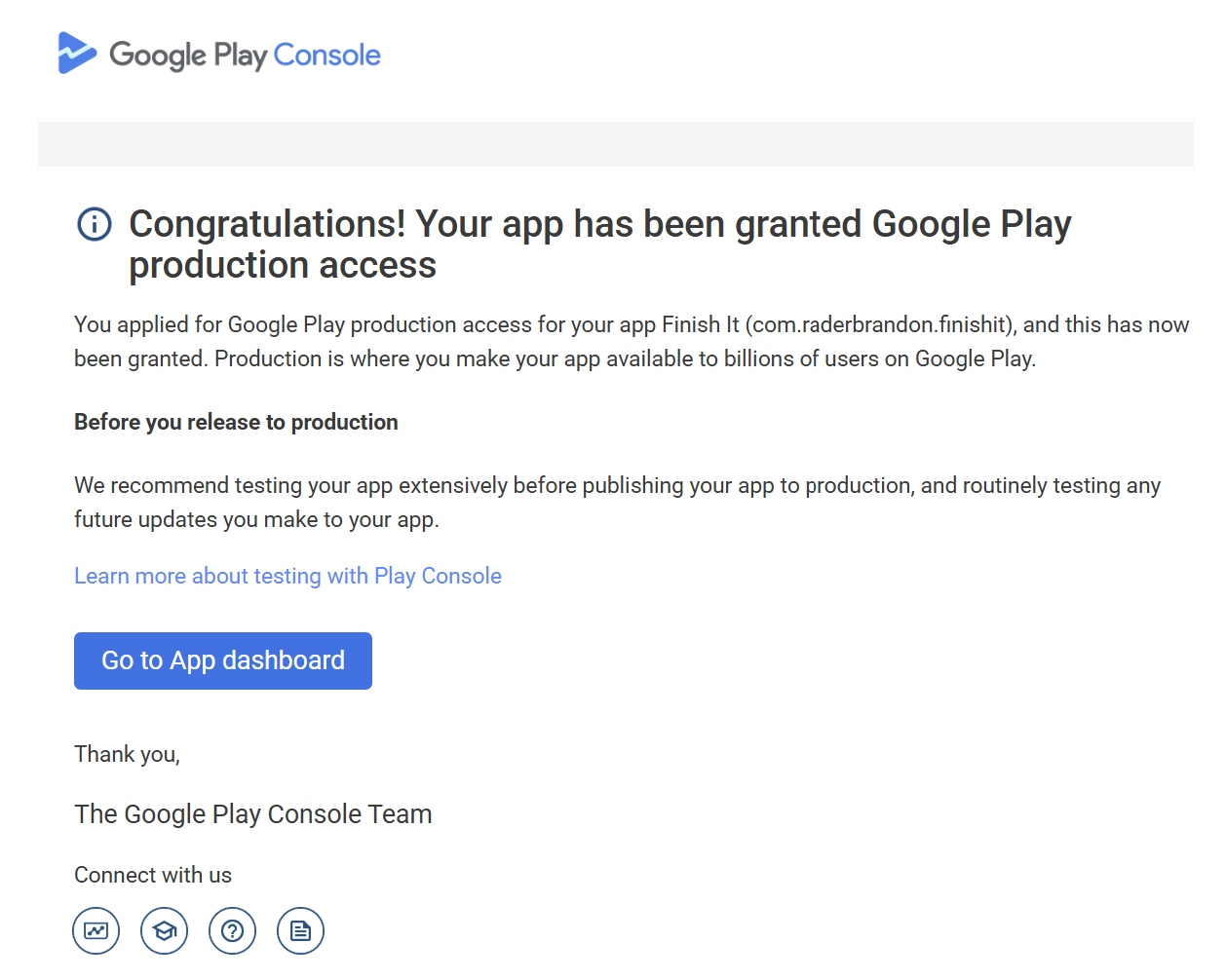
Verified Production Access
Quality QA Testing Reports
Clear, actionable reports with screenshots and evidence for every important issue found during testing.
Real Device Testing & Diagnostics
Real human testers use physical Android devices to test your app, verify real user flows, and provide clear testing evidence and professional QA reports.
Compliance Audit Passed
Transition your Android app to public production access with confidence. We deliver verified session logs and compliant Console activity.
One Cycle. Complete Approval.
Choose the ideal closed testing cycle for your Android release.
Loading Packages
Please wait while we fetch the best options for your region...
Frequently Asked Questions
Everything you need to know about passing your closed testing requirements.