12 Play Console app testers for Android app testing in Chile
Hire 12 Play Console app testers in Chile. Pass Google Play closed testing securely using our authentic 12 testers for 14 days Play Store service.
Launching a mobile application in Chile is a lot like hiking the rugged peaks of the Andes - it requires intense preparation, the right gear, and a solid team by your side. With one of the highest smartphone penetration rates in Latin America, Chile represents a massive opportunity for Android developers. However, before your app can reach the vibrant streets of Santiago or the coastal breezes of Valparaíso, it has to pass a formidable gatekeeper. Google has recently tightened its policies, making it mandatory for new developers to prove their software is stable, secure, and user-friendly before it goes live. This means you cannot simply upload your APK and hope for the best. You need real people interacting with your code, finding bugs, and providing authentic feedback that aligns with local Chilean user behavior.
Cracking the 14-Day Testing Challenge
To secure a spot on the world's largest mobile marketplace, your app must undergo Google Play Closed Testing. Specifically, the mandate requires you to gather at least 12 Testers for 14 Days of continuous, daily engagement. This is not just a polite request from Google - it is a strict compliance hurdle. If the system detects inactivity, fake accounts, or geographic spoofing, your testing phase will be invalidated, sending you right back to day one. For developers looking to capture the Chilean market, sourcing genuine local testers who understand the nuances of the region is absolutely critical. You need individuals who will actively tap, swipe, and stress-test your application exactly as a real customer would.
Real Testers vs. The Bot Farm Trap
When faced with the daunting task of finding testers, many developers panic. They turn to shady forums or automated bot services that promise overnight compliance. This is the fastest way to get your developer account flagged or permanently banned. Here is how real human engagement compares to automated risk.
Authentic Chilean Testers
When you invest in real human testers, you are buying peace of mind. These individuals use physical Android devices connected to genuine local networks in Chile. They generate authentic crash reports, leave meaningful feedback, and navigate your app at a normal, human pace. Because their Google accounts have a long history of organic activity, the Play Console views their engagement as highly trustworthy. This completely eliminates the risk of algorithmic flags and ensures your Closed Testing phase is completed smoothly. Moreover, real users can tell you if your Spanish localization feels natural or if your payment gateways work properly with local banks.
Automated Bots and Emulators
Bot farms rely on scripts, headless browsers, and server-racks of emulators to simulate traffic. While they might give the illusion of 12 testers, Google's machine learning algorithms are specifically designed to detect this behavior. Emulated devices lack real hardware identifiers, and bot accounts usually have zero search history or normal app usage outside of your test. When the Play Store Closed Testing review team analyzes your data, they will instantly see uniform session lengths, identical click patterns, and shared IP addresses. The result is a rejected production request, a wasted two weeks, and a potential strike against your developer profile.
The True Cost of Testing Methods
To make the right choice for your app, you need to understand how different approaches stack up against each other.
| Feature | Service | DIY | Bots |
|---|---|---|---|
| Account Safety | Maximum | Moderate | Extremely Low |
| Time Investment | 5 Minutes | 20+ Hours | 10 Minutes |
| Compliance Guarantee | Yes | No | Absolutely Not |
| Feedback Quality | Detailed & Actionable | Variable | Non-existent |
| Geographic Accuracy | 100% Local IPs | Difficult to verify | VPN Spoofed |
| Cost Efficiency | High (Saves time) | Low (Lost dev hours) | Low (Banned accounts) |
Your Launch Roadmap for the Play Store
Achieving production access requires a systematic approach. If you skip steps or rush the process, you risk failing the review phase. Here is the exact path you need to follow to conquer the testing requirements.
Prepare Your App for the Public
Before inviting anyone to test your application, it must be in a highly stable state. This is not an alpha test where major features are broken. Your UI should be polished, your core loops must function perfectly, and you must have basic error handling in place. Google expects the app to be production-ready, just lacking the final coat of polish that comes from real-world usage. Ensure your privacy policy is linked, your store listing is drafted, and all content ratings are accurately filled out in the console.
Configure the Testing Track
Navigate to your Play Console dashboard and locate the testing section. You will need to create a new release on the closed track. This involves uploading your signed App Bundle (AAB), writing brief release notes, and selecting the countries where the test will be available. If your primary target is Chile, ensure the region is explicitly enabled. Once the release is saved, you will need to add the email addresses of your testers to an approved list, or share a specialized opt-in link with them.
Maintain 14 Days of Active Engagement
This is the most critical phase. Your testers must download the app and open it regularly for a minimum of 14 consecutive days. It is not enough for them to simply install it and forget it. They need to explore different screens, trigger various functions, and generate session data. If a tester misses a few days, or uninstalls the app early, Google's systems will notice. Continuous, organic interaction is the only way to satisfy the algorithm and prove your software is ready for the masses.
Submit for Final Production Review
On day 15, assuming all requirements have been met, a new option will unlock in your dashboard allowing you to apply for production access. Google will ask you a series of questions about your testing phase. You will need to explain how you gathered feedback, what changes you made based on that feedback, and why you believe the app is now ready. Take this questionnaire seriously - human reviewers read these answers to determine if you genuinely utilized the 12 Testers for 14 Days rule or if you just treated it as a box-checking exercise.
Pre-Launch Compliance Checklist
Do not click submit until you have verified every single item on this list. A single oversight can delay your launch by weeks.
Console Configuration
Tester Management
Application Stability
Struggling with the 14-Day Testing Requirement?
Skip the hassle of recruiting unreliable testers. Our professional fleet of real Android devices guarantees Google Play compliance in exactly 14 days. Zero bots. Zero emulators. 100% production approval guarantee.
The Anatomy of Proper Google Play Closed Testing
Understanding the true intent behind Google's policies can help you navigate them more effectively. The tech giant introduced these strict requirements because the store was becoming flooded with low-effort, broken, and potentially malicious applications. By forcing new developers to undergo a rigorous evaluation period, Google is protecting its ecosystem and ensuring that Android users have a premium experience from day one.
When you engage in Play Store Closed Testing, you are essentially building a portfolio of trust. Every session logged by your Chilean testers serves as a vote of confidence. The algorithm looks at session duration, the diversity of devices used, the frequency of crashes, and the battery or network impact of your code. If your app drains the battery excessively, or crashes on specific Samsung devices popular in Chile, the testing phase will highlight these issues before they can negatively impact your public rating.
Furthermore, the requirement of 12 Testers for 14 Days is carefully calculated. Fourteen days is generally enough time to expose memory leaks that only happen after prolonged use, or to reveal flaws in push notification scheduling. It also proves that your app has lasting utility - if testers open it on day one but never return, it signals to Google that your app lacks engagement value. Therefore, structuring your test to encourage daily check-ins is vital. You might consider asking testers to focus on a different feature each day, or providing them with a daily task list to ensure comprehensive coverage of your codebase.
Frequently Asked Questions About Play Store Closed Testing
Developers often have deep concerns about how the evaluation period is graded. Here are the most detailed answers to your pressing questions.
What happens if a tester misses a day during the 14-day period?
Google's tracking system is sophisticated but allows for a tiny margin of realistic human behavior. If a single tester misses one day out of the 14, it will not automatically doom your entire campaign. However, if multiple testers go silent for days at a time, or if the overall aggregate activity drops below the algorithm's undisclosed threshold, your testing phase will be marked as insufficient. To be safe, you should aim for 100 percent daily participation. This is why many developers opt for professional services that guarantee daily log-ins. If you are managing friends or family in Chile, you must send them daily reminders. It is always better to over-deliver on engagement than to fall short and have to restart the clock entirely.
Can I update my app while the closed test is running?
Yes, you absolutely can, and Google actually encourages it. Pushing an update during the 14-day window demonstrates that you are actively monitoring feedback and making improvements. When you release a new version to the testing track, it does not reset your 14-day timer. However, you must ensure that the update does not break core functionality, as this could prevent your testers from logging their daily sessions. Keep in mind that every new release must go through a brief automated review process before it reaches your testers devices, which can take a few hours. Plan your updates carefully so they do not disrupt the daily engagement flow.
How does Google know if my testers are real people or bots?
Google commands the most advanced data analytics infrastructure on the planet. They do not just look at whether the app was opened - they analyze the entire context of the device. They check if the Google account has a history of YouTube viewing, Gmail usage, and web browsing. They look at hardware identifiers, network latency, carrier data, and sensor inputs like accelerometer shifts. Bots and emulators lack this rich history and physical context. If accounts with no search history suddenly install your app from the same IP block and swipe in perfectly straight lines, Google will instantly flag the test as fraudulent. Authenticity cannot be faked on this platform.
Why did my application for production access get rejected after 14 days?
Rejections usually happen for one of three reasons. First, the engagement was too low - your testers may have installed the app but failed to open it frequently enough. Second, the feedback questionnaire was poorly filled out. When you apply for production, you must write detailed explanations of the feedback you received and how you acted on it. If you write generic, one-sentence answers, the human reviewer will reject you. Third, your app may have generated too many crash reports or Application Not Responding errors during the test. If the software is deemed unstable, Google will not let it reach the public store.
Do I really need testers from Chile if my app is for the Chilean market?
While Google's baseline rule simply requires testers from anywhere, having local testers is vastly superior for several reasons. First, local users will interact with your app using regional network providers like Movistar or Entel, exposing latency issues you might not see on a fast connection abroad. Second, they can provide critical feedback on cultural nuances, Spanish localization, and local payment integrations like Webpay. Most importantly, if you ever face a manual review, showing that your test base aligns logically with your target market adds a massive layer of credibility to your developer account.
Is it possible to use family and friends to fulfill the requirement?
Technically, yes. If you have enough friends and family members who all own Android devices and have active Google accounts, you can invite them. However, in practice, this is incredibly difficult to manage. People forget to open the app, they go on vacation, or they simply get bored after three days. You will find yourself constantly nagging them to log in, straining your relationships. Furthermore, friends and family are heavily biased. They will tell you the app is great to spare your feelings, depriving you of the harsh, objective feedback you actually need to fix critical flaws before public launch.
How much time should testers spend in the app each day?
There is no officially published minimum session length, but a simple three-second launch-and-close is risky. The goal is to simulate genuine usage. Testers should spend enough time to complete a core action - reading an article, playing a level of a game, or navigating through a checkout flow. A healthy benchmark is anywhere from two to five minutes of varied interaction per day. They should click different buttons, open menus, and occasionally background the app before returning to it. This creates a realistic data footprint that proves the software is holding the user's attention.
What should I write in the final production application form?
The final questionnaire is your opportunity to defend your app. You will be asked how you recruited testers, what feedback you received, and what changes you made. Be extremely specific. Instead of saying 'Testers liked it and I fixed bugs', write 'We recruited testers via a professional beta community. They noted that the login button was hard to reach on taller devices, so we moved it down by 20 pixels in version 1.2. They also found a crash on Android 12 when uploading a photo, which we patched by updating our camera permissions.' Detailed, honest answers prove to the reviewer that you utilized the Closed Testing period properly.
The Testing Pipeline
A straightforward 4-step process to get your Android app approved.
Sign In
Connect your Google account and choose your preferred closed testing package for your Android app.
Opt-In URL
Share your Play Store opt-in URL. We immediately deploy 12 real testers to launch and review your Android app daily.
Testing Begins
Our crew initiates daily launch sessions on physical devices, verifying usability and logging crashes for your Android app.
Compliance Complete
We continuously perform closed app testing for 14 days to help you meet Google Play production requirements. We also provide a compliance report.
Why Developers Trust Us
Deploy your Android app onto real retail-grade handsets using our secure laboratory environment.
The 14-Day Production Guarantee
We complete the required 14-day closed testing process with real human testers and physical Android devices, while providing clear testing evidence and documentation throughout the process.
If Google specifically rejects production access due to insufficient testing engagement, you are covered by our free re-run or 100% refund guarantee, subject to our Refund Policy.
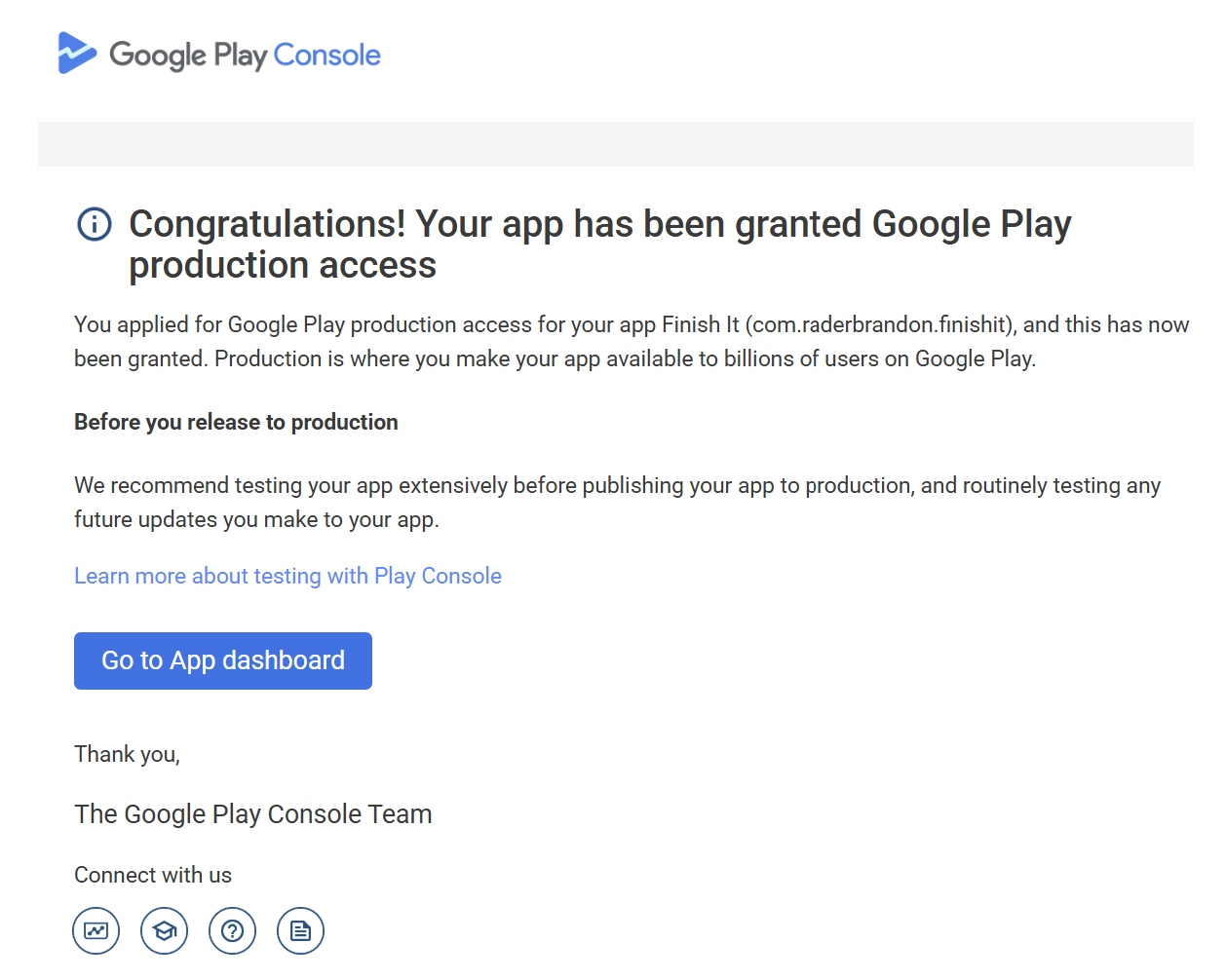
Verified Production Access
Quality QA Testing Reports
Clear, actionable reports with screenshots and evidence for every important issue found during testing.
Real Device Testing & Diagnostics
Real human testers use physical Android devices to test your app, verify real user flows, and provide clear testing evidence and professional QA reports.
Guaranteed App Approval
Transition your Android app to public production access with confidence. We deliver verified session logs and compliant Console activity.
One Cycle. Complete Approval.
Choose the ideal closed testing cycle for your Android release.
Loading Packages
Please wait while we fetch the best options for your region...
Frequently Asked Questions
Everything you need to know about passing your closed testing requirements.