12 Play Console app testers for Android app testing in Colombia
Find 12 Play Console app testers in Colombia. Pass Google Play closed testing smoothly using our 12 testers for 14 days Play Store service.
Imagine trying to sell winter coats in a tropical rainforest. It sounds absurd, right? Yet, countless developers launch Android applications without understanding the local digital climate of their target audience. When you decide to target the vibrant, rapidly growing digital economy of Colombia, you cannot afford to guess. The landscape is fiercely competitive, and Google Play Console compliance requires a level of localized precision that goes beyond mere translation. Securing 12 Play Console app testers for Android app testing in Colombia is not just about ticking a box for Google; it is about immersing your application in the real-world conditions of Bogota, Medellin, and Cali. You need human beings who navigate varying network speeds, distinct cultural nuances in user interfaces, and the specific daily habits of Colombian smartphone users. Getting this right means the difference between a smooth ascent up the regional app charts and a quiet, invisible death in the depths of the Play Store.
Why Colombia is a Critical Launchpad for Android
Colombia has quietly transformed into one of Latin America's most dynamic mobile markets. With a high smartphone penetration rate overwhelmingly dominated by Android devices, the country offers a fertile testing ground for developers aiming to conquer the broader Spanish-speaking world. The users here are tech-savvy, highly social, and expect a seamless mobile experience.
However, this potential comes with strict gatekeeping. Google requires rigorous validation before allowing an app into the wild. Conducting Google Play Closed Testing specifically within Colombia allows you to gather localized feedback while simultaneously meeting Google's strict criteria. If your application can handle the fluctuating cellular networks of the Andes and the high expectations of urban millennials in Medellin, it is built to survive almost anywhere.
The Google Play 14-Day Challenge
Google's current policy dictates a rigorous crucible for new developer accounts. You must maintain continuous engagement from your testing pool for a continuous 14-day period. This is not a casual suggestion; it is a mandatory gateway.
Dropping below the required tester count, even for a single afternoon, resets your clock. This window is designed to flush out unstable apps and weed out uncommitted developers. When you specify your testing pool, acquiring 12 Testers for 14 Days from your target demographic ensures that the engagement metrics Google monitors reflect genuine human interest, not automated pings from a server farm halfway across the globe.
Struggling with the 14-Day Testing Requirement?
Skip the hassle of recruiting unreliable testers. Our professional fleet of real Android devices guarantees Google Play compliance in exactly 14 days. Zero bots. Zero emulators. 100% production approval guarantee.
Real vs. Fake: The Danger of Bot Testers
The temptation to take shortcuts is real, especially when the compliance clock is ticking. Many developers turn to cheap online services offering instant testing pools. But Google's algorithms are vastly more sophisticated than these automated workarounds.
Authentic Colombian Testers
Real testers provide invaluable, human-centric data. They interact with your app organically, pausing to read text, tapping buttons with varied pressure, and generating unique crash reports based on actual device usage. Their session lengths vary naturally. They provide qualitative feedback on localization, pointing out if a phrase sounds unnatural to a Colombian user. Most importantly, their Google accounts have rich histories, making their engagement entirely legitimate in the eyes of Play Store Closed Testing algorithms.
Automated Bot Networks
Bots execute rigid, predictable scripts. They click at identical intervals and generate zero qualitative feedback. Google's Play Protect and developer console analytics can easily detect these synthetic patterns. A sudden influx of fresh, zero-history accounts interacting with your app from a single IP block is a massive red flag. Using bots often results in the immediate suspension of your developer account, permanently banning you from the ecosystem and destroying months of hard work.
Navigating the Closed Testing Maze
Getting your app from a local build to a fully compliant, tested, and published asset requires a strategic approach. Here is the path to successfully executing your Android app testing in Colombia.
Preparation and Localization
Before inviting a single tester, ensure your app speaks the local language, both literally and culturally. Adapt your UI to accommodate Spanish phrasing, which often runs longer than English. Verify that your server infrastructure can handle latency from South America.
Sourcing Local Testers
Identify and recruit reliable individuals based in Colombia. This can be done through local developer communities, social media groups, or specialized testing networks that guarantee authentic, geographically verified users.
Initiating the 14-Day Run
Add your testers' email addresses to your Play Console. Have them accept the opt-in link and install the app. Once they are active, monitor the dashboard closely. Ensure they open the app periodically to register active sessions.
Gathering Feedback and Iterating
Use this period to collect bug reports, crash logs, and subjective user feedback. Are they confused by the onboarding? Does the app drain the battery too fast on local networks? Address these issues dynamically.
Applying for Production
After successfully completing the requirement without any drop-offs, compile the feedback and answer Google's mandatory questionnaire about your testing process. Submit your app for production access with confidence.
Pre-Launch Checklist for the Colombian Market
Success requires meticulous preparation. Missing a single step can lead to frustrating delays.
App Readiness
Play Console Setup
Monitoring and Compliance
Deep Dive: The Developer's Guide to 12 Testers for 14 Days
Understanding the mechanics behind Google's policy is crucial for any developer aiming to launch successfully. The requirement for 12 Testers for 14 Days is not an arbitrary number pulled from thin air. Google implemented this hurdle to combat the overwhelming flood of low-quality, malicious, or simply abandoned applications that were clogging the Play Store ecosystem. By forcing developers to engage with real users over a sustained period, Google effectively ensures a baseline of quality and demonstrates developer commitment to the project.
When you specifically target a dynamic region like Colombia for your Google Play Closed Testing, you are making a highly strategic decision. Colombia is highly representative of a massive, emerging mobile market with millions of active Android users. If your application performs well there, handles the local infrastructure gracefully, and resonates with the population, it is highly likely to succeed across other Latin American countries. However, this means your testing phase must be exceedingly rigorous. You are not just looking for technical bugs or minor spelling errors; you are comprehensively testing product-market fit on a regional scale.
The Nuances of the 14-Day Window
The continuous testing clock is notoriously unforgiving and automated. It starts the moment the required number of testers have officially opted in and installed the application on their personal devices. If, on day 12, a tester decides to clean up their phone and uninstalls the app, or if they manually opt out of the testing track, your count drops below the minimum threshold. Google's system registers this immediate drop, and in almost all cases, the clock resets completely back to zero. This is precisely why having exactly the minimum required testers is a massive, unnecessary risk. Savvy, experienced developers always aim for a safety buffer, ideally starting with 15 or 20 testers to absorb any natural, unavoidable human attrition.
Furthermore, passive installs are absolutely not enough to satisfy the algorithm. Google actively monitors the engagement quality. If a group of people install the app but never actually open it, the testing phase will be flagged as invalid due to inactivity. The testers need to generate meaningful, varied sessions. They need to navigate through the complex menus, trigger different core functions, and essentially behave exactly like normal, curious users. This sustained, varied engagement is what signals to Google that your app is functional, safe, and actually holds user interest over time.
Localization Goes Far Beyond Simple Translation
Many inexperienced developers mistakenly believe that running their English text through an automated translator is entirely sufficient for global localization. In a market like Colombia, context and cultural nuance matter immensely. The Spanish spoken in Bogota has distinct colloquialisms, idioms, and structural preferences compared to the Spanish spoken in Spain, Mexico, or Argentina. If your app's interface feels robotic, overly formal, or obviously foreign, local users will abandon it within minutes. Your human testers are your first and best line of defense against poor localization efforts. They can quickly flag awkward phrasing, confusing button labels, and cultural missteps long before your app goes public and faces the harsh reality of user reviews.
Moreover, the technical and physical environment in Colombia can vary drastically. While major metropolitan areas boast excellent 4G and rapidly emerging 5G networks, users in more rural areas or those relying on budget-friendly mobile data plans might experience significant latency or connection drops. Testing exclusively with real local users allows you to observe exactly how your app handles slow loading times, interrupted media downloads, or unexpected offline scenarios. If your app crashes entirely every single time the cellular connection blips, your Colombian testers will find out, allowing you to implement better error handling and caching strategies before facing a destructive wave of one-star reviews upon launch.
Preparing for the Rigorous Production Questionnaire
Once you somehow survive the grueling 14-day trial without a reset, the journey is still not completely over. Google requires you to answer a highly comprehensive, multi-part questionnaire about your entire testing process before they even consider granting you production access. You will be asked detailed questions regarding how you found your testers, what specific demographic they represent, what exact kind of feedback you received, and crucially, what specific code or design changes you made to the app directly based on that feedback.
If you used fake accounts, emulators, or a cheap bot farm, answering these specific questions convincingly is nearly impossible. Google's manual reviewers look for specific, plausible, and highly detailed narratives. Being able to clearly state, "Our testers in Colombia consistently found that the checkout button was difficult to read on smaller budget Android devices under bright sunlight, so we significantly increased the contrast ratio and padding," demonstrates genuine user engagement. This detailed, user-driven narrative is exactly what the Play Store review team wants to see, and providing it significantly increases your chances of a swift, hassle-free approval.
Comparison: Service vs. DIY vs. Bots
Choosing exactly how to acquire and manage your testers is a pivotal decision that impacts your entire launch timeline. Let us break down the standard approaches available to developers today.
| Feature | Professional Testing Service | DIY Outreach Strategy | Automated Bot Networks |
|---|---|---|---|
| Authenticity | High (Real human users with varied devices) | High (Real human users from your personal network) | Zero (Automated scripts running on emulators) |
| Time Investment | Low (Recruitment and management handled for you) | Extremely High (You must recruit, manage, and track everyone) | Low (Instant but useless delivery) |
| Geographic Targeting | Yes (e.g., Highly specific Colombia targeting) | Completely depends on your existing local network | Often spoofed poorly via shared VPNs |
| Feedback Quality | High (Structured reporting and direct communication) | Variable (Friends may hesitate to give harsh criticism) | None (Bots cannot evaluate user experience) |
| Risk of Ban | Low (Fully compliant with all Google Play guidelines) | Low (Assuming users are real and active) | Extremely High (Almost guarantees an account strike) |
| Reliability (14 Days) | Guaranteed retention and daily active engagement | High risk of unexpected drop-off or inactivity | Guaranteed to fail the final algorithmic audit |
| Financial Cost | Moderate (A worthwhile investment for security) | Free (But costs immense personal time and effort) | Cheap (But costs your entire developer account) |
Frequently Asked Questions
The process of navigating the Play Store Closed Testing requirements can be incredibly complex and stressful for new developers. Here are the most detailed, comprehensive answers to the common questions developers face when preparing for launch.
Why does Google insist on exactly 14 continuous days of testing instead of just checking the app once?
Google explicitly established the 14-day continuous requirement to carefully observe the long-term stability, battery impact, and user retention of new applications. A poorly coded app might function perfectly during a quick five-minute manual review or for the first hour of use, but it could easily develop severe memory leaks, background data drain, or crash loops after a few days of intermittent use on a real device. The two-week window ensures that the application is subjected to a wide variety of real-world background states, device reboots, network changes, and OS interventions. Furthermore, it aggressively tests the developer's commitment. Maintaining a testing pool for two weeks requires active project management and genuine interest in product quality, effectively filtering out spam developers who look to upload hundreds of low-effort, ad-filled apps quickly.
Can I use testers from other countries if my main target market is specifically Colombia?
While Google technically allows your testers to be located from any region unless you explicitly restrict the testing track in the console to specific countries, doing so is highly detrimental to your overall launch strategy. If your app is designed specifically for the Colombian market, testing it with users located in Europe, Asia, or North America completely defeats the purpose of a beta test. Those foreign users will not experience the local South American network latency, they will not naturally understand the cultural nuances of your user interface, and their feedback on your localized Spanish text will be practically useless. Furthermore, if Google's algorithms see all your testing traffic coming from India or Eastern Europe for an app heavily localized and marketed for South America, it may raise serious red flags during the final manual review process. It is always the best practice to source testers directly from your actual intended target demographic to ensure the data is valid.
What exactly happens if a tester's phone breaks, or they simply uninstall the app on day 10 of the test?
This is unfortunately the most common and frustrating pitfall in the entire Google Play Closed Testing process. If your actively engaged tester count drops below the required minimum at any single point during the 14-day period, the testing requirement is officially considered incomplete by the automated system. You will likely have to scramble to recruit a replacement tester, get them opted in, and then you will have to start the 14-day clock entirely from scratch. This is exactly why industry veterans insist that you should never start a test with exactly the minimum number of required users. Always recruit a healthy buffer of extra testers. This way, if a few people inevitably break their phones, lose interest, or simply forget to open the app, your core active count remains comfortably above the mandatory threshold, protecting your timeline and your sanity.
How do I actually prove to Google that my chosen testers are real people and not just a purchased bot network?
You do not need to proactively send Google a dossier of identities for your testers, but Google's incredibly sophisticated backend systems are constantly analyzing the telemetry data. They look deeply at the age, activity, and history of the Google accounts associated with the tester emails provided. A bot farm usually relies on brand new accounts with zero organic search history, no YouTube watch time, and no prior diverse app installations. Real testers have rich, complex, and messy account histories spanning years. Additionally, Google monitors the physical behavior within the app. Real human users have highly varied session lengths, imprecise tap locations, and unpredictable navigation paths. Bots are highly repetitive and precise. When you finally apply for production access, providing specific, detailed examples of the qualitative feedback your human testers provided in the mandatory questionnaire is the ultimate proof of an authentic, legitimate testing phase.
Is it an absolute necessity to pay testers to participate in the closed testing phase?
There is absolutely no official Google policy requiring you to financially compensate your testers, and many independent developers successfully recruit friends, family members, or enthusiastic online community members entirely for free. However, when you desperately need a highly specific demographic, like precisely 12 Play Console app testers for Android app testing in Colombia, relying entirely on goodwill and favors can be exceedingly difficult and unreliable. Professional testing services compensate their users to ensure strict reliability, detailed feedback reporting, and absolute adherence to the demanding 14-day engagement requirement. If you are doing a DIY outreach campaign, offering a small, localized incentive, such as a local digital gift card or unlocking premium in-app features upon the official launch, can significantly boost user retention and drastically improve the quality of the feedback you receive during the critical testing window.
What should I realistically do if my testers are not finding any bugs during the entire 14 days?
A total lack of bug reports does not necessarily mean your newly developed app is perfect; it almost always means your testers are not pushing the app hard enough or exploring edge cases. If your testers report zero issues after a few days, you must actively guide them. Send them an email with specific, challenging scenarios to test. Ask them to try using the app while rapidly switching between Wi-Fi and cellular data, or ask them to intentionally enter incorrect, excessively long information into your input forms to see exactly how the error handling responds. The Google Play Closed Testing phase is about active, aggressive stress testing, not just passive observation. If you reach the very end of the 14 days with literally no feedback, you will struggle to answer Google's final production questionnaire, which asks specifically what you learned, what failed, and what you changed during the test to improve the user experience.
Can a failed closed test negatively impact my long-term developer account reputation with Google?
A closed test that simply fails to meet the 14-day criteria due to natural tester drop-off or inactivity will not permanently harm your account reputation; you simply will not be able to apply for the production track until you successfully complete a valid run. However, if your test fails because Google detects intentional fraudulent activity, such as the blatant use of emulator bot networks, purchased fake engagement, or synthetic accounts, the consequences are incredibly severe. Google routinely suspends and immediately terminates developer accounts for blatant policy violations related to artificial engagement manipulation. A developer account termination is generally permanent, and Google will actively ban any related accounts you attempt to create in the future using the same IP, payment methods, or personal details. It is absolutely never worth risking your entire digital business and future revenue just to save a few days or a few dollars during the mandatory testing phase.
How We Deliver 12 Testers
Your journey to Google Play production access, simplified and automated.
Connect Account
Authenticate your account to initialize the 14-day QA fleet for your Android release.
Assign Testers
Upload your testing link. We assign 12 verified users with real Android devices to download and test your Android release.
Daily QA Runs
A dedicated testing supervisor is assigned to monitor progress while testers engage with your Android app and provide feedback throughout the testing period.
Launch Ready
Our lab maintains active installations for two weeks straight, ensuring a clean track record and providing a QA compliance log for your release.
Our Testing Infrastructure
Satisfy your Play Store Console testing obligations with our managed physical device fleet tailored for Android builds.
The 14-Day Production Guarantee
We complete the required 14-day closed testing process with real human testers and physical Android devices, while providing clear testing evidence and documentation throughout the process.
If Google specifically rejects production access due to insufficient testing engagement, you are covered by our free re-run or 100% refund guarantee, subject to our Refund Policy.
Verified Production Access
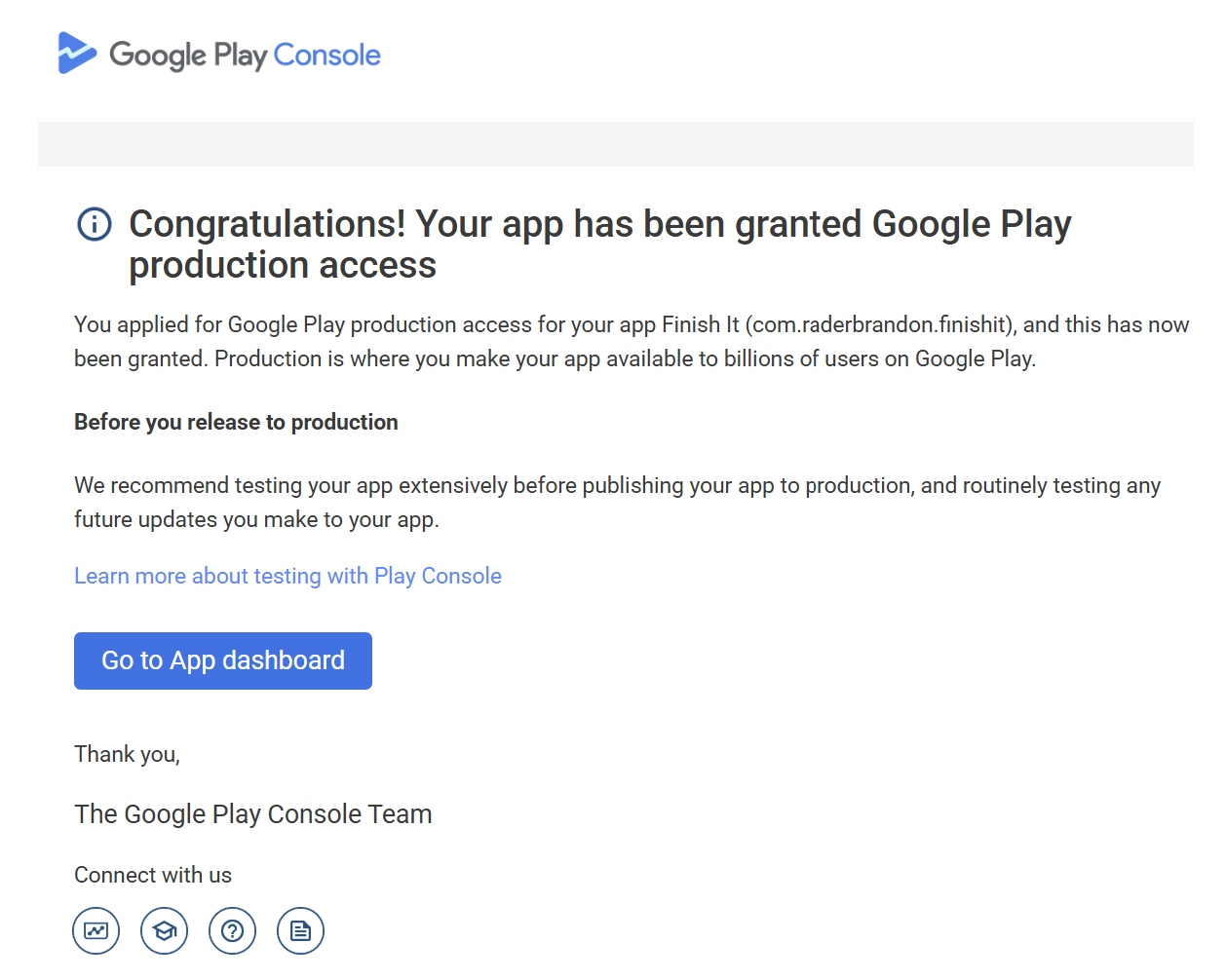
Quality QA Testing Reports
Clear, actionable reports with screenshots and evidence for every important issue found during testing.
Real Device Testing & Diagnostics
Real human testers use physical Android devices to test your app, verify real user flows, and provide clear testing evidence and professional QA reports.
Compliance Audit Passed
Our structured 14-day closed testing process is designed to meet Google Play's production requirements for your Android release.
Simple Closed Testing Pricing
Select the plan that fits your Android app complexity.
Loading Packages
Please wait while we fetch the best options for your region...
Frequently Asked Questions
Everything you need to know about passing your closed testing requirements.