12 Play Console app testers for Android app testing in Costa Rica
Hire 12 Play Console app testers in Costa Rica. Pass Google Play closed testing in 14 days with real Android testers and unlock Play Store production access.
Navigating Google Play Closed Testing from Costa Rica's Tech Ecosystem
Costa Rica has rapidly grown into a prominent Central American software development hub. Software studios in San Jose, agile development teams across Heredia, and independent app creators in Alajuela and Cartago are building high-quality mobile products for global markets. However, releasing an Android app to open production requires meeting strict Google Play compliance rules. Under policies established for personal developer accounts created after November 2023, Google requires app creators to run a verified closed test involving at least 12 opt-in testers continuously for 14 straight days before gaining production access.
Securing 12 reliable participants across diverse physical Android hardware remains a tricky operational hurdle for many Costa Rican engineering teams. Informal testing circles, friends, or local developer groups often experience high dropout rates and inconsistent app usage. These patterns trigger automated red flags in Google Play Console evaluation systems. Meeting Google standards requires systematic test coordination, genuine user sessions, real hardware diversity, and stable telemetry logs.
Understanding the 12 Testers for 14 Days Policy Mandate
Google established the closed testing mandate to protect the Play Store ecosystem from broken releases, unstable codebases, and malware. Under this rule, personal developer accounts must recruit at least 12 opt-in testers who install the closed track build from Google Play and keep it installed on their primary devices for two continuous weeks.
Passing this milestone involves much more than entering 12 email addresses into an email list in Play Console. Automated backend systems track engagement telemetry, installation persistence, and opt-in stability across all enrolled accounts. If participants uninstall the APK or AAB early, fail to open the build over several days, or register through artificial bot networks, the 14-day timer resets or Google denies production access during the manual review phase.
Closed Testing Roadblocks for Mobile Developers in Costa Rica
Engineers and digital product creators across Costa Rica often run into several predictable roadblocks when attempting to organize closed testing independently:
- Tester Inactivity and Natural Drop-Off: Testers commonly install the build on Day 1, explore the app once, and never reopen it. When Google telemetry shows zero active sessions between Day 4 and Day 14, production applications get rejected.
- Device and OS Homogeneity: Local testing circles frequently share similar smartphone models or regional carrier builds. This leaves critical edge-case crashes unnoticed on international devices, different screen densities, and varied Android OS versions.
- Bot Farm and Scripted Account Traps: Purchasing low-cost testing packages or automated clicks from shady web forums exposes developer accounts to Google Play Protect fraud algorithms, risking permanent account termination.
- Time Zone and Feedback Coordination Gaps: Chasing friends and coworkers for bug reports drains dozens of hours that developer teams should spend refining core product features, optimizing APIs, and preparing digital marketing campaigns.
Real Device Testers vs. Automated Bot Farms
Selecting the right testing approach directly determines whether your application passes production review on the initial try or gets locked in repeated testing cycles.
Real Human Testers (Recommended)
- Real physical Android devices spanning Android 10 through Android 15.
- Natural touch events, varied session times, and authentic network requests across real telecommunication carriers.
- Full 14-day continuous opt-in retention with organic background sessions and periodic app launches.
- Verified crash reports, UI feedback, and feature recommendations submitted through official Google Play channels.
- Complete adherence to Google Play Developer Program Policies and quality guidelines.
Bot Networks and Fake Testers (High Risk)
- Rooted emulator instances, headless scripts, and shared IP proxy farms identified by Google Play Protect.
- Identical session durations, robotic click paths, and sudden unnatural traffic spikes.
- Premature uninstalls and erratic opt-out events that trigger automated 14-day timer resets.
- Zero constructive feedback, qualitative user experience notes, or real bug reports.
- High probability of permanent Play Console account termination and associated account strikes.
Comparing Testing Methods for Google Play Closed Testing
The comparison table below outlines the core differences between managed testing services, internal DIY networks, and automated bot platforms.
| Feature / Metric | Managed Human Testing Service | DIY Internal Network | Automated Bot Farms |
|---|---|---|---|
| Active Human Testers | 12+ verified real human participants | Relies on friends and coworkers | Zero (scripted headless accounts) |
| Hardware Diversity | Broad mix of Samsung, Xiaomi, Pixel, Motorola | Limited to 2 - 3 local phone models | Virtual cloud emulators / rooted farms |
| Continuous 14-Day Retention | Guaranteed 100% completion rate | High risk of early uninstalls | Drops off unpredictably |
| Google Telemetry Quality | Organic daily opens, UI interaction, ANRs | Sporadic sessions and flatline gaps | Flagged as inorganic bot behavior |
| Account Security | Fully compliant with Play Policies | Safe but difficult to complete | Severe risk of developer account ban |
| Developer Time Invested | Under 15 minutes of initial setup | 25 to 40 hours of manual follow-ups | High maintenance and remediation |
Struggling with the 14-Day Testing Requirement?
Skip the hassle of recruiting unreliable testers. Our professional fleet of real Android devices guarantees Google Play compliance in exactly 14 days. Zero bots. Zero emulators. 100% production approval guarantee.
Deep Technical Insights on Play Console Telemetry and Android Vitals
To secure swift production track approval, developers must look under the hood of Google Play Console telemetry. When you submit your app for closed testing, Google does not merely check a binary pass-or-fail status on your tester list. Behind the scenes, the Play Console continuously collects system-level diagnostic metrics through Google Play Services and Google Play Protect.
1. Application Not Responding (ANR) Thresholds and Main Thread Health
An ANR occurs when the main UI thread of an Android application is blocked for more than 5 seconds. Google Play benchmarks your app against the bad behavior threshold, which is currently set at 0.47% overall ANR rate (and 0.34% for per-user daily ANR rate). If your application exceeds these limits during closed testing, Play Console flags your build as technically substandard.
During your 14-day test, monitor the following architectural patterns to keep ANR rates near zero:
- I/O Operations on the Main Thread: Ensure all disk reads, SQLite queries (via Room), and file caching run inside Kotlin Coroutines (
Dispatchers.IO), RxJava schedulers, or background worker threads. - Synchronous Network Calls: Never perform HTTP requests, GraphQL queries, or JSON serialization on the UI thread. Use asynchronous networking libraries like Retrofit, OkHttp, or Ktor.
- Heavy Layout Inflation: Deeply nested view hierarchies or complex Compose trees can choke frame rendering and trigger UI thread stalls on budget Android chipsets. Flatten your XML layouts with
ConstraintLayoutor optimize Jetpack Compose recomposition scopes.
2. Crash Rates and Uncaught Exception Handlers
Google enforces a strict bad behavior crash threshold of 1.09% across all device models (and 0.41% on specific core device models). Exceeding this rate during testing is one of the most common reasons Google rejects requests for production access.
Key crash prevention strategies include:
- Null Safety and Type Safety: For Kotlin apps, leverage strict null safety and avoid unsafe type casts (
as!). For React Native and Flutter, wrap third-party native bridges with comprehensive defensive error guards. - Global Uncaught Exception Handlers: Implement a global
Thread.UncaughtExceptionHandleror integrate crash reporting SDKs (such as Firebase Crashlytics or Sentry) to catch fatal exceptions gracefully while logging detailed stack traces. - Lifecycle and State Management: Verify that your activities and fragments survive configuration changes (like screen rotation, dark mode switching, and split-screen mode) without leaking references or crashing on recycled views.
3. Background Battery Management, Partial Wake Locks, and Background Tasks
Google Play Vitals aggressively tracks battery drain patterns. If your closed test testers report excessive battery usage, your app can be penalized before it ever reaches the public store.
Pay close attention to these vital battery metrics:
- Stuck Partial Wake Locks: A wake lock prevents the device CPU from entering low-power sleep mode. If your app holds a partial wake lock for more than an hour continuously, it gets logged as a battery violation. Replace raw wake locks with
WorkManageror Android's modernJobScheduler. - Excessive Background Location Requests: Requesting device location more than a few times per hour while the app is in the background is severely restricted on Android 12 through Android 15. Ensure location updates pause when UI components enter the stopped or destroyed lifecycle state.
- Foreground Service Compliance: Starting on Android 14 (API level 34), all foreground services require declaring an explicit foreground service type (such as
dataSync,mediaPlayback, orlocation) in theAndroidManifest.xmlalongside appropriate runtime permissions.
4. Telemetry Interaction Diversity: Touch Events and Session Depth
Google's review algorithms analyze how testers interact with your app. A healthy closed test should produce a natural distribution of user telemetry:
- Varied Session Lengths: Real humans open apps for varying intervals, ranging from 45 seconds of quick navigation to several minutes of deep usage. In contrast, bot scripts produce identical, flat session times.
- Diverse Geographic and Network Profiles: When testers access your build via varied Wi-Fi networks, 4G, and 5G cellular carriers across Costa Rica and international regions, it proves your network layer handles latency spikes, DNS resolution, and offline transitions reliably.
- UI Interaction Breadth: Natural navigation through tabs, forms, settings screens, and media players generates authentic motion event logs that prove the software is being actively exercised.
Mastering the Google Play Production Questionnaire
Once your 12 testers finish the 14-day continuous closed test, the "Apply for Production" button activates inside Google Play Console. Clicking this button opens an extensive questionnaire. Google review teams manually inspect these answers alongside your automated telemetry logs to determine whether your app qualifies for open production.
To maximize your chances of first-time approval, structure your questionnaire answers with clarity, technical detail, and concrete evidence:
Question 1: How did you recruit your testers?
- Bad Answer: "I asked some friends on WhatsApp and posted a link online."
- Good Answer: "We assembled a dedicated group of 15 vetted mobile testers spanning diverse Android hardware (Samsung Galaxy A series, Google Pixel 6/7, Xiaomi Redmi, and Motorola devices running Android 11 through 15). Testers were provided official Google Play opt-in links and installed the app directly through the closed testing track to ensure full compliance with Google Play Developer policies."
Question 2: How did testers engage with your app during the 14 days?
- Bad Answer: "They opened the app every day and liked it."
- Good Answer: "Testers executed a comprehensive test plan covering primary user flows: user authentication, profile creation, search filtering, offline caching, and core interaction loops. Testers averaged daily active sessions across the two-week test window, generating realistic UI interactions, network requests, and background lifecycle transitions on real cellular and Wi-Fi networks."
Question 3: What specific feedback and bugs were discovered during testing?
- Bad Answer: "There were no bugs, everything worked perfectly."
- Good Answer: "During Days 3 to 7, testers on Android 12 identified a layout clipping issue inside the checkout flow on small screen densities (320dp). Additionally, testers on Samsung One UI noted a minor memory leak during image cache invalidation. We also collected constructive user experience feedback regarding button contrast and onboarding tutorial speed."
Question 4: What changes, bug fixes, and updates did you implement based on feedback?
- Bad Answer: "We didn't need to make any changes."
- Good Answer: "Based on tester feedback, we pushed two iterative maintenance builds (Version 1.0.2 and 1.0.3) to the closed testing track. We refactored the checkout view using ConstraintLayout to resolve screen clipping, patched the image cache handler to eliminate memory leaks, and refined UI color contrast ratios to meet WCAG 2.1 accessibility standards. Follow-up testing confirmed that all reported issues were resolved."
Pre-Launch Verification Checklist for Costa Rican Developers
Before submitting your production application in Google Play Console, verify that your release meets all technical, architectural, and policy requirements.
Play Console Configuration and Security
Android Vitals and System Stability
Step-by-Step Roadmap to Production Approval
Follow this field-tested workflow to take your Android app from closed track setup to live production status on Google Play.
Track Configuration and Build Upload
Create your closed testing track inside Google Play Console. Upload your signed release AAB, configure target country availability, complete Content Rating questionnaires, and prepare your opt-in URL.
Tester Recruitment and Opt-In Onboarding
Assign 12+ verified human testers to your closed track. Testers accept the invitation via web or mobile opt-in links and install the app directly from Google Play on physical devices.
14-Day Active Telemetry Period
Testers interact with your app daily across real hardware, generating organic touch events, network traffic, lifecycle transitions, and authentic Android Vitals telemetry.
Feedback Analysis and Stability Patches
Monitor Play Console crash logs, ANR rates, and tester bug reports. Push iterative hotfix updates directly to the closed testing track without resetting your 14-day testing clock.
Production Access Application and Approval
Complete the 14-day testing window, submit detailed answers to Google's production readiness questionnaire, and receive official approval to launch on the public Google Play Store.
Frequently Asked Questions
Why does Google Play enforce 12 testers for 14 days on personal developer accounts?
Google introduced this requirement in late 2023 to raise software quality standards across the Play Store ecosystem. By requiring independent developers to conduct a verified 14-day closed test with at least 12 real users on physical devices, Google ensures that apps are evaluated for crashes, ANRs, battery drain, and UI usability before reaching the public store. This prevents broken, malware-laden, or abandoned applications from polluting search results and harming the Android user experience.
Can Costa Rican developers use testers located in other countries for closed testing?
Yes. Google Play permits closed testing participants from any geographic region, as long as your closed testing track includes those target countries in the Play Console track settings. Using international testers on diverse Android models often strengthens your telemetry profile by demonstrating app stability across various telecom operators, network latencies, screen resolutions, and manufacturer-specific Android skins like Samsung One UI, Xiaomi HyperOS, and Motorola My UX.
What happens if a tester uninstalls the app or leaves the test on Day 10?
If an enrolled tester uninstalls the application or leaves the testing group and your active tester count falls below 12, Google's automated evaluation system may pause or reset the 14-day countdown. To eliminate this risk, professional testing services always recruit 15 to 20 testers. This safety margin ensures that your active device count remains safely above the mandatory threshold throughout the entire two-week testing cycle.
Can I push new updates and bug fixes to the closed track during the 14 days?
Yes. Deploying update builds to your closed testing track during the 14-day testing period is fully supported and actively encouraged by Google. Releasing hotfixes demonstrates proactive developer maintenance and responsiveness to tester feedback. In fact, documenting these updates in your production application questionnaire proves to Google reviewers that genuine, constructive quality assurance took place.
How does Google detect automated bot farms and emulator-based testing?
Google Play Protect and Google Play Services analyze a wide range of hardware and behavioral telemetry signals. These include hardware sensor data (accelerometer, gyroscope), touch event coordinate jitter, battery temperature variance, Google account age and activity, IP subnet diversity, and background process states. Bot farms running emulators or automated click scripts generate synthetic, repetitive patterns that trigger fraud filters, leading to test invalidation or developer account suspension.
What are the most common reasons Google rejects production access applications?
The most frequent causes for production track rejection include: lack of daily tester engagement (such as zero sessions recorded between Day 5 and Day 14), high ANR or crash rates in Android Vitals exceeding Google thresholds, vague or generic answers in the production questionnaire, and unaddressed UI glitches on popular screen sizes. Maintaining steady daily telemetry, resolving reported bugs with patch releases, and providing concrete testing documentation ensures smooth approval.
Our QA Process
How we deploy real devices and guarantee compliance for your release.
Choose Package
Sign in with Google to configure the closed testing environment for your Android build.
Submit Link
Submit your Google Play Console testing link, and our team will assign qualified testers from our testing network to join your Android closed testing release.
Active Testing
A QA supervisor monitors daily check-ins, ensuring 12 unique Android users engage with your Android build every single day.
Get Approved
We guarantee 14 consecutive days of active user check-ins to satisfy Google's compliance policies, delivering an audit-ready PDF feedback report.
The Premium QA Advantage
Experience a next-generation testing infrastructure built for Google Play compliance for your Android release.
The 14-Day Production Guarantee
We complete the required 14-day closed testing process with real human testers and physical Android devices, while providing clear testing evidence and documentation throughout the process.
If Google specifically rejects production access due to insufficient testing engagement, you are covered by our free re-run or 100% refund guarantee, subject to our Refund Policy.
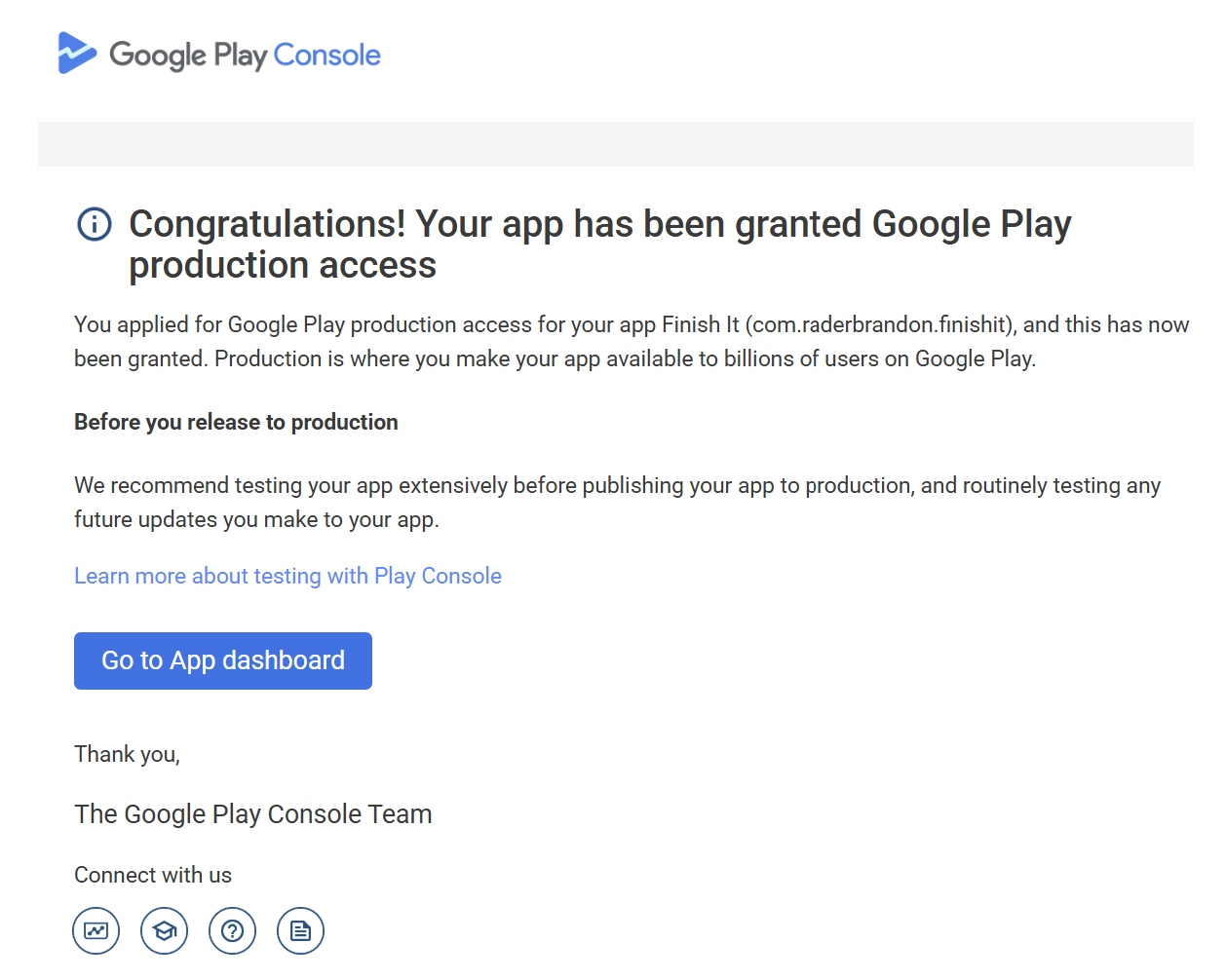
Verified Production Access
Quality QA Testing Reports
Clear, actionable reports with screenshots and evidence for every important issue found during testing.
Real Device Testing & Diagnostics
Real human testers use physical Android devices to test your app, verify real user flows, and provide clear testing evidence and professional QA reports.
Production Access Secured
Get your Android build approved on the first try. We create an audit-ready compliance profile that proves thorough quality assurance.
Affordable Compliance Cycles
Transparent plans built to satisfy Google Play Console guidelines for your Android build.
Loading Packages
Please wait while we fetch the best options for your region...
Frequently Asked Questions
Everything you need to know about passing your closed testing requirements.