12 Play Console app testers for Android app testing in Croatia
Hire 12 Play Console app testers in Croatia. Pass Google Play closed testing in 14 days with real Android testers and unlock Play Store production access.
Navigating Google Play Closed Testing Rules for Croatian Creators
Google enforces these closed testing regulations on all personal developer accounts created after late 2023. You cannot simply upload an Android App Bundle (AAB), recruit five colleagues, and request production access the following weekend. The Play Console demands a verified cohort of at least 12 testers who keep your app installed and opted in for 14 consecutive calendar days.
During this closed testing window, automated evaluation systems scan your app's telemetry. Google looks for genuine human engagement: opening different activities, generating organic logcat events, testing edge network conditions across regional carriers like Hrvatski Telekom, A1 Hrvatska, or Telemach, and sending feedback through the private Play Store testing channel. Skipping or faking these steps leads straight to a rejected production application.
Understanding the True Technical Risks of Bot Farms vs. Real Testers
Many developers under tight launch schedules turn to cheap online gigs or automated bot scripts to fulfill their 12 testers requirement. This is the fastest way to flag your developer account. Google Play services detect emulated environments, duplicate device fingerprints, identical IP subnets, and automated click routines with remarkable accuracy.
Synthetic & Bot Testing Networks
Runs on cloud emulator farms or rooted device racks with cloned Android IDs and hardware profiles.
Zero organic interaction, zero crashes reported, and abnormal battery or memory usage patterns flagged by Play telemetry.
High risk of automated rejection, account review delays, or permanent Play Console developer account termination.
Authentic Human Testing Cohorts
100% genuine Android hardware running across diverse OS versions (Android 11 through Android 15+).
Organic user sessions, diverse screen resolutions, realistic touch events, and legitimate crash telemetry.
Constructive private feedback submitted directly inside Google Play, satisfying all production review criteria.
When an automated farm simulates opt-ins, their accounts often lack historical Play Store transaction history, verified payment profiles, and realistic daily usage telemetry. Google's review algorithm easily spots a dozen accounts created solely for reciprocal app testing. When you use a managed testing service with authentic testers, your app receives legitimate engagement that protects your developer reputation.
Direct Comparison: How to Fulfill Closed Testing Requirements
Before deciding whether to run testing manually through friends and family, rely on mutual test swaps on public forums, or partner with a professional testing service, evaluate how each approach handles critical compliance factors:
| Feature & Requirement | Managed Professional Testing | DIY Friends & Family | Public Forum Reciprocal Swaps | Automated Bot Farms |
|---|---|---|---|---|
| Active 14-Day Retention | 100% Guaranteed with backups | Highly unpredictable (~40%) | High drop-out rates (~60%) | Fake automated retention |
| Real Hardware Diversity | Top Samsung, Xiaomi, Pixel, Motorola | Limited to your social circle | Random, unverified | Cloned emulators / VM racks |
| Google Play Policy Compliance | Fully compliant with human testers | Compliant but hard to sustain | Borderline spam patterns | Strict policy violation |
| Private Feedback Generation | Quality bug reports & UX suggestions | Casual comments like "looks ok" | Generic one-word feedback | None or auto-generated strings |
| Production Approval Probability | Over 99% first-try success | Moderate (if retention holds) | Low (due to telemetry gaps) | Near 0% (high risk of ban) |
| Developer Time Invested | Under 15 minutes setup | 20+ hours chasing people | 15+ hours testing other apps | Low setup, catastrophic risk |
Relying on DIY circles often leaves you in an anxious state for two weeks, messaging cousins and former university classmates to check whether they opened your build. A managed service removes this friction completely so you can stay focused on building features, refining user interfaces, and preparing marketing campaigns.
Struggling with the 14-Day Testing Requirement?
Skip the hassle of recruiting unreliable testers. Our professional fleet of real Android devices guarantees Google Play compliance in exactly 14 days. Zero bots. Zero emulators. 100% production approval guarantee.
Crucial Play Console Metrics Google Reviews for Production Approval
When the 14-day testing period concludes and you click the "Apply for Production" button in Google Play Console, your app is not automatically published. Instead, human reviewers and automated evaluation algorithms assess a 20-question review questionnaire along with granular telemetry data collected throughout the testing period:
- Daily Active Opt-In Ratio: Did you maintain at least 12 opted-in testers every single day without interruption? If your count dipped to 11 on day nine because someone changed phones or left the program, the 14-day clock might quietly fail behind the scenes.
- Android Vitals & Crash Telemetry: Reviewers verify whether your release is stable. High Application Not Responding (ANR) rates, unhandled runtime exceptions, or memory leaks on specific chipsets (like MediaTek Dimensity or Qualcomm Snapdragon) show that the app was not thoroughly tested before production.
- App Bundle Iteration: Did you publish bug fixes and build updates based on tester feedback? Pushing at least one minor patch or revision during the closed testing phase signals to Google that you actively iterate and resolve bugs discovered by your test cohort.
- Authentic In-App Navigation: Reviewers check if testers actually explored deep navigation paths, granted runtime permissions, triggered API calls, or tested billing workflows, rather than opening the splash screen and swiping away immediately.
- Quality of Qualitative Tester Feedback: Google asks you to summarize the feedback received during closed testing and explain the concrete changes you implemented. Generic statements with no actual Play Store feedback logs raise red flags during manual compliance checks.
Comprehensive Pre-Launch Closed Testing Checklist
Follow this structured checklist to ensure your Android App Bundle meets all Google Play technical standards, GDPR privacy requirements, and testing criteria before starting your 14-day countdown:
Core Technical & Bundle Preparation
Play Console & Closed Track Configuration
Compliance, Localization & Testing Oversight
Step-by-Step Roadmap to Production Access
Navigating the Google Play closed testing workflow requires a methodical approach. Follow this step-by-step roadmap from initial build upload to full production rollout:
Step 1: Finalize Build & Set Up Closed Track
Build your release-ready AAB file, set up your Closed Testing Track in Google Play Console, complete your Data Safety form, and publish the closed test release for Google's standard automated pre-launch checks.
Step 2: Onboard 12+ Verified Real-Device Testers
Add your dedicated tester cohort to the track via email lists or Google Groups. Provide both the web join link and Android Play Store direct opt-in link to ensure every tester accepts the invitation and installs the build.
Step 3: Maintain Active 14-Day Continuous Engagement
Keep all testers opted in and actively interacting with your application across the full 14 calendar days. Testers explore core flows, test UI states, trigger realistic network calls, and generate clean telemetry.
Step 4: Push an Iterative Update & Collect Feedback
Release at least one incremental update (e.g., version 1.0.1) addressing minor tweaks or edge-case bugs discovered during testing. Collect detailed feedback directly through private Play Store review channels.
Step 5: Complete the 20-Question Production Application
Once the 14-day requirement indicator turns green in Play Console, answer Google's production access questions thoughtfully. Provide comprehensive details regarding target audience, testing methods, feedback received, and fixes applied.
Step 6: Production Approval & Public Launch
Receive official production approval from the Google Play review team, promote your closed test build directly to the Production Track, and launch your application to global users on the Play Store.
Frequently Asked Questions
Why does Google Play require 12 testers for 14 days for personal developer accounts?
In late 2023, Google updated its Play Console developer policy to improve overall app quality and protect users from malware, unfinished utilities, and unstable builds. For personal developer accounts, Google mandates that at least 12 independent testers remain opted in continuously for 14 calendar days. This requirement ensures that new developers thoroughly test their software on real hardware, identify bugs, optimize Android Vitals, and establish legitimate testing records before publishing to public store listings.
What happens if a tester uninstalls the app or opts out on day 8?
If your active opted-in tester count drops below the mandatory 12-tester threshold at any point during the 14-day window, your progress pauses or resets completely. Google Play Console tracks daily active installations and opt-in states. If an account leaves early, you must recruit replacement testers and potentially restart the 14-day countdown. This is why working with a managed testing provider that guarantees surplus backup testers (typically 15 to 20 testers) is critical to prevent accidental resets.
Can I use free testing swap forums or reciprocal groups on Reddit/Discord?
While reciprocal testing communities exist, they carry significant failure rates and operational risks. Many participants in mutual swap groups install your app, keep it open for thirty seconds, and uninstall it a few days later once their own app gets your initial download. Furthermore, if participants use multiple dummy accounts on the same unverified hardware, Google's anti-abuse algorithms may flag the reciprocal pattern, leading to rejected production applications or account warnings.
Do testers need to be physically located in Croatia?
No, your testers do not have to be physically located in Croatia unless your app features strict regional geo-fencing (such as hyper-local transport or local banking services that block foreign IP addresses). However, if your app is localized in Croatian, English, or specific European markets, having testers who can test localized strings, regional date formats, and euro currency displays is beneficial. Our testing service accommodates both global testers and specific regional requirements to ensure full compatibility.
How should I answer Google's 20-question production application questionnaire?
Google requires developers to explain how they recruited testers, what feedback they received, how they prioritized bug fixes, and why the app is ready for global release. Your answers should be clear, detailed, and professional. Describe the real feedback you collected during the 14-day test, mention specific UI improvements or performance optimizations you made, and explain your target audience. Genuine, detailed answers backed by authentic Play Console testing telemetry ensure fast production approval.
What is the difference between an Open Track and a Closed Track in Google Play?
An Open Track allows anyone on Google Play to join your test without an invitation, but it does NOT count toward satisfying the mandatory 12 testers for 14 days requirement for new personal accounts. Google specifically requires testing to take place within a Closed Testing Track (or Internal Test Track promoted to Closed Track) where specific email addresses or Google Group members are explicitly invited and managed. Always ensure you configure a Closed Track to fulfill compliance rules.
Our QA Process
A straightforward 4-step process to get your Android app approved.
Choose Package
Connect your Google account and choose your preferred closed testing package for your Android app.
Submit Link
Share your Play Store opt-in URL. We immediately deploy 12 real testers to launch and review your Android app daily.
Active Testing
Our crew initiates daily launch sessions on physical devices, verifying usability and logging crashes for your Android app.
Get Approved
We continuously perform closed app testing for 14 days to help you meet Google Play production requirements. We also provide a compliance report.
The Premium QA Advantage
Deploy your Android app onto real retail-grade handsets using our secure laboratory environment.
The 14-Day Production Guarantee
We complete the required 14-day closed testing process with real human testers and physical Android devices, while providing clear testing evidence and documentation throughout the process.
If Google specifically rejects production access due to insufficient testing engagement, you are covered by our free re-run or 100% refund guarantee, subject to our Refund Policy.
Verified Production Access
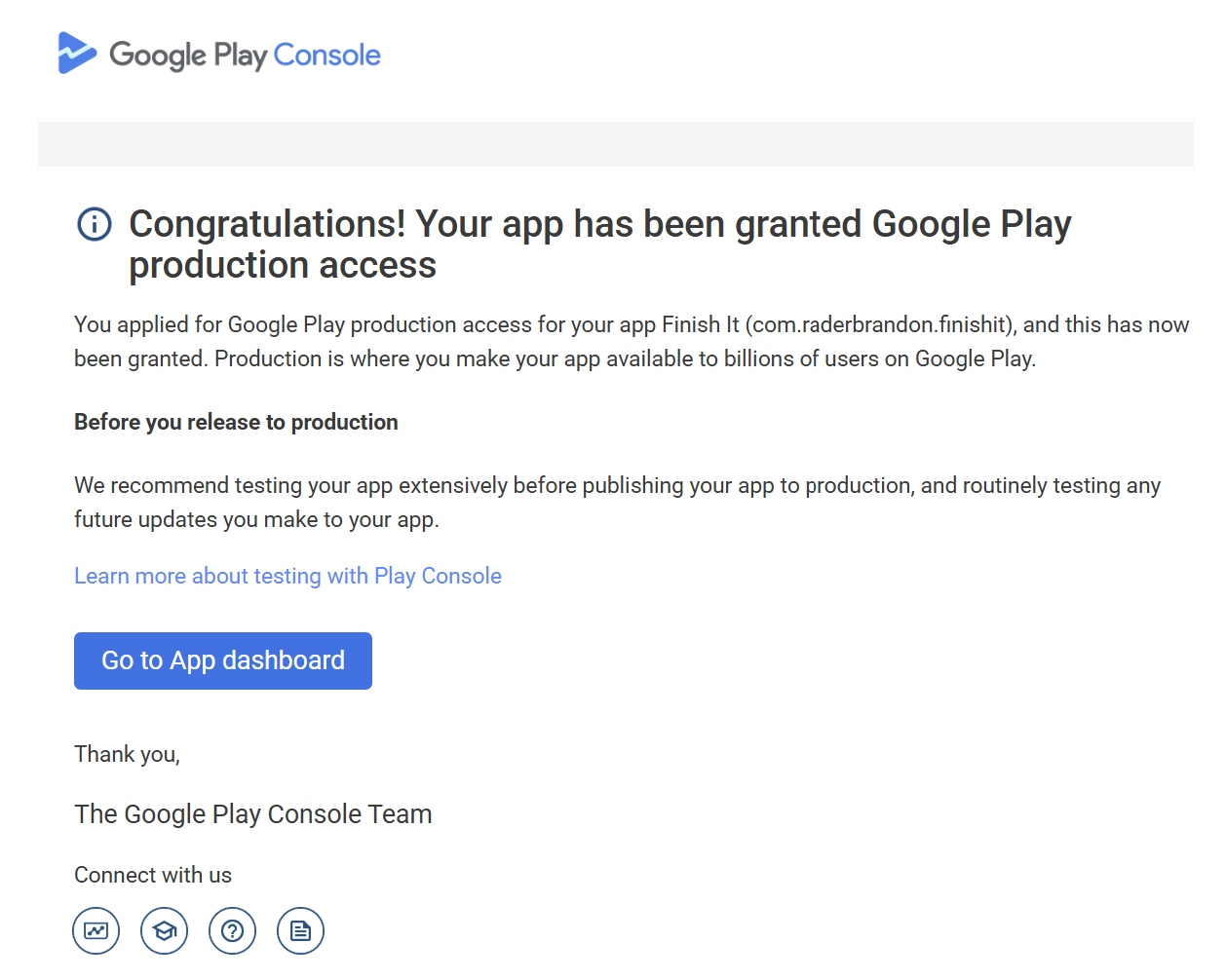
Quality QA Testing Reports
Clear, actionable reports with screenshots and evidence for every important issue found during testing.
Real Device Testing & Diagnostics
Real human testers use physical Android devices to test your app, verify real user flows, and provide clear testing evidence and professional QA reports.
Production Access Secured
Transition your Android app to public production access with confidence. We deliver verified session logs and compliant Console activity.
One Cycle. Complete Approval.
Choose the ideal closed testing cycle for your Android release.
Loading Packages
Please wait while we fetch the best options for your region...
Frequently Asked Questions
Everything you need to know about passing your closed testing requirements.