12 Play Console app testers for Android app testing in Ecuador
Need 12 Play Console app testers in Ecuador? Fulfill Google Play closed testing requirements with 12 testers for 14 days and launch on Play Store.
Ecuador is a land of incredible contrasts. From the high-altitude metropolis of Quito nestled in the Andes to the bustling coastal economic hub of Guayaquil, the geographical diversity is mirrored by a rapidly evolving digital landscape. As smartphone penetration deepens across both urban centers and rural provinces, launching an application here presents a massive opportunity. However, navigating this market means overcoming more than just diverse user behaviors. You must satisfy the strict compliance gates set by Google. Achieving success requires a localized approach to Google Play Closed Testing, ensuring your application resonates with real Ecuadorian users while perfectly aligning with stringent platform policies.
When you develop an application for this unique South American market, generic testing simply does not work. A user relying on a mobile network while commuting through the mountains will experience your application differently than someone on high-speed fiber in a coastal cafe. Capturing these real-world nuances is precisely why authentic Play Store Closed Testing is non-negotiable. If you try to bypass these requirements with automated scripts, you are not just risking policy violations - you are throwing away the chance to understand your actual audience. Engaging 12 Play Console app testers who actually live and breathe the local digital ecosystem ensures your product is genuinely ready for the spotlight.
The Core Challenge of Google Play Compliance
Google has fundamentally changed how new applications make their way to the public. To ensure a baseline of quality and security, the platform mandates rigorous testing phases before a full release. For many developers, the most daunting hurdle is the Closed Testing requirement. You cannot just compile your code and hit publish anymore. You need real humans interacting with your interface, uncovering bugs, and validating the user experience over a sustained period.
The specific benchmark developers often strive to meet involves gathering a dedicated group, often discussed as needing 12 Testers for 14 Days, to thoroughly evaluate the application. This process is designed to filter out unstable, low-effort, or malicious software. In a market like Ecuador, where diverse device types and network conditions are the norm, this testing period is your ultimate safety net. Failing to conduct this properly means your app might face rejection, or worse, a silent suspension that sets your launch timeline back by months.
Authentic Ecuadorian Testers
When you engage real users in Ecuador, you are buying peace of mind and actionable data. Real testers use real devices on actual local networks like Claro or Movistar. They navigate your application exactly how your future customers will. They experience the battery drain, the UI glitches on older screens, and the latency issues that emulators cannot replicate. More importantly, their activity patterns look perfectly natural to Google's algorithms because they are natural. This authentic engagement ensures you pass compliance checks smoothly while gathering feedback that actually improves your product.
Automated Bots and Fake Accounts
The temptation to cut corners is always present, but using click farms or automated bots is a direct path to failure. Google's sophisticated security infrastructure is specifically designed to detect synthetic testing behaviors. Bots do not take breaks, they do not hesitate before clicking, and they certainly do not use a diverse range of local IP addresses authentically. Relying on fake engagement not only violates policy but also leaves your application completely untested against real-world conditions. When the platform detects this fraud, the result is swift rejection, wasted time, and a tarnished developer account reputation.
Struggling with the 14-Day Testing Requirement?
Skip the hassle of recruiting unreliable testers. Our professional fleet of real Android devices guarantees Google Play compliance in exactly 14 days. Zero bots. Zero emulators. 100% production approval guarantee.
The Ultimate Checklist for the Ecuadorian Android Market
Preparing for launch requires meticulous planning. You need to ensure every technical and operational aspect of your application is polished before involving your 12 Play Console app testers. This comprehensive checklist breaks down the critical phases of your preparation.
Initial Technical Readiness
Ensure your Android App Bundle is as small as possible. Many users in Ecuador operate on limited data plans or older devices with constrained storage capacity. A bloated application will lead to high abandonment rates before the app is even opened. Use dynamic delivery features to serve only the necessary resources.
Test how your application handles sudden drops in connectivity. When a user transitions from Wi-Fi to a spotty 3G network in a rural area, your app must not crash. Implement robust caching mechanisms and clear error messages that guide the user gracefully when they go offline.
If your app involves transactions, ensure that pricing is accurately reflected and localized. While Ecuador uses the US Dollar, local payment gateways and banking integrations require specific attention. Ensure all Spanish text is natural and localized to Latin American dialects, avoiding overly formal or Spain-specific phrasing.
The Android device ecosystem in Ecuador is highly fragmented. While premium devices exist, the market is heavily skewed towards mid-range and budget smartphones from various manufacturers. Your UI must be responsive, and your memory footprint must be optimized to run smoothly on devices with lower RAM.
Preparing for Google Play Closed Testing
Do not just hand over the app and expect magic. Provide your 12 Testers for 14 Days with a specific list of tasks. Ask them to create accounts, reset passwords, navigate the primary workflows, and attempt edge-case scenarios. Clear instructions lead to high-quality, actionable feedback.
Create a frictionless way for testers to report issues. Whether it is an in-app reporting tool or a simple dedicated form, capturing screenshots and logs is essential. You need to know exactly what went wrong and where it happened during the testing period.
Your Closed Testing track utilizes your store listing. Ensure your icon, screenshots, and descriptions are fully completed and compelling. This sets the right context for your testers and prepares you for the eventual transition to production.
Double-check your email lists and opt-in links. Ensure that the testing track is properly configured for the correct geographical regions if you are geo-restricting the test. Incorrect configurations are the most common reason for delayed testing starts.
Your Roadmap to a Successful Ecuadorian App Launch
Understanding the journey from development to deployment is crucial. This roadmap outlines the strategic steps required to navigate Google Play Closed Testing effectively, leveraging your dedicated testing group to achieve full compliance and market readiness.
Step 1: Internal Quality Assurance
Before any external user touches your application, conduct rigorous internal testing. Use emulators and physical devices to catch the most obvious bugs. This phase ensures that when you finally invite external users, they are not blocked by critical crashes on the login screen. It is about respecting your testers' time.
Step 2: Securing Your Testing Cohort
Identify and onboard your 12 Play Console app testers. These individuals should represent your target demographic in Ecuador. Gather their Google account email addresses and add them to your Closed Testing list within the Play Console. Send out the opt-in links and verify that everyone has successfully installed the application.
Step 3: Initiating the 14-Day Evaluation
The clock starts ticking once your testers begin their engagement. During this period, which fundamentally relies on the 12 Testers for 14 Days methodology, you must monitor the vitals of your application. Check crash reports daily in your developer dashboard. Engage with your testers to ensure they are logging in regularly and executing the tasks you assigned.
Step 4: Iterative Bug Squashing
As feedback rolls in, prioritize the issues. Critical bugs that halt user progression must be fixed immediately. Push updates through the Closed Testing track to allow your cohort to verify the fixes. This active iteration demonstrates to the platform that you are genuinely maintaining and improving the software.
Step 5: Finalizing the Compliance Review
Once the mandated testing duration has concluded and your testers have provided their final feedback, you must aggregate the data. Ensure all crash rates are below the acceptable thresholds. Complete the final questionnaire required by Google, detailing what you learned and how you improved the app based on the closed testing phase.
Step 6: Promotion to Production
With compliance achieved and your application polished by authentic Ecuadorian user feedback, you are ready to promote your release to the production track. You can now launch with confidence, knowing your app has been battle-tested against the realities of the local market and meets all platform requirements.
Frequently Asked Questions About Testing in Ecuador
To provide complete clarity on this complex process, we have compiled the most detailed answers to the most common questions developers have when targeting the Ecuadorian Android ecosystem.
Why is it so critical to have testers specifically located in Ecuador rather than generic international testers?
The geographical location of your testers fundamentally changes the data you collect. Ecuador has a unique telecommunications infrastructure characterized by specific mobile network operators and regional variances in connectivity. A generic international tester running an emulator in a server farm will not experience the latency of a connection bouncing through local cell towers, nor will they understand the cultural context of your user interface.
Furthermore, Google Play Closed Testing algorithms are incredibly sophisticated at analyzing the origin of user interactions. If your application is designed for the Ecuadorian market, but all your testing traffic originates from data centers in Eastern Europe, it raises immediate red flags regarding the authenticity of your testing cohort. Utilizing 12 Play Console app testers who physically reside in the country ensures that the IP addresses, device language settings, and usage hours align perfectly with natural, expected patterns. This authentic data not only guarantees you pass the compliance checks but also provides you with genuine insights into how real local users will interact with your product.
What happens if some of my testers drop out or fail to engage during the mandatory 14-day period?
This is one of the most common pitfalls developers face during the 12 Testers for 14 Days cycle. Google requires continuous, active engagement to validate the testing phase. If testers install the app on day one and never open it again, the platform will likely view the test as insufficient, and your application for production access will be denied.
To mitigate this risk, you must actively manage your testing cohort. Do not just find the minimum number of users and hope for the best. It is highly recommended to recruit a buffer, securing perhaps fifteen or twenty individuals to ensure that at least a core group remains highly active. You should send daily reminders, provide new specific tasks to complete each day, and maintain open lines of communication. If a tester drops out completely, you may need to add a new tester and potentially extend the testing timeline to ensure you have enough data points to satisfy the Play Store Closed Testing requirements. Continuous monitoring of the Play Console dashboard will show you exactly who is active and who is falling behind.
Can I use automated scripts or testing farms to simulate user behavior and speed up the testing process?
Absolutely not. Attempting to bypass the human element of Google Play Closed Testing using automated scripts, bot networks, or commercial click farms is a severe violation of platform policies. Google has invested heavily in machine learning models that detect synthetic engagement. These systems analyze touch velocity, navigation patterns, session lengths, and network origins to differentiate between a real human and a script.
When you use bots, the interaction patterns are uniformly perfect, lacking the natural hesitations, varied swipe speeds, and sporadic usage times of actual users. If Google detects synthetic testing, the consequences are severe. Your application will be immediately rejected from moving to production, and your developer account will be flagged. In repeated or severe cases, the account may be permanently terminated without the possibility of appeal. Engaging authentic 12 Play Console app testers is the only secure, legitimate way to achieve compliance and safeguard your developer reputation.
How should I structure the tasks for my testers to ensure the highest quality feedback?
Leaving testers to explore an application aimlessly rarely yields comprehensive results. To maximize the value of your Play Store Closed Testing, you must structure the experience meticulously. Start by creating a daily schedule for your 12 Testers for 14 Days. On day one, focus entirely on the onboarding process - account creation, password recovery, and initial profile setup. Ask them to deliberately enter incorrect information to verify that your error handling works correctly and provides localized, helpful messages.
In subsequent days, guide them through specific core features. If it is an e-commerce app, have them add items to a cart, apply a discount code, and proceed to the checkout screen. Ask them to test the application while listening to music, or when receiving a phone call, to see how the app handles background state transitions. Finally, require them to submit a daily summary - a few sentences detailing what they liked, what felt confusing, and any visual glitches they noticed. This structured approach guarantees that every corner of your application is scrutinized before launch.
What specific device characteristics should I look for when selecting testers in Ecuador?
Ecuador has a diverse mobile hardware landscape. While flagship devices from major brands are present, a massive portion of the population relies on mid-range and entry-level smartphones from a wide variety of manufacturers. If you only test your application on the latest, most powerful devices, you are going to miss critical performance issues that affect the majority of your potential users.
When selecting your 12 Play Console app testers, mandate a diverse hardware portfolio. Ensure you have representation across different screen sizes, varying amounts of RAM, and different versions of the Android operating system. You need to know if your animations stutter on a device with only 2GB of RAM, or if your layouts break on older, smaller screens. By intentionally building a testing cohort with fragmented hardware, you simulate the real-world conditions of the Ecuadorian market. This ensures that when you finally launch, your application provides a stable, enjoyable experience for everyone, regardless of the device they can afford.
How does the review process work after the 14 days of closed testing are complete?
Once you have successfully navigated the 14 days of continuous testing, the process is not quite over. You must apply for access to the production track within the Play Console. This involves completing a detailed declaration form where Google asks specific questions about your testing methodology and the outcomes.
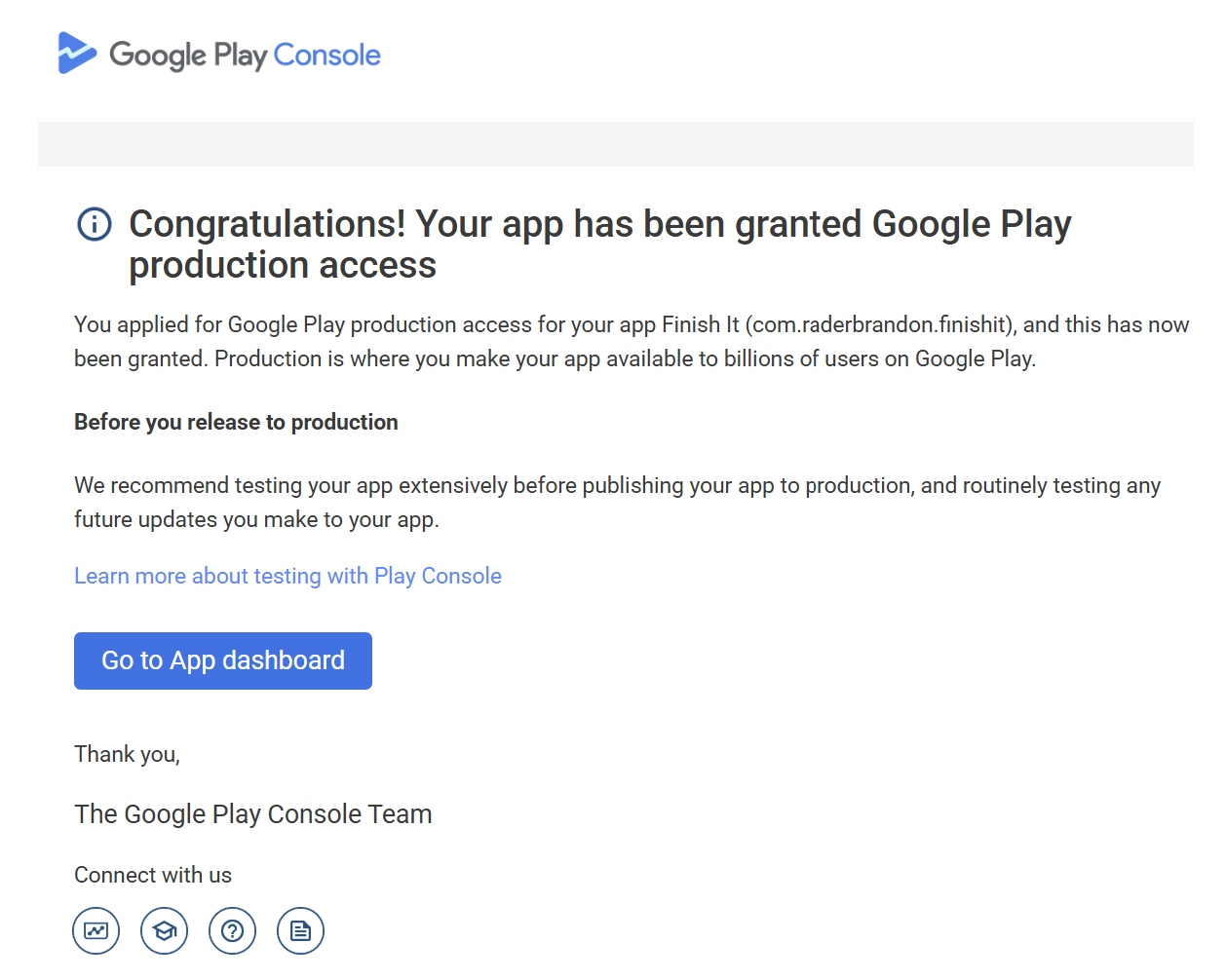
You will need to articulate exactly how you gathered your 12 Testers for 14 Days, what kind of feedback they provided, and critically, what changes you made to the application as a result of that feedback. Google wants to see evidence that the testing was not just a box-ticking exercise, but a genuine effort to improve the software quality. If your application had zero crashes and you made zero changes, this might actually look suspicious. Once you submit this form, Google's review team will manually evaluate your application, your testing data, and your answers. This review can take anywhere from a few days to over a week. Providing thorough, honest, and detailed answers based on your authentic Ecuadorian testing experience is the best way to ensure a swift and successful approval.
The Testing Pipeline
How we deploy real devices and guarantee compliance for your release.
Sign In
Sign in with Google to configure the closed testing environment for your Android build.
Opt-In URL
Submit your Google Play Console testing link, and our team will assign qualified testers from our testing network to join your Android closed testing release.
Testing Begins
A QA supervisor monitors daily check-ins, ensuring 12 unique Android users engage with your Android build every single day.
Compliance Complete
We guarantee 14 consecutive days of active user check-ins to satisfy Google's compliance policies, delivering an audit-ready PDF feedback report.
Why Developers Trust Us
Experience a next-generation testing infrastructure built for Google Play compliance for your Android release.
The 14-Day Production Guarantee
We complete the required 14-day closed testing process with real human testers and physical Android devices, while providing clear testing evidence and documentation throughout the process.
If Google specifically rejects production access due to insufficient testing engagement, you are covered by our free re-run or 100% refund guarantee, subject to our Refund Policy.
Verified Production Access
Quality QA Testing Reports
Clear, actionable reports with screenshots and evidence for every important issue found during testing.
Real Device Testing & Diagnostics
Real human testers use physical Android devices to test your app, verify real user flows, and provide clear testing evidence and professional QA reports.
Guaranteed App Approval
Get your Android build approved on the first try. We create an audit-ready compliance profile that proves thorough quality assurance.
Affordable Compliance Cycles
Transparent plans built to satisfy Google Play Console guidelines for your Android build.
Loading Packages
Please wait while we fetch the best options for your region...
Frequently Asked Questions
Everything you need to know about passing your closed testing requirements.