12 Play Console app testers for Android app testing in Iceland
Hire 12 Play Console app testers in Iceland. Pass Google Play closed testing in 14 days with authentic Android testers and unlock production access.
Understanding the Google Play Closed Testing Mandate
The Google Play ecosystem has evolved to emphasize stability, data security, and long-term user satisfaction. When you initiate a closed testing track in Google Play Console, your app must maintain an active pool of testers continuously opted in for at least 14 days. If your tester count dips below the required threshold or testers remain completely dormant, the automated 14-day evaluation clock can stall or reset entirely.
For creators targeting the Icelandic market, this mandate presents specific logistical challenges. With a compact national population of around 390,000, assembling a dependable group of local testers who will diligently open an unreleased APK day after day is tough. Whether your app integrates localized services, Icelandic language support, or regional payment processors, finding 12 testers for 14 days who provide genuine interaction is critical to proving your app is production-ready.
Play Store Closed Testing tracks allow developers to distribute pre-release builds via private Google Play opt-in URLs. Testers download and update the app directly through Google Play, generating the authentic installation logs and crash data that Google reviewers inspect when evaluating your production application.
The Icelandic Mobile Ecosystem and Testing Realities
Developing mobile applications for Iceland means designing for a tech-forward demographic with zero tolerance for sluggish performance or broken interfaces. Android holds a massive market footprint across the Nordic region, spanning premium flagships, mid-range workhorses, and rugged outdoor hardware. A successful test run must reflect this diverse hardware reality under authentic network conditions.
Icelandic mobile users frequently interact with sophisticated local infrastructure, including digital ID systems like Rafræn skilríki, localized banking portals, Aur payments, and multilingual interfaces catering to both native Icelandic speakers and international residents. When conducting Android app testing in Iceland, having real testers explore your app on local networks - switching between ultra-fast urban 5G in the Capital Region and fluctuating rural cellular coverage along the Ring Road - uncovers edge cases that automated emulators never detect.
Moreover, linguistic accuracy in Icelandic is critical. Grammatical subtleties, compound words, and specific character sets (such as ð, þ, and æ) can break UI layouts, trigger rendering overflow bugs, or distort database strings if not properly validated on physical Android screens. Ensuring your 12 Play Console app testers interact with these localized components guarantees a polished user experience before public launch.
The Pitfalls of Automated Bots and Click Farms
Under the pressure of strict deadlines, developers sometimes consider cheap online services that advertise instant opt-ins. These operations utilize emulator farms, automated bot scripts, and recycled Google accounts to simulate testing. Taking this shortcut is one of the quickest ways to trigger a permanent ban or complete rejection from Google Play.
Authentic Human Testers
Genuine testers operate on real physical Android smartphones across distinct IP ranges and genuine carrier networks. They navigate screens at human speeds, trigger organic touch events, grant realistic permissions, and experience authentic battery and memory lifecycles. When these testers submit feedback through Google Play Console, the submission carries legitimate user metadata that validates your application in Google's automated compliance checks.
Bot Farms and Synthetic Accounts
Bot farms rely on cloud-hosted virtual devices and emulators sharing synchronized IP subnets and identical device fingerprints. These scripts open the app in rigid, repeatable intervals, generate zero meaningful telemetry, and leave no genuine behavioral footprint. Google's sophisticated anti-fraud algorithms effortlessly detect synthetic activity, leading to immediate closed testing rejection, extended review penalties, or permanent developer account termination.
Google Play Console monitors critical telemetry throughout the 14-day testing period, including Android Vitals, ANR (Application Not Responding) rates, daily active device sessions, and crash clusters. When bot services abruptly stop pinging after minimal interaction, your dashboard displays unnatural drop-offs that signal bad faith testing. Securing authentic participants for your Google Play Closed Testing is the only reliable way to safeguard your developer reputation.
Step-by-Step Closed Testing Deployment Strategy
Executing a successful closed testing cycle requires a methodical approach that aligns your technical releases with Google Play Console compliance rules.
Console Configuration and Asset Preparation
Configure your closed testing track within Google Play Console. Complete all mandatory declarations, including target audience age groups, data safety forms, privacy policy URLs, and content ratings. Ensure your store listing metadata, localized descriptions, and high-resolution screenshots reflect the app build being submitted for review.
Tester Recruitment and Email List Setup
Create an approved tester list in the Closed Testing section using a dedicated Google Group or CSV list of tester Google accounts. Whether onboarding internal team members or leveraging a professional service to secure 12 Play Console app testers, ensure every participant has an active, good-standing Google Play account.
Build Upload and Track Release
Generate a signed Android App Bundle (.aab) targeting the latest API requirements. Upload the bundle to your closed track, write comprehensive release notes highlighting features for testing, and submit the release for initial Google compliance review.
Opt-In Distribution and Active Engagement
Once Google approves the closed track release, distribute the web or Android opt-in link to your testers. Ensure all testers accept the invitation, download the app via the Play Store, and maintain regular usage over the uninterrupted 14-day window. Actively monitor crash logs, push iterative hotfixes, and document user feedback directly inside the console.
Struggling with the 14-Day Testing Requirement?
Skip the hassle of recruiting unreliable testers. Our professional fleet of real Android devices guarantees Google Play compliance in exactly 14 days. Zero bots. Zero emulators. 100% production approval guarantee.
Technical Nuances of Android App Testing in Iceland
Optimizing an Android application for modern users demands thorough device matrix validation. In Iceland, users transition between home fiber Wi-Fi networks and mobile data roaming across varied geographical terrains. These transitions test network timeout thresholds, background syncing stability, and offline caching logic within your app architecture.
When managing 12 testers for 14 days, prioritize testing across diverse hardware tiers. An app that renders fluidly at 120Hz on a flagship Samsung Galaxy device may experience jank, excessive garbage collection, or memory leaks on an entry-level device with 3GB of RAM. Testing on physical devices uncovers thermal throttling issues, background battery optimization kills by custom OEM skins (such as One UI, MIUI, or ColorOS), and notification delivery failures caused by aggressive power management.
Furthermore, compliance with European General Data Protection Regulation (GDPR) standards is strictly enforced across Iceland via local data privacy laws. During your closed testing phase, verify that your consent management platforms (CMPs), analytics SDKs, and third-party tracking libraries do not collect or transmit sensitive identifiers before the user explicitly grants permission.
Pre-Flight Compliance and Functional Checklist
Before rolling out your closed testing track and inviting participants, verify that every technical and regulatory component is locked down.
Technical Architecture and Performance
Icelandic Localization and Compliance
Failing to resolve fundamental layout flaws or network handling bugs prior to your test run leads to disengaged testers and uninformative crash dumps. High-quality preparation ensures your 14-day testing window generates actionable insights.
Comparing Testing Methods for Google Play Closed Testing
Developers have multiple paths to satisfy testing quotas. Evaluating the tradeoffs between managed human testing, manual self-recruitment, and bot farms highlights the safest and most efficient choice.
| Evaluation Metric | Professional Managed Testing | DIY Organic Recruitment | Automated Bot Services |
|---|---|---|---|
| Participant Authenticity | 100% Verified Human Users | Friends, Colleagues, Acquaintances | Emulators & Automated Scripts |
| Device Hardware Variety | Wide spectrum of physical Android devices | Limited to available peer devices | Synthetic virtual device instances |
| Daily Engagement Consistency | Guaranteed daily opens & active sessions | Unpredictable; requires continuous chasing | Scripted, mechanical, easily flagged |
| Google Play Compliance Risk | Zero risk; adheres to all testing policies | Fully compliant but logistically fragile | Extreme risk; account bans & rejections |
| Qualitative Feedback | Structured bug reports & store feedback | Casual, unstructured, often superficial | None / auto-generated gibberish |
| Time to Production Access | 14 days predictable timeline | Frequent delays due to tester dropouts | Immediate failure at review stage |
| Geographic Flexibility | Target specific regions or global pools | Restricted to personal geographic circles | Non-existent or spoofed IP ranges |
Investing in a managed service for your 12 Play Console app testers eliminates the administrative burden of tracking down individual users. It guarantees consistent opt-ins and active sessions that satisfy every metric inspected by Google Play review teams.
Maximizing Feedback During the 14-Day Testing Window
Treating your 14-day closed test as an active developmental sprint elevates your app from a raw build to a commercial-grade product. When your testers interact with your app, collect telemetry on drop-off rates, conversion funnels, and navigation bottlenecks.
If a bug is uncovered on day four, do not freeze your development. Building, signing, and deploying an updated version code to your closed testing track is highly recommended. Google's review systems recognize iterative version updates during testing as a positive indicator of developer diligence. When testers download the update via Google Play and continue their sessions, it creates clean update telemetry that reinforces your production readiness.
Encourage your testing group to test edge cases: losing internet connectivity while submitting a form, backgrounding the app during a heavy data load, toggling dark mode dynamically, and adjusting system font sizes. Finding and patching these bugs during closed testing ensures that when your app opens to general availability, your public rating remains protected from negative reviews.
Applying for Production Access with Confidence
At the conclusion of the 14-day period with your continuous testing pool intact, the "Apply for Production" button will activate in your Google Play Console dashboard. Clicking this button initiates a final review process where you must complete a series of questions regarding your closed testing phase.
Google asks specific questions about how you recruited your testers, how they used your application, what feedback they provided, and what technical updates you pushed in response to that feedback. Because you ran a structured test with genuine human participants, you can provide comprehensive, authentic answers:
- Detail the specific physical device categories and Android OS versions tested.
- Summarize actionable user feedback regarding interface navigation, feature usability, or localization.
- Highlight specific crash fixes, memory optimizations, or UI adjustments completed during the 14-day cycle.
Providing thorough, transparent documentation based on real human testing ensures a swift, frictionless approval into full production release on the Google Play Store.
Frequently Asked Questions
Why do developers specifically seek 12 Play Console app testers?
While Google requires a total of 20 opted-in testers for personal accounts, many developers easily recruit 8 to 10 colleagues or friends internally. However, maintaining the full quota for 14 continuous days without dropouts is difficult. Securing 12 dedicated testers guarantees a safe buffer that keeps the active opted-in pool comfortably above the minimum threshold even if an internal tester forgets to participate.
Can testers located outside of Iceland test an Icelandic app?
Yes. Google Play Console allows you to distribute closed testing builds to any country where your testing track is enabled. While having local testers is ideal for validating localized language elements and regional payment integrations, testers worldwide operating real Android devices can fully validate performance, stability, and Google Play compliance requirements.
What happens if a tester uninstalls the app during the 14 days?
If a tester uninstalls the app or opts out of the testing track and your total opted-in count drops below Google's required threshold, the 14-day evaluation timer may pause or reset. Maintaining an active buffer of reliable testers prevents unexpected dropouts from derailing your release schedule.
How does Google distinguish between genuine testers and bot farms?
Google Play Services analyzes multi-layered telemetry, including hardware component identifiers, Google account age and activity history, screen interaction physics, realistic session intervals, and network diversity. Automated bots on emulators generate uniform, repetitive signatures that automated security algorithms detect and flag immediately.
Can I release updates to my app during the 14-day closed testing period?
Yes. Uploading new builds to your closed testing track during the 14 days is encouraged. It demonstrates to Google reviewers that you are actively responding to tester feedback and fixing bugs. The 14-day timer will continue uninterrupted as long as your tester pool remains continuously opted in.
What specific questions does Google ask when applying for production?
Google requires you to describe how you recruited your testers, how easy it was to find them, the nature of the feedback collected, how you engaged with testers, and the exact code or design changes you implemented based on their input. Having authentic human feedback makes answering these questions straightforward and credible.
How We Deliver 12 Testers
How we deploy real devices and guarantee compliance for your release.
Connect Account
Sign in with Google to configure the closed testing environment for your Android build.
Assign Testers
Submit your Google Play Console testing link, and our team will assign qualified testers from our testing network to join your Android closed testing release.
Daily QA Runs
A QA supervisor monitors daily check-ins, ensuring 12 unique Android users engage with your Android build every single day.
Launch Ready
We guarantee 14 consecutive days of active user check-ins to satisfy Google's compliance policies, delivering an audit-ready PDF feedback report.
Our Testing Infrastructure
Experience a next-generation testing infrastructure built for Google Play compliance for your Android release.
The 14-Day Production Guarantee
We complete the required 14-day closed testing process with real human testers and physical Android devices, while providing clear testing evidence and documentation throughout the process.
If Google specifically rejects production access due to insufficient testing engagement, you are covered by our free re-run or 100% refund guarantee, subject to our Refund Policy.
Verified Production Access
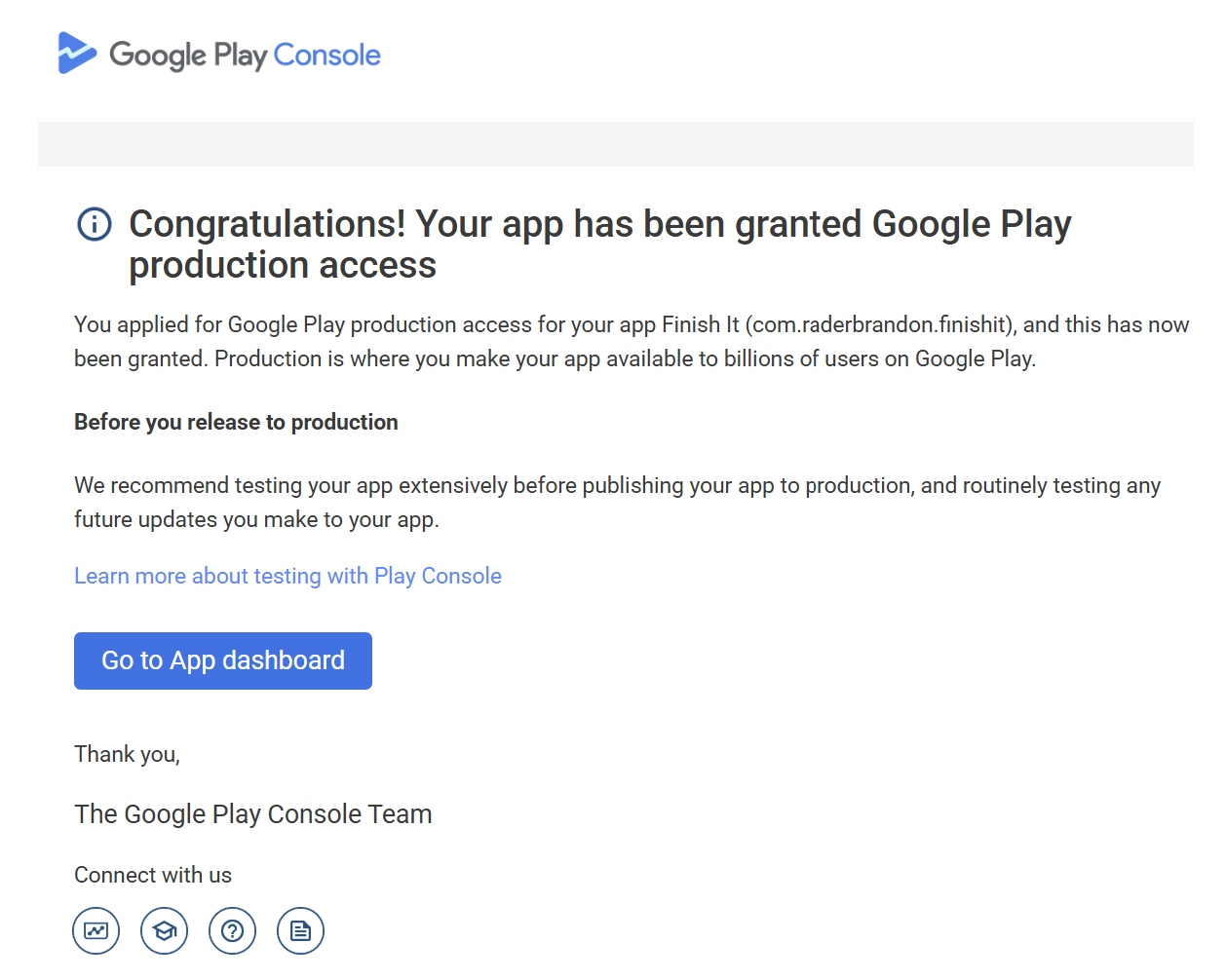
Quality QA Testing Reports
Clear, actionable reports with screenshots and evidence for every important issue found during testing.
Real Device Testing & Diagnostics
Real human testers use physical Android devices to test your app, verify real user flows, and provide clear testing evidence and professional QA reports.
Compliance Audit Passed
Get your Android build approved on the first try. We create an audit-ready compliance profile that proves thorough quality assurance.
Affordable Compliance Cycles
Transparent plans built to satisfy Google Play Console guidelines for your Android build.
Loading Packages
Please wait while we fetch the best options for your region...
Frequently Asked Questions
Everything you need to know about passing your closed testing requirements.