12 Play Console app testers for Android app testing in Kuwait
Hire 12 Play Console app testers in Kuwait. Pass Google Play closed testing in 14 days with real Android testers and unlock Play Store production access.
Why Google Play Closed Testing Matters for Kuwait Developers
Google introduced the 12 testers for 14 days closed testing policy to eliminate buggy, incomplete, or insecure apps from flooding the Play Store ecosystem. For developers building digital services in Kuwait, this rule requires careful planning. If you are developing Arabic-first interfaces, KNET-enabled payment flows, or geolocation services tuned to local governorates, testing cannot be an afterthought left to synthetic emulators.
+-------------------------------------------------------------------------+
|                  Google Play Closed Testing Workflow                    |
|                                                                         |
|  [ 12+ Opted-in Testers ] ---> [ 14 Consecutive Active Days ]           |
|                                         |                               |
|                                         v                               |
|  [ Real Hardware Telemetry ] + [ Qualitative In-App Feedback ]          |
|                                         |                               |
|                                         v                               |
|               [ Production Access Granted by Google ]                   |
+-------------------------------------------------------------------------+
When you request production track access, human review teams at Google inspect your Play Console dashboard analytics. They check whether your testers actively engaged with your build, reported issues, and remained opted in without dropping off. Meeting these metrics proves your application is stable, responsive, and ready for commercial rollout across Kuwait and the wider MENA region.
The Pitfalls of Friends, Family, and Bot Networks
Many creators initially try to bypass formal testing by asking friends or hiring cheap bot farms found on freelance websites. Both strategies almost always fail Play Store review guidelines.
Friends and family usually have good intentions, but they rarely treat testing like a technical job. They might install your APK or bundle on day one, open it for ten seconds, and never launch it again. When Google checks your retention curve and discovers that zero sessions occurred between day 4 and day 14, your request for production access gets denied. You then have to restart the 14-day clock from scratch.
Bot Farms and Synthetic Clicks
- Automated scripts pinging cloud emulators with identical device fingerprints.
- Zero realistic user journeys, no deep feature navigation, and zero crash logs generated.
- High risk of permanent Play Console account flagging for fraudulent engagement.
- Leaves hidden Arabic RTL rendering bugs, KNET webview errors, and layout breaks undiscovered.
Real Managed Human Testing
- Real human testers using genuine Android phones across multiple OS versions and screen sizes.
- Daily organic sessions with deep user interactions, screen navigation, and form inputs.
- Meaningful qualitative bug reports, crash reporting, and Play Console feedback submissions.
- 100% compliant telemetry that passes Google automated flags and manual production reviews.
Relying on click farms or automated bot installations carries even steeper consequences. Google Play Console algorithms easily detect cloud emulators sharing identical IP subnets, unnatural session intervals, and missing device sensor data. Accounts caught using bot networks face immediate rejection or permanent suspension. Genuine human testing remains the only safe path to production.
Comparing Your Testing Options for the Kuwait Market
Selecting the right testing approach depends on your deadline, budget, and development capacity. Below is an objective comparison showing how managed testing compares against DIY outreach and automated bot shortcuts.
| Testing Strategy | Real Hardware in Use | 14-Day Continuous Retention | In-App Arabic & RTL Testing | Play Console Policy Compliance | Risk of Account Rejection |
|---|---|---|---|---|---|
| Managed Testing Service | Guaranteed 100% Physical Devices | Verified Daily Active Participation | Yes, Comprehensive UI & Flow Checks | 100% Fully Compliant | Zero / Full Guarantee |
| DIY Friends & Peer Swaps | Mixed (Uncontrolled Devices) | Extremely Poor (High Drop-off Rate) | Partial (Unstructured Feedback) | Moderate (Low Activity Risk) | High (Wasted Time & Delays) |
| Cheap Automated Bot Farms | Zero (Virtual Cloud Emulators) | Fake Pings (Detected by Play Console) | No (Automated Scripts Only) | Violates Google Developer Terms | Extreme (Risk of Dev Ban) |
Struggling with the 14-Day Testing Requirement?
Skip the hassle of recruiting unreliable testers. Our professional fleet of real Android devices guarantees Google Play compliance in exactly 14 days. Zero bots. Zero emulators. 100% production approval guarantee.
Technical Nuances for Android Apps in Kuwait
Publishing an Android app tailored for Kuwait requires testing edge cases that generic global testing might miss. When preparing your release candidate, your testing team must validate critical regional components before submitting for production access.
1. Right-to-Left (RTL) Layout and Arabic Typography
Arabic user interfaces require comprehensive RTL mirroring across all fragments, view pagers, and custom views. Inverted padding, truncated Arabic fonts, and misaligned iconography frequently break user experience if not tested across varying screen aspect ratios. Real testers check that text expands gracefully and that bidirectional text strings (such as mixed English product codes and Arabic descriptions) render cleanly.
<!-- Ensure your AndroidManifest.xml supports RTL layouts properly -->
<application
    android:allowBackup="true"
    android:icon="@mipmap/ic_launcher"
    android:label="@string/app_name"
    android:roundIcon="@mipmap/ic_launcher_round"
    android:supportsRtl="true"
    android:theme="@style/Theme.KuwaitApp">
    <!-- Activity definitions -->
</application>
2. Payment Gateway WebViews and KNET Integration
Most commercial and service applications in Kuwait rely on payment gateways connecting to KNET or credit card payment processors. WebViews handling 3D-Secure redirects, OTP SMS autofill permissions, and timeout handling must be tested on real devices under different mobile network conditions (Ooredoo, STC, Zain Kuwait) to prevent cart abandonment and transaction failures.
3. Geolocation and Address Parsing
Unlike standard street-and-number addresses, Kuwait navigation often relies on Block, Street, Avenue, and Building hierarchies. Real testers interact with location pickers, Google Maps API integrations, and geofencing to ensure address forms capture accurate coordinates without crashing the checkout pipeline.
Complete Pre-Launch Checklist for Play Console Compliance
Before you invite your 12 testers to join your closed testing track, verify that your Play Console setup and release bundle adhere to Google requirements.
Google Play Console Setup
Build Quality and Regional Readiness
Step-by-Step Roadmap to Production Access
Navigating the 14-day closed testing journey is simple when you follow a structured, predictable roadmap. Here is how our managed testing process takes your app from closed test to approved production status.
Track Configuration and Invite Distribution
You provide your closed testing Google Group or opt-in web link. We assign a dedicated cohort of 12 or more verified testers equipped with active physical Android devices.
Installation and Baseline Verification
Every assigned tester accepts the invitation on Google Play, downloads the release build, and performs an initial exploratory session to generate baseline install telemetry.
Continuous 14-Day Active Engagement
Testers open and interact with your app daily across two full weeks. They navigate core screens, test local features, trigger user flows, and ensure your daily active user retention remains steady.
Qualitative Feedback and Bug Reporting
Testers submit structured feedback through Google Play private developer channels and report crashes, layout anomalies, or payment friction directly to you.
Production Track Application Submission
After day 14, you submit your production access application in Play Console. We provide detailed answers and summaries of tester engagement to help you pass Google review on your first attempt.
Best Practices for Answering Google Production Access Questions
Once your 14 continuous days conclude, the Google Play Console unlocks the Apply for Production questionnaire. This form is evaluated by human reviewers at Google, and your answers decide whether you get approved.
Focus on three key areas when completing the questionnaire:
- How you recruited your testers: State clearly that you engaged a dedicated cohort of real users and professional testers who evaluated your build on physical devices. Avoid vague statements like "I shared the link on social media."
- Summary of feedback received: Provide genuine examples of issues reported during the 14-day cycle (such as fixing a minor Arabic text clipping bug, adjusting button padding on small screens, or optimizing network timeout handling). Reviewers look for evidence that testing resulted in meaningful code improvements.
- Target audience and readiness: Describe your app value proposition for users in Kuwait, how you tested security and data protection, and why your team is prepared to maintain ongoing updates.
Frequently Asked Questions
Why does Google require 12 testers for 14 continuous days for personal accounts?
Google introduced this requirement in late 2023 for all newly registered personal developer accounts. The goal is to ensure that indie creators and small studios thoroughly test their applications for stability, user privacy, and policy compliance on real devices before making them publicly available to millions of users on the Play Store.
Can testers be located outside of Kuwait if my app is aimed at the Kuwait market?
Yes, Google does not restrict closed testers to a single country unless you explicitly restrict your closed track country availability in Play Console settings. However, ensure that your track includes the countries where your testers reside so they can download the app from Google Play without geo-restriction errors.
What happens if a tester uninstalls the app during the 14-day period?
If your active tester count drops below 12 opted-in participants, Google testing counter may pause or reset. Working with a professional managed testing service ensures you have buffer testers (typically 15 to 20 testers) so you always maintain the required threshold throughout the entire 14-day window.
Do your testers provide feedback in Arabic as well as English?
Yes, our testing cohorts can evaluate your application in both Arabic and English. They check localization, right-to-left layout alignment, local number formatting, and regional payment integrations to ensure full compatibility for Kuwait users.
Can I release updates or bug fixes while the 14-day testing is running?
Absolutely. Pushing new updates to your closed testing track during the 14-day period is actually encouraged by Google. It demonstrates active developer maintenance and shows that you are actively resolving bugs discovered by your testers.
What is your guarantee if Google rejects my initial production access application?
If Google asks for additional testing days or clarification after your first submission, our managed testing team continues testing your build without additional fees until your production access is successfully approved.
The Testing Pipeline
A straightforward 4-step process to get your Android app approved.
Sign In
Connect your Google account and choose your preferred closed testing package for your Android app.
Opt-In URL
Share your Play Store opt-in URL. We immediately deploy 12 real testers to launch and review your Android app daily.
Testing Begins
Our crew initiates daily launch sessions on physical devices, verifying usability and logging crashes for your Android app.
Compliance Complete
We continuously perform closed app testing for 14 days to help you meet Google Play production requirements. We also provide a compliance report.
Why Developers Trust Us
Deploy your Android app onto real retail-grade handsets using our secure laboratory environment.
The 14-Day Production Guarantee
We complete the required 14-day closed testing process with real human testers and physical Android devices, while providing clear testing evidence and documentation throughout the process.
If Google specifically rejects production access due to insufficient testing engagement, you are covered by our free re-run or 100% refund guarantee, subject to our Refund Policy.
Verified Production Access
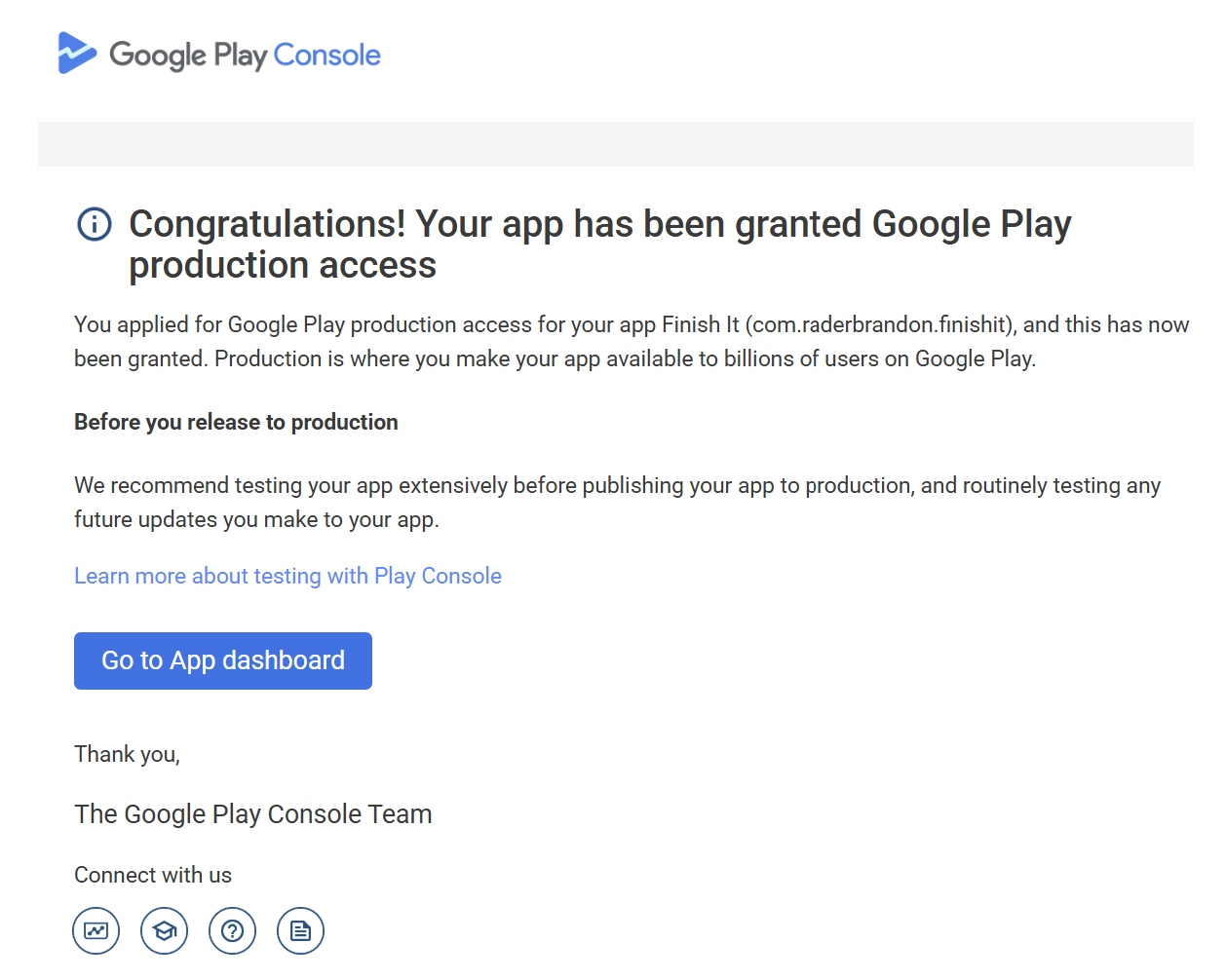
Quality QA Testing Reports
Clear, actionable reports with screenshots and evidence for every important issue found during testing.
Real Device Testing & Diagnostics
Real human testers use physical Android devices to test your app, verify real user flows, and provide clear testing evidence and professional QA reports.
Guaranteed App Approval
Transition your Android app to public production access with confidence. We deliver verified session logs and compliant Console activity.
One Cycle. Complete Approval.
Choose the ideal closed testing cycle for your Android release.
Loading Packages
Please wait while we fetch the best options for your region...
Frequently Asked Questions
Everything you need to know about passing your closed testing requirements.