12 Play Console app testers for Android app testing in Luxembourg
Hire 12 Play Console app testers in Luxembourg. Pass Google Play closed testing in 14 days with real Android testers and unlock Play Store production access.
Understanding Google's 12 Testers for 14 Days Rule in Luxembourg
Google established the closed testing requirement to eliminate low-effort, buggy apps and ensure that new software functions reliably under authentic conditions. For developers deploying software targeted at Luxembourg, the review process focuses strictly on user retention, crash frequency, and telemetry continuity. It is not enough to have 12 contacts download your APK or AAB bundle and ignore it for two weeks.
Genuine Managed Testing Track
Real human users install your application via Google Play Store invite links on physical Android hardware across diverse OEM brands.
Testers explore UI workflows, interact with localized features, and generate organic log traces across consecutive daily sessions.
Constructive feedback and crash diagnostics get filed directly through Google Play closed testing feedback channels.
Low-Quality Bot & Farm Risks
Automated scripts or cloud emulators download the package once and remain dormant throughout the testing window.
Google Play Console detects identical device fingerprints, unnatural session durations, and suspicious IP clustering.
Production review requests are denied outright, forcing the developer to reset the entire 14-day testing timeline.
When your testing pool reflects real human activity, Google Play Console records legitimate metric telemetry. Evaluators inspect these logs when you submit your production access questionnaire, evaluating your bug triage cadence and tester engagement before granting public store visibility.
Navigating Closed Testing Challenges in the Luxembourg Market
Developing software for Luxembourg presents distinct technical nuances that require thorough verification during the closed testing period. With a multilingual user base navigating French, German, Luxembourgish, and English interfaces, your Android build must handle dynamic locale switching, right-to-left layout adjustments, and localized formatting without interface clipping or runtime exceptions.
Furthermore, applications integrating European payment rails, PSD2 banking APIs, or regional authentication standards demand verified device testing across multiple Android API levels. If testers drop off because of recurring launch crashes or unhandled network state transitions on local cellular carriers, your 14-day continuous retention counter can stall, delaying your launch roadmaps.
| Testing Dimension | Managed Professional Testers | DIY Friends & Family | Automated Bot Networks |
|---|---|---|---|
| Hardware Diversity | Real physical phones (Samsung, Pixel, Xiaomi, OnePlus) | Limited to personal circles and 2 to 3 phone models | Virtual machines, rooted emulators, cloud headless devices |
| 14-Day Retention | 100% guaranteed continuous opt-in with spare backup devices | High tester fatigue, forgotten installs, and early dropouts | Flagged immediately by Google Play telemetry algorithms |
| Feedback Quality | Detailed bug logs, UX insights, device specs, edge-case triage | Casual, vague, one-word notes or non-existent comments | Synthetic, repetitive comments triggering spam filters |
| Review Approval Rate | Exceptionally high first-attempt production approval rate | Moderate with frequent 14-day timeline restarts | Near total rejection, account strikes, and policy flags |
| Setup Speed | Immediate deployment within 24 hours of build upload | Days spent chasing friends and coordinating email invites | Instant setup but creates fatal compliance risk |
| Telemetry Health | Organic session curves, genuine touch events, low ANRs | Irregular spikes followed by long stretches of zero activity | Static zero-runtime installs with no foreground interaction |
Struggling with the 14-Day Testing Requirement?
Skip the hassle of recruiting unreliable testers. Our professional fleet of real Android devices guarantees Google Play compliance in exactly 14 days. Zero bots. Zero emulators. 100% production approval guarantee.
Technical Play Console Telemetry Google Monitors
Google's automated review system tracks granular telemetry inside your Google Play Console dashboard. Knowing what these background systems measure allows you to prepare your build for deep scrutiny:
- Daily Active Devices on Track: The algorithm verifies that the minimum number of opt-in devices remains enrolled and active throughout the unbroken 14-day window. If the active device count drops below 12 for even a single 24-hour cycle, your 14-day retention counter will automatically pause or reset to day zero.
- Android Vitals Core Thresholds: Your application must maintain a user-perceived crash rate strictly below 1.09% and a user-perceived ANR (Application Not Responding) rate below 0.47% across all testing devices. Exceeding these bad behavior thresholds during closed testing directly signals to Google's automated reviewers that your software is unstable.
- Session Length, Foreground Runtimes, and Input Events: Telemetry monitors screen navigation depth, input events, and foreground runtimes to distinguish real humans from mock device hooks. Real users open apps at varying times of day, pause to read text, navigate between fragments, and trigger realistic network requests rather than static background pings.
- Console Feedback Submissions and Bug Logging: Testers providing private feedback via the Play Store test URL indicate active user-developer dialogue. Google's human evaluation team checks whether users reported issues directly through Google Play and whether those reports resulted in developer responses or code revisions.
- App Version Iteration and Patch Cadence: Pushing at least one minor patch or update during the 14-day cycle shows active maintenance and responsiveness to early tester reports. A static build uploaded once and never updated during two weeks of testing raises red flags if testers supposedly found zero flaws.
- Device Hardware Diversity: Google evaluates the variety of system architectures (arm64-v8a, armeabi-v7a), screen resolutions, RAM capacities, and Android OS versions (from Android 11 through Android 15) represented in your tester cohort to verify broad compatibility across the Android ecosystem.
How to Answer Google Play Production Access Questions
Once you reach Day 14 with 12 or more active testers, the "Apply for production" button becomes clickable in your Google Play Console dashboard. Clicking this button opens a mandatory questionnaire where you must provide detailed, written proof of your testing process. Google human reviewers read these answers alongside your telemetry data before deciding whether to unlock your production track. Here is how to structure your answers with concrete, developer-grade detail:
1. How did you recruit your testers?
Avoid generic answers like "I asked my friends and coworkers." Instead, outline a structured testing campaign:
- Specify that you recruited verified Android users with diverse physical hardware running Android 11 through Android 15.
- Mention that you established a dedicated Google Group or email distribution list to manage opt-ins and coordinate testing instructions.
- State that testers were selected based on their familiarity with your app's core domain (such as European cross-border logistics, financial calculators, multilingual productivity tools, or leisure utilities).
2. What feedback did you receive from testers during closed testing?
Google looks for authentic, technical, and usability-focused feedback rather than glowing marketing praise. Provide specific examples:
- Detail user interface feedback regarding layout scaling on smaller screens, font legibility in French and German translations, or dark mode contrast issues.
- Mention feedback concerning navigation flows, such as confusing button placements, onboarding friction, or slow initial asset loading.
- Note any device-specific edge cases reported by testers on specific OEM skins like Samsung One UI, Xiaomi HyperOS, or Google Pixel clean builds.
3. What changes and improvements did you make based on tester feedback?
Demonstrate that you treated your closed testing period as an active engineering sprint:
- Reference specific version updates pushed to the closed testing track during the 14-day window (e.g., "In version 1.0.2, we optimized database queries on the home dashboard to eliminate a 200ms frame drop during scrolling").
- Explain how you resolved any caught exceptions or edge-case network timeouts identified in Firebase Crashlytics or Google Play Vitals.
- Describe UI tweaks implemented to fix string truncation for long German compound words and dynamic text scaling on high-density displays.
4. Why is your app ready for production release?
Summarize your stability metrics and operational readiness:
- Highlight that your Android Vitals remained well within Google's acceptable thresholds, with a user-perceived crash rate of 0.0% and zero ANRs recorded across all tester devices.
- Confirm that all core user flows, data persistence layers, payment integrations, and offline fallback states have been verified on physical hardware.
- Reiterate that you have a comprehensive customer support channel and crash-monitoring infrastructure ready to support production users from day one.
Step-by-Step Production Readiness Checklist
Before you initiate your closed testing track and invite your 12 testers, execute this comprehensive pre-launch checklist to secure your codebase and Google Play Console configuration.
Play Console Configuration
Build Stability & SDK Verification
Tester Engagement Protocol
Your Path from Closed Testing to Production Release
Securing full production rights on Google Play requires following a systematic process that aligns with Google's quality requirements.
Track Setup and Build Upload
Upload your signed Android App Bundle (AAB) to the Closed Testing track. Set up your tester list with verified Google accounts and submit the build for standard pre-test Google approval.
Tester Opt-in and Deployment
Distribute the opt-in URL to your 12+ real human testers. Verify that each participant accepts the invite, downloads the build, and opens the application on their personal Android handset.
14-Day Active Engagement Cycle
Maintain continuous daily interaction across the testing group. Monitor Google Play Android Vitals for unexpected crashes, and push iterative improvements if stability issues arise.
Quality Auditing & Questionnaire Prep
Document the testing feedback received, issues fixed, and feature improvements executed during the 14 days. Prepare concise, technical answers for the Play Console production questionnaire.
Production Access Submission
Submit your formal application for production access. Google reviewers evaluate your engagement metrics, vital stability, and questionnaire responses before granting full public store publication.
Frequently Asked Questions
Why does Google Play require 12 testers for 14 days for Luxembourg developers?
Google introduced this rule for personal developer accounts created after November 13, 2023, to ensure new apps meet basic stability, safety, and quality benchmarks before reaching general audiences. For developers targeting Luxembourg or international markets, this policy guarantees that software handles real-world usage patterns, multiple device configurations, and dynamic network environments without severe crashes or broken user flows. Google wants proof that your app has been battle-tested on real hardware by actual humans before allowing public distribution on the Play Store.
Can I use emulators or cloud testing devices to complete the 14 days?
No, relying on emulators, virtual devices, or automated bot farms will almost certainly result in a rejected production application. Google Play Console tracks hardware telemetry, sensor outputs, battery states, GPU render profiles, and unique device fingerprints. When an account exhibits automated or synthetic usage patterns, Google resets the testing counter or denies production privileges outright, forcing you to start over with genuine human testers.
What happens if a tester uninstalls the app during the 14-day testing window?
If an enrolled tester uninstalls the app or leaves the testing group, your active device count can fall below the mandatory threshold of 12. If the active count drops, Google Play will pause or reset your 14-day timeline. It is best practice to enroll 15 to 20 testers so that you maintain a comfortable buffer above the minimum 12-tester requirement throughout the entire duration, protecting your schedule from accidental uninstalls or device switches.
Do all testers need to be physically located inside Luxembourg?
Not necessarily, unless your app is strictly geo-restricted to Luxembourg on Google Play. If your closed testing track is configured for global or multi-regional access, testers from other European or international territories can participate. However, ensure that your localized features (such as currency displays, language strings for French, German, and Luxembourgish, and regional regulatory checks) are thoroughly vetted during the cycle.
Can I push build updates during the active 14-day closed testing period?
Yes, pushing app updates to your closed testing track is fully supported and recommended. Uploading new versions to fix bugs reported by your testers demonstrates active development and responsiveness. Your 14-day testing clock continues uninterrupted as long as testers continue updating and using the build. In fact, having at least one build update during the 14-day window provides concrete evidence of bug fixing for your production questionnaire.
What questions does Google ask when applying for production access?
After completing the 14 continuous days with 12 active testers, you must answer a detailed questionnaire in Google Play Console. Google asks how you recruited your testers, what feedback you received during testing, what bugs or crashes were identified, how you improved the app based on tester input, and why you believe the app is ready for production. Providing specific, technical feedback records and referencing iterative app updates ensures a smooth approval without delays.
Our QA Process
A straightforward 4-step process to get your Android app approved.
Choose Package
Connect your Google account and choose your preferred closed testing package for your Android app.
Submit Link
Share your Play Store opt-in URL. We immediately deploy 12 real testers to launch and review your Android app daily.
Active Testing
Our crew initiates daily launch sessions on physical devices, verifying usability and logging crashes for your Android app.
Get Approved
We continuously perform closed app testing for 14 days to help you meet Google Play production requirements. We also provide a compliance report.
The Premium QA Advantage
Deploy your Android app onto real retail-grade handsets using our secure laboratory environment.
The 14-Day Production Guarantee
We complete the required 14-day closed testing process with real human testers and physical Android devices, while providing clear testing evidence and documentation throughout the process.
If Google specifically rejects production access due to insufficient testing engagement, you are covered by our free re-run or 100% refund guarantee, subject to our Refund Policy.
Verified Production Access
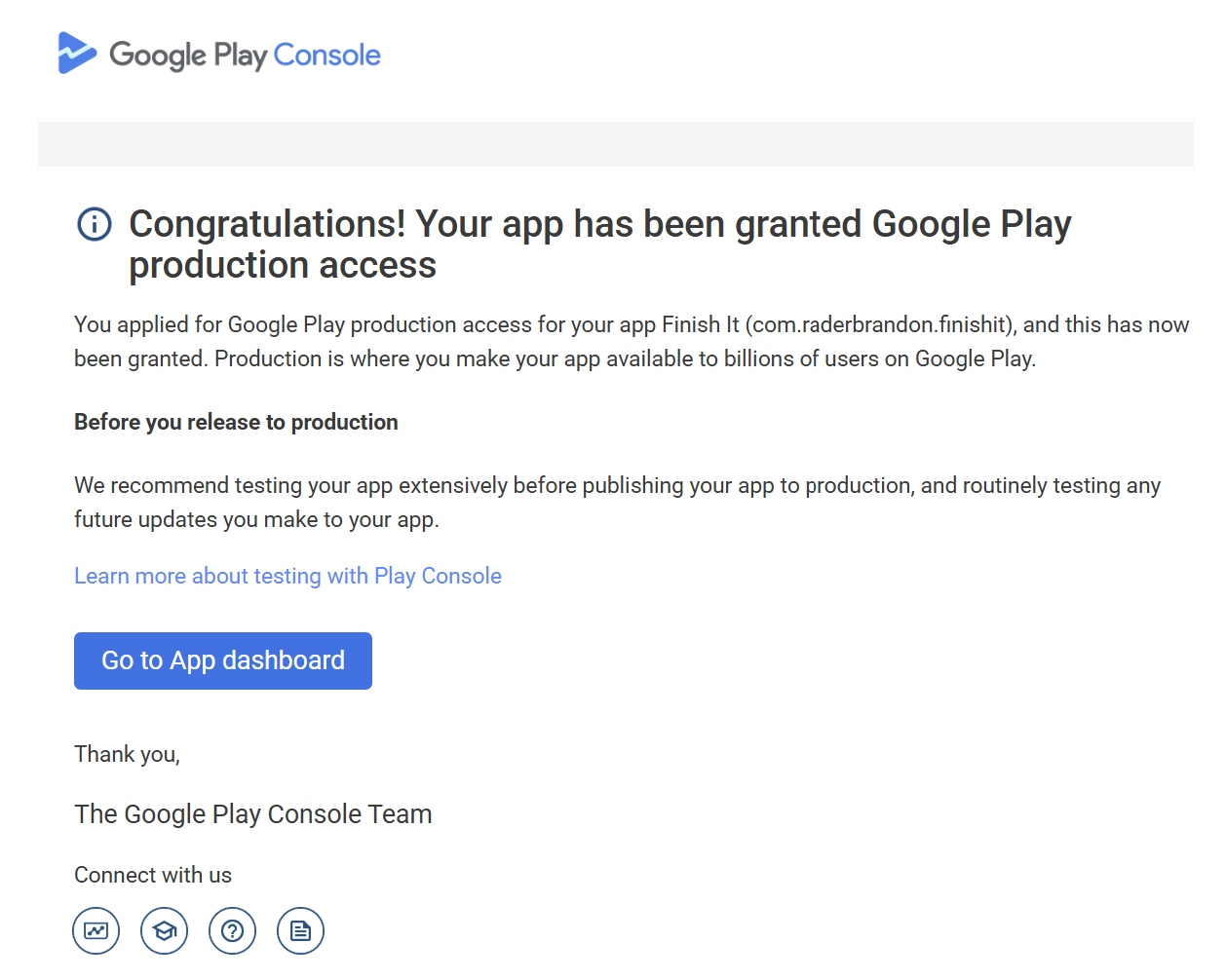
Quality QA Testing Reports
Clear, actionable reports with screenshots and evidence for every important issue found during testing.
Real Device Testing & Diagnostics
Real human testers use physical Android devices to test your app, verify real user flows, and provide clear testing evidence and professional QA reports.
Production Access Secured
Transition your Android app to public production access with confidence. We deliver verified session logs and compliant Console activity.
One Cycle. Complete Approval.
Choose the ideal closed testing cycle for your Android release.
Loading Packages
Please wait while we fetch the best options for your region...
Frequently Asked Questions
Everything you need to know about passing your closed testing requirements.