12 Play Console app testers for Android app testing in Mongolia
Hire 12 Play Console app testers in Mongolia. Pass Google Play closed testing in 14 days with real Android testers and unlock Play Store production access.
Understanding the 12 Testers for 14 Days Closed Testing Rule
Google requires all individual developer accounts created after November 13, 2023, to complete a mandatory closed testing phase before applying for public production access. To publish your app to the Google Play Store, you must recruit at least 12 opted-in testers who maintain continuous engagement with your build for a minimum of 14 consecutive days. This rule protects users from buggy or unstable software by ensuring new apps undergo thorough quality assurance on real devices.
Passing this requirement involves more than collecting email addresses on an invite list. Google Play Console monitors backend telemetry to verify that real users download your Android App Bundle (AAB), open screens on multiple days, interact with features, and keep the build installed throughout the full two-week period. If engagement drops or testers uninstall early, your 14-day timer can pause or reset, and your production application may be denied.
Real Human Testing vs. Automated Bots and Emulator Rings
When faced with tight release schedules, some developers consider shortcuts like purchasing fake installs from internet forums, deploying automated bot rings, or running scripts across rooted Android emulators. While these shortcuts might inflate raw numbers, Google Play Protect and Console analytics identify automated traffic patterns easily. Using emulator farms or synthetic clicks puts your developer standing at severe risk, often leading to immediate review rejections, permanent account closures, and device bans.
Real Human Testers (ACL Guaranteed)
- Authentic Smartphone Hardware: Physical devices from Samsung, Xiaomi, Redmi, Realme, POCO, and Google Pixel running Android versions 10 through 15.
- Natural User Telemetry: Genuine touch gestures, organic session lengths, varied screen navigation paths, and authentic background lifecycle events.
- Verified Play Console Analytics: Authentic install logs, valid Play Store opt-in tokens, and legitimate Android Vitals stability metrics.
- Actionable Feedback & Logs: Detailed UI notes, reproducible crash stack traces, and complete data for your production access questionnaire.
Bot Networks & Scripted Emulators
- Virtual Machines & Cloned Emulators: Reused virtual IMEI signatures and rooted environments that trigger immediate Play Protect security flags.
- Synthetic Click Scripts: Repetitive, robotic interaction routines with zero device accelerometer motion or natural finger pauses.
- High Account Suspension Risk: 14-day timer resets, denied production access requests, and permanent developer account terminations.
- Zero Helpful QA Insights: No genuine usability feedback, missing crash logs, and undetected memory leaks on real mobile hardware.
Mobile Market Dynamics and Testing Realities in Mongolia
Mongolia has built a vibrant, fast-growing digital economy anchored by a young, mobile-first population and active tech hubs across Ulaanbaatar. From cutting-edge fintech apps, digital wallets, and mobile banking services to e-commerce, on-demand logistics, and nomadic lifestyle utilities, mobile software powers daily life across the country. However, software engineers and startup founders in Mongolia face specific technical and operational challenges when running Google Play closed testing tracks independently:
- Wide Hardware Fragmentation Across the Country: While tech workers and business professionals in Ulaanbaatar often use the latest flagship smartphones from Apple and Samsung, millions of mobile users across Mongolia rely on a broad spectrum of Android devices. Mid-range and entry-level phones from Xiaomi, Redmi, Realme, Honor, Huawei, and budget Samsung Galaxy A-series models dominate the market. Testing your build solely among colleagues, personal friends, or family members usually limits your test pool to a few high-end phones. This approach leaves critical memory leaks, GPU rendering glitches, and CPU thermal throttling unaddressed on budget hardware.
- Variable Network Infrastructure and Handoffs: Mobile connectivity in Mongolia relies heavily on leading telecom providers such as Unitel, Mobicom, G-Mobile, and Skytel across 4G LTE, expanding 5G zones in urban districts, and high-latency satellite or regional 3G connections across rural aimags. Real Android app testing must evaluate how your app behaves during sudden network drops, offline caching routines, socket reconnections, and high-latency API responses. Bot farms and emulators run over stable server connections and will never uncover real-world network failure states.
- Tester Fatigue and High Drop-off Rates: Gathering 12 willing friends or local acquaintances to install a closed test build is relatively simple on Day 1. However, keeping those same individuals engaged every day for 14 straight days is notoriously difficult. Without structured coordination, casual testers routinely forget to open the app, mute testing notifications, or clear device storage by deleting unfamiliar apps. As soon as your opted-in tester count drops below 12, Google Play Console pauses your testing clock, turning a 14-day requirement into a multi-month struggle.
- Cultural and Language Customization (Cyrillic Script): Mongolian apps frequently feature Mongolian Cyrillic alongside English or traditional Mongolian script. Testing on real devices ensures that dynamic font rendering, custom typography layouts, bidirectional text wrapping, and input method editor (IME) keyboards function seamlessly across diverse screen aspect ratios and density buckets (hdpi, xhdpi, xxhdpi, xxxhdpi).
Strategic Comparison: Testing Options for Mongolian Developers
Selecting the right testing approach early saves valuable engineering hours and protects your developer account reputation. Below is a comprehensive comparison of professional managed testing, DIY peer exchanges, and automated bot networks:
| Feature | Managed Testing (ACL) | DIY Peer Swapping | Bot / Emulator Networks |
|---|---|---|---|
| Physical Hardware | 100% Real Android Smartphones | Inconsistent, limited devices | Virtual Machines / Rooted Emulators |
| 14-Day Continuous Retention | Guaranteed daily engagement buffer | High drop-off after 2 to 3 days | Synthetic, flagged by algorithms |
| Google Play Compliance | Fully compliant with Play rules | Compliant only if peers stay active | Severe risk of permanent ban |
| Bug Reports & Feedback | Structured logs and UX insights | Superficial or missing comments | Automated strings or empty logs |
| Production Access Approval | High first-attempt pass rate | Frequently rejected or reset | Immediate rejection or account flag |
| Developer Effort | Zero hassle, fully managed setup | 25+ hours chasing participants | Quick setup, disastrous outcome |
| Device Diversity | Multiple brands, chipsets & OS levels | Homogeneous personal devices | Cloned emulator instances |
| Questionnaire Support | Comprehensive response guidance | Guesswork and uncertain data | Fabricated details that fail review |
Struggling with the 14-Day Testing Requirement?
Skip the hassle of recruiting unreliable testers. Our professional fleet of real Android devices guarantees Google Play compliance in exactly 14 days. Zero bots. Zero emulators. 100% production approval guarantee.
Complete Pre-Launch Checklist for Play Console Compliance
Before uploading your release build to the closed testing track and inviting your 12 testers, ensure your application package, backend infrastructure, and Play Console listing meet all required developer policies. Overlooking fundamental technical standards can lead to automated rejections or lengthy review delays.
1. Technical Architecture & Build Configuration
Adopt Android App Bundle (AAB): Build and export an optimized release .aab package instead of an old .apk file to take advantage of Google Play Dynamic Delivery and reduced binary download footprints.
Comply with Target API Mandates: Verify that your targetSdkVersion in build.gradle targets the latest Google Play requirement (Android 14 / API level 34 or higher) so your app supports modern permission models and system security features.
Optimize R8 and ProGuard Rules: Test release builds with minification and obfuscation enabled to ensure that essential data serialization models, reflection libraries, and third-party SDK entry points are not stripped during compilation.
Integrate Real-Time Diagnostic SDKs: Implement Firebase Crashlytics, Sentry, or Bugsnag to log unhandled runtime exceptions, ANR events, and background thread crashes during the 14-day test cycle.
Configure Network Security Config: Ensure your network security configuration strictly enforces secure HTTPS endpoints with proper TLS certificate pinning and cleartext traffic disabled.
2. Store Listing, Data Safety & Compliance Declarations
Host a Dedicated Privacy Policy: Publish a live, publicly accessible HTTPS privacy policy URL explaining what user data is collected, how it is processed, and third-party SDK sharing practices.
Complete the Data Safety Section Accurately: Disclose all data types gathered or shared by your application, including device identifiers, coarse/fine location, financial data, and crash logs.
Provide Functional Demo Credentials: If your app contains login screens, SMS OTP verifications, or subscription paywalls, configure working test credentials in the Play Console App Access section so reviewers can inspect all features.
Prepare Localized Store Metadata: Upload high-resolution graphic assets, including a 512x512 app icon, a 1024x500 feature graphic, and clean device screenshots highlighting key app capabilities.
Declare Target Audience and Content Ratings: Complete the Google Play Content Rating questionnaire and target age declaration accurately to prevent policy flags related to child protection policies.
The 5-Step Roadmap from Closed Testing to Production Release
Securing production access in Google Play Console requires a systematic, disciplined approach through each testing phase. Follow this detailed 5-step roadmap to move your Android project smoothly from initial closed track setup to public release:
Step 1: Configure Closed Testing Track & Google Group
Open your Google Play Console dashboard and navigate to the Closed Testing section under Release management. Create a new closed testing track and associate it with a dedicated Google Group containing your testers' email addresses. Define a clear feedback channel, such as an in-app feedback dialog, support email address, or issue tracker URL.
Step 2: Sign and Upload AAB Build to Closed Track
Sign your release Android App Bundle using your production upload keystore or Google Play App Signing. Upload the bundle to your closed track and submit it for Google review. Carefully analyze the automated Pre-Launch Report generated by Firebase Test Lab Robo test runs to resolve startup crashes, security vulnerabilities, or layout overflows across test devices before user distribution.
Step 3: Distribute Opt-In Links & Verify Installations
Once Google approves the closed test release, share the official opt-in URL (either web-based or Android Play Store direct link) with your 12+ real testers. Ensure every tester opts into the testing program through their Google account and downloads the app directly from the Play Store onto their physical Android smartphone.
Step 4: Execute 14-Day Continuous Human Testing
Maintain consistent daily app engagement across the full 14-day window. Testers open the app, navigate different workflows, input test data, test offline behaviors, and report bugs. Developers monitor Android Vitals in Play Console, ensuring that user-perceived crash rates stay below the 1.09% threshold and user-perceived ANR rates remain well below 0.47%.
Step 5: Complete Production Access Questionnaire
After completing 14 full days with at least 12 continuously active testers, the 'Apply for Production' button activates in your Play Console dashboard. Complete Google's mandatory questionnaire with honest, thorough details regarding your tester recruitment strategy, user feedback, and iterative bug fixes to secure your public production release approval.
How to Answer Google Play's Production Access Questionnaire
After finishing your 14-day closed testing period with 12 active participants, you must submit detailed answers to Google's production access evaluation form. Human reviewers at Google evaluate these answers alongside your app's telemetry logs to determine whether your application is ready for production. Here is how to structure each response effectively:
1. How did you recruit your testers?
Provide a clear, authentic description of your tester recruitment strategy. State that you enlisted a dedicated, diverse group of real Android device testers spanning various smartphone manufacturers (such as Samsung, Xiaomi, Redmi, Realme, POCO, and Google Pixel) and multiple Android OS versions (Android 10 to Android 15). Explain that your testers represent your target user demographic and tested your app in realistic hardware, battery, and network environments. Avoid generic statements and emphasize that all testing occurred on physical consumer devices.
2. What feedback did you receive from your testers during closed testing?
Never write that testers found no bugs or that everything worked perfectly on the first try. Real human testing always reveals edge cases. Share specific, credible feedback collected during the test cycle. For instance, mention tester suggestions regarding UI readability on small screens, layout alignment adjustments for Mongolian Cyrillic text strings, button touch target sizing on compact displays, or network timeout alerts during weak cellular connections. Demonstrating that testers provided constructive feedback proves genuine human participation.
3. What changes and improvements did you make to your app based on tester feedback?
Detail the exact technical updates, performance optimizations, and code fixes deployed to your closed track during testing. Mention how you pushed updated builds (for example, rolling out version codes 1.0.1 through 1.0.4) to address reported layout cutoffs, optimize database queries for smoother list scrolling, handle background lifecycle transitions cleanly, or refine error handling when API calls fail. Listing specific version updates and technical resolutions demonstrates proactive developer maintenance.
Frequently Asked Questions (FAQs)
Why does Google Play enforce the 12 testers for 14 days closed testing requirement?
Google established this mandatory policy for all personal developer accounts registered after November 13, 2023. The goal is to elevate app quality across the Play Store by requiring individual developers and small software teams to rigorously test their apps on physical devices before publishing publicly. This ensures that crashes, memory leaks, and policy violations are caught early, protecting general consumers from broken or insecure applications.
Can developers in Mongolia use emulators or automated testing scripts to fulfill this rule?
No. Google Play Console uses advanced telemetry to analyze hardware sensor outputs, touch gesture dynamics, battery thermal states, and network packet signatures. Emulators and automated bot scripts lack authentic hardware identities and natural human interaction patterns. Relying on emulators or synthetic bots often results in production access rejection, timer resets, or permanent developer account termination for policy violations.
What happens if a tester uninstalls the app or leaves the closed test before the 14 days end?
If your active opted-in tester count falls below the required 12-tester threshold at any point, Google's automated tracking system may pause or completely reset the 14-day qualification countdown. To eliminate this risk, our managed testing service provides a safety buffer of 15 to 20 real testers. This ensures your active opted-in count remains comfortably above 12 every day, even if an individual device experiences an unexpected issue.
Can I deploy bug fixes and new build versions during the 14-day testing period?
Yes. Publishing new App Bundle versions to your active closed testing track during the 14-day window is not only allowed but strongly encouraged by Google. Releasing incremental updates to address tester feedback demonstrates active development and responsive maintenance. When filling out the production access questionnaire, you can cite these version releases as concrete evidence of iterative quality improvement.
How does ACL ensure my Android app achieves production approval on the first attempt?
ACL provides a dedicated team of verified human testers using physical Android smartphones spanning diverse manufacturers, screen sizes, and Android OS versions. Our testers install your build via official Google Play opt-in links, interact with your app daily, and submit structured feedback. Furthermore, we provide you with comprehensive guidance and documentation to help you answer Google Play's production access questionnaire with complete confidence.
Is this testing service accessible for software developers based across Mongolia?
Yes. Our testing service fully supports developers, indie creators, and tech agencies located anywhere in Mongolia, including Ulaanbaatar, Erdenet, Darkhan, and regional tech centers. All you need to do is add our tester group email to your Google Play Console closed testing track, share your opt-in link, and our managed testing team handles the complete 14-day verification process from start to finish.
Our QA Process
Your journey to Google Play production access, simplified and automated.
Choose Package
Authenticate your account to initialize the 14-day QA fleet for your Android release.
Submit Link
Upload your testing link. We assign 12 verified users with real Android devices to download and test your Android release.
Active Testing
A dedicated testing supervisor is assigned to monitor progress while testers engage with your Android app and provide feedback throughout the testing period.
Get Approved
Our lab maintains active installations for two weeks straight, ensuring a clean track record and providing a QA compliance log for your release.
The Premium QA Advantage
Satisfy your Play Store Console testing obligations with our managed physical device fleet tailored for Android builds.
The 14-Day Production Guarantee
We complete the required 14-day closed testing process with real human testers and physical Android devices, while providing clear testing evidence and documentation throughout the process.
If Google specifically rejects production access due to insufficient testing engagement, you are covered by our free re-run or 100% refund guarantee, subject to our Refund Policy.
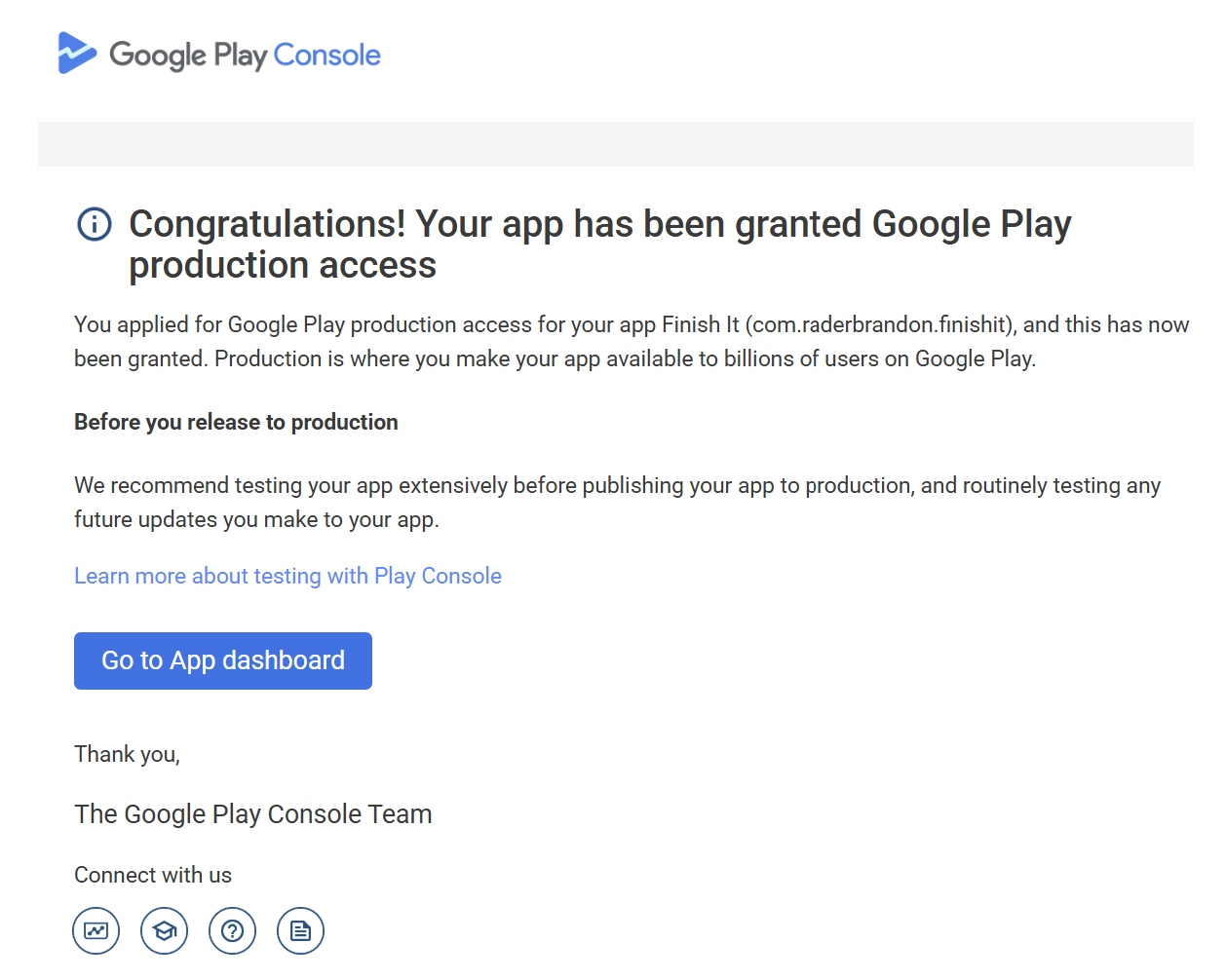
Verified Production Access
Quality QA Testing Reports
Clear, actionable reports with screenshots and evidence for every important issue found during testing.
Real Device Testing & Diagnostics
Real human testers use physical Android devices to test your app, verify real user flows, and provide clear testing evidence and professional QA reports.
Production Access Secured
Our structured 14-day closed testing process is designed to meet Google Play's production requirements for your Android release.
Simple Closed Testing Pricing
Select the plan that fits your Android app complexity.
Loading Packages
Please wait while we fetch the best options for your region...
Frequently Asked Questions
Everything you need to know about passing your closed testing requirements.