12 Play Console app testers for Android app testing in Nepal
Hire 12 Play Console app testers in Nepal. Pass Google Play closed testing in 14 days with real Android testers and unlock Play Store production access.
The Realities of Google Play Closed Testing in Nepal
Google Play Closed Testing is designed to guarantee stability, security, and real engagement before any mobile app gains public visibility. For developers in Nepal, navigating this testing mandate presents real-world logistical hurdles. Reaching out to friends, family, or social media groups often yields quick uninstalls after day one or two, which immediately interrupts the required 14-day streak in your Google Play Console dashboard. Furthermore, modern Nepali applications frequently integrate specific local services, including eSewa, Khalti, IME Pay, or location tracking across rugged Himalayan topography and variable mobile data networks like Ncell and Nepal Telecom (NTC).
When testers drop out prematurely, Google Play Console pauses the countdown timer, forcing you to recruit replacements and restart the evaluation. Meeting the compliance criteria demands organized tester management, reliable daily app launches, and diverse hardware coverage across different Android versions and device manufacturers common in South Asia, including Xiaomi, Samsung, Vivo, and Realme.
Comparing Managed Human Testing Against Automated Bots
Developers seeking to satisfy the 12 testers for 14 days policy often face a choice between cheap automated testing tools and dedicated human testing services. While bot farms promise fast opt-ins, their automated sessions generate identical device footprints, static IP subnets, and zero meaningful interactions, which triggers immediate red flags in Google automated audit systems.
Authentic Physical Device Testers
Real human testers download your Android app directly from the Google Play Store via private Closed Testing opt-in links. They interact with UI components, trigger genuine touch events, rotate screens, test background services, and simulate natural network shifts between Wi-Fi and 4G data. This generates clean telemetry, organic session durations, and realistic user feedback logs that Google review teams look for when approving production access.
Automated Bots & Emulator Farms
Automated scripts run on emulators inside cloud server farms with virtualized Android IDs and repetitive touch coordinates. They fail to handle SMS OTP verifications for Nepali payment gateways and register abnormal zero-latency responses. Google machine learning models detect these artificial usage patterns, leading to production access rejections, test resets, or permanent developer account terminations under spam and deceptive behavior policies.
Technical Breakdown: Testing Strategies for Nepal Developers
Choosing the right approach to satisfy your Play Store Closed Testing requirements can determine whether your app publishes on schedule or gets delayed for months. The comparison below highlights how different testing strategies perform across critical technical and compliance metrics.
| Evaluation Metric | Professional Managed Testing | Self-Organized Friends & Family | Automated Bot Services |
|---|---|---|---|
| Compliance Certainty | High - 100% verified real physical devices with active daily retention | Low - High drop-off rate and irregular launch habits cause test resets | Zero - Triggers Google algorithmic fraud and spam filters |
| Device Diversity | Broad mix of Android 10 through Android 15 on varied OEM hardware | Limited to whatever phones your personal network owns | Virtualized emulator instances with cloned hardware profiles |
| Network Realism | Real consumer ISP and mobile network data paths (Wi-Fi, 4G, 5G) | Real local connections, but inconsistent usage schedules | Data center IP ranges and proxy pools flagged by Google |
| Feedback Quality | Structured bug reports, UI feedback, and actionable crash data | Vague comments with little to no technical detail | Synthetic or non-existent feedback logs |
| Developer Time Saved | Turnkey management - zero daily monitoring or tester chasing needed | Heavy effort spent reminding people to open the app every day | Fast setup, but results in lost accounts and wasted project weeks |
| Production Approval Rate | Consistently high on the first formal production application | Medium to low due to sporadic usage data in Play Console | Immediate rejection or prolonged manual account audit |
Struggling with the 14-Day Testing Requirement?
Skip the hassle of recruiting unreliable testers. Our professional fleet of real Android devices guarantees Google Play compliance in exactly 14 days. Zero bots. Zero emulators. 100% production approval guarantee.
Comprehensive Pre-Testing Preparation Checklist
Before initiating your Google Play Closed Testing track, you must prepare both your codebase and your Google Play Console configuration. Rushing into the closed track with broken build configurations or missing compliance questionnaires will lead to rejected releases or invalid testing cycles.
Google Play Console & Compliance Setup
Nepali Market & Architecture Readiness
Step-by-Step Roadmap to Production Access
Navigating from an initial development build to an approved public production release requires following a structured, sequential workflow. By maintaining discipline throughout each phase, you ensure that your metrics remain pristine when Google reviews your production application.
Track Configuration & Build Release
Create a Closed Testing track in Google Play Console. Upload your signed Android App Bundle (AAB), define clear release notes explaining the core features, and submit the track for Google initial compliance review. Ensure the track status changes to active before distributing links.
Tester Onboarding & Opt-In Verification
Distribute the web opt-in or Android direct join link to your verified testers. Ensure that at least 12 testers successfully opt into the program through their Google accounts and install the app onto their physical Android devices from Google Play.
14 Days of Continuous Active Engagement
Maintain uninterrupted daily engagement across the 14 consecutive days. Testers must open the application, interact with different screens, exercise core features, and trigger genuine user telemetry. Monitor your Play Console dashboard to verify opt-in stability.
Telemetry Monitoring & Iterative Updates
Track Android Vitals for slow rendering frames, ANRs (Application Not Responding), or fatal crashes. If bugs are discovered, deploy incremental updates directly to the closed testing track. Updating your build during the test demonstrates proactive maintenance.
Production Access Application & Verification
Once the 14-day counter completes, unlock the Apply for Production questionnaire. Provide comprehensive, articulate answers detailing your testing feedback, bug fixes implemented, and user demographic insights to secure full production access.
Frequently Asked Questions
Why does Google require 12 testers for 14 days for personal developer accounts?
Google introduced this requirement to elevate the overall quality and security of apps distributed through the Google Play Store. Prior to this policy, millions of low-effort, buggy, or malicious apps were published without adequate quality assurance. By mandating a continuous 14-day closed testing period with at least 12 real testers, Google ensures that developers thoroughly test their software on various physical devices, resolve fatal crashes, and validate core user flows before publishing to billions of users globally.
Can I use testers located outside of Nepal if my target audience is in Nepal?
Yes, Google allows testers from any geographical region to participate in your closed test, provided the countries are enabled in your Closed Testing track settings. However, if your app includes region-specific features such as Nepali payment integrations (Khalti, eSewa), localized SMS verification, or geo-restricted API endpoints, having testers located in Nepal or testing with valid local credentials ensures that these critical functions perform reliably in real-world conditions.
What happens if a tester uninstalls the app on day 10 of the 14-day cycle?
If an opted-in tester uninstalls the app and your active tester count drops below the mandatory threshold of 12, Google Play Console will pause or reset the 14-day tracking timer. To prevent this setback, professional teams recruit a safety buffer of 15 to 20 testers. This buffer ensures that even if one or two participants switch devices or uninstall the app, your active tester count consistently stays above 12 throughout the entire 14-day period.
How does Google detect if developers are using automated bots or fake accounts?
Google Play Console monitors sophisticated device telemetry, including hardware identifiers, Android OS build numbers, battery state changes, touch gesture patterns, network latency, and Google account reputation. Bot farms operating on virtualized emulators generate uniform, repetitive signatures and lack natural human usage patterns. When Google algorithms identify these anomalies, the production access request is automatically rejected, and the developer account faces risk of suspension.
Can I publish updates to my app during the active 14-day testing period?
Yes, you can upload new App Bundles (AABs) to your Closed Testing track at any point during the 14-day window. In fact, releasing bug fixes and UI improvements in response to tester feedback demonstrates active development and quality control. Google review teams look favorably upon developer accounts that actively address issues and iterate on their builds before requesting public production access.
What questions does Google ask when applying for production access after 14 days?
When the 14 days finish, Google prompts you to fill out a detailed production access application. You must answer questions regarding how you recruited your testers, what specific feedback you collected during the closed test, which bugs or crashes were identified, and how you improved your application based on that feedback. Providing detailed, genuine responses based on real human testing is critical to passing the review.
How We Deliver 12 Testers
How we deploy real devices and guarantee compliance for your release.
Connect Account
Sign in with Google to configure the closed testing environment for your Android build.
Assign Testers
Submit your Google Play Console testing link, and our team will assign qualified testers from our testing network to join your Android closed testing release.
Daily QA Runs
A QA supervisor monitors daily check-ins, ensuring 12 unique Android users engage with your Android build every single day.
Launch Ready
We guarantee 14 consecutive days of active user check-ins to satisfy Google's compliance policies, delivering an audit-ready PDF feedback report.
Our Testing Infrastructure
Experience a next-generation testing infrastructure built for Google Play compliance for your Android release.
The 14-Day Production Guarantee
We complete the required 14-day closed testing process with real human testers and physical Android devices, while providing clear testing evidence and documentation throughout the process.
If Google specifically rejects production access due to insufficient testing engagement, you are covered by our free re-run or 100% refund guarantee, subject to our Refund Policy.
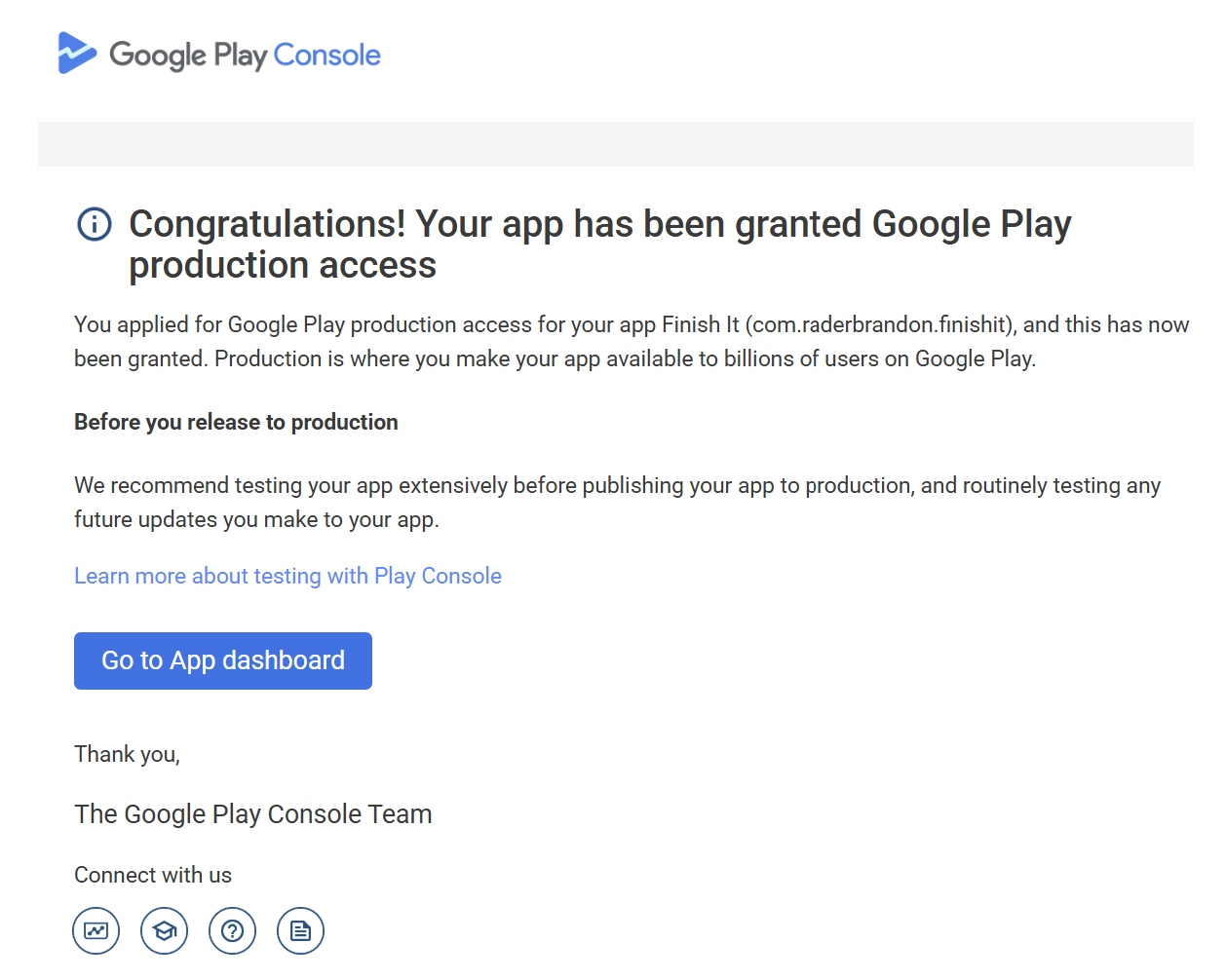
Verified Production Access
Quality QA Testing Reports
Clear, actionable reports with screenshots and evidence for every important issue found during testing.
Real Device Testing & Diagnostics
Real human testers use physical Android devices to test your app, verify real user flows, and provide clear testing evidence and professional QA reports.
Compliance Audit Passed
Get your Android build approved on the first try. We create an audit-ready compliance profile that proves thorough quality assurance.
Affordable Compliance Cycles
Transparent plans built to satisfy Google Play Console guidelines for your Android build.
Loading Packages
Please wait while we fetch the best options for your region...
Frequently Asked Questions
Everything you need to know about passing your closed testing requirements.