12 Play Console app testers for Android app testing in New Zealand
Secure 12 Play Console app testers in New Zealand. Fulfill Google Play closed testing smoothly with our 12 testers for 14 days Play Store service.
New Zealand is geographically isolated, but its mobile market is a highly connected, fiercely critical ecosystem. Launching an application here serves as the perfect stress test for any developer.
If your software crashes during a morning commute in Auckland or fails to load over a patchy cellular connection in rural Otago, local users will uninstall it immediately. Word of mouth spreads rapidly in a smaller population, making a flawless initial release absolutely essential for long-term viability.
This is exactly why passing Google Play Closed Testing with real, local users is not just a regulatory hurdle - it is a critical survival tactic. You cannot simply upload an APK and hope the algorithms figure it out.
Google requires undeniable proof that real humans have actively engaged with your application before they unlock production access. Finding exactly 12 Play Console app testers for Android app testing in New Zealand is a complex process. You are stepping into a strict regulatory environment governed by daily engagement metrics and unyielding compliance rules.
The Reality of the Testing Grind
Getting people to install your unfinished application is only the first tiny step of the process. Keeping them coming back every single day is where the real nightmare begins.
Google monitors the telemetry data with absolute precision. They track daily opens, session durations, and background error logs to ensure the testing phase is completely legitimate.
If your testers open the application once and forget about it for the rest of the week, your application for production access will be denied flat out. There is zero room for error.
You need a foolproof system to secure 12 Testers for 14 Days of continuous activity. These testers must tap buttons, navigate complex menus, and generate the authentic usage data that proves your software is ready for the public.
Authentic Engagement Versus Automated Junk
When you are developing an application aimed at the New Zealand market, having testers who actually live there is invaluable. A tester in another country might not understand the local formatting for phone numbers, addresses, or currency. They will not notice if your location-based features are glitching out when searching for suburbs in Hamilton or Dunedin. Local testers catch the small, regional nuances that foreign testers miss entirely.
Furthermore, Google Play pays attention to the geographic distribution of your test group. If your app is designed for local businesses but all your testers are logging in from across the globe, it raises a massive red flag in the review process. Gathering a dedicated group of 12 Play Console app testers for Android app testing in New Zealand ensures your data matches your target demographic. This alignment between your app's intended audience and your testing pool builds critical trust with the review team.
Authentic New Zealand Testers
Genuine testers from Wellington to Christchurch provide the exact telemetry Google wants to see. They use varied network connections, from fast home fiber to spotty rural cellular data. Their devices range from brand-new flagship phones to three-year-old budget models. This diversity creates a rich, natural testing environment. When these users interact with your app, their session lengths vary naturally. They might spend five minutes one day and thirty seconds the next. This organic usage pattern signals to the Play Console algorithms that real humans are evaluating your product, drastically increasing your chances of approval.
Automated Bots and Fake Accounts
Using automated scripts or click farms to fake your testing data is the fastest way to get your developer account banned. Bots leave a very obvious digital footprint. They often connect from identical IP ranges, use the exact same device models, and interact with your app at unnatural, robotic intervals. Google has spent billions perfecting their fraud detection systems. If they detect that your Play Store Closed Testing data looks artificial, they will not just reject your app - they might permanently suspend your entire developer profile. The risk is simply never worth the perceived shortcut.
Struggling with the 14-Day Testing Requirement?
Skip the hassle of recruiting unreliable testers. Our professional fleet of real Android devices guarantees Google Play compliance in exactly 14 days. Zero bots. Zero emulators. 100% production approval guarantee.
Comparing Your Testing Strategies
You have a few different paths you can take to get your app through the mandatory testing phase. Each approach requires a different investment of time, money, and mental energy.
| Feature | Professional Service | DIY Friend Group | Automated Bots |
|---|---|---|---|
| Effort Required | Minimal - Handled by pros | Massive - Constant nagging | Low - But extremely risky |
| Data Authenticity | High - Real human behavior | Medium - Friends forget to test | Zero - Easily detected |
| Daily Engagement | Guaranteed for 14 days | Drops off after day three | Robotic and unnatural |
| Geographic Targeting | Specific to New Zealand | Limited to your social circle | Usually random data centers |
| Approval Success Rate | Extremely high | Very low and frustrating | Almost guaranteed rejection |
| Feedback Quality | Detailed and actionable | Simple and unhelpful | None whatsoever |
The Comprehensive Pre-Launch Checklist
Before you even think about inviting your first tester, you need to ensure your app and your Play Console listing are completely prepared. If you invite testers to a broken experience, you will waste their time and your valuable evaluation window.
App Stability and Core Mechanics
Ensure the app launches cleanly on at least three different screen sizes without user interface overlap.
Verify that all essential third-party integrations and tools are properly initialized and not throwing silent errors.
Implement basic error handling so the app fails gracefully rather than crashing completely to the home screen.
Double-check that all placeholder text and debug buttons have been completely removed from the live views.
Confirm that the app respects device dark mode and light mode settings without rendering text invisible.
Play Console Configuration
Fill out the content rating questionnaire completely and honestly to avoid policy compliance strikes later.
Upload clear, accurate privacy policy documents to a reliable web host and link them correctly in the console.
Prepare your store listing assets, including high-quality screenshots and a compelling, keyword-rich description.
Set up your closed testing track and carefully input the email addresses of your confirmed participants.
Ensure your target audience and country availability specifically includes New Zealand for regional releases.
Tester Communication Strategy
Draft a clear welcome email explaining exactly what you need them to do over the coming period.
Create a simple, friction-free way for testers to report bugs, such as a basic feedback form.
Schedule gentle daily reminder messages to ensure they actually open the app and trigger a required session.
Prepare specific tasks for them to complete, like trying a new feature or testing the search function.
Your Continuous Testing Roadmap
Navigating the evaluation period is a marathon, not a sprint. You cannot just start the clock and walk away. You need to actively manage the process every single day to ensure Google receives the data they require.
Day 1: The Initial Rollout
This is where the rubber meets the road. You need to ensure all your selected participants receive the opt-in link and successfully install the application. Be prepared to offer technical support, as some users always struggle with accepting testing invitations. Verify in your Play Console dashboard that the installations are actually registering properly.
Day 3: The First Engagement Drop
By the third day, the novelty has completely worn off. This is the exact moment when casual testers usually stop opening the app. You must send out your first batch of reminders. Ask your testers to perform a specific action, like updating their profile picture or browsing a specific menu, to force a meaningful session log.
Day 7: The Midpoint Analysis
You are halfway through the required period for 12 Testers for 14 Days. Check your technical vitals dashboard carefully. Are there any hidden crashes happening in the background? Are users experiencing slow rendering times? Gather the initial feedback from your testers and start prioritizing the bug fixes for your eventual production release.
Day 10: Deep Feature Testing
Now that the app has proven basically stable, push your testers to try the edge cases. Ask them to put their phone in airplane mode while using the app, or to rapidly tap buttons to see if the interface breaks. You want to uncover the weird, obscure bugs now before real paying customers find them on the live store.
Day 14: Final Data Verification
The final day has finally arrived. Do not immediately hit the submit button. Wait a full 24 hours to ensure all the usage data from the last day has synced with Google's servers. Review your crash rates, unresponsiveness rates, and overall engagement metrics. If everything looks incredibly healthy, you are ready to apply for production access.
Post-Approval: Launch and Beyond
Once Google officially approves your application, the real work begins. Take all the feedback you gathered during the Google Play Closed Testing phase and implement the most critical improvements. Roll out your production version to the New Zealand market with absolute confidence, knowing it has been battle-tested by real locals.
Frequently Asked Questions About the Testing Process
Developers always have pressing questions when facing Google's stringent requirements. Below is an exhaustive breakdown of the most common concerns regarding the testing phase, specifically tailored to the nuances of launching in the current ecosystem.
Why does Google insist on this continuous testing period?
The mobile app market is completely saturated with low-effort, broken, and malicious software. In the past, anyone could publish an app in five minutes, leading to a terrible experience for Android users. Google implemented the strict testing rule to act as a massive filter. It forces developers to prove they are serious about their product. By requiring prolonged engagement, Google ensures that the app functions correctly over time, does not drain the battery excessively, and handles varied network conditions. It is a quality control measure designed to protect the integrity of the ecosystem and ensure users only download software that actually works as intended.
Can I use testers from other countries if my app is only for New Zealand?
Technically, the Play Console does not rigidly block you from using testers located outside your target region, provided your testing track is configured to allow them. However, it is highly discouraged. If your app relies on local payment gateways, specific GPS coordinates, or regional information, foreign testers simply cannot test those features properly. Furthermore, if Google manually reviews your testing data and notices a massive disconnect between your stated target audience and your testing pool, it could raise major suspicions. Securing 12 Play Console app testers for Android app testing in New Zealand ensures your telemetry data perfectly aligns with your launch strategy, making the approval process much smoother.
What exactly counts as a valid tester in the eyes of the Play Console?
A valid tester is a user with a legitimate, active Google account who has officially clicked the required opt-in link provided by your closed testing track. They must then download the application directly from the official store onto a physical Android device. Sideloading the application package manually does not count. Emulators generally do not provide the proper hardware identifiers and are often flagged. The tester must open the app and interact with it organically on multiple different days throughout the mandatory window. Their device must send analytics and usage data back to Google's servers to reliably verify their activity.
How hard is it to manage a DIY testing group using my friends and family?
It is significantly more difficult than most developers anticipate. While your friends might gladly agree to help initially, they have their own lives, jobs, and distractions. Asking them to remember to open a buggy, unfinished app every single day for two weeks is a huge imposition. By day four, engagement almost always plummets to zero. You will find yourself constantly messaging them, begging them to open the app just for two minutes. This strains relationships and often results in failed testing periods because the usage data is too sparse. This is the primary reason professional testing services exist - to remove the emotional friction and guarantee the required data metrics.
What happens if a tester misses a day or two of engagement?
Google's evaluation algorithms are complex and somewhat opaque, but they generally understand that real human beings are not perfect robots. If one or two testers miss a single day out of the entire period, it will not automatically doom your application. However, if the overall aggregate data shows a massive drop in engagement, or if several testers go dormant for consecutive days, your chances of approval drop drastically. The goal is to maintain a consistent, healthy baseline of daily active users throughout the entire period. You simply cannot afford to have your app sit completely idle for an entire weekend.
Is it safe to pay people directly on forums to test my application?
Paying random strangers on the internet is an incredibly risky strategy. First, you have no way to reliably verify their geographic location or the quality of their devices. Second, many of these individuals run automated device farms, which Google is remarkably good at detecting and banning. Third, if they decide to abruptly stop testing on day ten, you have absolutely zero recourse and have lost your money and your time. Finally, sharing your app with unvetted strangers exposes your intellectual property to potential theft before you have even launched. Professional services offer clear contracts, absolute confidentiality, and guaranteed completion, making them the only secure option for serious developers.
How do I know if my app is completely ready for the closed testing phase?
Your app should be considered feature complete before you invite anyone to test it. It should not be a rough prototype or a basic wireframe. Core user flows, such as account creation, navigation, and primary functions, must work reliably. The app should not crash under normal usage conditions. While minor visual bugs or spelling errors are entirely acceptable, game-breaking issues that prevent the user from moving past the loading screen are not. If your app crashes constantly, your testers will simply uninstall it, and you will fail the Google Play Closed Testing requirements before you even get a chance to start gathering useful feedback.
What should I do if my application for production access is rejected?
A rejection is incredibly frustrating, but it is not the end of the road. Google will usually provide a vague reason for the rejection, such as insufficient testing data or a specific policy violation. Your first step is to carefully review your technical vitals dashboard for any hidden crashes or performance issues you missed. Next, critically evaluate your tester engagement. Did they actually use the app, or just open it once? You will need to address the underlying technical issues, gather a fresh group of dedicated testers, and completely restart the evaluation clock. Do not simply reapply without changing anything, as this can easily trigger a more severe manual review of your entire developer account.
Does the size or complexity of my app change the rigorous testing requirements?
No. Google applies the exact same rules to every single developer, regardless of whether you are building a simple flashlight app or a massive, complex financial tracking tool. You still need to demonstrate a long period of continuous, stable usage from your testing pool. However, more complex apps naturally require much more careful management during the testing phase, as there are simply more individual components that can break under pressure. You will need to provide your testers with much more detailed instructions to ensure they interact with all the different modules and hidden features of a larger, more intricate application.
How can I keep my testers motivated and engaged for two full weeks?
Motivation requires consistent communication and clear structure. Do not just hand them the app and walk away silently. Send them daily updates. Tell them what specific features to poke at today. Share small victories with them, like noting that thanks to their excellent feedback, you fixed a highly annoying login bug. Make them feel like they are a crucial part of the development team, not just unpaid quality assurance workers. Some developers successfully offer small rewards, like a free premium subscription or an in-app currency bonus, upon successful completion of the testing period. A little bit of genuine appreciation goes a incredibly long way in maintaining their daily engagement.
Are there specific device requirements for the active testing pool?
Google explicitly likes to see diversity in your hardware metrics. While they do not strictly mandate specific models, having all your testers using the exact same brand of phone on the exact same version of the operating system is not ideal. It artificially limits the scope of your telemetry data. Ideally, your pool of 12 Testers for 14 Days should encompass a healthy mix of high-end, mid-range, and older budget devices. They should be running several different versions of the operating system. This hardware variety proves to the evaluation team that your app is robust and properly optimized for the fractured, chaotic reality of the global mobile ecosystem.
What is the functional difference between internal testing, closed testing, and open testing?
Internal testing is exclusively for your immediate team; it has very few restrictions and is meant for highly unstable, early builds. Closed testing is the mandatory phase we have been extensively discussing, requiring a specific number of verified external users for a set duration to definitively prove stability. Open testing is a completely optional phase where your app is visible on the store, but marked as early access, allowing absolutely anyone to download it and provide private feedback before the official launch. You must successfully conquer the Play Store Closed Testing phase before you are even permitted to consider moving on to open testing or full production.
Can I update my application during the active testing period?
Yes, and in fact, you often absolutely should. If your testers uncover a critical bug on day three that prevents them from using the app properly, you absolutely must push an update to fix it. Pushing a technical update does not reset your timer, provided that your testers download the new update and continue to engage with the application consistently. Regular updates during the testing phase actually signal to Google that you are an active, responsive developer who cares deeply about software quality, which can subtly improve your standing during the final manual review process. Just ensure the updates do not introduce completely new, untested, and unstable features at the very last minute.
How does Google accurately know if my testers are real people or automated bots?
Google utilizes the most sophisticated behavioral analysis artificial intelligence on the planet. They constantly look at dozens of invisible data points. Bots swipe screens with perfect mathematical precision; humans wobble and hesitate slightly. Bots open apps at the exact same time every day; human schedules are inherently erratic. Bots often share identical hardware signatures or connect through known virtual private network endpoints. If your testing data looks too perfect, too uniform, or too mechanical, the system will flag it immediately. Authentic Play Store Closed Testing requires the messy, slightly unpredictable behavior that only real human beings can ever truly generate.
Should I translate my application if my testers are primarily located in New Zealand?
New Zealand is a primarily English-speaking country, so if your app is already presented in English, you are generally perfectly fine. However, incorporating local spelling conventions or offering a dedicated regional language option can significantly endear your app to the local market and your specific testing pool. It explicitly shows a level of polish and deep respect for the region that generic, globally targeted apps almost always lack. While not strictly required for passing the closed testing phase, regional localization consistently results in much better user feedback, higher ratings, and significantly improved long-term retention rates for your final product.
How We Deliver 12 Testers
A straightforward 4-step process to get your Android app approved.
Connect Account
Connect your Google account and choose your preferred closed testing package for your Android app.
Assign Testers
Share your Play Store opt-in URL. We immediately deploy 12 real testers to launch and review your Android app daily.
Daily QA Runs
Our crew initiates daily launch sessions on physical devices, verifying usability and logging crashes for your Android app.
Launch Ready
We continuously perform closed app testing for 14 days to help you meet Google Play production requirements. We also provide a compliance report.
Our Testing Infrastructure
Deploy your Android app onto real retail-grade handsets using our secure laboratory environment.
The 14-Day Production Guarantee
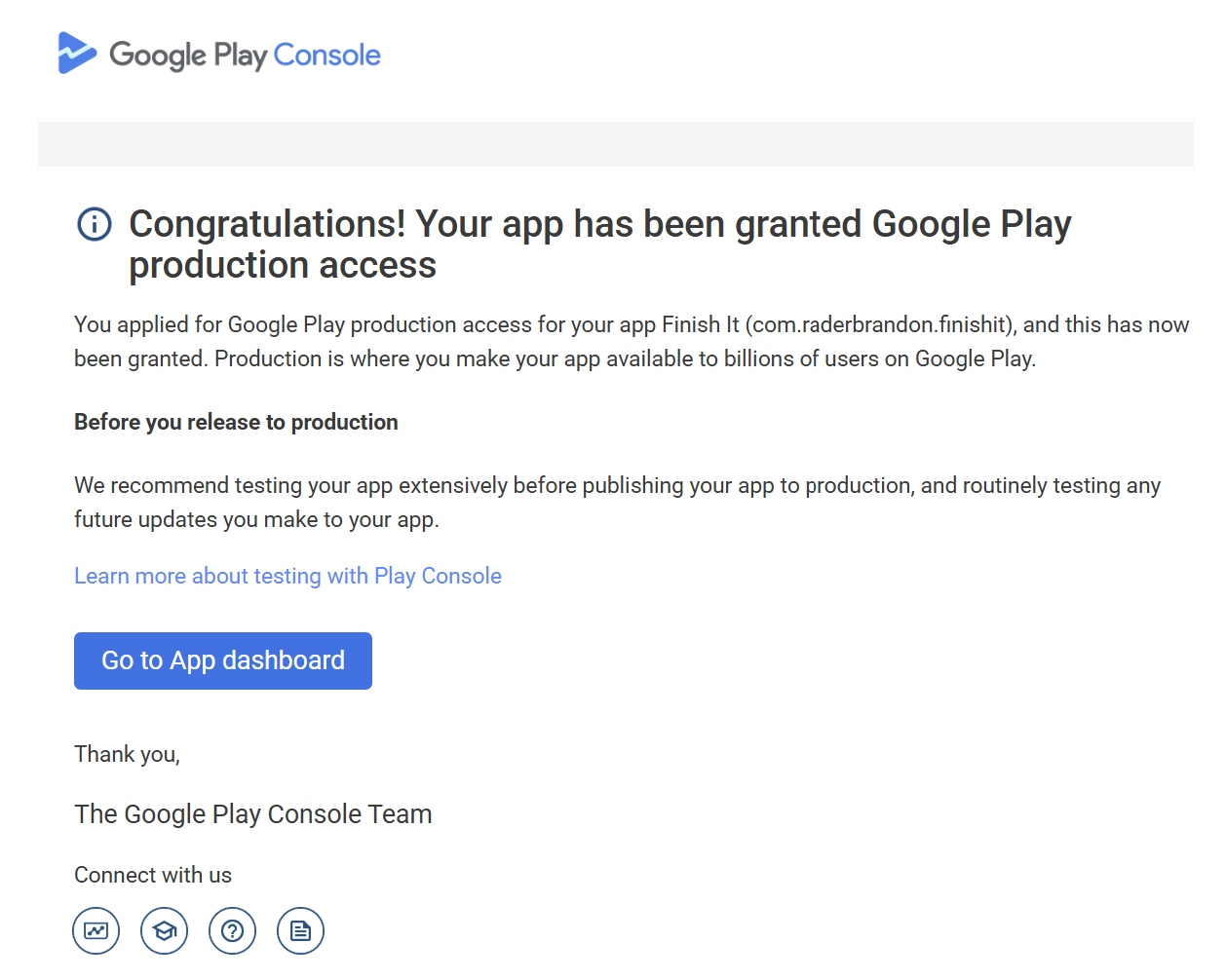
We complete the required 14-day closed testing process with real human testers and physical Android devices, while providing clear testing evidence and documentation throughout the process.
If Google specifically rejects production access due to insufficient testing engagement, you are covered by our free re-run or 100% refund guarantee, subject to our Refund Policy.
Verified Production Access
Quality QA Testing Reports
Clear, actionable reports with screenshots and evidence for every important issue found during testing.
Real Device Testing & Diagnostics
Real human testers use physical Android devices to test your app, verify real user flows, and provide clear testing evidence and professional QA reports.
Compliance Audit Passed
Transition your Android app to public production access with confidence. We deliver verified session logs and compliant Console activity.
One Cycle. Complete Approval.
Choose the ideal closed testing cycle for your Android release.
Loading Packages
Please wait while we fetch the best options for your region...
Frequently Asked Questions
Everything you need to know about passing your closed testing requirements.