12 Play Console app testers for Android app testing in Nicaragua
Hire 12 Play Console app testers in Nicaragua. Pass Google Play closed testing in 14 days with real Android testers and unlock Play Store production access.
The Reality of Android App Verification for Nicaragua Developers
Building Android applications out of Managua, Leon, Granada, or Esteli represents an exciting surge in Central American tech entrepreneurship. Independent developers, software consultancies, and digital agencies across Nicaragua are creating fintech wallets, agricultural management portals, commerce engines, and tourism utilities. However, bringing those solutions to global consumers on the Google Play Store requires passing Google's most demanding compliance milestone: mandatory closed testing for personal developer accounts.
Under Play Console policies instituted for all personal developer accounts registered after November 2023, you must recruit at least 12 opt-in testers who remain actively engaged with your build for 14 continuous days. Merely installing the APK is not enough. Google reviews continuous telemetry signals, background logs, crash-free stability, and real human feedback before granting production access. For developers in Nicaragua, achieving this benchmark with peer groups often leads to sudden tester drop-offs, reset timers, and delayed market debuts.
Understanding Google Play Closed Testing Requirements in 2026
Google Play closed testing is an automated and human-evaluated gatekeeping system. It assesses whether your app is stable across varied hardware form factors and whether real human beings find value in its functionality.
+-------------------------------------------------------------------------+
|                  GOOGLE PLAY PRODUCTION ACCESS PIPELINE                 |
+-------------------------------------------------------------------------+
|  1. Internal Testing Track (Core Architecture & Sandbox Verification)   |
|                                |                                        |
|                                v                                        |
|  2. Closed Testing Track (12+ Opted-In Testers via Google Groups)       |
|                                |                                        |
|                                v                                        |
|  3. Active 14-Day Testing Phase (Daily App Opens, Logs, & Feedback)     |
|                                |                                        |
|                                v                                        |
|  4. Production Access Evaluation Form (Metric Audit & QA Responses)     |
|                                |                                        |
|                                v                                        |
|  5. Production Track Approval -> Global App Store Launch               |
+-------------------------------------------------------------------------+
For Nicaraguan software creators, coordinating 12 reliable testers across local networks like Claro or Tigo creates severe friction. When friends or coworkers forget to open the app, switch off notifications, or uninstall after a few days, Google's algorithm flags irregular engagement. A single tester drop-out on day twelve invalidates the testing window, forcing teams to restart the 14-day clock from zero.
Why Nicaraguan Development Teams Choose Professional Managed Testing
Relying on ad-hoc WhatsApp tester groups or mutual review rings often leads to account flags and wasted sprints. Professional managed testing guarantees uninterrupted retention, real Android device diversity, and verifiable engagement telemetry.
Manual & Ad-Hoc Tester Groups
- Frequent Tester Drop-off: Friends and casual testers forget to open the build daily or uninstall prematurely.
- Limited Hardware Matrix: Testing gets restricted to a few local Xiaomi, Samsung, or Motorola models.
- Unreliable Telemetry: Sparse in-app events that fail to trigger genuine Google Play Console session benchmarks.
- Lack of Structured Feedback: Superficial comments without actionable logs, stack traces, or usability critiques.
- Repeated Application Rejections: Inconsistent testing activity results in denied production track permissions.
Managed Testing Compliance Services
- Guaranteed 14-Day Continuity: Dedicated real users who keep the app installed and actively interact daily.
- Comprehensive Device Matrix: Real physical hardware covering Android 10 through Android 15 across varied screen sizes.
- Rich Behavioral Telemetry: Organic session lengths, deep screen navigation, and legitimate background syncs.
- Direct Play Console Feedback: Actionable bug reports and functional reviews submitted through private console channels.
- Streamlined Production Approval: Pristine engagement metrics that satisfy both automated filters and human auditors.
Technical Breakdown: Real Testers vs. Automated Bot Farms
Some developers attempt to bypass the 12 testers for 14 days closed testing requirement by purchasing cheap bot packages or emulator scripts. This is the fastest way to get a Google Play Console account permanently flagged or terminated. Google's anti-fraud infrastructure evaluates hundreds of device integrity signals to separate real humans from synthetic traffic.
| Feature / Metric | Managed Real Testers | DIY Peer Groups | Automated Bot Farms |
|---|---|---|---|
| Device Authenticity | 100% Genuine Physical Hardware | Real Physical Hardware | Emulators, Virtual Devices, Farmed VMs |
| Play Integrity Status | Passes Strong / Device Integrity | Passes Device Integrity | Fails or Triggers Basic Integrity Only |
| IP & Network Profile | Diverse Residential ISPs | Clustered Local Networks | Datacenter Proxies / Suspicious VPNs |
| Usage Patterns | Variable Session Times & Swipes | Short, Inconsistent Bursts | Scripted Clicks & Identical Timestamps |
| Crash Report Quality | Actionable Steps & Reproduction | Generic "App Crashed" Notes | No Telemetry or Synthesized Logs |
| Console Approval Rate | 98%+ on First Submission | 40% - 55% First-Attempt Success | 0% (Immediate or Deferred Account Ban) |
Google checks SafetyNet and Play Integrity API tokens, accelerometer sensor readings, battery discharge curves, ambient screen state transitions, and Google account reputation history. Emulated environments lack authentic hardware sensor jitter and realistic memory allocation footprints. When automated review systems detect identical device fingerprints or sudden traffic bursts from datacenter IP blocks, the account is marked for non-compliance. Real human testers on physical devices are the only safe way to pass Play Store closed testing.
Struggling with the 14-Day Testing Requirement?
Skip the hassle of recruiting unreliable testers. Our professional fleet of real Android devices guarantees Google Play compliance in exactly 14 days. Zero bots. Zero emulators. 100% production approval guarantee.
The 5 Crucial Console Metrics Google Monitors During Closed Testing
To ensure your application is ready for global distribution, Google Play Console evaluates five core operational metrics throughout the 14-day closed testing window:
- Daily Active Opt-Ins (DAU Retention): The total number of enrolled testers must never fall below 12. If even one tester opts out through the web opt-in URL, the counter drops and your 14-day progression pauses.
- Session Frequency and Depth: Testers must open the app repeatedly across distinct days, explore multiple activity routes, and trigger API endpoints rather than bouncing on the splash screen.
- Android Vitals & Crash-Free Users: Your crash-free user rate must stay well above 99.0%, and Application Not Responding (ANR) rates must remain below Google's 0.47% bad behavior threshold.
- Private Tester Feedback Volume: Testers should submit bug logs, feature ideas, or usability feedback through the private Google Play testing interface. Google checks for feedback presence before granting production access.
- Release Iteration & Responsiveness: Pushing at least one updated App Bundle (.aab) during testing demonstrates active development and responsiveness to tester findings.
Pre-Launch Closed Testing Checklist for Nicaraguan Apps
Before submitting your closed testing track for review, verify every item in this pre-launch checklist to avoid avoidable delays.
Play Console Setup & Compliance
Build Stability & Performance
Step-by-Step Roadmap to Google Play Production Approval
Navigating the closed testing track requires a structured progression from early sandbox builds to formal production approval.
1. Internal Testing and Sandbox Verification
Upload your initial build to the Internal Testing track. Run internal smoke tests with your immediate engineering team to catch critical initialization bugs, database migration errors, and UI scaling issues.
2. Closed Testing Track Configuration and Build Release
Create your Closed Testing track, link your tester Google Group, and submit your new release for review. Once Google approves the build for testing, distribute the opt-in web and Android join links to your testing cohort.
3. The 14-Day Active Engagement Cycle
Ensure all 12+ testers accept the invite, download the application from Google Play, and interact with features consistently. Collect crash logs, monitor Android Vitals in Play Console, and release incremental updates to address feedback.
4. Production Access Questionnaire Submission
Once the 14 continuous days are completed, the "Apply for Production" button activates in Play Console. Complete the detailed questionnaire describing your testing methodology, feedback received, and product improvements.
5. Production Approval and Global Deployment
Google's review team evaluates your questionnaire responses alongside the 14-day telemetry audit. Upon approval, promote your closed testing build directly to the Production track for worldwide release.
Frequently Asked Questions (FAQs)
Why does Google Play require 12 testers for 14 days for personal developer accounts?
Google introduced this requirement to elevate app quality, reduce malware distribution, and ensure new developers understand real-world Android performance standards. By enforcing 14 continuous days of testing with at least 12 active users, Google verifies that an application has been evaluated on physical devices, has acceptable crash rates, and delivers genuine utility before reaching billions of Android users on the open market.
What happens if a tester uninstalls the app on day 10 of the closed test?
If your active tester count drops below the mandatory threshold of 12 opt-in participants, Google Play Console will pause the 14-day qualification timer. If the deficit is not immediately resolved by onboarding replacement testers, the entire 14-day countdown may reset once 12 active testers are restored. This is why it is best practice to enroll 15 to 20 testers to maintain a reliable safety buffer against unexpected drop-offs.
Can I use emulators or cloud testing farms to complete my 14-day test?
No. Google Play tracks hardware telemetry, sensor data, Play Integrity tokens, and Google account reputation. Emulators and virtual device farms fail to reproduce authentic human behavioral signals and often share blacklisted datacenter IP addresses. Attempting to pass testing with automated scripts or emulators frequently results in automatic rejection of your production access request and can lead to permanent account termination.
Do all 12 testers have to be located in Nicaragua?
No, Google Play does not mandate that all testers reside in Nicaragua. However, your Closed Testing track settings must include the specific countries where your testers are registered. Having a geographically diverse group of testers with verified Google accounts across different regions and carrier networks provides strong telemetry and proves your app functions reliably across global environments.
How should I answer the Production Access questions once the 14 days are complete?
When applying for production access, provide comprehensive, technical, and transparent answers. Detail your recruitment methodology, outline specific bugs or UX friction discovered by testers during the 14 days, explain the architectural fixes or UI improvements you deployed in response, and describe why your application is now stable and valuable for general release. Vague, one-sentence answers are a primary cause of manual rejection by Google reviewers.
Can I update my app bundle (.aab) while the 14-day closed test is underway?
Yes, you are encouraged to release updates during the closed testing period. Deploying new versions through the closed testing track demonstrates active maintenance and responsiveness to user feedback. Updating the build does not reset your 14-day timer, provided that your testers update to the new version and maintain continuous daily interaction throughout the remaining schedule.
How It Works
How we deploy real devices and guarantee compliance for your release.
Get Started
Sign in with Google to configure the closed testing environment for your Android build.
App Submission
Submit your Google Play Console testing link, and our team will assign qualified testers from our testing network to join your Android closed testing release.
14-Day Cycle
A QA supervisor monitors daily check-ins, ensuring 12 unique Android users engage with your Android build every single day.
Production Access Approval
We guarantee 14 consecutive days of active user check-ins to satisfy Google's compliance policies, delivering an audit-ready PDF feedback report.
Why Choose AppConsoleLab
Experience a next-generation testing infrastructure built for Google Play compliance for your Android release.
The 14-Day Production Guarantee
We complete the required 14-day closed testing process with real human testers and physical Android devices, while providing clear testing evidence and documentation throughout the process.
If Google specifically rejects production access due to insufficient testing engagement, you are covered by our free re-run or 100% refund guarantee, subject to our Refund Policy.
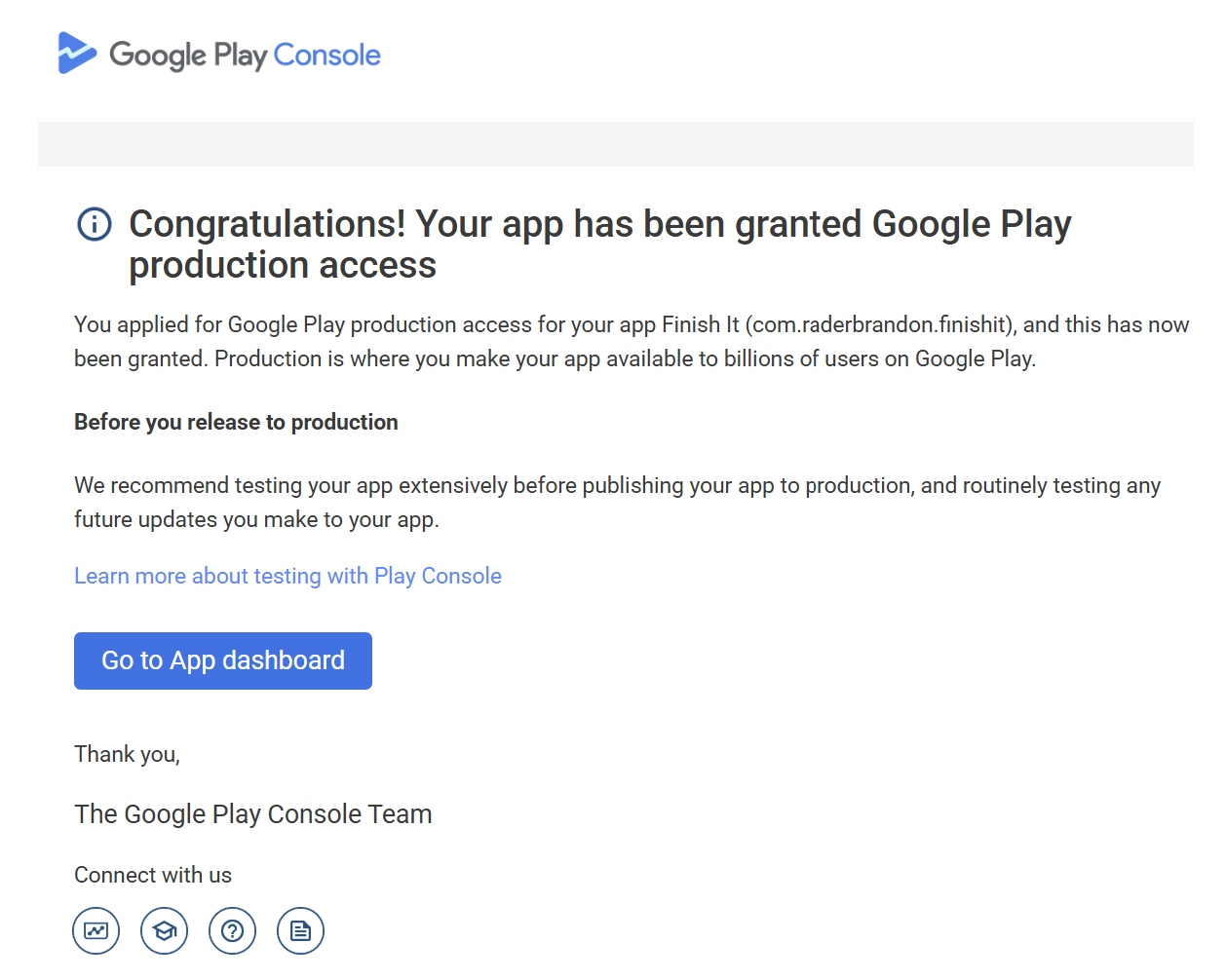
Verified Production Access
Quality QA Testing Reports
Clear, actionable reports with screenshots and evidence for every important issue found during testing.
Real Device Testing & Diagnostics
Real human testers use physical Android devices to test your app, verify real user flows, and provide clear testing evidence and professional QA reports.
Play Store Ready
Get your Android build approved on the first try. We create an audit-ready compliance profile that proves thorough quality assurance.
Affordable Compliance Cycles
Transparent plans built to satisfy Google Play Console guidelines for your Android build.
Loading Packages
Please wait while we fetch the best options for your region...
Frequently Asked Questions
Everything you need to know about passing your closed testing requirements.