12 Play Console app testers for Android app testing in Nigeria
Get 12 Play Console app testers in Nigeria. Pass Google Play closed testing easily with our authentic 12 testers for 14 days Play Store service.
Launching an app in Nigeria is like navigating the bustling streets of Lagos during rush hour. It requires intense focus, adaptability, and an intimate understanding of the local environment.
You are not just building software, you are building for a vibrant, mobile-first economy. Device diversity here is massive, ranging from top-tier Samsung Galaxy devices to incredibly popular entry-level Tecno, Infinix, and Itel smartphones.
Before your app icon shines on screens across the country, you must survive a mandatory trial. For personal developer accounts, this means clearing the Google Play Closed Testing policy.
Finding 12 testers for 14 days is not a simple bureaucratic hoop. It is a crucial stress test for your software.
If your app crashes on a fluctuating 3G network in Port Harcourt, Google will notice. True Play Store Closed Testing demands authentic engagement from real local users.
Why Nigeria's Mobile Market Demands Real Testing
Nigeria boasts one of the fastest-growing and most dynamic mobile markets globally. Millions of users rely entirely on their smartphones for daily banking, commerce, and entertainment.
If you skip proper testing in this specific environment, your app is almost guaranteed to fail upon public launch.
You cannot rely on a generic global testing audience. You urgently need users who understand the local context, local slang, and local pain points.
Google Play Closed Testing is specifically designed to enforce this standard. It forces developers to ensure their app performs well under real world conditions before a wide release.
The Trap of Fake Testers
Many developers completely panic when they see the strict 12 testers requirement in their dashboard. Facing a tight launch deadline, they turn to shady marketplace services offering instant bot testers, click farms, or emulator farms to bypass the rules quickly. This is arguably the most destructive choice a new developer can make for their business.
Google has deployed highly sophisticated, machine-learning-driven tools to detect artificial engagement and fake accounts. If they catch you using bots to fake your way through the testing phase, the consequences are severe. Your app will not only be rejected, but your entire developer account could be permanently suspended, locking you out of the Android ecosystem forever.
You need real human beings opening your app, clicking buttons, scrolling through menus, and experiencing the user interface over two solid weeks. These users need to generate organic usage data, battery consumption metrics, and natural crash logs. Anything less than genuine human interaction is a direct violation of Play Store Closed Testing guidelines and a massive risk to your hard work.
Authentic Testing in Nigeria
Real Nigerian users testing your app means actual installs on physical devices like Tecno, Infinix, and Nokia. These human testers experience your app on local telecommunication networks like MTN, Airtel, or Globacom. They provide genuine, contextual feedback on the user experience, spot localization or cultural errors, and ensure your app handles intermittent internet connectivity gracefully. This active, daily engagement over the required period signals high quality to Google's automated systems and ensures a smooth manual approval process.
The Bot Farm Risk
Using automated bot farms or cloud emulator farms results in zero actual user engagement. Bots do not scroll naturally, they do not test payment gateways like Paystack, and they certainly do not leave constructive, written feedback. Google's Play Console dashboard meticulously tracks device types, session durations, screen touch patterns, and interaction frequency. When the algorithm sees twelve identical virtual devices logging in for exactly ten seconds a day from a single IP block, your app will be flagged, immediately rejected, and your account put at severe risk.
Your 14-Day Roadmap to Production
The process of satisfying the 12 testers for 14 days policy is a structured, day-by-day journey. It requires careful orchestration and constant monitoring. Here is exactly what happens when you partner with a professional testing service that exclusively utilizes real Android users located in Nigeria.
App Review and Onboarding
Before any testing begins, your application is reviewed for basic compliance and stability. We ensure it meets initial Google Play guidelines and does not contain obvious crashing bugs. You then add our verified Nigerian tester email addresses to your Play Console Closed Testing track. Our team guides you step-by-step through creating the alpha release and successfully rolling it out to the designated tester group.
Installation and First Impressions
Once the release is officially active on the store, our 12 unique testers in Nigeria receive an invitation. They opt in and install your application on their physical, daily-driver Android devices. This happens across various hardware brands and operating system versions to ensure maximum compatibility testing. Testers immediately provide initial written feedback on the installation size, download speed over local networks, and the vital first launch experience.
Continuous Daily Engagement
For the next 14 consecutive days, each of the 12 testers opens and actively interacts with your app. They navigate through deeply nested menus, test core functional features, and simulate normal, unpredictable user behavior. This continuous, varied engagement is exactly what the Google Play Closed Testing algorithm looks for to verify that real human beings are testing the product prior to a public launch.
Feedback Collection and Reporting
Throughout the entire two-week testing period, our testers meticulously report any bugs, unexpected crashes, or confusing UI elements they encounter. This feedback is gathered specifically from a Nigerian context, providing invaluable local insights. For example, if a localized feature or currency display fails, it is heavily documented. You receive all this detailed feedback to make necessary code adjustments before you apply for production access.
Applying for Production Access
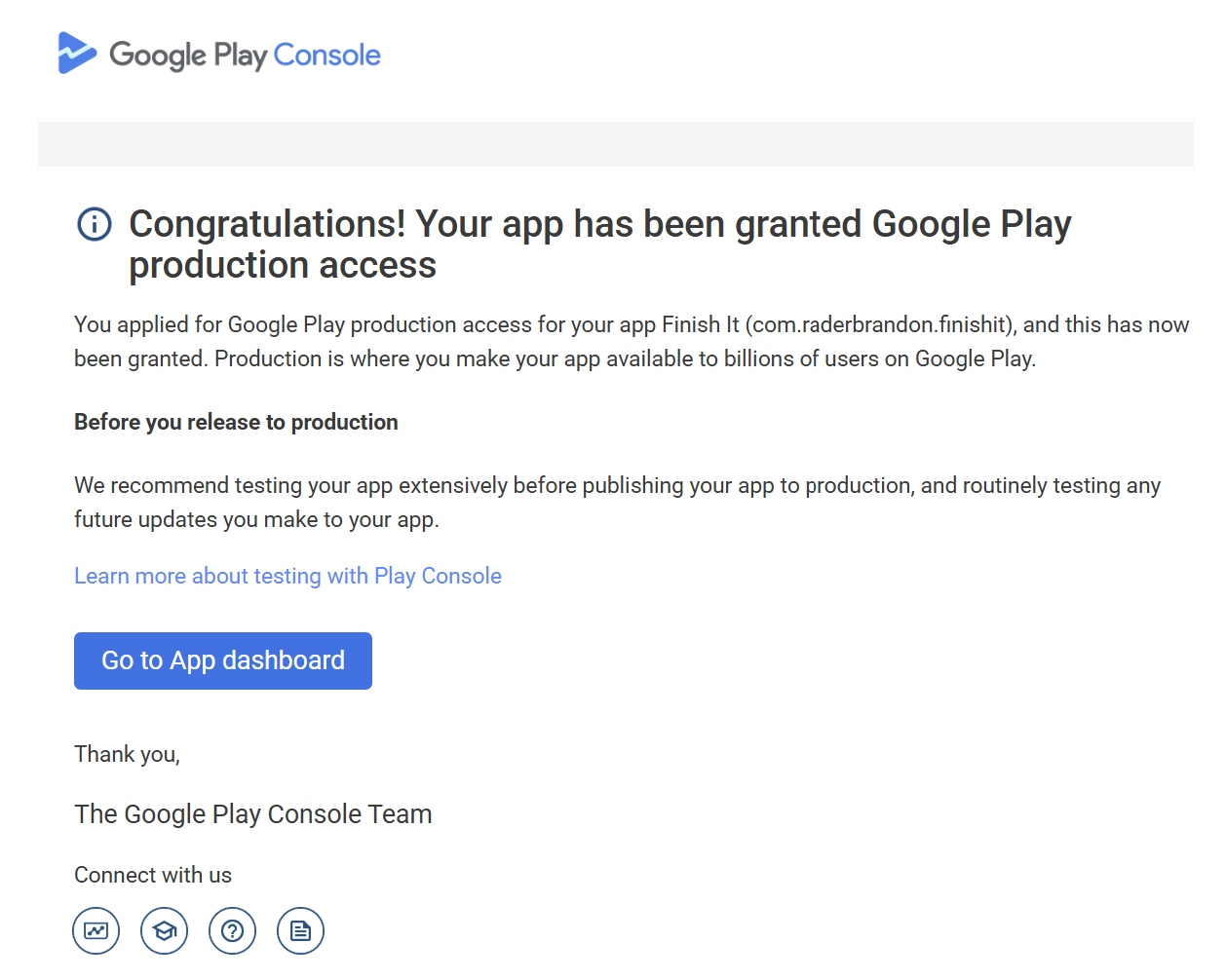
After 14 full days of successful, uninterrupted testing, the Play Console dashboard will finally unlock the option to apply for production. You will be required to answer a comprehensive series of questions about your testing methodology and the specific feedback you received. Armed with our detailed daily tester reports, you can confidently and accurately answer these questions to secure your app approval from Google's review team.
Struggling with the 14-Day Testing Requirement?
Skip the hassle of recruiting unreliable testers. Our professional fleet of real Android devices guarantees Google Play compliance in exactly 14 days. Zero bots. Zero emulators. 100% production approval guarantee.
Comparing Your App Testing Options
When you need to clear the stringent Google Play Closed Testing hurdle, you generally have three main options. Understanding the risks and benefits of each is critical to your app's survival. Here is exactly how they stack up against each other.
| Feature | Professional Testing Service | DIY Testing (Friends and Family) | Bot Farms and Fake Services |
|---|---|---|---|
| Real Nigerian Devices | Yes, guaranteed diverse physical devices. | Usually limited to whatever premium phones your friends own. | No, mostly emulators or overseas server farms. |
| 14-Day Consistency | 100% consistent daily engagement guaranteed. | Extremely hard to force friends to open an app daily. | Automated, but easily and quickly detected by Google. |
| Actionable Feedback | Detailed, constructive UI/UX bug reports. | Often vague comments like "It looks nice," lacking technical depth. | Zero actual feedback provided to the developer. |
| Play Console Compliance | Fully compliant with the 12 testers for 14 days rule. | Often fails completely if even one tester misses a few days. | High risk of permanent developer account ban. |
| Time Investment | Minimal, we handle all the logistics and follow-ups. | Massive, requires constant nagging and reminding. | Fast upfront, but ultimately leads to rejection and wasted time. |
Pre-Launch Checklist for the Nigerian Market
Before you even invite your very first tester, your application needs to be technically and visually ready. The Play Store Closed Testing phase is not a sandbox for broken, alpha-stage software that crashes on launch. It is designed for polished beta versions that are nearly ready for the public. Use this comprehensive checklist to ensure your app is fully prepared for its critical 14-day trial in the Nigerian market.
Technical Readiness and Optimization
Ensure your total app download size is heavily optimized. Mobile data costs in Nigeria can be high, so an overly bloated APK will deter users and cause immediate uninstalls.
Rigorously test for offline functionality. Many Nigerian users experience intermittent network coverage or power outages. Your app should fail gracefully, display helpful error messages, and cache vital data when possible.
Verify that all your backend API endpoints are fully accessible from West African IP addresses and are not accidentally blocked by aggressive regional firewalls or security settings.
Play Console Configuration and Policy
Complete your Data Safety form with 100% accuracy. Google is incredibly strict about privacy policies, data collection declarations, and how user information is handled in transit.
Set up a dedicated closed testing track and ensure it is entirely separate from any internal testing tracks you may have used previously during development.
Prepare a concrete list of specific features or user flows you want the 12 testers to focus heavily on during their mandatory 14-day engagement period.
Localization, Marketing, and Content
Double-check that any currency displays default to the Nigerian Naira (NGN) where appropriate, and that localized spelling, slang, or cultural terminology is completely correct.
Ensure your app icon, store screenshots, and detailed store description are finalized, as these vital marketing assets will be fully visible to your closed testers via the Play Store interface.
Deep Dive into the 12 Testers for 14 Days Policy
In November 2023, Google fundamentally changed the landscape of how new developers publish Android applications. To combat a rising tide of low-quality submissions, malware, and asset-flip spam, they introduced a uniquely strict requirement specifically for newly created personal developer accounts. You must now conduct a comprehensive Closed Testing phase with a bare minimum of 12 individual testers who are opted-in for at least 14 consecutive days.
This is absolutely not a mere suggestion or a best practice guideline. It is a hard-coded, mandatory requirement built directly into the Google Play Console infrastructure.
Many new developers severely misunderstand what this complex policy actually entails. It is not nearly enough to simply add 12 random email addresses to a testing list and wait two weeks. Those 12 specific individuals must physically click the generated opt-in link, authenticate their accounts, download the application directly from the Google Play Store servers, and crucially, keep it installed on their primary devices for a full, uninterrupted two weeks.
Furthermore, Google's sophisticated backend algorithms constantly monitor the engagement levels of these testers. If the testers install the app on day one and completely forget about it, never opening it again, Google's review system will easily flag the test as insufficient and reject your application for production access. The system demands proof of life. It looks for varied session times, network state changes, and organic interaction patterns that prove real humans are evaluating the software.
The core philosophy behind the Google Play Closed Testing mandate is to ensure that developers are actively seeking out, receiving, and incorporating genuine user feedback before unleashing their code on the wider public. When the grueling 14 days are finally up, the Play Console dashboard will present you with a mandatory, detailed questionnaire. You will be pointedly asked how you recruited your testers, what specific, actionable feedback they provided, and exactly what code changes or UI modifications you made based directly on that feedback.
If you used fake testers, you will naturally have no genuine feedback to report. If your answers are vague, copy-pasted, or unconvincing, the human reviewers at Google will unhesitatingly deny your request to publish the app publicly. This policy is especially critical when targeting geographically specific regions like Nigeria. An application that works flawlessly on a high-end flagship device connected to a gigabit Wi-Fi network in San Francisco might crash repeatedly on a budget device struggling with a 3G connection in Lagos.
By aggressively enforcing this 14-day testing period, Google is effectively forcing developers to build better, more resilient, and more culturally aware software that actually serves the end user effectively. Finding 12 reliable testers for 14 days is an undeniable logistical challenge, which is exactly why utilizing a dedicated, professional service equipped with real, local users is the most effective and secure strategy for long-term success.
Sourcing Authentic Testers Across Nigeria
How do you practically find 12 reliable people in Nigeria to download and test an unreleased app every single day for two continuous weeks? It is a logistical nightmare for most solo developers or small international teams. If you attempt to ask friends, family members, or colleagues, they usually agree enthusiastically on day one. But by day four, they get busy and forget. By day ten, they might have intentionally uninstalled the app to free up precious storage space for photos or videos.
Our professional approach solves this massive headache entirely. We have spent years building and maintaining an extensive, highly vetted network of real smartphone users across all major Nigerian cities and tech hubs, including Lagos, Abuja, Kano, Ibadan, and Port Harcourt. We want to be abundantly clear: these are not automated scripts or bots. These are everyday people - university students, young professionals, and tech enthusiasts - who own a incredibly wide variety of physical Android devices.
We deliberately maintain a tester pool with diverse hardware capabilities. We have users with the absolute latest flagship phones, and crucially, we have users with older, budget-friendly models that dominate the African market. This extreme hardware diversity is the secret ingredient for true, effective Play Store Closed Testing.
When you initiate a testing campaign with us, we carefully select 12 ideal testers from our active network. We then take over the entire management of their daily engagement. We utilize automated SMS and email systems to send them strict daily reminders and highly specific, varied tasks to perform within your app. We require them to submit daily activity logs, screenshots, and report any bugs or UI friction they encounter. We handle all the financial compensation and the complex daily communication logistics.
This comprehensive management means you do not have to lose sleep worrying about a rogue tester suddenly dropping out on day twelve, thereby ruining your entire Google Play Closed Testing run and forcing you to start over from scratch. We absolutely guarantee the full 14 days of continuous, authentic engagement required by Google's strict algorithms. You get the ultimate peace of mind knowing that real Nigerians are rigorously testing your app under real-world conditions, giving you the best possible, mathematically highest chance of being swiftly approved for the production track.
Troubleshooting Common Closed Testing Rejections
Even if you successfully manage to complete the agonizing 14-day period and see the dashboard unlock, Google can still firmly reject your application for production access during the final review. Understanding exactly why apps get rejected at this final hurdle is key to avoiding these devastating pitfalls. Here are the most common, recurring reasons for failure after completing the 12 testers for 14 days requirement.
1. Lack of Genuine, Varied Engagement Google meticulously tracks session lengths, crash logs, and granular interaction frequency. If your testers only opened the app once for exactly three seconds every single day, Google's AI knows this is unnatural. The engagement metrics must look like natural, chaotic human behavior. Testers should explore different screens, leave the app running in the background, and trigger various app states. This is exactly why paying for cheap, automated Fiverr services always ends in catastrophic failure. Real Play Store Closed Testing explicitly requires actual, messy human usage.
2. Poor Quality or Vague Feedback Responses When applying for production, you must answer specific questions about the feedback you actively received. If you write generic, dismissive answers like "Testers said the app is good and fast," your application will almost certainly be rejected. Google reviewers want to see detailed, thoughtful responses. You must explicitly explain that a tester found a navigation bug on the settings screen, and you patched it in version 1.0.2. You need to demonstrate specific, actionable insights that improved the software.
3. Unresolved Crashes and Application Not Responding (ANR) Errors If your app experiences high crash rates or "App Not Responding" (ANR) errors during the two-week testing phase, and you do not push active updates to fix them, Google will not let you publish. The entire foundational point of Closed Testing is to identify and fix bugs before public exposure. If your dashboard shows a 5% crash rate and you ignore it, you fail the test. You must show a trajectory of improvement.
4. Policy Violations Discovered During Active Testing Sometimes, an application passes the initial automated store review but subtly violates a core policy that only becomes apparent during active, daily use. For example, if your app quietly prompts users for intrusive background location permissions without a proper, in-app disclosure explanation, testers might flag this, or Google's manual reviewers might catch it by reviewing the tester session logs. You must ensure strict, unwavering adherence to all Developer Program Policies throughout the entire testing phase.
Frequently Asked Questions (FAQ)
Why do I specifically need testers located in Nigeria?
If your app is specifically designed for the Nigerian market, testing it exclusively with users in Europe or North America will not provide accurate or useful results. Nigerian users can test critical localized features, verify local payment gateway integrations like Paystack or Flutterwave, and accurately assess app performance on local mobile networks which can be highly variable. Google's review team heavily values testing that matches the intended target demographic of the application.
What exactly is the 12 testers for 14 days requirement in detail?
It is a mandatory, non-negotiable policy implemented by Google for all personal Google Play Developer accounts created after November 2023. Before you can publish any app to the public production track, you must successfully run a closed test with at least 12 individual, unique users who opt-in, download the app, and actively keep the app installed on their devices for 14 consecutive days while engaging with it.
Can I safely use automated bots or cloud emulators for Google Play Closed Testing?
Absolutely not. Google's security systems are highly advanced and easily detect automated bot traffic, VPN masking, or data center emulator usage. Using fake testers is the quickest way to fail. It will result in your app being swiftly rejected, and you risk having your entire developer account permanently banned for severe policy violations without the possibility of appeal.
How do you physically ensure the testers actually open the app every single day?
We actively manage a vetted, private network of real smartphone users. We use a proprietary internal system to send daily push notifications, SMS reminders, and specific, varied daily tasks to our testers. They are strictly required to submit daily activity logs and written feedback. We actively monitor their participation metrics to guarantee 100% compliance with the 14-day requirement.
What specific kind of devices do the Nigerian testers actually use?
Our extensive network includes a vast array of physical Android devices that are genuinely popular in Nigeria. This deliberately includes everything from high-end Samsung Galaxy smartphones to the widely used, budget-friendly devices from dominant brands like Tecno, Infinix, and Itel. This ensures highly comprehensive hardware and screen-size testing.
What happens if a tester uninstalls the app or drops out before the 14 days are fully over?
If a tester drops out or becomes inactive, it can completely invalidate the entire two-week testing period. This is the absolute biggest risk of relying on DIY testing with friends. With our professional service, we provide a safety buffer and actively manage the user pool. If a user becomes inactive, we immediately swap in a standby backup tester to ensure your critical 14-day streak remains unbroken and fully compliant with Google's demands.
Will Google automatically approve my app the second after the 14 days finish?
No, the approval is not automatic. Completing the 14 days simply unlocks the button in your dashboard to apply for production access. You must still fill out a highly detailed, multi-part questionnaire explaining your specific testing process, the exact feedback you gathered, and the concrete improvements you made to the code. We provide you with the detailed daily feedback reports necessary to answer these questions confidently and secure your final approval.
Can I push new updates to the app during the 14-day testing period?
Yes, absolutely. In fact, Google strongly encourages this. Pushing updates to fix bugs that your testers have found demonstrates active development and responsiveness to feedback, which is exactly what the Play Store Closed Testing policy is designed to promote. Pushing an update does not reset your 14-day clock, as long as the testers update the app and continue engaging with it daily.
Does the Play Store Closed Testing rule apply to all types of developer accounts?
Currently, the strict 12 testers for 14 days rule applies primarily to newly created personal developer accounts registered after a specific date in late 2023. Enterprise, corporate, or organizational accounts may have different testing thresholds or legacy exemptions, but rigorous, real-world testing is always highly recommended for any successful commercial app launch regardless of account type.
How It Works
A straightforward 4-step process to get your Android app approved.
Get Started
Connect your Google account and choose your preferred closed testing package for your Android app.
App Submission
Share your Play Store opt-in URL. We immediately deploy 12 real testers to launch and review your Android app daily.
14-Day Cycle
Our crew initiates daily launch sessions on physical devices, verifying usability and logging crashes for your Android app.
Production Access Approval
We continuously perform closed app testing for 14 days to help you meet Google Play production requirements. We also provide a compliance report.
Why Choose AppConsoleLab
Deploy your Android app onto real retail-grade handsets using our secure laboratory environment.
The 14-Day Production Guarantee
We complete the required 14-day closed testing process with real human testers and physical Android devices, while providing clear testing evidence and documentation throughout the process.
If Google specifically rejects production access due to insufficient testing engagement, you are covered by our free re-run or 100% refund guarantee, subject to our Refund Policy.
Verified Production Access
Quality QA Testing Reports
Clear, actionable reports with screenshots and evidence for every important issue found during testing.
Real Device Testing & Diagnostics
Real human testers use physical Android devices to test your app, verify real user flows, and provide clear testing evidence and professional QA reports.
Play Store Ready
Transition your Android app to public production access with confidence. We deliver verified session logs and compliant Console activity.
One Cycle. Complete Approval.
Choose the ideal closed testing cycle for your Android release.
Loading Packages
Please wait while we fetch the best options for your region...
Frequently Asked Questions
Everything you need to know about passing your closed testing requirements.