12 Play Console app testers for Android app testing in Panama
Hire 12 Play Console app testers in Panama. Pass Google Play closed testing in 14 days with real Android testers and unlock Play Store production access.
Navigating Google Play Closed Testing from Panama's Tech and Fintech Hub
Panama has rapidly transformed into a vibrant logistics, financial technology, and digital innovation hub connecting North, Central, and South America. From agile development agencies in Panama City's banking district and City of Knowledge (Ciudad del Saber) to independent Android software engineers in Colon, David, and Chitre, local creators are designing sophisticated mobile apps. Whether developing mobile banking tools, supply-chain trackers, tourism guides, or cross-border e-commerce platforms, software creators face a crucial milestone before their Android applications can go live globally. Every personal Google Play developer account registered after November 2023 must successfully complete a mandatory closed testing phase with at least 12 testers for 14 days continuously before gaining access to open production.
For mobile developers and emerging startup founders across Panama, recruiting 12 dedicated testers who own distinct physical Android smartphones and commit to testing an application without interruption presents a significant operational hurdle. Relying on close friends, family members, or casual social media groups often causes missed sessions, abrupt uninstalls, and flatlined telemetry in Google Play Console. These inconsistencies often lead to rejected production access requests and wasted development cycles. To successfully pass Google Play closed testing on the first attempt, Panamanian engineers need a reliable testing process that provides genuine human engagement, diverse hardware, and clean Android Vitals telemetry.
Understanding the 12 Testers for 14 Days Mandate
The Google Play closed testing policy requires personal developer accounts to recruit a minimum of 12 opt-in testers who maintain the app installed on their physical Android devices for at least 14 consecutive calendar days. Google created this standard to prevent buggy, half-finished, or insecure applications from flooding the Play Store, ensuring developers thoroughly test their builds under real-world conditions before public distribution.
Fulfilling this mandate requires far more than merely collecting 12 email addresses on an internal testing track list. Google's review algorithm evaluates actual engagement, install persistence, and background telemetry data. If testers uninstall the app halfway through the test, fail to open the build periodically, or opt in using bot accounts and cloud emulators, the Play Console system resets the 14-day counter or denies production track access during the manual review phase.
Common Closed Testing Hurdles for Panamanian Dev Teams
Engineering teams, solo indie hackers, and software studios throughout Panama regularly encounter several recurring roadblocks when trying to manage closed testing independently:
- Tester Attrition and Zero-Session Inactivity: Peer testers often accept the web invite on Day 1, launch the app once, and never open it again. When Google Play Console telemetry detects zero engagement between Day 3 and Day 14, production access applications are rejected.
- Homogeneous Device Ecosystems: Testing within an immediate personal circle or local office typically limits testing to only two or three popular device brands, failing to detect device-specific crashes on different Android versions and screen densities.
- Severe Bot Farm and Emulation Risks: Buying fake tester packages or automated installs from unverified internet marketplaces triggers Google's sophisticated anti-fraud algorithms. This leads to immediate application rejection or permanent developer account termination.
- Distraction from Core Feature Engineering: Manually coordinating 12 to 20 individual testers, following up on uninstalls, and logging bug reports consumes dozens of engineering hours that should be spent improving software architecture and marketing the product.
Real Device Testers vs. Automated Bot Farms
Selecting the right testing framework directly decides whether your Android application smoothly passes production review on your first try or remains trapped in endless 14-day testing cycles.
Real Human Testers (Recommended)
- Real physical Android smartphones spanning Android 10, 11, 12, 13, 14, and 15.
- Natural human interaction patterns with organic touches, scrolling, and genuine network requests.
- Guaranteed 14-day continuous retention with active periodic sessions across the test window.
- Constructive qualitative feedback, bug reports, and crash telemetry submitted through official channels.
- Full compliance with Google Play Developer Program Policies and review guidelines.
Bot Networks and Fake Testers (High Risk)
- Scripted headless emulators, rooted testbeds, and data center IP farms flagged by Play Protect.
- Robotic, identical session intervals, zero touch variance, and unnatural network bursts.
- Sudden uninstalls, frozen telemetry curves, and abrupt opt-out spikes that reset testing counters.
- Zero meaningful bug findings, actionable UX feedback, or genuine device logs.
- Extreme risk of permanent Play Console account suspension and associated developer bans.
Comparing Testing Methods for Google Play Closed Testing
The comparison table below details the differences between managed human testing services, DIY internal peer networks, and automated bot networks.
| Feature / Metric | Managed Human Testing Service | DIY Internal Network | Automated Bot Farms |
|---|---|---|---|
| Active Human Testers | 12+ verified real human testers | Dependent on friends and family | Zero (scripted bots and emulators) |
| Hardware Diversity | Diverse Samsung, Xiaomi, Pixel, Motorola, Honor | Very limited local device models | Virtual emulators and rooted farms |
| Continuous 14-Day Retention | Guaranteed 100% completion rate | High risk of tester drop-offs | High rate of sudden disconnects |
| Google Telemetry Health | Organic app open, session, and ANR data | Sporadic, sparse, or flatlined data | Flagged as inorganic bot activity |
| Account Safety | 100% compliant with Play Policies | Policy compliant but hard to coordinate | Extreme risk of developer account ban |
| Developer Time Required | Less than 15 minutes of initial setup | 20 to 40 hours of manual follow-ups | High maintenance and remediation time |
Struggling with the 14-Day Testing Requirement?
Skip the hassle of recruiting unreliable testers. Our professional fleet of real Android devices guarantees Google Play compliance in exactly 14 days. Zero bots. Zero emulators. 100% production approval guarantee.
Technical Play Console Metrics You Must Monitor
To make sure your closed testing track passes Google Play Console evaluation, actively monitor the following essential telemetry metrics in your developer dashboard:
- Daily Active Devices (DAD): Keep your daily active device count steady across all 12+ tester devices throughout the entire 14-day test cycle.
- Opt-in Status and Track Retention: Verify that all opted-in testers maintain their active enrollment status through the Google Play web or Android opt-in link for the full 14 days without opting out.
- Application Not Responding (ANR) and Crash Rates: Keep your ANR rate below the bad behavior threshold of 0.47% and crash rates well under 1.09% to ensure healthy Android Vitals scores.
- Android Vitals and Background Telemetry: Track cold start latency, memory usage spikes, background service wake locks, and frame render times across diverse Android OS versions and hardware specs.
Pre-Launch Verification Checklist for Panamanian Developers
Before submitting your production access application in the Google Play Console, confirm that your release meets all technical, functional, and policy requirements.
Play Console Configuration
Testing Stability and Engagement
Step-by-Step Roadmap to Production Approval
Follow this structured roadmap to navigate your Android app smoothly from closed testing track setup to live production status on Google Play.
Track Configuration and Build Upload
Set up your closed testing track in Google Play Console. Upload your signed release AAB, verify country availability, configure tester access permissions, and generate your official opt-in link.
Tester Recruitment and Opt-In Onboarding
Assign 12+ verified human testers to your closed track. Testers accept the invitation via the web or mobile Play Store link and install the application directly onto their physical devices.
14-Day Active Telemetry Period
Testers launch and interact with the application daily on real physical Android devices, producing authentic touch gestures, session durations, and genuine background telemetry logs.
Feedback Analysis and Stability Patches
Monitor Android Vitals, crash reports, and tester feedback. Release bug fixes or performance patches directly to the closed testing track without resetting your 14-day testing progress.
Production Access Application and Approval
Complete the 14-day testing requirement, complete Google Play Console's production readiness questionnaire with comprehensive testing insights, and secure official production approval.
Frequently Asked Questions
Why does Google Play require 12 testers for 14 days for personal developer accounts?
Google introduced this mandatory closed testing requirement in late 2023 to improve the overall quality, security, and stability of new apps submitted to the Google Play Store. By ensuring personal developer accounts test their software with at least 12 real users for 14 consecutive days before releasing to open production, Google filters out malware, low-effort clones, and unstable software. This closed testing period confirms that the application runs reliably across various Android hardware configurations and operating system versions in real-world scenarios.
Can I use testers located outside of Panama for my closed test?
Yes. Google Play allows developers to recruit closed testing participants from any geographic region worldwide, provided those countries are selected in your closed testing track settings within the Google Play Console. In fact, utilizing an international testing group with varied Android smartphone brands, screen resolutions, and telecommunication carriers can strengthen your app's telemetry profile. This proves to Google's review algorithm that your application performs reliably across diverse global network conditions.
What happens if a tester uninstalls the app on Day 9 of the test?
If an enrolled tester uninstalls your application or leaves the testing program, and your active tester count drops below the mandatory threshold of 12, Google's automated monitoring system may pause or reset your 14-day countdown. To eliminate this risk, professional testing services onboard 15 to 20 verified testers to provide a safe buffer. This guarantees that your active device count remains comfortably above 12 throughout every single day of the 14-day testing cycle.
Can I push bug fixes and new updates to the closed track during the 14 days?
Yes. Pushing update builds to your closed testing track during the 14-day testing window is completely supported and encouraged by Google. Releasing hotfixes, optimizing UI flows, and correcting errors identified by testers demonstrates proactive maintenance and responsible engineering. These updates do not reset your 14-day timer, provided that your testers update the app and continue their daily testing routines.
How does Google distinguish between real human testers and bot farms?
Google Play Protect and Google Play Console telemetry monitor numerous deep hardware and behavioral signals. These include touch event trajectories, screen touch pressure variance, device sensor data (accelerometer and gyroscope), Google account age, IP subnet diversity, and natural background OS operations. Automated bot farms, headless cloud emulators, and rooted device setups create synthetic, highly repetitive activity patterns that trigger Google's anti-abuse filters, resulting in application rejections and potential account terminations.
What specific questions does Google ask when applying for production access?
Once you complete the 14-day testing period, Google presents a production readiness questionnaire in Play Console. The questionnaire asks you to describe: how you recruited your 12 testers, what feedback and bug reports you received, what changes or stability improvements you made to your app based on that feedback, and why you believe your application is ready for open production. Answering these questions thoroughly with real testing data and clear explanations leads to fast approval.
How We Deliver 12 Testers
A straightforward 4-step process to get your Android app approved.
Connect Account
Connect your Google account and choose your preferred closed testing package for your Android app.
Assign Testers
Share your Play Store opt-in URL. We immediately deploy 12 real testers to launch and review your Android app daily.
Daily QA Runs
Our crew initiates daily launch sessions on physical devices, verifying usability and logging crashes for your Android app.
Launch Ready
We continuously perform closed app testing for 14 days to help you meet Google Play production requirements. We also provide a compliance report.
Our Testing Infrastructure
Deploy your Android app onto real retail-grade handsets using our secure laboratory environment.
The 14-Day Production Guarantee
We complete the required 14-day closed testing process with real human testers and physical Android devices, while providing clear testing evidence and documentation throughout the process.
If Google specifically rejects production access due to insufficient testing engagement, you are covered by our free re-run or 100% refund guarantee, subject to our Refund Policy.
Verified Production Access
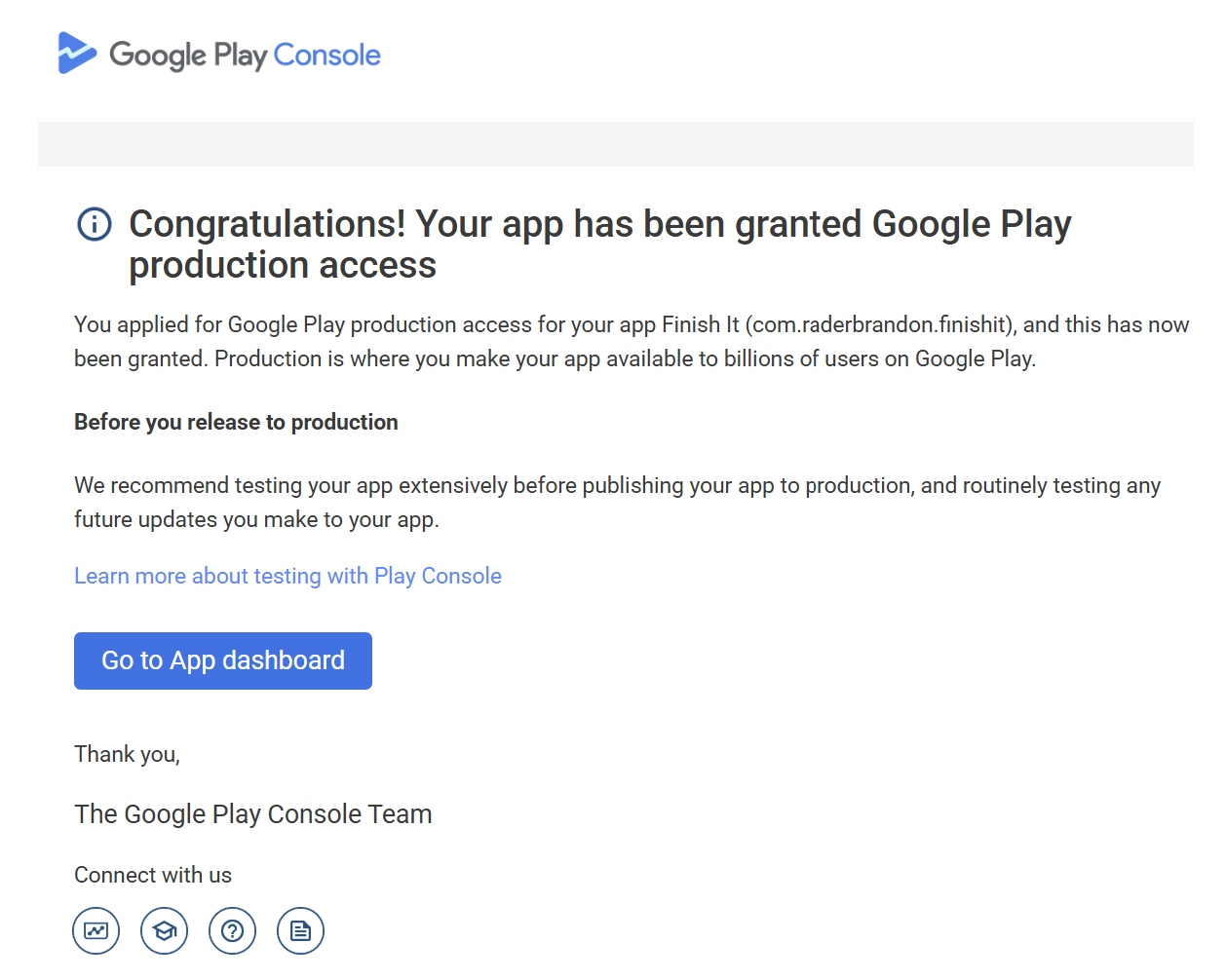
Quality QA Testing Reports
Clear, actionable reports with screenshots and evidence for every important issue found during testing.
Real Device Testing & Diagnostics
Real human testers use physical Android devices to test your app, verify real user flows, and provide clear testing evidence and professional QA reports.
Compliance Audit Passed
Transition your Android app to public production access with confidence. We deliver verified session logs and compliant Console activity.
One Cycle. Complete Approval.
Choose the ideal closed testing cycle for your Android release.
Loading Packages
Please wait while we fetch the best options for your region...
Frequently Asked Questions
Everything you need to know about passing your closed testing requirements.