12 Play Console app testers for Android app testing in Paraguay
Hire 12 Play Console app testers in Paraguay. Pass Google Play closed testing in 14 days with real Android testers and unlock Play Store production access.
The Secret to Passing Google's 14-Day Test in Paraguay
Securing production access in the modern Google Play Console is no longer a matter of simply uploading a clean APK or Android App Bundle (AAB). Google reviewers want clear, undeniable telemetry showing your software has been battle-tested by living human beings under genuine daily operating conditions.
Many independent software creators in Paraguay make the mistake of assuming a casual group chat with friends or college peers is enough to satisfy Play Store Closed Testing. They send out test links, collect twelve initial downloads on day one, and wait for the two-week calendar timer to expire.
Google's automated compliance algorithms track deep engagement signals, background telemetry, crash-free session ratios, and continuous retention across the entire testing cycle. If your testers open the application once on day one and leave it dormant for two weeks, Google flags the entire track as inactive.
The mobile device landscape across Paraguay is diverse, featuring everything from budget Xiaomi, Motorola, and Samsung Galaxy A-series phones to flagship devices running various customized Android OS skins. Your app must prove it can survive real-world memory pressure, sudden cellular handshakes, and diverse screen configurations without throwing unhandled exceptions.
Your testing team must replicate this authentic, chaotic environment every single day. They must install the application through official Play Store opt-in channels, navigate screens, test core user flows, submit diagnostics, and keep the build installed without interruption for 14 consecutive days.
Real Testers vs Automated Bots - The Technical Reality
Faced with the daunting task of finding and managing 12 testers for 14 days, some developers seek shortcuts through cheap automated services or scripted bot farms. This path introduces severe compliance hazards. Google uses advanced machine learning models specifically trained to detect automated click scripts, virtual emulator farms, and unnatural telemetry signatures. If Google flags your testing track for synthetic traffic, you risk losing production approval and facing permanent developer account termination.
Understanding the deep architectural differences between genuine human testers and automated scripts highlights why real testing remains the only reliable route to production approval.
Real Human Testers in Paraguay
Authentic users test your software on physical Android devices featuring unique hardware IDs, carrier configurations, and historical usage. These testers operate established Google accounts with natural browser histories, authentic Google Play purchase records, and regular daily app interactions.
When real humans test your build, their interaction telemetry reflects natural variance. They scroll at irregular intervals, pause between menu selections, trigger background battery optimizations, and encounter edge-case UX hurdles. Furthermore, real testers provide meaningful qualitative feedback, highlighting broken localized text, awkward navigation, or slow API response times over local mobile data connections.
Automated Bot and Emulator Farms
Scripted bot services deploy cloud-hosted emulator instances running automated UI test scripts like Appium or ADB shell inputs. These systems generate rigid, mathematically predictable tap patterns, identical session lengths, and simultaneous login bursts that immediately trigger Google's fraud detection filters.
Emulators and bot farms operate on newly spun, empty Google accounts lacking digital footprints or organic device telemetry. They generate zero qualitative insights, cannot evaluate real-world design readability, and will never catch localized usability flaws. Deploying bots exposes your Play Console account to instant suspension, stripping away your ability to release apps on Android indefinitely.
Your Step-by-Step Play Console Testing Roadmap
Navigating Google Play Closed Testing requires precision, disciplined release tracking, and a systematic workflow. Every milestone, from the initial bundle compilation to the final production application questionnaire, must be executed according to Google's strict developer guidelines.
Follow this structured roadmap to guide your Android app through the 14-day closed testing marathon successfully.
Prepare Build and Console Configuration
Compile your production-ready Android App Bundle (AAB) using valid release signing keys and clean ProGuard or R8 obfuscation rules. Set up your basic Google Play Console listing, including app categorization, privacy documentation links, target audience declarations, and preliminary graphic assets. Ensure your target SDK meets or exceeds Google's latest platform API level requirements.
Create and Populate the Closed Testing Track
Navigate to the Closed Testing section under the Release management menu. Create a dedicated closed testing track and configure an email list consisting of verified, unique Google accounts belonging to your active testers. Generate your secure Play Store opt-in web link and distribute it directly to your designated testing group.
Coordinate Verified Tester Opt-Ins
Ensure all invited participants open the official testing link, accept the closed testing agreement, and download the build directly through the Google Play Store app. Verify your Play Console dashboard registers a minimum of 12 active, opted-in test devices before considering the formal 14-day testing period active.
Maintain 14 Days of Active Daily Engagement
Monitor testing activity continuously over 14 consecutive days. Your testers must keep the application installed on their physical hardware, launching it regularly, interacting with core features, testing UI components, and triggering live API calls. Track your Android Vitals dashboard to catch crashes, ANRs (Application Not Responding), and excessive memory consumption early.
Address Bug Reports and Push In-Flight Updates
When testers uncover bugs or UI inconsistencies on specific Android OS versions, push patched builds directly to the closed testing track. Uploading revised AAB bundles during the active testing window does not reset your 14-day progress, provided your active tester count remains at or above 12 and users update their installs.
Submit Detailed Production Access Application
Once the 14-day requirement concludes, the Play Console unlocks the Apply for Production button. Complete the comprehensive review questionnaire with clear, transparent answers detailing your testing methodologies, user feedback gathered, bugs fixed, and architectural optimizations implemented before requesting full public store access.
Struggling with the 14-Day Testing Requirement?
Skip the hassle of recruiting unreliable testers. Our professional fleet of real Android devices guarantees Google Play compliance in exactly 14 days. Zero bots. Zero emulators. 100% production approval guarantee.
Comparing Your Closed Testing Strategy Options
When tackling Google's mandatory testing rules, developers generally consider three primary paths: managing an informal DIY circle of friends and family, hiring a dedicated managed testing service, or using automated testing scripts. Evaluating these strategies side by side clarifies their impact on compliance, timeline reliability, and developer sanity.
| Feature | Professional Managed Service | DIY (Friends and Colleagues) | Automated Script Farms |
|---|---|---|---|
| Passes Google Review | Guaranteed compliance with genuine telemetry | Variable, high risk of sudden drop-offs | Extremely dangerous, high ban rate |
| Real Hardware Testing | Verified physical Android devices | Limited device variety among friends | Cloud emulators and virtual machines |
| Active 14-Day Retention | Monitored, guaranteed retention daily | Testers often forget or uninstall early | Artificial, predictable server pings |
| Actionable UX Feedback | Detailed bug logs and user insights | Vague answers like 'everything works' | Zero qualitative feedback provided |
| Developer Time Required | Fast 5-minute setup, hands-off management | Constant daily messaging and reminding | Minimal setup, but catastrophic ban risk |
| Network and Geo Diversity | Real carrier and Wi-Fi data environments | Restricted to personal immediate circle | Static data center IP proxy networks |
| Standby Tester Redundancy | Instant replacement if a device fails | None, losing one tester resets timeline | None, entire farm can be flagged at once |
Essential Pre-Launch Compliance Checklist
Before you dispatch your closed testing invitations, your application and Play Console configuration must satisfy technical and legal benchmarks. Overlooking store listing details or privacy disclosures can result in production rejection, even after completing the full 14 days of testing.
Review this comprehensive pre-launch checklist to ensure your app meets all platform standards.
Store Listing and Account Foundations
Privacy, Security, and Legal Governance
Tester Management and Track Execution
Deep Technical Dive: Understanding Android Vitals and Telemetry
Google does not evaluate your testing phase solely by counting calendar days. Behind the scenes, the Play Console continuously analyzes diagnostic telemetry aggregated through Google Play Services on every tester's physical device.
The core metrics Google tracks during closed testing include:
- User-Perceived Crash Rate: Google monitors the percentage of daily active users who experience at least one unhandled crash. For production apps, the platform-wide bad behavior threshold is 1.09%. During closed testing, a spike in crashes signals to automated review systems that your build is unstable and unready for public distribution.
- User-Perceived ANR Rate: Application Not Responding (ANR) events occur when the main UI thread freezes for longer than 5 seconds. Google enforces a strict bad behavior threshold of 0.47% for ANRs. Testers navigating heavy database queries or unoptimized network calls on low-tier hardware help you catch these UI freezes before review.
- Session Depth and Interaction Frequency: Google measures the depth of user sessions. A healthy test track exhibits multiple distinct app launches per user over two weeks, variable session durations lasting from 30 seconds to several minutes, and natural interaction across various fragments and activities.
- Background Wake Locks and Battery Drain: Excessive background CPU wake locks or unthrottled background location requests register as battery drain anomalies in your console vitals.
By utilizing real human testers across diverse Android hardware, you generate authentic diagnostic logs. If an unexpected memory leak crashes the app on Android 14 devices, your testers encounter it safely inside the closed track, giving you the stack trace needed to deploy a fix before applying for production.
Navigating the Production Access Application Questionnaire
Completing 14 days of closed testing unlocks the final hurdle: Google's Production Access Review Questionnaire. This is a manual review step where Google engineers and policy reviewers evaluate your answers to determine if your testing process was genuine.
To maximize your approval chances, prepare structured, detailed responses covering these core areas:
- Recruitment Strategy and Audience Selection: Explain how you recruited your testers and why they represent your target user demographic in Paraguay or broader international markets. Highlight that testers operated on physical hardware across varied network environments.
- Engagement and Feedback Collection: Describe the channels you used to collect qualitative feedback, such as in-app feedback forms, direct email support, or bug tracking boards. Provide specific examples of user comments regarding navigation, readability, or feature workflows.
- Bugs Discovered and Technical Iterations: Document real technical issues identified during the 14 days. Mention specific edge cases, such as an input validation bug on local phone numbers, a layout overflow on small screens, or a network timeout issue, and describe the build updates you pushed to resolve them.
- Value Proposition and App Readiness: Summarize why your application is now stable, compliant, and ready to provide a secure, high-value experience to general Android consumers on Google Play.
Providing honest, technically articulate answers demonstrates to Google reviewers that you treated closed testing as a genuine quality assurance phase rather than a superficial checklist item.
Frequently Asked Questions
Do my closed testers need to be physically based inside Paraguay to pass compliance?
No, Google Play does not mandate that your 12 closed testers reside in the specific country your app targets. You can satisfy the 12 testers for 14 days requirement using verified testers located anywhere globally, as long as they use authentic, personal Google accounts on real Android hardware. However, if your application relies heavily on localized Paraguayan services, specific local payment APIs, or regional cellular carrier integrations, incorporating testers with regional access can provide valuable localized validation alongside universal compliance testing.
What happens if a tester accidentally deletes the app on day 10 of testing?
If a tester uninstalls the application or opts out of the closed testing program, your active installed tester count drops immediately in the Play Console. If your total active tester count falls below the mandatory minimum of 12 at any point during the 14-day window, Google's automated tracker pauses or resets your progress. To safeguard against this, professional testing services always maintain backup testers and active device redundancy to ensure your active count stays consistently above 12 every single day without interruption.
Can I release updates to my app during the active 14-day closed testing period?
Yes, pushing updated builds to your closed testing track is fully supported and actively encouraged by Google. Releasing new versions to patch bugs or optimize UI components proves you are actively maintaining the software based on testing insights. Updating your build does not reset your 14-day countdown timer, provided your testers install the updated version and your total opted-in active tester count remains at or above 12.
How does Google's automated system differentiate between real testers and bot scripts?
Google evaluates multi-layered hardware and behavioral telemetry. Authentic testers have established Google accounts with historical Play Store activity, search footprints, and varied device sensors. Real human usage displays natural timing variations, erratic touch coordinates, orientation changes, and realistic network latency. Bot farms and emulators, by contrast, use blank Google accounts, static cloud IP addresses, identical hardware identifiers, and rigid, machine-timed tap intervals that easily trigger automated anti-abuse flags.
How often are testers required to interact with the application during the 14 days?
Google does not publish a rigid daily time requirement, but the system looks for regular, natural engagement throughout the 14-day period. Opening the app once on day one and leaving it untouched until day 14 does not demonstrate meaningful validation. A compliant testing workflow involves testers launching the app periodically across the two weeks, navigating different screens, testing features, and generating realistic user sessions that reflect authentic app usage.
Is the 12 testers for 14 days rule required for every Android developer account?
This specific requirement applies to all personal Google Play developer accounts created after November 13, 2023. Organization (enterprise) developer accounts and older personal accounts established before this cutoff date are generally exempt from the mandatory 14-day closed testing block. However, thorough closed testing remains a recommended engineering practice for all development teams to optimize Android Vitals and prevent early user churn.
Final Thoughts on Launching Successfully in Paraguay
The burgeoning mobile software market in Paraguay offers immense opportunities for independent developers, fintech innovators, and software startups. Whether you are building an on-demand utility, an educational platform, an e-commerce storefront, or an engaging mobile game, delivering a rock-solid, crash-free user experience is the key to winning customer trust and earning high store ratings.
Viewing Google Play Closed Testing as a strategic quality milestone rather than a bureaucratic hurdle will elevate the quality of your software. By partnering with real human testers on genuine physical devices, you eliminate compliance risks, safeguard your developer account reputation, and ensure that your official public release across Paraguay and the global Android market is an overwhelming success.
Our QA Process
Your journey to Google Play production access, simplified and automated.
Choose Package
Authenticate your account to initialize the 14-day QA fleet for your Android release.
Submit Link
Upload your testing link. We assign 12 verified users with real Android devices to download and test your Android release.
Active Testing
A dedicated testing supervisor is assigned to monitor progress while testers engage with your Android app and provide feedback throughout the testing period.
Get Approved
Our lab maintains active installations for two weeks straight, ensuring a clean track record and providing a QA compliance log for your release.
The Premium QA Advantage
Satisfy your Play Store Console testing obligations with our managed physical device fleet tailored for Android builds.
The 14-Day Production Guarantee
We complete the required 14-day closed testing process with real human testers and physical Android devices, while providing clear testing evidence and documentation throughout the process.
If Google specifically rejects production access due to insufficient testing engagement, you are covered by our free re-run or 100% refund guarantee, subject to our Refund Policy.
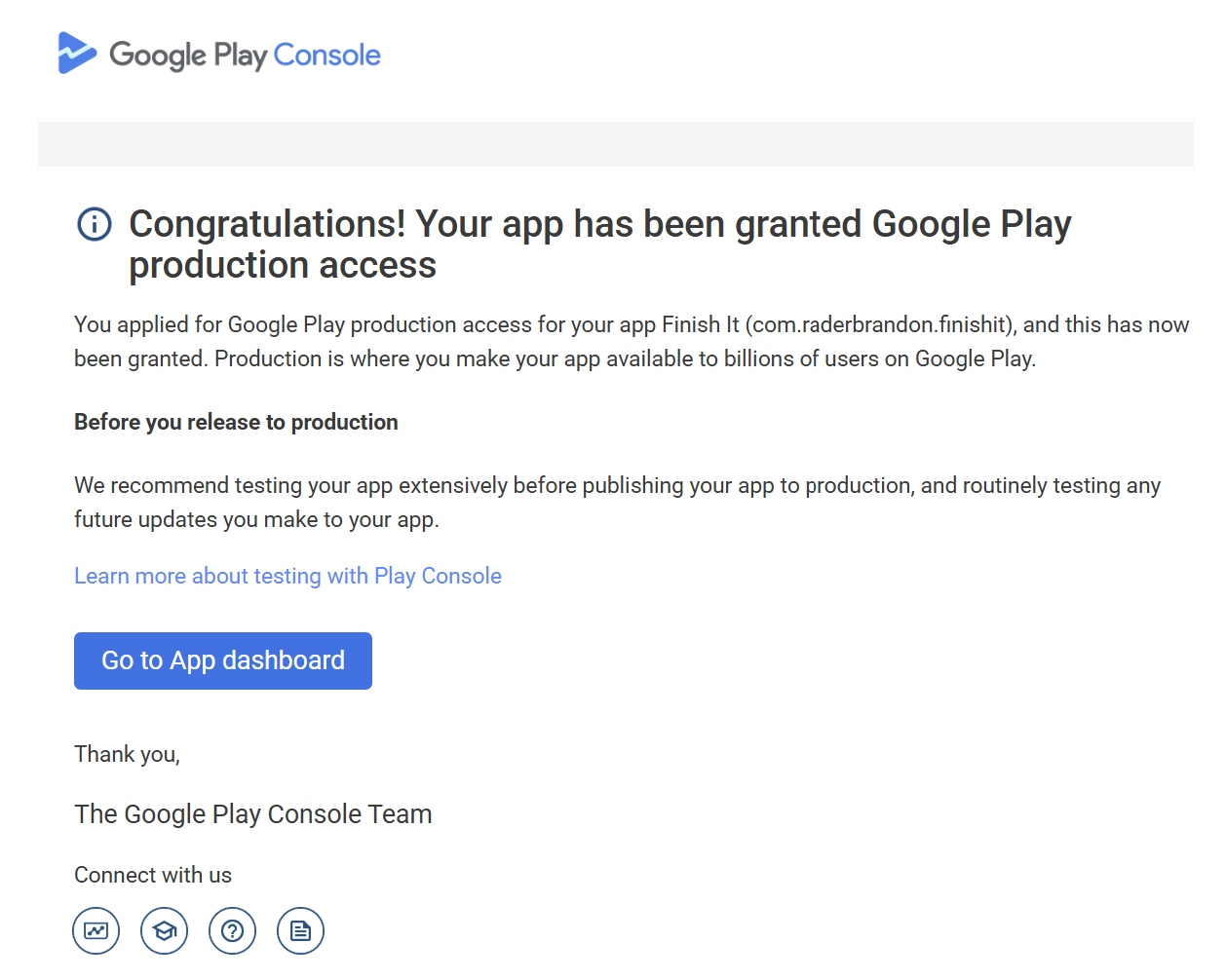
Verified Production Access
Quality QA Testing Reports
Clear, actionable reports with screenshots and evidence for every important issue found during testing.
Real Device Testing & Diagnostics
Real human testers use physical Android devices to test your app, verify real user flows, and provide clear testing evidence and professional QA reports.
Production Access Secured
Our structured 14-day closed testing process is designed to meet Google Play's production requirements for your Android release.
Simple Closed Testing Pricing
Select the plan that fits your Android app complexity.
Loading Packages
Please wait while we fetch the best options for your region...
Frequently Asked Questions
Everything you need to know about passing your closed testing requirements.