12 Play Console app testers for Android app testing in Peru
Get 12 Play Console app testers in Peru. Pass Google Play closed testing easily with our authentic 12 testers for 14 days Play Store service.
Launching an Android app in Peru is not just about translating your interface into Spanish and hoping for the best. From the bustling, highly connected streets of Lima to the variable network conditions found in Cusco and the Amazon basin, the Peruvian digital landscape is as wildly diverse as its geography. For developers, this means your application must be resilient, adaptable, and thoroughly vetted before it ever reaches the wider public. However, before you can even think about conquering the Peruvian digital market, you are immediately faced with a rigid bureaucratic hurdle: Google Play Closed Testing. To get your application published, Google mandates a strict, continuous testing phase with real users. Finding a reliable, active group to fulfill this requirement, especially if you find yourself suddenly searching for those final 12 Play Console app testers to complete your mandatory pool, is often the most frustrating bottleneck separating your hard work from an actual, profitable product launch.
Why the Peruvian Market Demands Rigorous Pre-Launch Vetting
The smartphone adoption rate across Peru has been climbing at an incredible pace. Modern Peruvian consumers expect flawless performance, whether they are booking a ride in Callao, ordering food in Trujillo, or checking their bank balances in Arequipa.
If your application stutters on older Android hardware or drops data during sudden network transitions, local users will simply uninstall it. There is very little patience for unoptimized software in today's competitive app ecosystem.
This makes localized, hands-on testing absolutely vital. You simply cannot rely on virtual emulators hosted in a remote server farm to accurately tell you how your application behaves in real-world Latin American conditions.
Google understands this fundamental reality, which is exactly why Play Store Closed Testing is now a non-negotiable requirement for new developers. They want undeniable proof that real humans have interacted with your software on real devices over a sustained period.
The Unvarnished Truth About Google Play Closed Testing
Far too many ambitious developers severely underestimate the closed track requirement. It is definitely not a mere bureaucratic checkbox that you can lazily click through in a single weekend.
The policy is incredibly specific: you must have real, opted-in users to keep your application installed and actively engaged for a continuous fortnight. Any break in this chain can result in a rejected application.
Finding genuine, reliable participants organically is notoriously difficult. Your friends and family might enthusiastically install the application on day one, only to completely forget about it by day three, effectively resetting your hard-earned progress.
When you inevitably realize that your organic network is falling short, sourcing a professional service to provide precisely 12 Testers for 14 Days becomes the most logical, stress-free path to ensure full policy compliance and avoid a devastating launch delay.
Struggling with the 14-Day Testing Requirement?
Skip the hassle of recruiting unreliable testers. Our professional fleet of real Android devices guarantees Google Play compliance in exactly 14 days. Zero bots. Zero emulators. 100% production approval guarantee.
The Dangers of Cutting Corners: Real Testing vs. Bot Farms
When developers become desperate to meet the testing thresholds, they sometimes turn to shady providers offering instantaneous results. This is a catastrophic mistake that can lead to permanent bans. Google's detection algorithms are incredibly sophisticated and can easily spot artificial engagement. Here is a breakdown of why authentic engagement is the only viable path.
Authentic User Testing
Genuine testing involves real human beings installing your application on their personal Android devices. These devices have unique hardware IDs, varied screen resolutions, and authentic Google account histories. When a real user interacts with your application, their usage patterns are naturally erratic. They might open the application in the morning, browse for a few minutes, close it, and return the next day. This organic behavior is exactly what the Play Store review algorithms are looking for. Furthermore, real testers can provide actual, actionable feedback about UI glitches, confusing navigation, or localization errors specific to the Peruvian market. Investing in real human engagement not only ensures compliance but actively improves the final quality of your digital product.
Automated Bot Farms
Bot farms rely on automated scripts running on server racks or rooted devices sitting in a warehouse. These accounts often have zero genuine history and mimic human behavior poorly. They will typically open the application at the exact same time every day, click the exact same coordinates, and stay active for a mathematically perfect duration. Google's security systems immediately flag these identical, robotic patterns as fraudulent manipulation. If your developer account is caught using bot farms to bypass the testing requirements, the penalties are severe. Your application will be instantly rejected, your developer fee will not be refunded, and your entire developer account could be permanently terminated, effectively ending your mobile development career before it even begins.
Essential Feature Comparison: Choosing Your Testing Strategy
Understanding the different approaches to fulfilling the testing mandate is crucial for a smooth launch. Below is a detailed comparison of common strategies.
| Feature | Professional Service | DIY (Friends & Family) | Automated Bots |
|---|---|---|---|
| Account Authenticity | High (Real Google Accounts) | High (Real Google Accounts) | Extremely Low (Flagged Accounts) |
| Device Diversity | Excellent (Varied Android Models) | Limited (Whatever friends own) | Poor (Often emulators) |
| Retention Guarantee | 100% Guaranteed for 14 Days | Unpredictable & Unreliable | Guaranteed to be flagged |
| Compliance Risk | Zero (Fully Compliant) | Low (But high risk of failure) | Critical (Account Ban Risk) |
| Actionable Feedback | Detailed & Constructive | Biased & Often unhelpful | None |
| Time Investment | Minimal (Outsourced) | Massive (Constant nagging) | Zero |
Pre-Launch Prep: Your Peruvian App Deployment Checklist
Before you initiate your formal testing phase, you must ensure that your application is genuinely ready for human interaction. Submitting a broken application to your testers will only result in crashes and wasted time. Follow this comprehensive checklist to prepare your digital product for the rigorous evaluation process.
Technical Readiness & Localization
Ensure that every single string of text, button label, and error message is properly translated into Latin American Spanish. Do not rely solely on automated translation tools, as they often miss crucial cultural nuances or use awkward phrasing that will immediately alienate Peruvian users.
Test your application's behavior under severe network throttling. Peru's mobile infrastructure can be inconsistent outside major urban centers. Your application should gracefully handle sudden drops from 4G to 3G, offline states, and high-latency connections without crashing or corrupting user data.
Verify that your user interface scales correctly across a wide variety of screen sizes and aspect ratios. The Android market in Peru is dominated by a vast array of mid-range and budget devices from various manufacturers. Your layout must be fluid and responsive to accommodate these technical differences.
Implement robust crash reporting and analytics tools before handing the application over to your testers. You need concrete data on how the application performs in the wild. If a tester experiences a fatal crash, your dashboard should capture the exact stack trace and device information immediately.
Play Console Configuration
Google requires a meticulous disclosure of exactly what user data your application collects, how it is encrypted, and whether it is shared with third parties. Take the time to fill out the Data Safety section accurately, as discrepancies here are a primary cause for application rejection.
Navigate to your Play Console dashboard and officially set up your closed track. You must carefully define your release, upload your signed Android App Bundle (AAB), and prepare the track to accept the email addresses of your designated testing group.
Do not simply throw the application at your testers and expect them to know what to do. Write a clear, concise guide outlining the core functionalities they need to explore, specific user flows to complete, and exactly how they should report any bugs or visual glitches they encounter.
The Roadmap to a Successful Peruvian Launch
Navigating the path from a finished codebase to a live application requires patience, strategy, and strict adherence to Google's protocols. This roadmap outlines the typical journey for a developer aiming for the Peruvian market.
Phase 1: Internal Quality Assurance
Before involving any external parties, conduct a rigorous internal audit of your application. Hunt down obvious memory leaks, ensure basic navigation flows logically, and verify that your localized Spanish text fits within the designated UI components without awkward clipping or overflow.
Phase 2: Securing Your Testing Roster
This is the pivotal moment where you must gather your reliable group of participants. Whether you are leveraging a professional agency to supply exactly 12 Play Console app testers or managing a larger group, ensure that every single participant has a valid Google account and understands the 14-day commitment.
Phase 3: The 14-Day Evaluation Crucible
Once the application is distributed via the closed track, the clock starts ticking. Your participants must download the application, keep it installed on their primary devices, and interact with it periodically. Monitor your Play Console dashboard closely to ensure the active install metric remains stable throughout the entire two-week period.
Phase 4: Feedback Integration and Refinement
As your testers interact with the application, they will inevitably uncover minor bugs, confusing UI elements, or performance hiccups. Collect this feedback diligently. You are expected to release at least one or two minor updates during the testing phase to demonstrate to Google that you are actively maintaining and improving the software based on user input.
Phase 5: Applying for Production Access
After successfully completing the mandatory 14-day continuous testing phase and integrating user feedback, you will finally unlock the ability to apply for production access. Submit your comprehensive application to Google's review team, highlighting the testing you conducted and the improvements you made. Once approved, your application is ready to conquer the Peruvian market.
Frequently Asked Questions About Google Play Closed Testing
Developers targeting the Peruvian market often have highly specific questions regarding the intricacies of the testing requirements. Below is a meticulously detailed compilation of the most common inquiries, providing in-depth answers to ensure your launch proceeds without a hitch.
Why does Google explicitly mandate 20 testers for 14 days, and what if I only have a few?
Google implemented this stringent policy to drastically improve the overall quality of applications available on the Play Store. Historically, the platform was flooded with low-quality, buggy, or outright malicious applications that ruined the user experience. By forcing developers to maintain a minimum of 20 active, opted-in testers for a continuous 14-day period, Google ensures that only serious, committed developers can publish software. This process acts as a massive filter against spam and low-effort clones. If you currently only have a handful of reliable friends willing to help, you are mathematically short of the requirement. This is precisely why many independent developers seek out professional services to supply the remaining 12 Play Console app testers needed to reach the threshold. Falling short of the required number, even by a single person, means you cannot progress to the production phase, trapping your application in development purgatory.
Does the geographic location of my testers matter if my primary target audience is in Peru?
From a strict policy compliance standpoint, Google does not currently mandate that your required testers must be physically located in the country you intend to target. You can technically fulfill the basic Google Play Closed Testing requirement using testers from Europe, Asia, or North America, even if your app is specifically designed for users in Lima or Cusco. However, from a practical and strategic perspective, having testers who reside in or deeply understand the local environment is immensely beneficial. Local testers can accurately evaluate your Spanish localization, assess how the app performs on regional mobile networks, and confirm whether local payment gateways function correctly. While you can use a global testing service to quickly meet the numerical requirement and pass Google's automated checks, supplementing that with genuine local feedback will significantly improve your app's reception upon its official launch.
What exactly constitutes 'active testing' during the 14-day closed track period?
'Active testing' is a critical concept that many developers fundamentally misunderstand, leading to unexpected rejections. Google does not simply want people to download the application on day one and then never open it again. While they do not explicitly publish the exact algorithmic thresholds, the consensus is that testers need to retain the application on their device for the entire 14 days and engage with it periodically. This means opening the application, navigating through various screens, testing core features, and perhaps triggering some background processes. If a tester uninstalls the application on day six, they are no longer counted towards your active pool. If your active install base drops below the required 20 users at any point during the fortnight, the 14-day timer will reset, forcing you to begin the agonizing waiting period all over again. Therefore, maintaining consistent, organic engagement is paramount.
Can I use automated bots, scripts, or emulators to simulate the required 12 Testers for 14 Days?
Absolutely not. Attempting to bypass the Play Store Closed Testing requirements using automated bots, click-farms, or server-hosted emulators is the most dangerous mistake a developer can make. Google's Play Protect and developer security algorithms are incredibly advanced. They analyze hardware identifiers, IP address clusters, user behavioral patterns, and account histories with frightening accuracy. If they detect that a cluster of mathematically perfect, identical interactions is occurring on your application, they will immediately flag your developer account for fraudulent activity. The consequences are severe and swift: your application will be permanently rejected, your developer registration fee will be forfeited, and your entire developer account could be terminated. Furthermore, Google often bans associated accounts, meaning you could be permanently exiled from the Android ecosystem. Always invest in real, authentic human testing.
What should I do if my application keeps crashing on my testers' devices in Peru?
If your application is consistently crashing during the closed testing phase, you must pause and address the root technical issues immediately. First, utilize your crash reporting tools to gather detailed stack traces and device logs. Identify exactly which Android versions and specific hardware models are experiencing the failures. In the Peruvian market, you may encounter a wide variety of older or budget-friendly Android devices that lack the processing power or memory of flagship phones. You may need to optimize your image assets, fix memory leaks, or adjust your minimum SDK requirements. Once you have engineered a solution, you must upload a new version of your application to the closed testing track. Pushing updates during the testing phase is highly encouraged, as it demonstrates to Google's reviewers that you are an active, responsible developer who listens to feedback and maintains their software.
How do I ensure my Peruvian Spanish localization is actually accurate and culturally appropriate?
Relying exclusively on automated translation services for your application's user interface is a recipe for disaster. Latin American Spanish, and specifically the dialect and colloquialisms used in Peru, can vary significantly from the Spanish spoken in Spain or Mexico. Automated tools frequently produce stiff, formal, or contextually incorrect translations that make your application feel cheap and untrustworthy to local users. To ensure accuracy, you must involve native Peruvian speakers in your review process. Have them carefully read through every single menu, error alert, onboarding screen, and push notification. They can help you adjust the tone to be more natural and engaging. A perfectly localized application builds immediate trust with the user, drastically reducing initial uninstall rates and improving your long-term retention metrics in the competitive South American market.
What happens if a tester accidentally uninstalls the application on day 12 of the 14-day period?
This is one of the most stressful scenarios a developer can face. If a tester uninstalls your application before the full 14-day period has concluded, they are immediately removed from your active tester count. If this removal causes your total number of active, opted-in testers to drop below the mandatory threshold of 20, your 14-day consecutive testing streak is broken. The Google Play Console will register this drop, and the timer required for production access will effectively reset. You will be forced to recruit a replacement tester, get them onboarded, and start the grueling two-week waiting period from the very beginning. This incredible fragility is exactly why it is highly recommended to recruit more than the bare minimum of 20 testers. Aiming for 25 to 30 initial participants provides a crucial safety buffer, ensuring that even if a few people drop out or break their phones, your compliance streak remains entirely intact.
How exactly do I transition from the closed testing track to the full production release?
The transition from closed testing to production is not an automatic process; it requires a formal application and manual review. Once your dashboard indicates that you have successfully maintained the required number of active testers for 14 continuous days, a new option will unlock in your Play Console allowing you to apply for production access. Clicking this will present you with a detailed questionnaire from Google. You will be required to explain exactly how you conducted your testing, what specific feedback you received from your participants, and precisely what changes or bug fixes you implemented as a result of that feedback. You must provide thoughtful, detailed answers to these questions. Google's review team will manually evaluate your submission. If they are satisfied that you conducted a genuine testing phase and improved the application, they will grant you production access, finally allowing you to publish your app to the public Play Store in Peru and beyond.
How We Deliver 12 Testers
How we deploy real devices and guarantee compliance for your release.
Connect Account
Sign in with Google to configure the closed testing environment for your Android build.
Assign Testers
Submit your Google Play Console testing link, and our team will assign qualified testers from our testing network to join your Android closed testing release.
Daily QA Runs
A QA supervisor monitors daily check-ins, ensuring 12 unique Android users engage with your Android build every single day.
Launch Ready
We guarantee 14 consecutive days of active user check-ins to satisfy Google's compliance policies, delivering an audit-ready PDF feedback report.
Our Testing Infrastructure
Experience a next-generation testing infrastructure built for Google Play compliance for your Android release.
The 14-Day Production Guarantee
We complete the required 14-day closed testing process with real human testers and physical Android devices, while providing clear testing evidence and documentation throughout the process.
If Google specifically rejects production access due to insufficient testing engagement, you are covered by our free re-run or 100% refund guarantee, subject to our Refund Policy.
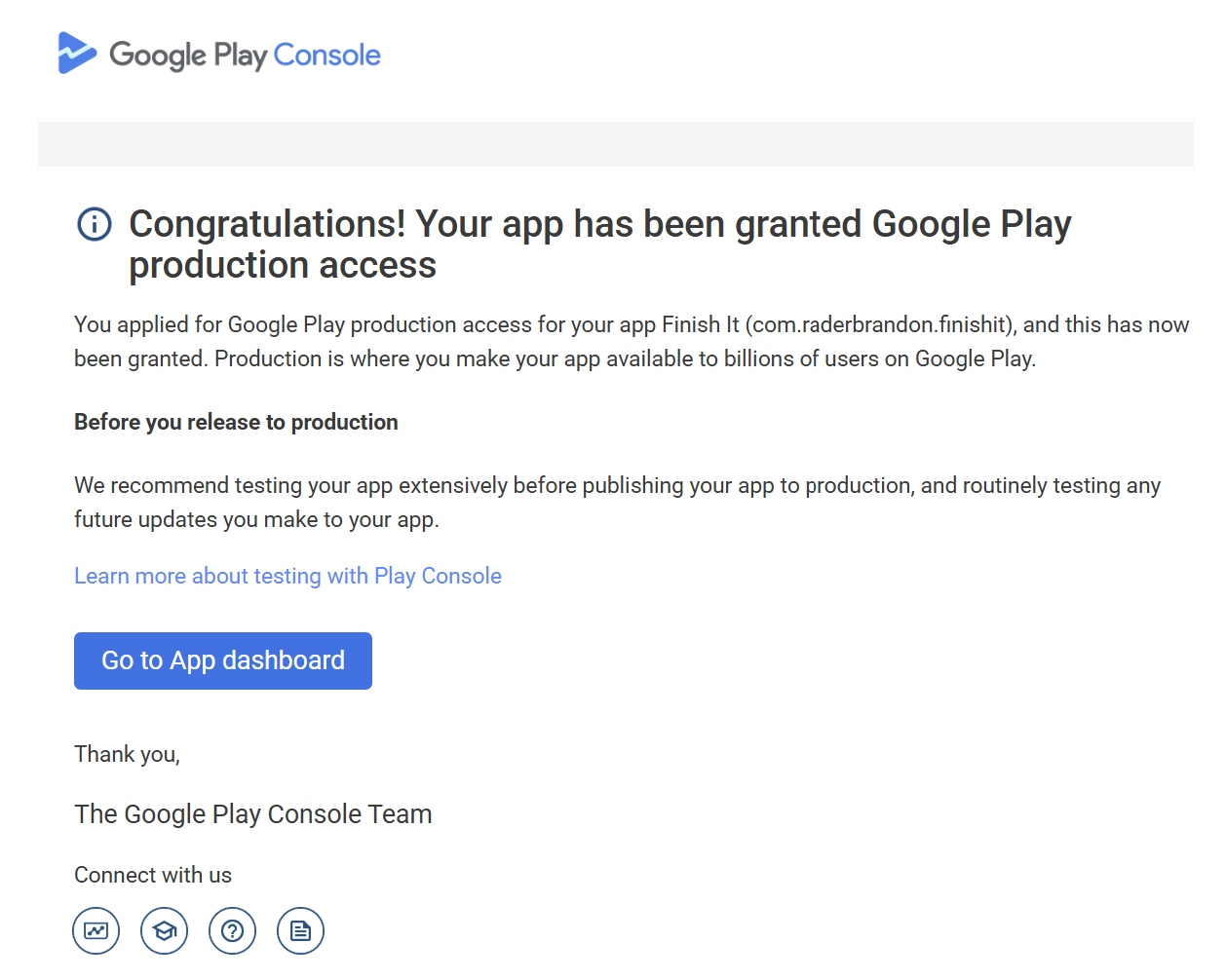
Verified Production Access
Quality QA Testing Reports
Clear, actionable reports with screenshots and evidence for every important issue found during testing.
Real Device Testing & Diagnostics
Real human testers use physical Android devices to test your app, verify real user flows, and provide clear testing evidence and professional QA reports.
Compliance Audit Passed
Get your Android build approved on the first try. We create an audit-ready compliance profile that proves thorough quality assurance.
Affordable Compliance Cycles
Transparent plans built to satisfy Google Play Console guidelines for your Android build.
Loading Packages
Please wait while we fetch the best options for your region...
Frequently Asked Questions
Everything you need to know about passing your closed testing requirements.