12 Play Console app testers for Android app testing in Tanzania
Hire 12 Play Console app testers in Tanzania. Pass Google Play closed testing in 14 days with real Android testers and unlock Play Store production access.
Navigating Google Play Closed Testing in Tanzania
Publishing an Android app in Tanzania requires meeting both local consumer needs and global Play Console compliance standards. The Tanzanian smartphone market is characterized by a vibrant mix of entry-level and mid-range devices from Transsion brands like Tecno, Infinix, and Itel, along with Samsung Galaxy A-series, Xiaomi Redmi devices, and older Android hardware. Furthermore, users connect through diverse mobile telecommunications networks such as Vodacom Tanzania, Tigo, Airtel, and Halotel, often experiencing variable bandwidth, localized latency spikes, and periodic connection handoffs.
When you submit an app for Play Store Closed Testing, Google's automated monitoring system does not just count the number of email invites you send out. The platform actively monitors telemetry: opt-in velocity, install timestamps, daily active user sessions, screen orientation changes, background memory consumption, crash frequencies, and application unresponsive rates. If your testing group consists of friends who download the build on day one and never launch it again, your production application questionnaire will fail to demonstrate meaningful validation. Achieving full Google Play Closed Testing compliance means proving that your Android application functions reliably across actual Tanzanian device profiles, offline edge cases, and local network constraints without fatal exceptions.
The Pitfalls of Bot Networks Versus Authentic Tester Engagement
Under pressure to meet product launch deadlines, many app publishers consider using cheap bot farms, automated emulator scripts, or informal link swaps. These shortcuts represent the quickest path to a permanent developer account suspension. Google uses machine learning models trained on millions of authentic user interactions to inspect closed testing data. When an account exhibits artificial usage, the Play Console flags the app for policy circumvention.
Authentic Human Testing
Real human testers provide natural behavioral variance that algorithms recognize immediately. Real users open apps at irregular intervals throughout the day, navigate menus with varied swipe speeds, switch between light and dark system modes, rotate screens, and encounter genuine edge cases on physical hardware. Their session logs feature organic device fingerprints, varying battery states, realistic carrier data, and legitimate background app switching. This authentic activity provides solid proof to the Google review board that your product has undergone exhaustive, real-world user validation.
Automated Bots and Emulator Farms
Automated scripts, virtual emulators, and low-cost bot services rely on repetitive interaction loops running on data center IP addresses or emulated hardware. These setups exhibit synchronized session durations, identical touch coordinates, missing sensor telemetry, and zero device-level variance. Google's security systems easily detect these synthetic patterns. Using automated testing tricks can lead to immediate rejection of production access, loss of your registration fee, and a permanent ban of your developer account.
Comparing Closed Testing Strategies for Tanzanian Developers
Choosing how to execute your closed testing phase determines whether you launch on schedule or waste months troubleshooting console rejections. Below is a detailed breakdown of the three primary methods available to engineering teams and solo developers in Tanzania:
| Evaluation Criteria | Managed Professional Testing | DIY Friends & Peer Networks | Automated Bots & Emulators |
|---|---|---|---|
| Active Tester Reliability | Guaranteed 100% daily retention for the entire 14-day window | Unpredictable; high drop-off and uninstalls after 48 hours | Artificial pings with zero authentic user behavior |
| Hardware Diversity | Real physical devices spanning Android 9.0 through Android 15 | Limited to devices owned by immediate friends and colleagues | Emulated virtual instances with uniform hardware profiles |
| Network Realism | Diverse cellular (Vodacom, Airtel, Tigo) and broadband connections | Typically restricted to local Wi-Fi or single operator circles | Data center IP blocks and repetitive proxy subnets |
| Play Console Approval Rate | Extremely high due to structured, compliant usage telemetry | Moderate to low; often stalled by poor engagement metrics | 0% approval rate; triggers immediate account suspension |
| Daily Engagement Monitoring | Automated tracking and active check-ins to prevent drop-outs | Requires constant manual chasing and reminders | Scripted automated pulses easily flagged by Google |
| Feedback Quality | Detailed crash logs, UX critique, and structured bug submissions | Superficial feedback like "looks good" or no written notes | None or randomized generic text strings |
| Production Form Assistance | Comprehensive data and guidance for the 14-day review questionnaire | Developer must guess how to explain poor user metrics | Not applicable; account flagged before questionnaire stage |
Struggling with the 14-Day Testing Requirement?
Skip the hassle of recruiting unreliable testers. Our professional fleet of real Android devices guarantees Google Play compliance in exactly 14 days. Zero bots. Zero emulators. 100% production approval guarantee.
Step-by-Step Compliance Roadmap for Android Apps
Securing production access on the Google Play Store is a structured, repeatable engineering process. By following this five-stage compliance roadmap, software teams in Tanzania can complete their closed testing requirements smoothly without resetting the 14-day clock.
1. Track Configuration and App Bundle Upload
Compile your production-ready Android App Bundle (AAB) with release keys and ProGuard or R8 code shrinking enabled. Navigate to your Google Play Console, open your app dashboard, and create a new release under the Closed Testing track. Configure your country availability to include Tanzania and any other target geographic markets. Set up your tester email list using Google Groups or direct email invitations, ensuring all permissions, terms of service URLs, and data privacy declarations are fully validated.
2. Seamless Tester Onboarding and Opt-In
Distribute the generated web opt-in and Android Play Store join links to your 12 dedicated testers. Each tester must accept the invitation using the primary Google account associated with their physical Android device. Once opted in, testers download and install the build directly from the Play Store rather than sideloading an APK. This creates legitimate install attribution in the Google Play Console analytics dashboard.
3. Continuous Daily Testing and Telemetry Generation
During the mandatory 14-day testing period, all testers must keep the application installed on their smartphones and launch it regularly. Testers explore core functional flows, test offline caching mechanisms, input data, test local payment or API workflows, and interact with push notifications. This activity generates healthy daily active user (DAU) curves, session duration distributions, and Android vitals data required by Google's compliance systems.
4. Iterative Bug Fixing and Build Updates
Monitor your Firebase Crashlytics, Sentry, and Play Console vitals dashboards for any reported crashes, Native Memory ANRs, or UI thread freezes. When bugs or rendering issues are detected on specific screen sizes or OS versions, push incremental version code updates to your Closed Testing track. Releasing updates during the testing phase shows the Google Play review team that you actively maintain the app and utilize tester feedback.
5. Production Access Application Submission
Once the 14 continuous days with 12 active opted-in testers are complete, the Play Console unlocks the Apply for Production button. You will be presented with a comprehensive questionnaire where you must describe your target audience, explain how you recruited testers, detail the feedback gathered during the test, and summarize the technical adjustments you made. Providing detailed, honest answers backed by real testing data results in quick production approval.
Pre-Launch Readiness Checklist for Tanzanian Developers
Before you begin your Google Play Closed Testing cycle, make sure both your software architecture and your store listing meet Google Play's baseline technical and policy requirements. Use this checklist to audit your release build before sharing it with external testers.
Technical Architecture & Device Optimization
Verify that your app supports 64-bit architectures and targets the latest Android API level (Target SDK 34 or higher) required by Google Play policies.
Test low-RAM optimization and background memory usage to ensure smooth performance on devices with 2GB to 3GB of RAM common across East Africa.
Implement graceful network error handling, offline local storage caching (e.g., Room database or DataStore), and timeout fallbacks for unstable mobile connections.
Minimize overall download size using dynamic feature modules, WebP image compression, and resource shrinking to reduce mobile data usage for local testers.
Integrate reliable crash tracking tools such as Firebase Crashlytics or Bugsnag to log unhandled runtime exceptions during closed testing sessions.
Play Console Listing & Legal Compliance
Host a fully transparent, accessible Privacy Policy web page that clearly outlines what personal and device data your app collects, stores, and shares.
Complete the Play Console Data Safety questionnaire accurately, disclosing location tracking, contact access, storage permissions, and third-party analytics SDKs.
Prepare high-resolution store graphics: 512x512 app icon, 1024x500 feature banner, and at least four detailed screenshots showcasing actual app functionality.
Provide clear test login credentials in the App Access section of the console if your app requires phone number verification (OTP), user registration, or paid access.
Confirm that all Swahili and English localization strings, currency representations (TZS), and date formats render correctly without layout clipping.
Closed Testing Track Management
Set up an active Closed Testing track under the Release management menu and verify that your track status displays as Active and Rollout at 100%.
Ensure the country availability settings for your testing track explicitly include Tanzania alongside any other regional testing locations.
Double-check that all 12+ tester Gmail addresses are properly added to your designated Google Group or email list and marked as opted-in via the web link.
Establish a central feedback channel (such as a support email address, Google Form, or Discord server) for testers to report issues during testing.
Essential Optimization Strategies for Apps in East Africa
Launching an Android app for the Tanzanian market requires a deep understanding of local user habits, mobile infrastructure, and hardware realities. Developers who tailor their software specifically to the East African ecosystem achieve significantly higher retention rates, better Play Console vitals, and smoother production approval.
Optimizing for Local Hardware and Memory Constraints
In Tanzania, millions of consumers use smartphones manufactured by Transsion (Tecno, Infinix, Itel) and budget models from Samsung and Xiaomi. Many of these devices run Android Go Edition or have limited RAM and internal storage. If your app consumes excessive heap memory or runs background services that drain batteries, the Android operating system will kill your background tasks. This leads to poor user vitals and potential Google Play Closed Testing flags. Profile your build using Android Studio Profiler to ensure your app maintains a lightweight memory footprint, releases unused bitmap caches, and minimizes unnecessary background wake-locks.
Handling Cellular Connectivity and Offline Data Sync
While 4G and 5G networks are expanding across major cities like Dar es Salaam, Arusha, and Mwanza, mobile internet in peripheral districts can switch between 3G, EDGE, or experience temporary blackouts. An app that crashes when a network request fails will receive immediate negative feedback. Implement resilient network architectures using Kotlin Coroutines, Retrofit with custom OkHttp interceptors, and local database caching. Your app should store user actions locally while offline and synchronize automatically when connectivity is restored, providing a smooth, uninterrupted user experience.
Localized Payment and Communication Workflows
Many consumer and B2B apps in Tanzania integrate mobile money payment channels such as M-Pesa, Tigo Pesa, Airtel Money, or Halopesa, alongside local SMS verification gateways. During Google Play Closed Testing, ensure that your staging and sandbox environments allow testers to complete end-to-end checkout and verification flows without requiring real money transactions. If your production review team cannot test your core monetization or authentication features due to hardcoded local payment barriers, your production access application will be delayed.
Frequently Asked Questions
Why does Google Play require 12 testers for 14 continuous days before production access?
Google introduced this mandatory closed testing requirement to protect the Play Store ecosystem from low-quality, buggy, or malicious apps created by personal developer accounts. In the past, bad actors and inexperienced developers frequently published broken or clone applications that degraded user trust and caused security vulnerabilities. Requiring exactly 12 Testers for 14 Days on an active closed testing track forces developers to validate their software on diverse physical Android devices before releasing it to the public. Google monitors whether the app runs without crashing, evaluates user retention, and assesses whether the developer actively fixes reported bugs. This process acts as a quality filter, ensuring that only stable, well-maintained software achieves public production status.
Can I use testers located outside of Tanzania for my Tanzanian Android app?
Yes, Google does not restrict your testers to the physical borders of Tanzania unless you deliberately restrict your Closed Testing track country settings. As long as your testing track includes the countries where your testers live, individuals worldwide can opt in and install your build. However, having local Tanzanian testers provides important practical benefits. Local testers evaluate your app under actual Tanzanian network conditions (Vodacom, Tigo, Airtel), test local phone number formats, verify Swahili translations, and test local API responses. While international testers satisfy technical Play Console compliance, combining them with local users ensures your app is fully optimized for your target audience.
What happens if a tester uninstalls my app on day 10 of the 14-day testing period?
If a tester uninstalls your application or leaves the testing group before the full 14 days are complete, their active status is revoked in the Play Console backend. If your total count of active, opted-in testers drops below the mandatory minimum of 12, Google's automated compliance timer will pause or reset entirely. You will not be allowed to apply for production access until you re-establish a continuous 14-day streak with at least 12 active testers. To avoid this setback, it is best practice to recruit 15 to 20 testers. Maintaining a buffer ensures you stay above the 12-tester threshold even if a few participants change devices or drop out early.
Do my testers need to open and interact with the application every single day?
Yes, consistent user interaction is vital for passing the production review. While Google does not publish an exact daily usage quota, its algorithms actively monitor engagement metrics such as daily active sessions, screen views, session length, and Android vitals. If 12 testers download your app on day one and never open it again for the remaining 13 days, Google will classify the test as dormant or artificial. When you subsequently apply for production access, the review team will likely reject your request due to insufficient engagement. Testers should open the app regularly, test different features, trigger state updates, and use the software naturally throughout the 14-day testing window.
How should I fill out the Google Play production access questionnaire after 14 days?
When your 14-day testing window concludes, the Apply for Production button becomes active in your Play Console dashboard, opening a detailed questionnaire. You must answer questions regarding your target audience, your tester recruitment methods, the specific feedback you received, and the code changes you implemented during the testing phase. Avoid vague or generic answers such as "everything went well" or "tested by friends." Instead, provide concrete, professional details: list the specific device models tested (e.g., Tecno Spark, Samsung Galaxy A14), describe real bugs discovered (such as offline caching failures or UI layout issues), explain how you resolved those bugs with new builds, and summarize your feedback collection process. Concrete, technical explanations demonstrate that your app is thoroughly tested and ready for production launch.
Why should Tanzanian developers choose a managed testing service instead of finding testers manually?
Finding 12 reliable people who will commit to installing an unfinished app, keeping it on their devices for two full weeks, and using it daily is challenging and time-consuming. Friends, family, and online contacts often forget to open the app, run out of phone storage space, or accidentally uninstall the build, resetting the 14-day timer. A professional, managed testing service provides a guaranteed group of verified, real Android device owners who maintain continuous daily activity and provide structured technical feedback. This eliminates the risk of testing resets, protects you from dangerous bot networks, ensures high Android vitals compliance, and frees your engineering team to focus on building features rather than chasing testers.
Our QA Process
Your journey to Google Play production access, simplified and automated.
Choose Package
Authenticate your account to initialize the 14-day QA fleet for your Android release.
Submit Link
Upload your testing link. We assign 12 verified users with real Android devices to download and test your Android release.
Active Testing
A dedicated testing supervisor is assigned to monitor progress while testers engage with your Android app and provide feedback throughout the testing period.
Get Approved
Our lab maintains active installations for two weeks straight, ensuring a clean track record and providing a QA compliance log for your release.
The Premium QA Advantage
Satisfy your Play Store Console testing obligations with our managed physical device fleet tailored for Android builds.
The 14-Day Production Guarantee
We complete the required 14-day closed testing process with real human testers and physical Android devices, while providing clear testing evidence and documentation throughout the process.
If Google specifically rejects production access due to insufficient testing engagement, you are covered by our free re-run or 100% refund guarantee, subject to our Refund Policy.
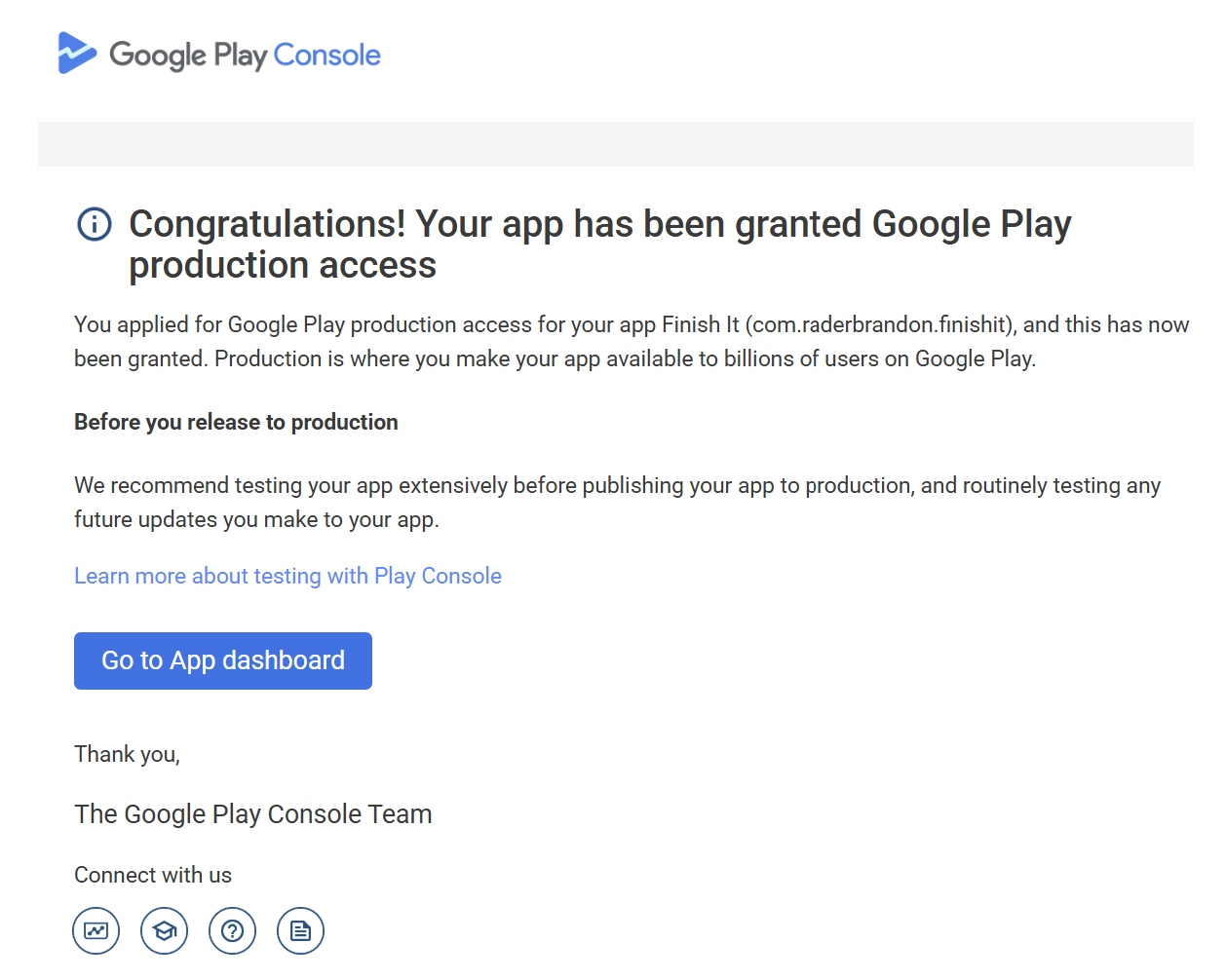
Verified Production Access
Quality QA Testing Reports
Clear, actionable reports with screenshots and evidence for every important issue found during testing.
Real Device Testing & Diagnostics
Real human testers use physical Android devices to test your app, verify real user flows, and provide clear testing evidence and professional QA reports.
Production Access Secured
Our structured 14-day closed testing process is designed to meet Google Play's production requirements for your Android release.
Simple Closed Testing Pricing
Select the plan that fits your Android app complexity.
Loading Packages
Please wait while we fetch the best options for your region...
Frequently Asked Questions
Everything you need to know about passing your closed testing requirements.