12 Play Console app testers for Android app testing in Trinidad
Hire 12 Play Console app testers in Trinidad. Pass Google Play closed testing in 14 days with real Android testers and unlock Play Store production access.
The Reality of Google Play Closed Testing for Trinidadian Developers
Building an Android application from Port of Spain, San Fernando, or Chaguanas comes with unique strengths and specific hurdles. The tech ecosystem across Trinidad and Tobago is growing fast, with mobile software solving local logistics, e-commerce, digital payments, and media distribution. However, every indie developer and studio encounters the exact same gatekeeper when preparing for a global or regional launch: the Google Play 20-tester, 14-day closed testing mandate.
Getting 12 Play Console app testers for Android app testing in Trinidad to complement your internal group or reaching the full quota of active testers can quickly turn into a bottleneck. Many developers start by asking friends, family, and local tech groups across WhatsApp, Reddit, or LinkedIn. While people eagerly sign up on day one, engagement quickly drops off by day four. Google Play Console tracks continuous daily opt-ins and device telemetry, meaning inactive testers will cause your production access application to be rejected.
Understanding how to fulfill Google Play closed testing requirements with genuine, active Android hardware is the difference between launching on schedule and being stuck in endless review cycles.
Understanding Google's 14-Day Closed Testing Rule
Google introduced mandatory closed testing for personal developer accounts created after November 2023. Under these rules, you must recruit at least 12 to 20 testers who remain opted in via Google Play for a minimum of 14 consecutive days.
[Developer Account Created]
          │
          ▼
[Configure Closed Track in Play Console]
          │
          ▼
[Recruit 12-20 Opted-In Testers] ─── (Must stay opted-in for 14 continuous days)
          │
          ▼
[Daily Engagement & Telemetry Generation]
          │
          ▼
[Apply for Production Access] ─── (Google reviews automated health & feedback logs)
          │
          ▼
[Production Track Approved / Live on Play Store]
Google does not just check whether tester email addresses were added to a list in your Play Console dashboard. Automated evaluation algorithms examine real device metrics, session lengths, update installations, and feedback submissions through the Play Store closed testing interface. If your testers install the app once and never open it again, Google flags the track as artificial or insufficiently evaluated.
Why Caribbean Developers Face Specific Testing Roadblocks
Developers operating in Trinidad and Tobago encounter three distinct logistical challenges during closed testing:
- Device Fragmentation Across Carrier Networks: Trinidadian users rely on a wide range of devices, from entry-level Samsung Galaxy A-series and Xiaomi handsets to high-end flagship devices, connected through Digicel and bmobile cellular networks or local Wi-Fi broadband. Testing exclusively on emulator environments fails to capture carrier-specific latency, background sync issues, and battery optimization profiles.
- Tester Attrition and Ghosting: Relying on voluntary peer testers often leads to high drop-out rates. If three testers uninstall your build on day eight, your continuous 14-day counter resets or raises red flags during final production review.
- Local Storefront vs. Global Availability Configuration: Misconfiguring country availability inside the Play Console track settings frequently prevents testers outside your immediate geographic region from viewing or downloading the closed testing build.
Real Testers vs. Emulator Farms and Bot Networks
When time is running short, some developers consider automated testing farms or cheap bot services promising instant compliance. Doing so poses severe risks to your Google Play developer standing.
Authentic Managed Testers
- Genuine Physical Hardware: Real Android devices running Android 10 through Android 15 across varied screen sizes and chipsets.
- Natural Usage Telemetry: Real human interaction patterns with varied session durations, navigation flows, and network states.
- Valid Feedback Loops: High-quality bug reports, usability notes, and crash logs submitted through official Google Play channels.
- Guaranteed Retention: Zero dropouts across the entire 14-day mandatory window, protecting your compliance timeline.
- Account Safety: 100% compliant with Google Play Developer Program policies and automated telemetry verification checks.
Bot Networks & Cheap Click Farms
- Scripted Virtual Emulators: Data center IP addresses, identical device IDs, and synchronized touch inputs easily detected by Google.
- Zero Organic Interaction: Launching the app for three seconds and closing it creates anomalous flatlined telemetry.
- No Actionable Feedback: Generic or empty feedback fields that trigger manual audit flags during production access review.
- High Dropout Rates: Unstable accounts that get banned or deactivated mid-cycle, breaking the consecutive 14-day requirement.
- Permanent Account Penalties: High risk of track rejection, extended probationary periods, or complete developer account termination.
Google's automated review system actively monitors account integrity. When twenty accounts download an APK from identical IP blocks or run identical headless emulators without battery discharge metrics or sensor variations, the algorithm flags the entire release. Working with real, managed human testers guarantees that your Play Console health dashboard reflects genuine real-world usage.
Struggling with the 14-Day Testing Requirement?
Skip the hassle of recruiting unreliable testers. Our professional fleet of real Android devices guarantees Google Play compliance in exactly 14 days. Zero bots. Zero emulators. 100% production approval guarantee.
Comparing Closed Testing Strategies for Android Releases
Selecting the right approach depends on your budget, timeline, and available local network. Here is how managed testing compares to DIY outreach and automated bot scripts.
| Evaluation Metric | Managed Closed Testing Service | DIY Community & Peer Outreach | Automated Scripts & Bot Services |
|---|---|---|---|
| Setup Time | Under 24 Hours | 3 to 7 Days | Instant (High Risk) |
| Tester Retention Rate | 100% Guaranteed (14 Full Days) | 30% - 50% (High Dropout Risk) | Unpredictable (Frequent Bans) |
| Device Diversity | High (Varied OEMs & OS Versions) | Low (Limited to Personal Circles) | None (Virtual Machine Clones) |
| Telemetry Quality | Genuine Human Interaction | Authentic but Inconsistent | Synthetic & Easily Flagged |
| Actionable Bug Reports | Detailed Logs & Qualitative Notes | Informal Chat Messages | None |
| Production Approval Rate | 98%+ on First Submission | 50% - 60% (Frequent Rejections) | < 10% (High Ban Probability) |
| Developer Time Invested | Near Zero (Fully Managed) | 15 - 25 Hours of Follow-ups | Low Initial, High Recovery Cost |
Step-by-Step Roadmap: From Closed Track to Play Store Production
Fulfilling the 12 to 20 testers for 14 days requirement requires strict adherence to Play Console procedures. Follow this tested milestone process to ensure a smooth transition to production access.
Track Configuration & App Bundle Upload
Export your signed Android App Bundle (.aab) with complete target API compliance (API level 34+). In the Google Play Console, navigate to Testing > Closed testing, create a dedicated track, and upload your build. Verify that your store listing assets, privacy policy URL, and content rating questionnaires are fully completed.
Tester Email Group Setup & Track URL Distribution
Create a dedicated Google Group or email list containing your verified testers. Add this group to your closed testing track settings. Once saved, copy the Join on Android and Join on the web opt-in URLs. Ensure your testers use their active Google Play accounts to accept the testing invitation and download the initial release.
14-Day Continuous Telemetry & Daily Interaction
Maintain the active testing window for at least 14 unbroken days. Testers must periodically launch the app, explore screens, test offline handling, and interact with core features. Use the Play Console dashboard to monitor active installs, session counts, and Android Vitals metrics such as crash rates and ANR (Application Not Responding) events.
Feedback Gathering & Bug Remediation
Collect qualitative feedback and crash reports directly through the Google Play testing channel or your in-app feedback dialogs. Release iterative patch builds to the closed track if critical issues arise. Frequent updates during closed testing demonstrate to Google reviewers that you actively maintain the software.
Production Access Application & Verification
Once the 14-day timer completes with all active tester requirements fulfilled, the Apply for production button will unlock in your Play Console dashboard. Complete the required questionnaire detailing how you recruited testers, summarized user feedback, and optimized your build based on closed testing findings.
Comprehensive Pre-Launch Closed Testing Checklist
Before applying for production access, ensure every technical, operational, and regulatory item on this checklist is thoroughly verified.
Technical Readiness & Android Vitals
Ensure the app bundle targets the latest required Android API level and supports 64-bit architectures.
Verify that crash rate stays well below Google's bad behavior threshold of 1.09% across all supported devices.
Confirm that ANR (Application Not Responding) rate remains strictly below the 0.47% maximum threshold.
Test background permission declarations (e.g., location, notifications, camera) to ensure strict adherence to Google Play policies.
Track Configuration & Opt-In Health
Confirm that at least 12 to 20 unique testers are actively opted into the closed testing track.
Verify country and region availability settings inside Play Console include all tester locations.
Ensure all opt-in links remain active and accessible throughout the entire 14-day duration.
Verify that testers have successfully downloaded the build via the Play Store rather than sideloading via APK.
Production Application Preparation
Compile a comprehensive summary of bugs identified, features adjusted, and optimizations applied during testing.
Prepare clear, authentic answers for Google's questionnaire regarding tester recruitment methodology and engagement analysis.
Ensure privacy policy, terms of service, and app content disclosures match your production release metadata.
Key Play Console Metrics You Must Monitor During Testing
Navigating closed testing is not just about waiting out a two-week timer. Google Play Console collects detailed operational signals that determine whether your production request will be granted. Pay close attention to these core areas:
1. Active Device Installations and Daily Active Users (DAU)
Google checks whether your testers keep the application installed on their physical hardware. If half of your testing cohort uninstalls the app within forty-eight hours, the testing track loses compliance status. A steady baseline of daily opens and active sessions provides concrete proof of an authentic user community.
2. Android Vitals and Performance Thresholds
The Play Console tracks device stability automatically. If your app experiences high memory leaks, excessive wake locks, or unhandled exceptions on specific processor architectures (such as MediaTek or Qualcomm Snapdragon chipsets common in the Caribbean market), your Android Vitals score will drop. Maintaining clean vitals during closed testing is a major prerequisite for rapid production approval.
3. Iterative Build Distribution
Distributing at least one or two minor version updates during the 14-day testing period shows Google that you are actively responding to tester feedback and fixing edge-case bugs. It reinforces the legitimacy of your development lifecycle.
4. Qualitative Feedback Submissions
Testers have the option to leave private feedback for closed tracks directly through the Play Store app listing. Having multiple testers submit genuine, constructive comments about UI responsiveness, layout scaling, or feature behavior provides strong evidence of real human evaluation.
Frequently Asked Questions
Why does Google Play require 12 to 20 testers for 14 days for new developer accounts?
Google introduced this mandatory closed testing requirement to improve overall software quality on the Play Store and reduce malicious or low-effort app submissions. By requiring individual developers to run a closed test with at least 12 to 20 opted-in testers for 14 continuous days, Google ensures that apps are evaluated on real devices for stability, security compliance, and user experience before reaching public production tracks.
Can I use testers located outside of Trinidad and Tobago for my closed test?
Yes. Google Play allows testers from any country, provided you have configured your closed testing track to include those countries under your track availability settings. Using a geographically diverse pool of testers with different Android hardware models, OS versions, and screen densities often strengthens your telemetry profile and uncovers device-specific bugs.
What happens if a tester uninstalls the app during the 14-day testing period?
If a tester uninstalls the app or leaves the testing program and your active tester count drops below the required minimum threshold, Google's automated counter may pause or reset. To prevent delays, it is best practice to recruit several buffer testers (for example, engaging 20 to 25 testers when targeting a 12 to 20 tester requirement) to guarantee uninterrupted compliance throughout the 14 consecutive days.
Why should I avoid using bot networks or automated click farms for closed testing?
Bot networks and click farms rely on virtual emulators, recycled IP subnets, and scripted touch patterns that are easily detected by Google Play's fraud and telemetry analysis systems. Using these services puts your developer account at risk of immediate track rejection, extended manual audits, or permanent account termination under Google's deceptive behavior policies.
What questions does Google ask when I apply for production access after 14 days?
When your 14-day closed testing period finishes, Google presents a production access questionnaire in the Play Console. You will be asked how you recruited your testers, what specific feedback you received, how you engaged with your testing community, and what bug fixes or improvements you made to your app during the testing phase. Detailed, honest, and specific answers are critical for quick approval.
How does a managed closed testing service ensure guaranteed production approval?
A professional managed closed testing service provides real human testers operating on genuine physical Android devices. These testers install your app through official Google Play opt-in links, interact with your features across the full 14-day period, generate authentic Android Vitals telemetry, and submit qualitative feedback. This fully satisfies Google's compliance criteria and removes the risk of tester dropouts or artificial activity flags.
How It Works
How we deploy real devices and guarantee compliance for your release.
Get Started
Sign in with Google to configure the closed testing environment for your Android build.
App Submission
Submit your Google Play Console testing link, and our team will assign qualified testers from our testing network to join your Android closed testing release.
14-Day Cycle
A QA supervisor monitors daily check-ins, ensuring 12 unique Android users engage with your Android build every single day.
Production Access Approval
We guarantee 14 consecutive days of active user check-ins to satisfy Google's compliance policies, delivering an audit-ready PDF feedback report.
Why Choose AppConsoleLab
Experience a next-generation testing infrastructure built for Google Play compliance for your Android release.
The 14-Day Production Guarantee
We complete the required 14-day closed testing process with real human testers and physical Android devices, while providing clear testing evidence and documentation throughout the process.
If Google specifically rejects production access due to insufficient testing engagement, you are covered by our free re-run or 100% refund guarantee, subject to our Refund Policy.
Verified Production Access
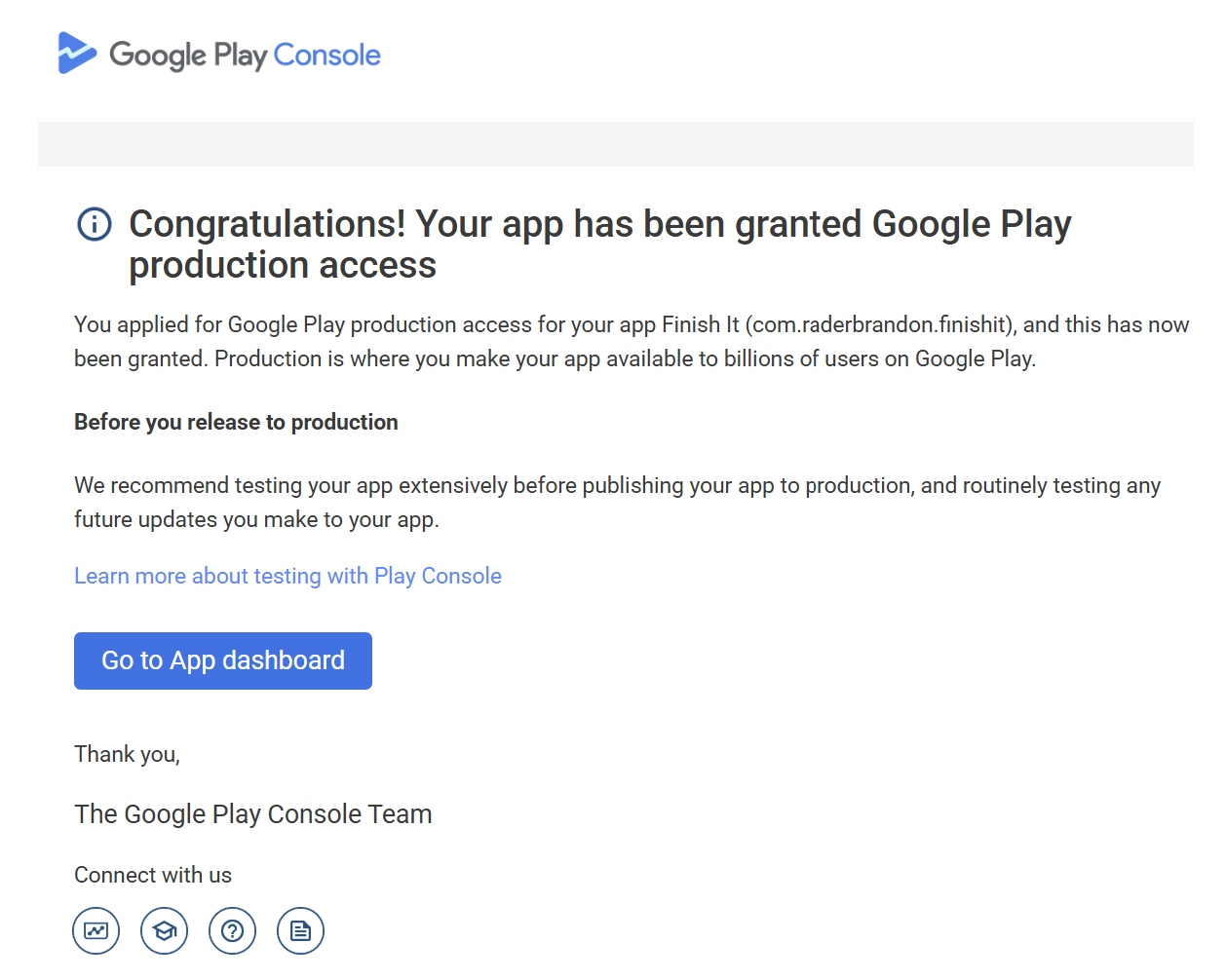
Quality QA Testing Reports
Clear, actionable reports with screenshots and evidence for every important issue found during testing.
Real Device Testing & Diagnostics
Real human testers use physical Android devices to test your app, verify real user flows, and provide clear testing evidence and professional QA reports.
Play Store Ready
Get your Android build approved on the first try. We create an audit-ready compliance profile that proves thorough quality assurance.
Affordable Compliance Cycles
Transparent plans built to satisfy Google Play Console guidelines for your Android build.
Loading Packages
Please wait while we fetch the best options for your region...
Frequently Asked Questions
Everything you need to know about passing your closed testing requirements.