12 Play Console app testers for Android app testing in UAE
Hire 12 Play Console app testers in UAE. Complete Google Play closed testing requirements confidently with 12 testers for 14 days for Play Store.
Launching an app in the United Arab Emirates is not just about translating your interface into Arabic or slapping on a local currency converter. It is a highly competitive, fast-paced digital market where users expect absolute perfection from the very first tap. When you are pushing your Android app to this demanding audience, getting your Google Play Closed Testing right is the difference between a massive launch and a complete flop.
You cannot just rely on automated scripts or generic global feedback. The UAE market demands localized context. You need real people sitting in Dubai, Abu Dhabi, or Sharjah, interacting with your app on local networks like Etisalat or Du. This is exactly why sourcing 12 Play Console app testers specifically from the UAE is a non-negotiable step for serious developers. It ensures your app meets both the high expectations of local users and the strict compliance rules of the platform.
The Google Play 12 Testers Rule: What It Really Means for UAE Apps
If you recently created a new developer account, you already know the big hurdle. You must run a closed test with 12 testers for 14 days before you can even apply for production access. This rule is not a simple suggestion, it is a strict quality control measure. Google wants to see that your app is functional, safe, and ready for a real-world audience.
For developers targeting the UAE, this means your 12 testers for 14 days should ideally reflect your actual user base. When your testers are based in the UAE, their feedback helps you catch region-specific bugs. They will spot issues with local payment gateways, right-to-left layout glitches, and network latency problems that a tester in another country would completely miss.
Real vs. Bot Testing: The High Stakes of Compliance
The temptation to cut corners is incredibly real for many developers. Exhausted by the strict Google Play Closed Testing requirements, some creators turn to cheap bot farms or fake automated accounts just to hit that magical 12-tester quota and get it over with. In a high-value, highly scrutinized market like the United Arab Emirates, this critical mistake can destroy your app's potential before it even has a chance to launch. Google's sophisticated machine learning algorithms are designed specifically to catch this exact type of fraudulent behavior. Let us break down exactly why genuine human testing is the only viable, safe, and logical way to go for your upcoming release.
Genuine Human Testing in the UAE
When you hire real users based in the UAE, you get authentic, invaluable engagement. Real people will actually download your app, tap through the menus, read the text, and try to break things in unpredictable ways. They provide qualitative feedback that bots simply cannot generate. More importantly, genuine users have distinct device IDs, varied daily usage patterns, different screen brightness levels, and real Google accounts with years of search history and data. This kind of organic, messy human activity passes Google's strict Play Store Closed Testing checks with flying colors, keeping your developer account completely safe and your launch timeline on track. You get actual insights into how a local resident interacts with your interface.
Fake Bots and Automated Farms
Automated testing farms use rigid scripts to simulate basic app downloads and superficial opens. These bots have zero context of the UAE market or its cultural nuances. They heavily rely on virtual private networks, brand new empty Google accounts, and identical device signatures that scream suspicious behavior. Google's security algorithms are incredibly smart and will quickly flag this unnatural, robotic behavior. If you are caught using bots or fake accounts to fulfill your 12 testers for 14 days requirement, your app will be swiftly rejected. In the worst cases, your entire developer account could be permanently banned, wiping out months or even years of hard work, investment, and planning.
Struggling with the 14-Day Testing Requirement?
Skip the hassle of recruiting unreliable testers. Our professional fleet of real Android devices guarantees Google Play compliance in exactly 14 days. Zero bots. Zero emulators. 100% production approval guarantee.
The Ultimate Pre-Launch Checklist for the UAE Market
Before you invite your very first tester to your closed track, you need to make absolutely sure your app is perfectly primed for the UAE audience. Rushing into the testing phase with a half-baked product will only result in useless feedback and a wasted 14 days. This extensive, comprehensive checklist covers everything from deep localization efforts to technical compliance and security standards. Use it to audit your application thoroughly.
Localization and Cultural Relevance
Ensure complete right-to-left layout support for Arabic language users. Check that all swipe gestures, navigation menus, and text alignments feel completely natural and fluid.
Verify that local date, time, and currency formats for the Arab Emirates Dirham are displaying correctly across all screens, especially on critical billing pages and product catalogs.
Thoroughly review all imagery, icons, and text content to ensure it respects UAE cultural norms, local advertising guidelines, and religious sensitivities.
Test your app's performance on local mobile networks to account for any specific latency, firewall configurations, or data throttling that might occur in the region.
Google Play Closed Testing Preparation
Set up your Google Play Console developer account perfectly and verify all your identity, business registration, and payment information well in advance.
Complete all required app content declarations with absolute honesty, including detailed data safety forms, a comprehensive privacy policy, and accurate content ratings.
Create a detailed, highly structured feedback form or an intuitive in-app feedback loop mechanism to capture actionable insights from your 12 testers for 14 days.
Prepare exceptionally clear testing instructions that guide your UAE testers on which specific features, menus, and user flows you want them to focus their attention on.
Technical Readiness and Security Standards
Integrate a robust, industry-standard crash reporting tool to automatically log any errors, stack traces, and application not responding events your testers might encounter.
Ensure your Android App Bundle is fully optimized for size and signed correctly with the appropriate production release keys before uploading it to the console.
Rigorously test all third-party API integrations, especially local payment gateways, social media login providers, and mapping services commonly used in the UAE.
Verify that your backend servers and databases can handle the expected load, utilizing regional Middle East data centers if possible to guarantee the lowest possible latency.
Comparison of App Testing Solutions in the UAE Market
Choosing the right testing approach is one of the most critical decisions you will make before launching. Making the wrong choice can lead to wasted time, poor user experience, or even account suspension. Here is a highly detailed breakdown of your primary options when trying to fulfill the strict Play Store Closed Testing requirements.
| Feature | Professional UAE Testing Service | DIY Sourcing (Friends/Family) | Bot Farms / Fake Accounts |
|---|---|---|---|
| Authentic Local Feedback | Yes - Actionable, deep insights | Limited - Biased, surface-level opinions | None - Zero real human feedback |
| Compliance Guarantee | High - Uses real, aged Google accounts | Moderate - Extremely hard to track 14 days | Low - Massive risk of account suspension |
| Time Investment | Low - Fully managed and automated | High - Constant follow-up and nagging needed | Low - But causes massive headaches later |
| Device Variety | Excellent - Spans real market devices | Poor - Limited to the phones of close circles | None - Relies heavily on cheap emulators |
| Issue Reporting | Detailed crash logs, screenshots, and UX notes | Vague, delayed, or entirely non-existent | None - Bots do not report bugs |
| Cultural Context | Perfect - Understands local UAE nuances | Good - If they are local residents | None - Completely disconnected from reality |
| Overall Cost | Moderate - An essential business investment | Free - But costs your valuable development time | Cheap - But costs your entire developer account |
Your 14-Day Roadmap to Play Console Approval
Navigating the full 14 days of closed testing can feel overwhelming, especially when you are anxious to get your product to market. However, with a structured plan, this period can be incredibly productive. Follow this detailed, day-by-day roadmap to ensure your app makes it through the testing phase smoothly, successfully, and with the maximum amount of actionable feedback.
Day 1 to 3: Onboarding and Initial Engagement
The first few days are all about getting your 12 testers actively on board and familiar with the software. They need to accept the Google Play Closed Testing invitation via their email, download the app successfully from the store, and complete their very first sign-in process. This is the absolute best time to monitor your crash logs closely, as any major show-stopping bugs or authentication failures will typically appear right during the initial launch sequence. Make sure your testers based in the UAE are successfully navigating the core onboarding flow without getting stuck on verification codes or permissions screens.
Day 4 to 7: Deep Dive into Core Features
Now that your testers are somewhat familiar with the basics and the interface, they should start exploring the main functionality of your app. If you have an e-commerce platform, they should be aggressively adding items to their cart, applying discount codes, and navigating the checkout process. If it is a utility or productivity app, they should be testing the primary tools and exporting data. Encourage your testers to try different network conditions, like switching rapidly between their home Wi-Fi and local cellular data. This is exactly when the most valuable qualitative feedback regarding user experience starts rolling in.
Day 8 to 11: Edge Cases and Stress Testing
In the critical second week, it is time to ask your testers to push the app to its absolute limits. Have them test obscure edge cases, like losing their internet connection mid-task, receiving a phone call while watching a video, or intentionally entering incorrect, formatted data into forms. This destructive phase is crucial for ensuring your app handles errors gracefully and recovers without crashing, which is a major factor in long-term user retention. Your main goal here is to identify and fix the subtle, hard-to-reproduce bugs that could deeply frustrate real users in the UAE market.
Day 12 to 14: Final Review and Production Preparation
As you approach the highly anticipated finish line, verify in the console that all 12 testers have maintained continuous, unbroken access to your app for the full 14 days. Carefully review all the aggregated feedback collected over the past two weeks and prioritize the final round of crucial bug fixes. Start preparing your main Google Play Store listing by creating localized screenshots, writing compelling descriptions, and selecting relevant keywords tailored specifically for the UAE audience. Once the magical 14 days are officially complete, you can confidently click that button and apply for production access in the Play Console.
Deep Dive: Frequently Asked Questions About UAE App Testing
To help you further understand the complex nuances of the Google Play Closed Testing policy, we have compiled an extensive, highly detailed list of frequently asked questions. These comprehensive answers cover everything from the most basic platform rules to advanced, market-specific strategies for the United Arab Emirates.
Why does Google require exactly 12 testers for 14 days for new accounts?
Google introduced the strict 12 testers for 14 days rule to drastically improve the baseline quality of applications entering the Play Store ecosystem. In the past, many novice developers would push poorly optimized, bug-filled, or even malicious apps directly to production without any oversight. By forcing new developer accounts to run a comprehensive closed test, Google ensures that real humans have actively verified the app's core functionality, safety protocols, and overall user experience before it ever reaches the general public. This mandatory, rigorous period acts as a powerful filter, protecting everyday users from bad software and raising the overall standard of the entire Android ecosystem. It is a necessary hurdle that ultimately benefits everyone involved.
Do all my testers actually have to be physically located in the UAE?
While Google's automated systems do not explicitly force you to geolocate your testers to a specific country, having them based in your primary target market is highly, highly recommended for your own success. If your app is designed specifically for residents of the UAE, local testers will provide far more relevant, actionable feedback. They intimately understand the local context, cultural nuances, language preferences, and user expectations. Furthermore, they can reliably test region-specific technical integrations, such as local payment processors like PayTabs or Telr, or location-based services in specific emirates, which remote testers in other countries simply cannot verify accurately or safely.
What happens if one of my testers uninstalls the app before the 14 days are completely over?
If a tester decides to opt out of the Google Play Closed Testing track or completely uninstalls the app before the mandatory 14-day period is successfully complete, it can severely disrupt or even invalidate your entire testing progress. Google's backend systems closely track the continuous engagement and installation status of the minimum required testers. You must maintain a solid roster of at least 12 active, opted-in testers for the entire duration without interruption. This is precisely why it is incredibly important to source reliable, committed testers who understand the process, rather than relying on casual acquaintances or distant relatives who might forget the rules and casually delete the app to save storage space.
How do I actually find reliable, high-quality Android app testers in the UAE?
Finding reliable, dedicated testers locally can be a surprisingly challenging endeavor. You can try leveraging local Dubai or Abu Dhabi developer communities, posting in specialized social media groups, or tapping into professional networking events within the UAE tech scene. However, manually coordinating 12 busy individuals, ensuring they actually test the app daily, and collecting their structured feedback is a massive logistical nightmare. The most effective, time-efficient, and stress-free method by far is to partner with a professional app testing service that specializes in providing verified, real human testers. These specialized services manage the entire complex process from start to finish, ensuring strict compliance with the 12 testers for 14 days rule without the massive headache of managing people yourself.
Will using automated bot farms or cheap testing services get my developer account banned?
Yes, absolutely, and it is the biggest mistake you can make. Using automated bot farms, software emulators, or fake, freshly created Google accounts to artificially inflate your tester count is a direct, severe violation of Google Play developer policies. Google utilizes incredibly sophisticated machine learning algorithms to analyze user behavior patterns, device hardware signatures, and historical account data. They can easily, instantly differentiate between genuine human interaction and rigid automated scripts. If you are caught trying to manipulate or bypass the Play Store Closed Testing process, your app will be immediately suspended, and your developer account is at a very high risk of being permanently, irreversibly terminated, losing you all future publishing rights.
What specific kind of feedback should I expect to gather from my closed testing phase?
You should aim to collect a healthy mix of both qualitative and quantitative feedback. Quantitative data is hard data, which includes automated crash reports, application not responding errors, and performance metrics like app load times and memory usage. Qualitative feedback is just as vital, if not more so. This includes written comments on the user interface design, the logic of the navigation flow, and overall emotional satisfaction. A truly good tester will tell you if a specific checkout button is too small to tap comfortably on a mobile screen, or if a specific feature feels culturally confusing. Building this comprehensive feedback loop is the entire fundamental purpose of the Play Store Closed Testing phase.
Am I allowed to update my app during the 14-day testing period, or should I wait?
Yes, you are highly encouraged to update your app during the testing phase if necessary. If your testers discover a critical, app-breaking bug on day three, you absolutely should compile and push an update to fix it immediately. Releasing timely updates shows the Google review team that you are actively maintaining the software and seriously responding to the feedback generated. However, it is vital to keep in mind that pushing a new update does not restart your 14-day timer, provided your existing testers continue to engage with the newly updated version of the app without uninstalling it.
What should I realistically do if Google rejects my application for production access after the test?
If your final application for production access is surprisingly rejected, Google will typically provide a specific reason or a set of guidelines in the Play Console dashboard. Common reasons for rejection include insufficient daily tester engagement, unresolved critical bugs that were ignored, or incomplete app content declarations regarding data privacy. Do not panic or give up. Carefully read the feedback provided by the review team, address the specific issues outlined meticulously, and if necessary, run another full round of testing to gather more data and prove stability. It is crucial to demonstrate to Google that you have taken the testing phase seriously and made tangible, visible improvements based on the results.
How does the closed testing process differ for apps requiring a paid subscription or in-app purchases?
If your app includes complex in-app purchases or recurring paid subscriptions, the testing phase is exponentially more critical. You need to ensure that the entire payment flow works flawlessly and securely before asking real UAE users to spend their hard-earned money. Google graciously provides specific testing tools and license testing accounts that allow your closed testers to simulate actual purchases without actually being charged any real currency. This allows you to rigorously verify that the premium features unlock correctly upon purchase and that the complex billing systems are properly integrated, which is especially important when dealing with local UAE currency conversions and regional payment methods.
Is this closed testing phase strictly required for all updates to an already existing, published app?
The strict 12 testers for 14 days rule applies primarily to new personal developer accounts created after November 2023. If you have an established, older developer account or if you operate as a verified enterprise developer, the mandatory testing requirements may differ slightly and might not force the exact 14-day window. However, running a comprehensive closed test before pushing a major, game-changing update is always considered a professional best practice, regardless of your account status or history. It allows you to catch dangerous regression bugs and gather initial, safe reactions to new features before rolling them out to your entire, massive user base.
How much time should I allocate daily to manage the testing process if I do it myself?
If you are bravely managing the entire testing process completely by yourself, you should expect to spend at least one to two solid hours daily. This dedicated time is absolutely needed to review complex crash logs, answer tester questions via email, follow up with inactive testers who forgot to open the app, and manually categorize the scattered feedback you receive into a workable spreadsheet. It can be a very tedious, time-consuming process, which ultimately takes your focus away from actually developing and improving the app itself. This significant time investment is another major reason why many smart developers choose to outsource their Google Play Closed Testing to dedicated professionals who handle the logistics.
Does completing a successful closed test guarantee my app will be a massive financial success in the UAE?
A successful closed test is a crucial, unavoidable first step, but it is absolutely not a guarantee of commercial or financial success. Passing the Play Store Closed Testing phase simply means your application is technically sound, relatively bug-free, and officially complies with Google's baseline security and quality requirements. To truly succeed and thrive in the highly competitive, saturated UAE market, you still desperately need a strong, targeted marketing strategy, continuous long-term user engagement tactics, and a deep commitment to providing regular content updates based on long-term user feedback. The testing phase just gives you the strong, compliant foundation you need to build a successful business upon.
The Testing Pipeline
How we deploy real devices and guarantee compliance for your release.
Sign In
Sign in with Google to configure the closed testing environment for your Android build.
Opt-In URL
Submit your Google Play Console testing link, and our team will assign qualified testers from our testing network to join your Android closed testing release.
Testing Begins
A QA supervisor monitors daily check-ins, ensuring 12 unique Android users engage with your Android build every single day.
Compliance Complete
We guarantee 14 consecutive days of active user check-ins to satisfy Google's compliance policies, delivering an audit-ready PDF feedback report.
Why Developers Trust Us
Experience a next-generation testing infrastructure built for Google Play compliance for your Android release.
The 14-Day Production Guarantee
We complete the required 14-day closed testing process with real human testers and physical Android devices, while providing clear testing evidence and documentation throughout the process.
If Google specifically rejects production access due to insufficient testing engagement, you are covered by our free re-run or 100% refund guarantee, subject to our Refund Policy.
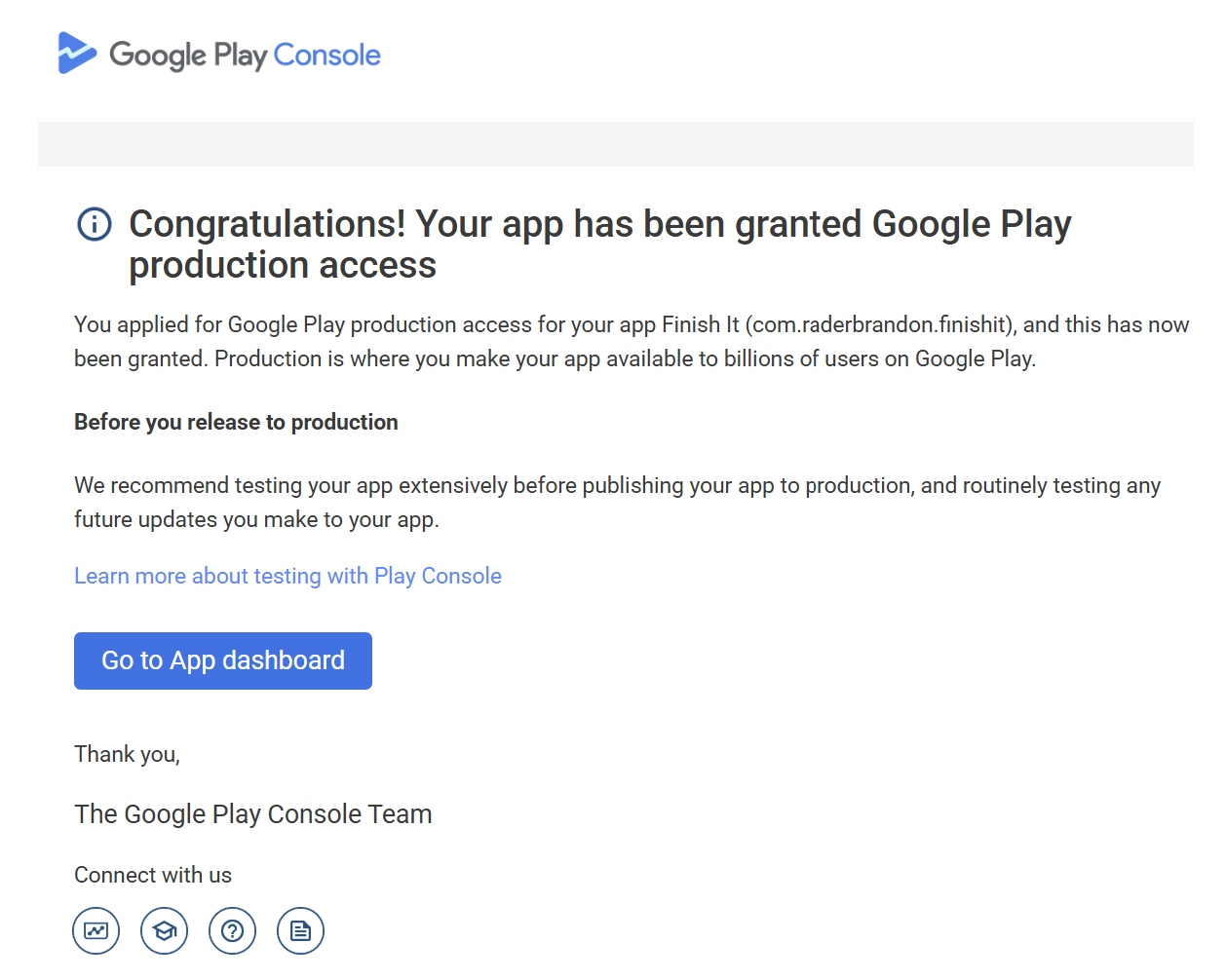
Verified Production Access
Quality QA Testing Reports
Clear, actionable reports with screenshots and evidence for every important issue found during testing.
Real Device Testing & Diagnostics
Real human testers use physical Android devices to test your app, verify real user flows, and provide clear testing evidence and professional QA reports.
Guaranteed App Approval
Get your Android build approved on the first try. We create an audit-ready compliance profile that proves thorough quality assurance.
Affordable Compliance Cycles
Transparent plans built to satisfy Google Play Console guidelines for your Android build.
Loading Packages
Please wait while we fetch the best options for your region...
Frequently Asked Questions
Everything you need to know about passing your closed testing requirements.