12 Play Console app testers for Android app testing in Uzbekistan
Hire 12 Play Console app testers in Uzbekistan. Pass Google Play closed testing in 14 days with real Android testers and unlock Play Store production access.
Understanding the 12 Testers for 14 Days Closed Testing Rule
Google Play Console enforces a mandatory closed testing requirement for all personal developer accounts created after November 2023. Under this policy, creators and engineering teams cannot publish Android apps directly to public production tracks without first running a closed testing cycle. The requirement demands at least 12 opted-in testers who maintain continuous access and engagement for 14 consecutive days.
This quality benchmark filters out unstable releases, unhandled crashes, and broken user journeys before software reaches global audiences. Google Play Console telemetry actively tracks user installs, launch events, screen transitions, session duration, and opt-in retention. Simply entering a list of email addresses is not enough. If testers uninstall the app early, go inactive, or fail to interact across the testing window, Google's 14-day timer can stall or reset, delaying your production release.
Real Human Testing vs. Automated Bots and Emulator Rings
To bypass this two-week waiting window, some developers turn to automated bot scripts, device farms, or emulator rings found on unverified forums. While automated scripts can generate synthetic clicks, Google Play Protect and automated Play Console analytics easily detect artificial telemetry, static IP clusters, and missing hardware sensor data. Using synthetic bots risks failed reviews, timer resets, and permanent account termination.
Real Human Testers (ACL Guaranteed)
- Authentic Physical Hardware: Real Android devices from Xiaomi, Samsung, Redmi, Realme, POCO, Vivo, and Google Pixel running Android 10 through 15.
- Natural User Interaction: Genuine touch gestures, varied session lengths, organic navigation paths, and authentic background lifecycle events.
- Verified Play Console Analytics: Legitimate opt-in events through the Google Play Store, clean Android Vitals telemetry, and active install states.
- Actionable Developer Feedback: Realistic bug discoveries, crash traces, UI layout issues across varied aspect ratios, and detailed responses for your production application questionnaire.
Bot Networks & Scripted Emulators
- Virtual Environments: Emulated Android instances sharing identical hardware fingerprints and virtual network adapters that trigger compliance flags.
- Synthetic Scripts: Repetitive, robotic interaction routines that lack authentic user sensor movement and real touch latency.
- High Account Risk: Instant rejection of production access, stalled 14-day countdown timers, and severe strikes against your Google Play developer profile.
- Zero Practical Feedback: Automated logs that fail to catch real layout defects, memory leaks on lower-end chipsets, or network timeout bugs.
Mobile Market Dynamics and Testing Realities in Uzbekistan
Uzbekistan's technology sector is undergoing rapid digital growth, powered by IT Park Uzbekistan, expanding fintech platforms, e-commerce ecosystems, and digital government initiatives. From Tashkent and Samarkand to Bukhara and Namangan, millions of citizens rely on mobile apps daily for banking, payments, deliveries, education, and transport. Android commands over 75% of the mobile operating system market across the country, making device compatibility critical for local software developers.
When executing self-managed Google Play closed testing in Uzbekistan, developers face several practical hurdles:
- Extensive Hardware Fragmentation: While tech professionals in urban hubs often use upper-tier flagship smartphones, the broader user base across Uzbekistan relies heavily on budget and mid-range devices from Xiaomi (Redmi 9/10/12/Note series), Samsung Galaxy A-series, Realme, TECNO, and Infinix. Testing solely on modern personal phones or high-end office devices fails to expose memory pressure issues, low-RAM background kills, and slow UI rendering on lower-tier MediaTek or Unisoc processors.
- Network Fluctuations and Regional Connectivity: Mobile connectivity across Uzbekistan spans major mobile operators such as Ucell, Beeline Uzbekistan, Mobiuz, UZTELECOM (Uzmobile), and Humans. Network speeds range from ultra-fast 5G corridors in central Tashkent to variable 4G LTE and 3G connections across rural regions. Authentic testing reveals how your app handles packet drops, offline caching, slow REST API responses, and sudden network handoffs.
- Tester Drop-off and Volunteer Fatigue: Organizing 12 reliable volunteers among friends, colleagues, or social media groups frequently leads to broken testing cycles. While contacts may download the app on day one, they inevitably forget to open it after a couple of days or accidentally uninstall it. When active daily installations drop below 12, Google halts the qualification clock, forcing developers to restart the two-week period.
Strategic Comparison: Testing Options for Uzbekistani Developers
Selecting the right testing approach early prevents prolonged launch delays and safeguards your developer account reputation. Here is how professional managed testing compares to DIY peer groups and automated bot services:
| Feature | Managed Testing (ACL) | DIY Peer Swapping | Bot / Emulator Networks |
|---|---|---|---|
| Physical Hardware | 100% Real Android Smartphones | Inconsistent, limited devices | Virtual Machines / Rooted Emulators |
| 14-Day Continuous Retention | Guaranteed daily engagement | High drop-off after 2 to 3 days | Synthetic, flagged by algorithms |
| Google Play Compliance | Fully compliant with Play rules | Compliant only if peers stay active | High risk of permanent ban |
| Bug Reports & Feedback | Structured logs and UX insights | Superficial or missing comments | Automated strings or empty logs |
| Production Access Approval | High first-attempt pass rate | Frequently rejected or reset | Immediate rejection or account flag |
| Developer Effort | Zero hassle, fully managed setup | 25+ hours chasing participants | Quick setup, disastrous outcome |
Struggling with the 14-Day Testing Requirement?
Skip the hassle of recruiting unreliable testers. Our professional fleet of real Android devices guarantees Google Play compliance in exactly 14 days. Zero bots. Zero emulators. 100% production approval guarantee.
Complete Pre-Launch Checklist for Play Console Compliance
Before submitting your closed release build and sending invitations to your 12 testers, confirm that your application package, backend configurations, and Play Console declarations satisfy all compliance rules. Overlooking these prerequisites can lead to review rejections or testing track freezes.
1. Technical Architecture & Build Requirements
Adopt Android App Bundle (AAB): Build and sign an official .aab package rather than a standard APK. AAB binaries enable dynamic feature delivery and optimize download sizes across different device architectures.
Target the Latest Android SDK: Ensure your targetSdkVersion in build.gradle meets Google Play requirements (Android 14 / API level 34 or higher), ensuring modern runtime permission handling and background execution limits.
Configure ProGuard and R8 Rules: Verify that code shrinking, resource stripping, and obfuscation rules do not discard essential data serialization models, reflection libraries, or third-party payment gateway classes.
Embed Crash Reporting SDKs: Integrate Firebase Crashlytics or Sentry to track unhandled exceptions, native ANR (Application Not Responding) triggers, and memory stack traces during the live testing window.
Optimize Memory and App Size: Compress heavy vector graphics, remove unused localization resources, and ensure the cold-start app launch time remains under 2.5 seconds on low-memory Android hardware.
2. Store Listing, Policies & App Access
Publicly Accessible Privacy Policy: Host a comprehensive privacy policy on a live HTTPS web page that clearly describes user data collection, storage duration, third-party analytics SDKs, and account deletion procedures.
Complete Data Safety Disclosures: Accurately disclose all collected or shared data points in the Play Console Data Safety section, including device IDs, location services, analytics, and contact information.
Provide Functional Test Credentials: If your application features a login screen, paywall, OTP authentication, or gated dashboard, supply working test account credentials under 'App Access' so Google reviewers and testers can inspect every screen.
Upload Polished Listing Visuals: Provide high-resolution graphic assets, including a 512x512 app icon, a 1024x500 feature graphic, and descriptive screenshots illustrating core app capabilities across phone and 7-inch tablet layouts.
Declare Target Audience and Content Rating: Complete the Google Play Content Rating questionnaire and accurately define your intended age group to ensure proper regional classification and policy alignment.
The 5-Step Roadmap from Closed Testing to Production Release
Navigating the Google Play closed testing track to public production requires a disciplined, step-by-step methodology. Following this structured workflow guarantees full compliance with Google Play review policies:
Step 1: Track Creation and Tester Group Configuration
Navigate to your Google Play Console dashboard, open the 'Closed testing' section under 'Testing', and create a new closed testing track. Set up an associated Google Group containing tester email addresses. Define a dedicated feedback channel, such as an email address, issue tracker, or web feedback form, so testers can report usability observations directly.
Step 2: AAB Upload and Pre-Launch Report Evaluation
Upload your signed release Android App Bundle (AAB) to the closed testing track. Allow Google Play's automated Firebase Test Lab to run the Pre-Launch Report (Robo test). Review the automated results to fix any initial crashes, security vulnerabilities, or layout overflows on virtual test devices before rolling the track out to human users.
Step 3: Tester Invitation and Real Device Installation
Share the generated Google Play opt-in web link and Android store link with your 12+ verified testers. Ensure every tester accepts the closed testing invitation using their registered Google account and installs the application directly from the official Google Play Store onto their physical Android device.
Step 4: 14-Day Active Engagement and Metric Tracking
Maintain daily active engagement across the full 14 consecutive days. Real testers explore app features, navigate multiple screens, test background notifications, and trigger everyday use cases. Monitor your Play Console dashboard and Android Vitals to ensure the crash rate stays well below 1.09% and the ANR rate remains under 0.47%.
Step 5: Production Access Questionnaire Submission
Once the 14-day requirement completes with at least 12 active participants continuously opted in, the 'Apply for Production' button unlocks in your Play Console dashboard. Submit detailed, authentic responses detailing how you recruited testers, the feedback received, and the technical updates made to secure production approval on your first attempt.
How to Answer Google Play's Production Access Questionnaire
When your 14-day testing period finishes, Google requires you to complete a mandatory production access questionnaire before granting permission to publish to the public store. Google's human evaluation team uses your answers, alongside console analytics, to assess your software's readiness. Here is how to answer each core question with authority and detail:
1. How did you recruit your testers?
Provide a clear, honest, and professional summary of your recruitment process. Explain that you assembled a dedicated group of real Android device testers representing your target user demographics in Uzbekistan and international markets. State that testers used diverse physical devices from manufacturers such as Xiaomi, Samsung, Realme, and Google Pixel across multiple Android OS versions (ranging from Android 10 to Android 15). Emphasize that testing took place over real mobile networks (like Ucell, Beeline, and Wi-Fi) rather than emulators or automated test farms.
2. What feedback did you receive from your testers?
Never write generic answers like "no bugs were found" or "the testers loved everything." Google reviewers consider unrealistic praise a major red flag. Instead, provide detailed technical and user experience feedback collected during testing. Mention specific items such as:
- UI overflow issues on smaller screen dimensions (like 5.5-inch budget phones).
- Slow loading times on image-heavy screens during high-latency mobile data connections.
- Suggestions to enhance font contrast and button hit areas for better accessibility.
- Translation refinements for Uzbek (Latin/Cyrillic) and Russian localization strings.
- Feedback regarding navigation clarity in onboarding and checkout flows.
3. What changes and improvements did you make to your app?
Explain the specific technical updates and bug fixes deployed during the closed testing period. Detail how you incremented version codes (for example, moving from Version Code 1 to Version Code 4) to resolve the issues reported by testers. Mention optimizations like:
- Implementing asynchronous image caching to reduce scroll stutter on low-RAM devices.
- Refactoring network timeout thresholds to gracefully handle intermittent 3G/4G connectivity.
- Correcting layout constraints to prevent button clipping on devices with navigation bars.
- Updating error-handling states and offline banners when network requests fail.
Deep Dive into Android Vitals and Play Console Performance Metrics
Google Play Console monitors technical quality metrics known as Android Vitals to determine whether your app meets production publishing criteria. If your application exceeds established bad behavior thresholds during the 14-day closed testing period, Google may deny production access or limit store visibility post-launch. Understanding these thresholds is essential:
- User-Perceived Crash Rate: Google's maximum acceptable threshold for crashes is 1.09% of daily active users. For individual device models, the threshold is 8.0%. Maintaining clean crash telemetry during your 14-day test proves to Google's evaluation team that your build is stable across varied hardware architectures.
- User-Perceived ANR (Application Not Responding) Rate: The global ANR threshold is 0.47%. ANRs occur when the main UI thread is blocked for more than 5 seconds by heavy disk I/O, synchronous database operations, or expensive computation. Real human testing on mid-tier and budget chipsets helps catch background thread bottlenecks before public release.
- Stuck Wake Locks and Background Resource Use: Excessive background CPU usage or improper background service management drains device batteries rapidly. Play Console monitors wake lock duration and background alarm frequency, ensuring apps do not degrade battery health.
- Slow UI Rendering and Frozen Frames: If more than 50% of frames take longer than 16 milliseconds to render (or if frozen frames exceed 0.1%), users experience noticeable lag. Testing on real physical screens allows developers to optimize Compose and XML layout hierarchies for smooth 60fps and 120fps performance.
Frequently Asked Questions (FAQs)
Why does Google Play require 12 testers for 14 days for developers in Uzbekistan?
This rule applies universally to all personal developer accounts created globally after November 13, 2023. Google implemented this mandate to ensure independent creators and small startups thoroughly test their Android applications on genuine hardware before releasing them to general consumers. This policy helps eliminate low-quality, buggy, or policy-violating apps from the Play Store ecosystem.
Can I use Android Studio emulators or cloud virtual machines for closed testing?
No. Google Play Console uses advanced telemetry to track real device hardware characteristics, sensor inputs, battery drain rates, touch coordinates, and carrier connectivity. Emulators and virtual device rings generate synthetic signatures that are easily flagged by Google Play Protect algorithms. Relying on emulators can lead to cancelled testing cycles, rejected production applications, or permanent developer account suspensions.
What happens if a tester uninstalls the app or goes inactive before 14 days?
If your active tester count drops below the mandatory threshold of 12 at any point during the two-week testing window, Google's system may pause or reset the 14-day qualification countdown. ACL prevents this issue by providing a safety buffer of 15 to 20 dedicated human testers. This buffer guarantees that your project maintains well over 12 actively engaged testers every single day without interruption.
Can I release updates and new build versions while closed testing is running?
Yes. Publishing new version codes and bug fix updates to your active closed testing track during the 14-day window is fully supported and recommended. Deploying updates demonstrates to Google's review team that you are actively responding to tester feedback and improving your software quality. Simply upload new AAB builds to the existing closed track without deleting or recreating the track.
How does ACL guarantee production access approval for my Android app?
ACL assigns verified human testers equipped with real physical Android smartphones across diverse manufacturers (including Xiaomi, Samsung, Realme, and Pixel) and Android OS versions (Android 10 to 15). Our testers opt in through official Google Play Store links, engage with your application daily for the full 14 days, and provide actionable feedback. We also offer expert guidance to help you craft thorough, compliant answers for Google's production access questionnaire.
Is this testing service suitable for developers and startups based across Uzbekistan?
Yes. Our testing service is tailored for software developers, IT Park Uzbekistan members, and tech startups based in Tashkent, Samarkand, Bukhara, Fergana, Andijan, Namangan, and anywhere across the region. You simply create your closed testing track in Google Play Console, invite our dedicated Google Group, and share your opt-in URL. Our team manages the entire 14-day testing process and delivers the telemetry required for seamless production approval.
Our QA Process
How we deploy real devices and guarantee compliance for your release.
Choose Package
Sign in with Google to configure the closed testing environment for your Android build.
Submit Link
Submit your Google Play Console testing link, and our team will assign qualified testers from our testing network to join your Android closed testing release.
Active Testing
A QA supervisor monitors daily check-ins, ensuring 12 unique Android users engage with your Android build every single day.
Get Approved
We guarantee 14 consecutive days of active user check-ins to satisfy Google's compliance policies, delivering an audit-ready PDF feedback report.
The Premium QA Advantage
Experience a next-generation testing infrastructure built for Google Play compliance for your Android release.
The 14-Day Production Guarantee
We complete the required 14-day closed testing process with real human testers and physical Android devices, while providing clear testing evidence and documentation throughout the process.
If Google specifically rejects production access due to insufficient testing engagement, you are covered by our free re-run or 100% refund guarantee, subject to our Refund Policy.
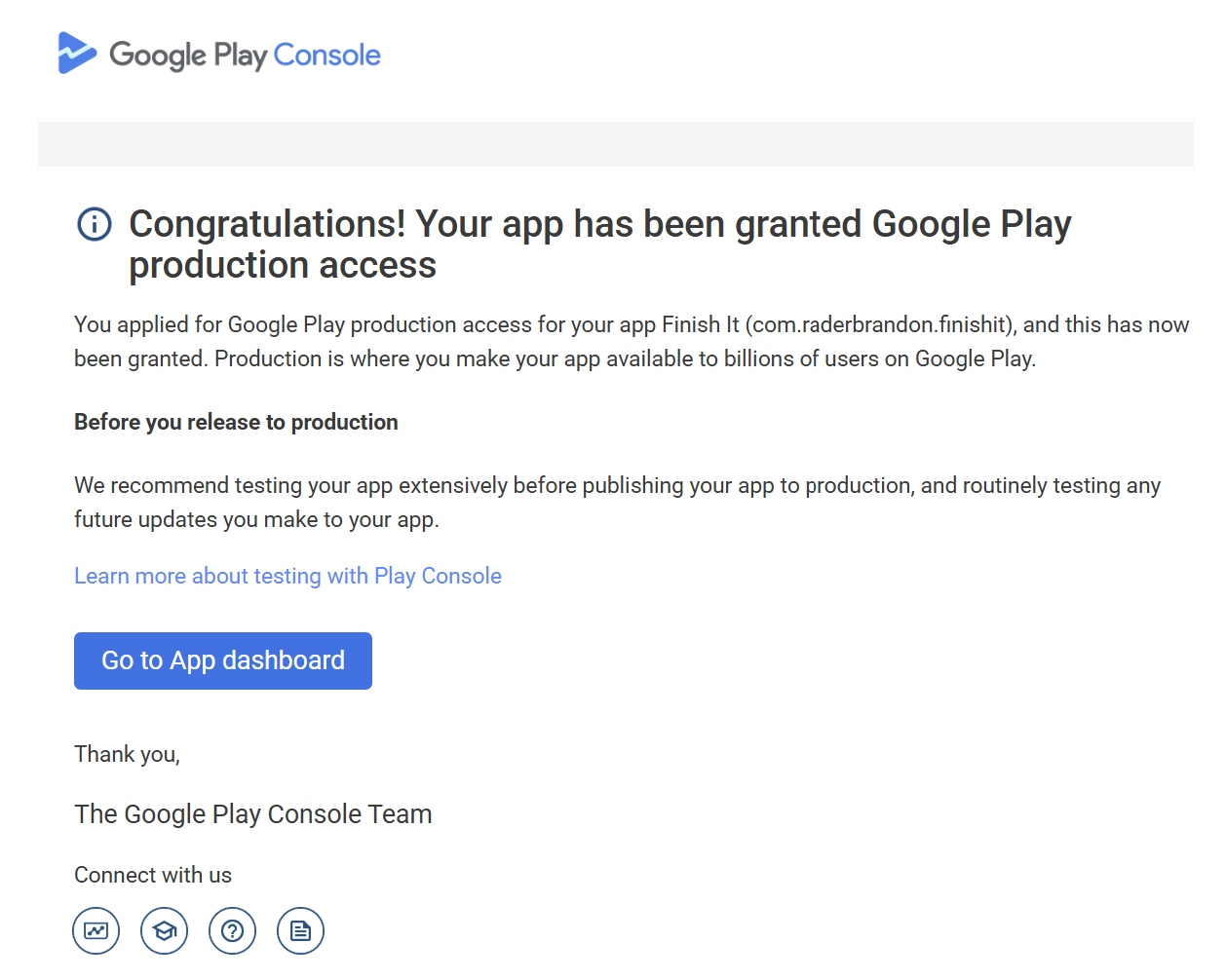
Verified Production Access
Quality QA Testing Reports
Clear, actionable reports with screenshots and evidence for every important issue found during testing.
Real Device Testing & Diagnostics
Real human testers use physical Android devices to test your app, verify real user flows, and provide clear testing evidence and professional QA reports.
Production Access Secured
Get your Android build approved on the first try. We create an audit-ready compliance profile that proves thorough quality assurance.
Affordable Compliance Cycles
Transparent plans built to satisfy Google Play Console guidelines for your Android build.
Loading Packages
Please wait while we fetch the best options for your region...
Frequently Asked Questions
Everything you need to know about passing your closed testing requirements.