12 Play Console app testers for Android app testing in Venezuela
Hire 12 Play Console app testers in Venezuela. Pass Google Play closed testing in 14 days with real Android testers and unlock Play Store production access.
Overcoming Closed Testing Obstacles in Venezuela
Building Android apps in Venezuela presents unique engineering challenges. Software developers across Caracas, Maracaibo, Valencia, and Barquisimeto build cutting-edge solutions for fintech, logistics, on-demand deliveries, and digital commerce. Yet, getting an app approved on the Google Play Store has become significantly harder. Under Google's personal developer account policy, you must complete the mandatory 12 Testers for 14 Days Closed Testing phase before applying for full production access.
This requirement is not a simple box-ticking exercise. Google Play Console tracks deep operating system telemetry, physical device interactions, background services, and real user engagement. In Venezuela, developers must test against high device fragmentation, varying Android OS versions, dual-currency pricing architectures (VES and USD), and localized mobile networks like Movistar, Digitel, and Movilnet/Cantv. Relying on friends or casual chat groups frequently fails because testers forget to open the app, opt out prematurely, or uninstall early, resetting the 14-day evaluation clock.
The Pitfalls of Bot Networks Versus Managed Testing
Desperate developers sometimes turn to cheap bot farms, emulator scripts, or reciprocal testing groups found on social forums. This approach almost always leads to rejection. Google's automated anti-abuse algorithms easily detect synthetic device fingerprints, shared VPN data center subnets, and artificial UI click routines. When the Play Console detects fraudulent testing behavior, it resets the testing period or rejects your production access questionnaire.
Authentic Managed Testing
Real physical Android devices running varied OEM software including Tecno HiOS, Infinix XOS, Xiaomi MIUI/HyperOS, and Samsung One UI across Android 10 to Android 15. Testers install your App Bundle via official Google Play Closed Testing opt-in links, test your app over authentic cellular connections (Movistar, Digitel, Movilnet) and Wi-Fi networks, trigger genuine touch events, evaluate offline caching, and generate healthy Android Vitals metrics with zero synthetic footprint.
Bot Farms & Fake Opt-Ins
Virtual emulators or scripted device farms running on headless cloud servers or centralized emulator pools. These setups reuse identical hardware profiles, lack legitimate Google account history, produce zero authentic Google Play Services background syncs, and generate abnormal touch telemetry. They fail Google Play Console evaluation, trigger immediate 14-day timer resets, and risk permanent developer account suspension.
| Feature | Managed Closed Testing | DIY Friends & Family | Bot Networks / Emulators |
|---|---|---|---|
| Hardware Verification | 100% Real Physical Devices (Tecno, Infinix, Samsung, Xiaomi) | Limited Personal Devices | Virtual / Emulated Profiles |
| 14-Day Uptime Guarantee | Guaranteed Continuous Opt-in Retention | Frequent Dropouts & Uninstalls | Scripted Automated Heartbeats |
| Android Vitals Telemetry | Genuine OS Metrics & Crash Logging | Irregular Usage Signals | Blacklisted Data Center IPs |
| Network Diversity | Real Carrier Connections (Movistar, Digitel, Cantv) | Single Local Wi-Fi Network | Data Center Proxies / VPNs |
| Production Approval Rate | 99%+ First-Attempt Success | Unpredictable / Moderate | 0% (High Account Ban Risk) |
| Actionable Bug Reports | Comprehensive Stack Traces & UX Logs | Casual Text Messages ("Looks good") | Zero Human Usability Feedback |
| Questionnaire Preparation | Full Audit Trail & Fix Summary Ready | Incomplete Testing Records | Fabricated / Flagged Data |
Struggling with the 14-Day Testing Requirement?
Skip the hassle of recruiting unreliable testers. Our professional fleet of real Android devices guarantees Google Play compliance in exactly 14 days. Zero bots. Zero emulators. 100% production approval guarantee.
Navigating the Venezuelan Tech Ecosystem: Technical Testing Nuances
Publishing a production-ready Android application for Venezuela requires strict attention to regional user behaviors, hardware distribution, and infrastructure constraints. If your app targets users in Caracas or regional hubs like Zulia, Carabobo, or Lara, your 14-day testing period must rigorously stress-test specific technical domains:
1. Dual-Currency UI & Real-Time Exchange Synchronization
Venezuelan apps often display prices in both Venezuelan Bolívar (VES) and US Dollars (USD), frequently synchronizing with official BCV (Banco Central de Venezuela) exchange rates. During closed testing, testers must stress-test UI text components for string clipping, currency formatting edge cases, locale currency symbols, and sudden API price update shifts during active user sessions.
2. Pago Móvil Integration & P2P Payment Verification
Fintech and e-commerce applications in Venezuela rely heavily on Pago Móvil (C2P, P2P) systems, bank reference code inputs, QR-based transfers, and multi-currency wallets. Closed testers must thoroughly test validation algorithms for Venezuelan ID numbers (V-, E-, J-, G- prefixes), bank routing codes, reference number inputs, and edge-case network timeouts during payment confirmation requests.
3. Aggressive OS OEM Battery Management (Tecno, Infinix, Xiaomi)
Budget-friendly and mid-range devices from Transsion Holdings (Tecno, Infinix) and Xiaomi dominate a large share of the Venezuelan market. These manufacturers employ aggressive OEM background task killers (such as HiOS Battery Lab and MIUI Cleaner). If your app relies on Firebase Cloud Messaging (FCM), WorkManager background syncs, or foreground location services, closed testing on physical hardware ensures your background jobs and push notifications survive aggressive RAM clearance.
4. Resilient Network Handling (Movistar, Digitel, Movilnet, Cantv)
Mobile internet connectivity can fluctuate significantly between fiber-connected urban centers and high-latency mobile cells. Testers operating on genuine 3G/4G/LTE mobile data networks help uncover how your networking layer (Retrofit, OkHttp, Ktor) handles dropped TCP packets, socket timeouts, offline caching with Room or Realm, and retry-backoff algorithms.
Android Vitals Benchmarks for Closed Testing Success
Google Play monitors your Android Vitals throughout the entire 14-day closed testing window. If your build exceeds Google's core technical bad behavior thresholds, your application for production access will be declined.
- User-Perceived Crash Rate (Target: < 1.09%): Google flags apps where more than 1.09% of daily active users experience a crash. Real tester telemetry captures fatal exceptions across different Android API levels (from legacy API 26 up to API 35) before your app ever reaches open production.
- User-Perceived ANR Rate (Target: < 0.47%): Application Not Responding (ANR) dialogs occur when the main UI thread is blocked for more than 5 seconds. This frequently happens during heavy JSON parsing, database operations on the main thread, or unoptimized image loading over slow mobile connections.
- Excessive Background Wake Locks: Apps holding partial wake locks for more than one hour continuously drain battery, triggering automated flags in Play Console.
- Slow UI Rendering (Slow Frames > 50%): Ensuring smooth 60fps/120fps UI scrolling on entry-level MediaTek and Unisoc processors commonly found in budget smartphones.
Pre-Launch Compliance Checklist for Venezuelan Developers
Executing an organized Google Play Closed Testing cycle requires systematic technical and operational discipline. Complete these actionable steps before distributing your closed track opt-in links:
Build Architecture & Regional Hardening
Play Console Track Configuration
Telemetry Monitoring & Triage Protocol
Step-by-Step Roadmap to Google Play Production Release
Transitioning from a closed testing build to a verified live production app follows a clear, five-stage pathway:
Track Setup & Initial Security Review
Upload your production-ready Android App Bundle to the Closed Testing track. Complete all Play Console compliance declarations, Data Safety forms, and store listing metadata. Submit the closed track release for Google's preliminary review.
Tester Onboarding & Opt-In Confirmation
Distribute your Play Store closed testing opt-in link to at least 12 to 20 verified physical Android testers. Confirm that every tester accepts the invite, downloads the build directly from the Play Store, and opens the application.
14 Consecutive Days of Continuous Testing
Testers actively interact with the application over 14 uninterrupted days. They navigate key user journeys, test core features, execute background syncs, and generate authentic Google Play Services telemetry across different network environments.
Bug Triage & Iterative Patch Deployment
Review real-time crash reports and feedback submitted by testers. Upload iterative patch builds (.aab) to the closed testing track to resolve discovered issues without resetting your ongoing 14-day evaluation timer.
Production Access Application & Verification
Once the 14 days elapse and all criteria are met, the 'Apply for Production' button activates. Submit detailed answers to Google's production questionnaire, summarizing your testing methodology, feedback received, and fixes deployed to secure live status.
Mastering the Google Play Production Access Questionnaire
At the end of your 14-day testing period, the Play Console requires you to submit answers to a comprehensive production access questionnaire. Google's human and automated reviewers evaluate these responses to decide whether your app is truly production-ready. Submitting generic, one-sentence answers like "tested with friends, no bugs found" will result in instant rejection.
Here is the exact strategy for answering each section with high-authority technical depth:
1. How did you recruit your testers?
Clearly explain that you recruited testers across a diverse hardware matrix representing your target market (such as Tecno, Infinix, Xiaomi, and Samsung devices running Android 10 through Android 15 across Caracas, Maracaibo, and Valencia). State that testers were selected based on their access to physical devices and local network carriers (Movistar, Digitel, Cantv).
2. What feedback did you receive from testers during closed testing?
Provide specific, technical examples of feedback. Mention UI scaling adjustments on smaller screen resolutions, optimization of network timeout thresholds on slow 3G connections, improvements to Pago Móvil reference number validation, or adjustments to dark mode contrast levels.
3. What changes and improvements did you make to your app based on feedback?
Detail the exact code fixes and build updates deployed to your closed track during the test. Reference specific App Bundle version codes (e.g., "In Version Code 102, we fixed an ANR caused by synchronous database reads on the main thread; in Version Code 103, we added retry interceptors for API calls over high-latency mobile networks").
4. Why do you believe your app is ready for open production?
Summarize your Android Vitals stability metrics (0.0% Crash Rate, 0.0% ANR Rate), confirm that all core user journeys have been validated by active physical testers, and state that your Data Safety and Privacy policies are fully aligned with Google Developer Program Policies.
Frequently Asked Questions
Why does Google Play enforce the 12 testers for 14 days policy for Venezuelan developers?
In late 2023, Google introduced a mandatory policy requiring all new personal developer accounts created after November 13, 2023, to conduct a closed test with a minimum of 12 testers opted in continuously for at least 14 days before applying for production access. This rule applies globally to all developers, including those in Venezuela. The objective is to verify that applications are technically stable, secure, free of critical crashes and ANRs, and thoroughly tested on genuine physical hardware before becoming accessible to the general public on the Play Store.
Can I use Android emulators, cloud VM farms, or bot services to complete Closed Testing?
No. Using Android emulators, cloud-hosted virtual devices, automated clicking scripts, or bot rings is a direct violation of Google Play Developer Program Policies. Google Play Console monitors hardware identifiers, Google Play Services heartbeat tokens, touch event kinematics, and network routing. When automated bot patterns or data center IP subnets are detected, Google will reject your application for production access and may permanently terminate your developer account for fraudulent activity.
What happens if a tester uninstalls the app or leaves the test on day 10?
If an enrolled tester opts out or uninstalls the application and your total active opted-in tester count drops below the mandatory threshold of 12, Google Play Console may pause or reset the 14-day timer back to day 1. To protect your release schedule against unexpected device resets or tester dropouts, it is strongly advised to maintain a buffer of 15 to 20 active testers throughout the entire 14-day window.
Can testers outside of Venezuela test an app designed specifically for the Venezuelan market?
Yes, testers can reside in any country, provided those countries are explicitly enabled in your Closed Testing track settings in Google Play Console. However, for applications that incorporate localized Venezuelan features - such as Pago Móvil payment gateways, Cédula de Identidad validation masks, dual VES/USD currency pricing, or carrier SMS OTP delivery - having physical testers in Venezuela on local networks (Movistar, Digitel, Movilnet) is critical for identifying regional compatibility issues before public launch.
Does pushing a new App Bundle (.aab) update reset the 14-day closed testing counter?
No. Deploying new build versions (.aab) to your active Closed Testing track does not reset the 14-day clock, as long as your testers remain opted in and update to the new release. In fact, shipping patch updates that resolve bugs reported by testers during the testing window provides clear, verifiable proof of active quality assurance when Google reviews your production access application.
What are the most common reasons Google rejects production access after 14 days?
The most common rejection reasons include: insufficient or non-existent tester engagement (testers installed the app once and never opened it again), using bot or emulator services that generated synthetic telemetry, submitting vague or generic answers to the production access questionnaire (e.g., claiming zero bugs occurred), having Android Vitals crash rates exceeding 1.09% or ANR rates exceeding 0.47%, and failing to maintain at least 12 opted-in testers for the full 14 consecutive days.
The Testing Pipeline
A straightforward 4-step process to get your Android app approved.
Sign In
Connect your Google account and choose your preferred closed testing package for your Android app.
Opt-In URL
Share your Play Store opt-in URL. We immediately deploy 12 real testers to launch and review your Android app daily.
Testing Begins
Our crew initiates daily launch sessions on physical devices, verifying usability and logging crashes for your Android app.
Compliance Complete
We continuously perform closed app testing for 14 days to help you meet Google Play production requirements. We also provide a compliance report.
Why Developers Trust Us
Deploy your Android app onto real retail-grade handsets using our secure laboratory environment.
The 14-Day Production Guarantee
We complete the required 14-day closed testing process with real human testers and physical Android devices, while providing clear testing evidence and documentation throughout the process.
If Google specifically rejects production access due to insufficient testing engagement, you are covered by our free re-run or 100% refund guarantee, subject to our Refund Policy.
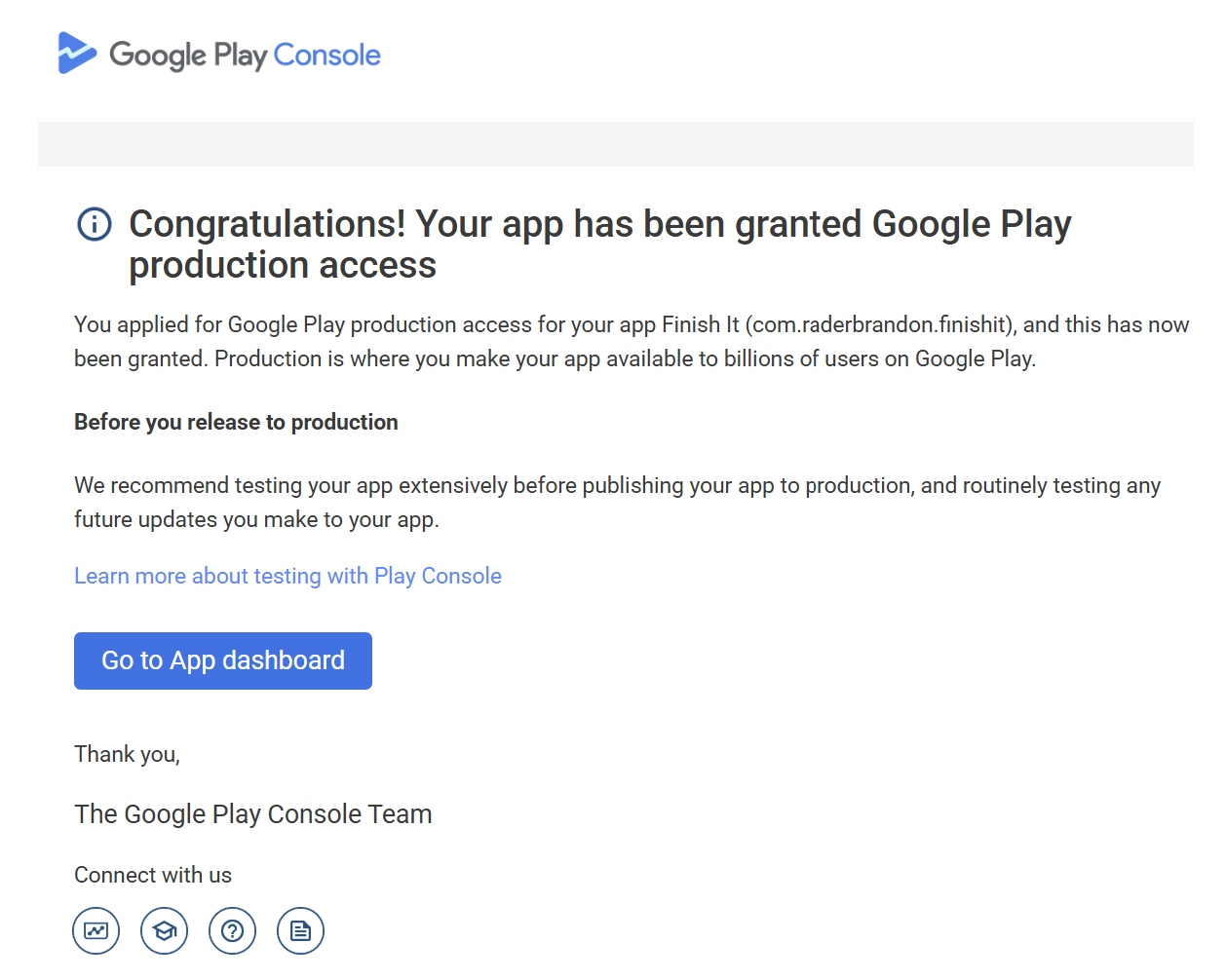
Verified Production Access
Quality QA Testing Reports
Clear, actionable reports with screenshots and evidence for every important issue found during testing.
Real Device Testing & Diagnostics
Real human testers use physical Android devices to test your app, verify real user flows, and provide clear testing evidence and professional QA reports.
Guaranteed App Approval
Transition your Android app to public production access with confidence. We deliver verified session logs and compliant Console activity.
One Cycle. Complete Approval.
Choose the ideal closed testing cycle for your Android release.
Loading Packages
Please wait while we fetch the best options for your region...
Frequently Asked Questions
Everything you need to know about passing your closed testing requirements.