12 Play Console app testers for Android apps in Philippines
Find 12 Play Console app testers in the Philippines. Pass Google Play closed testing smoothly using our 12 testers for 14 days Play Store service.
Launching a new Android application is a thrilling milestone, but getting past the strict gates of the Google Play Console is often the hardest part. If you are looking to validate your mobile experience, the Philippines offers one of the most vibrant and engaged smartphone markets in the world. With high English proficiency, a deeply digital culture, and a massive preference for Android devices, this country acts as the ultimate stress test for your software. However, Google does not just want to see that your app works - they demand proof that real humans find it valuable. This is where the mandatory Google Play Closed Testing phase comes in. You must gather 12 testers for 14 days to actively engage with your application. Choosing testers from the Philippines not only helps you meet this strict compliance rule but also provides you with high quality, actionable feedback from a market that truly understands mobile technology. It is not just about ticking a box for the Play Store Closed Testing requirements, it is about ensuring your app is completely ready for a global audience.
The Real Cost of Fake Testers
Many developers look for shortcuts when they see the 12 testers for 14 days requirement. They might turn to cheap click farms or automated bots, hoping to fool the system. This is a massive mistake. Google has advanced algorithms designed specifically to detect unnatural behavior.
Real Human Testers
Real users download your app on authentic, everyday devices with standard network histories. They tap around randomly, leave genuine feedback, and naturally open the app at different times of the day. This organic behavior signals to the Google Play Console that your app is legitimate, safe, and actually interesting to real people. It practically guarantees a smooth approval process for your production release.
Fake Bot Services
Bots and click farms use emulators or device farms on VPNs to simulate activity. They follow rigid, predictable patterns that Google flags almost instantly. Using these services does not just lead to a rejected closed testing phase - it can result in a permanent ban of your developer account. The money you save upfront will cost you your entire business in the long run.
Understanding Google Play Closed Testing Requirements
If you want to publish an app on the Google Play Store today, you have to play by Google's new rules. The landscape of app publishing has changed dramatically over the last year. Gone are the days when you could simply upload an APK file, fill out a description, and see your app live in a matter of hours. Google introduced the strict 12 testers for 14 days policy to combat the flood of low quality apps, malware, and abandoned projects that were cluttering the marketplace. They want to ensure that every new app provides a baseline level of quality and stability.
The Google Play Closed Testing phase is a mandatory period where a select group of users must install your app and keep it on their devices for two straight weeks. But it is not just about having the app sit dormant on a phone. These users need to actively open the app, interact with its features, and ideally provide feedback through the Play Console infrastructure. The system monitors the installation status, the crash reports, the Application Not Responding (ANR) errors, and the general engagement levels. If your testers simply install the app on day one and never open it again, Google will likely reject your application for production access.
This requirement is particularly daunting for independent developers and small startup teams. Finding 12 reliable people who will commit to testing an app every single day for two weeks is a massive logistical headache. Friends and family might promise to help, but they often forget after a few days. This is why securing a dedicated team of 12 Play Console app testers is so critical. When you source these testers from a highly active mobile market like the Philippines, you get the added benefit of authentic network conditions, varied device types, and genuine user interactions. The Philippine market is diverse, meaning your app will be tested on a wide range of hardware, from high end flagship phones to budget friendly devices. This exposes performance bottlenecks and UI issues that you might have missed in a sterile development environment.
To pass the Play Store Closed Testing review, you need to show a consistent timeline of engagement. Google's reviewers look at the dashboard data to verify that the 12 testers for 14 days condition was met without any suspicious gaps. They also look at the feedback submitted. While you do not need a perfect app to pass, you do need to prove that you are actively monitoring the testing phase and making necessary improvements. If your app crashes frequently during the 14 days, you are expected to push updates to fix those issues. Testing your Android apps in the Philippines provides a robust environment to gather this data, refine your code, and ultimately build a product that Google is proud to host on their store.
Struggling with the 14-Day Testing Requirement?
Skip the hassle of recruiting unreliable testers. Our professional fleet of real Android devices guarantees Google Play compliance in exactly 14 days. Zero bots. Zero emulators. 100% production approval guarantee.
Step-by-Step Roadmap to Launching Your App in the Philippines
Navigating the Google Play Console can feel like a maze. Follow this roadmap to ensure you hit every milestone during your Play Store Closed Testing phase.
Configure Your App Release
Before inviting anyone, your app must be fully set up in the Play Console. This includes filling out the content rating questionnaire, setting up your store listing with basic screenshots, and uploading a signed release bundle to the closed testing track. Ensure your privacy policy is linked and accessible.
Recruit Your 12 Philippine Testers
Once your release is ready, you need to gather the email addresses of your 12 testers. These must be the exact Gmail accounts they use on their Android devices. Add these emails to your tester list in the Play Console and generate the opt in link.
The 14-Day Engagement Period
Distribute the opt in link to your testers. They must accept the invitation, download the app directly from the Play Store, and keep it installed for 14 consecutive days. During this time, they should open the app regularly, explore different screens, and report any bugs they encounter.
Analyze and Update
Monitor your Play Console dashboard daily. Look for crash reports or ANR warnings. If a tester finds a significant bug, compile a fix, upload a new version to the closed testing track, and have your testers update their app. This shows Google you are actively maintaining the software.
Submit for Production Access
After exactly 14 days of continuous testing by at least 12 users, the Play Console will unlock the option to apply for production. You will need to answer a series of questions about your testing process, the feedback you received, and the changes you made. Be thorough and honest.
Essential Pre-Launch Checklist for the Philippine Market
Do not start your 14 day clock until you are absolutely certain your app is ready. Use this checklist to verify your preparation.
Play Console Configuration
Tester Coordination
Technical Readiness
Comparing Your Testing Options
When it comes to fulfilling the Google Play Closed Testing requirements, developers generally have three paths. Here is how they stack up against each other.
| Feature | Professional Service | DIY (Friends & Family) | Automated Bots |
|---|---|---|---|
| Passes Google's Checks | Yes, highly reliable | Mostly, if they remember | No, extremely high risk |
| Time Investment | Very Low | Extremely High | Low |
| Quality of Feedback | Detailed and actionable | Vague or non-existent | None |
| Device Variety | High (Real varying devices) | Low (Whatever friends have) | Fake (Server emulators) |
| 14-Day Consistency | Guaranteed daily usage | Often missed days | Suspiciously robotic |
| Account Safety | 100% Safe | 100% Safe | High risk of account ban |
Frequently Asked Questions (FAQ)
Getting your app approved can be confusing. Here are the most detailed answers to the common questions about the 12 testers for 14 days rule and testing in the Philippines.
What exactly is Google Play Closed Testing?
Google Play Closed Testing is a mandatory evaluation phase required for all new personal developer accounts created after November 2023. Before you can publish your app to the public, you must invite a specific group of users to test your application. This environment allows you to gather initial feedback, monitor technical performance, and prove to Google that your app is functional, safe, and ready for a wider audience.
Why do I need specifically 12 testers for 14 days?
Google set the 12 testers for 14 days benchmark to filter out spam, abandoned projects, and low effort applications. By requiring 12 real people to keep the app installed and engage with it over two straight weeks, Google ensures that the developer is serious about their product. It provides a large enough sample size to catch common crashes while giving users enough time to uncover deeper functional bugs.
Can I use my friends and family in the Philippines for this?
Yes, you can absolutely use friends and family. However, the challenge is consistency. The Play Store Closed Testing rules demand continuous engagement for the full 14 days. Friends often install the app on day one to support you, but forget to open it again. If Google detects a lack of activity, they may reject your application. Professional testing services ensure that daily engagement metrics are consistently met.
How does Google know if I use bots to fake the testing?
Google possesses some of the most sophisticated fraud detection systems in the world. They track data points such as IP addresses, device hardware IDs, touch patterns, session lengths, and network behavior. Bots typically run in server farms with predictable, robotic interactions. If Google detects that your 12 testers are actually automated scripts, your app will be rejected, and your developer account may be permanently terminated.
What happens if a tester uninstalls the app before the 14 days are over?
If a tester uninstalls the app or leaves the testing program before the 14 day period is complete, they no longer count towards your required minimum. If your total number of active testers drops below the required 12, your 14 day clock will reset, or you will fail the final review. This is why it is highly recommended to recruit more than 12 testers - ideally 15 to 20 - as a buffer against dropouts.
Does the Philippines market require specific localization for my app?
While the Philippines has a very high level of English proficiency, making full localization optional for basic testing, tailoring your app to local preferences can yield better feedback. Ensure your app handles slower or intermittent internet connections gracefully, as network speeds can vary across different regions of the country. If your app involves payments, integrating local payment gateways like GCash can significantly improve the testing experience.
How long does the Google review process take after the 14 days of testing?
Once your 12 testers for 14 days requirement is fulfilled, the Play Console will allow you to answer a questionnaire and apply for production access. After submitting this application, Google's manual review team will evaluate your testing data, your answers, and the app itself. This final review process typically takes anywhere from 3 to 7 business days, though it can take longer during peak periods or if your app requires closer scrutiny.
Can I push updates to my app during the 14-day closed testing period?
Yes, and it is actually highly encouraged. Releasing updates during the Google Play Closed Testing phase shows Google that you are actively responding to feedback and fixing bugs. When you upload a new version to the closed testing track, your testers will receive the update through the Play Store. Pushing an update does not reset your 14 day clock, as long as the testers keep the app installed and remain opted into the program.
What kind of feedback does Google expect me to collect from the testers?
Google wants to see qualitative feedback regarding the user experience, functionality, and design of your app. When you apply for production, you will be asked to summarize the feedback you received and explain how you acted on it. You should collect comments on confusing navigation, broken buttons, slow loading times, and overall satisfaction. Having a documented log of this feedback is crucial for passing the final evaluation.
Do the 12 testers need to have different types of Android devices?
While Google does not explicitly state that testers must have different devices, having a diverse range of hardware is incredibly beneficial for your app's stability. Testing on various screen sizes, Android OS versions, and hardware capabilities helps uncover hidden bugs. A mix of Samsung, Xiaomi, Oppo, and Vivo devices - which are very popular in the Philippines - provides an excellent and realistic hardware spread for your Google Play Closed Testing.
What if I want to launch globally, but only test in the Philippines?
That is a perfectly valid strategy. You can conduct your Play Store Closed Testing entirely with users in the Philippines, even if your ultimate goal is a worldwide release. The mechanics of the Play Console testing track remain the same regardless of geography. Once your app is approved for production based on the Philippine testing data, you can then adjust your target countries and regions in the Play Console to include the rest of the world.
How do I handle negative feedback from testers during this phase?
Negative feedback during closed testing is a good thing - it means your testers are paying attention and finding the flaws before real customers do. Do not ignore it. Log the complaints, prioritize the critical bugs, and push updates to resolve them. When you fill out the final production application, explicitly mention the negative feedback you received and detail the exact steps you took to improve the app based on that input.
Is it against Google's policies to pay people to test my app?
Google does not prohibit developers from compensating users for their time and effort during the testing phase. However, they strictly forbid paying for positive reviews, fake ratings, or automated bot engagement. If you are hiring a professional service to provide 12 Play Console app testers, you are paying for their structured testing methodology and guaranteed daily engagement, which is entirely compliant with Google's policies as long as the testers are real humans.
Can I stop the testing early if everything looks perfect after 7 days?
No. The 14 day duration is a hard, non negotiable requirement embedded in the Play Console infrastructure. Even if your app runs flawlessly and you have collected zero bug reports, the system will not unlock the production application button until the full 14 days have passed. You must maintain the engagement of your 12 testers for the entire required duration without exception.
What are the most common reasons apps get rejected after the closed testing phase?
The most frequent reasons for rejection include a lack of consistent tester engagement, failing to answer the production application questions thoroughly, and having an app that clearly violates Google's core policies (like lacking a proper privacy policy or asking for unnecessary permissions). Additionally, if your app registers high crash rates during testing and you never push an update to fix them, Google will view the app as unready for a public release.
How does the Play Console track if a user has opted in?
When you add a tester's email to your list, they must click a specific opt in web link generated by the Play Console. By clicking this link while logged into their Google account, they officially join the testing program. The Play Console dashboard will then update to show how many invited users have actively opted in and subsequently installed the application on their Android devices.
Can I use Android emulators on my computer instead of real devices for the 12 testers?
No. Google requires the app to be installed and tested on actual, physical Android devices. Emulators do not accurately replicate real world network conditions, battery usage, or typical human touch interactions. Google's systems can easily distinguish between an app running on an emulator and one running on a physical phone. Relying on emulators for your 12 testers for 14 days will almost certainly result in rejection.
What if my app is a paid app? How do the testers download it?
If your app is listed as a paid application, your closed testers will still be prompted to pay for it when they try to download it from the Play Store. To bypass this, you must create promo codes within the Play Console and distribute them to your 12 testers. They can redeem these codes at checkout to download and test the app for free.
Do I really need a privacy policy just for the closed testing phase?
Yes, absolutely. A comprehensive privacy policy is required before you can even roll out a release to the closed testing track. The policy must clearly state what data your app collects, how it is used, and who it is shared with. You must host this policy on a valid website and link it in the App Content section of the Play Console. Failing to provide this will block your testing progress.
What happens if my app crashes repeatedly during the 14 days?
Crashes are expected during testing, but ignoring them is a red flag. If your app crashes frequently, you must investigate the stack traces in the Play Console, develop a fix, and roll out a new version. If you finish the 14 days with a high, unresolved crash rate, Google's reviewers will likely determine that your app provides a poor user experience and will deny your application for production access until the stability issues are resolved.
How It Works
How we deploy real devices and guarantee compliance for your release.
Get Started
Sign in with Google to configure the closed testing environment for your Android build.
App Submission
Submit your Google Play Console testing link, and our team will assign qualified testers from our testing network to join your Android closed testing release.
14-Day Cycle
A QA supervisor monitors daily check-ins, ensuring 12 unique Android users engage with your Android build every single day.
Production Access Approval
We guarantee 14 consecutive days of active user check-ins to satisfy Google's compliance policies, delivering an audit-ready PDF feedback report.
Why Choose AppConsoleLab
Experience a next-generation testing infrastructure built for Google Play compliance for your Android release.
The 14-Day Production Guarantee
We complete the required 14-day closed testing process with real human testers and physical Android devices, while providing clear testing evidence and documentation throughout the process.
If Google specifically rejects production access due to insufficient testing engagement, you are covered by our free re-run or 100% refund guarantee, subject to our Refund Policy.
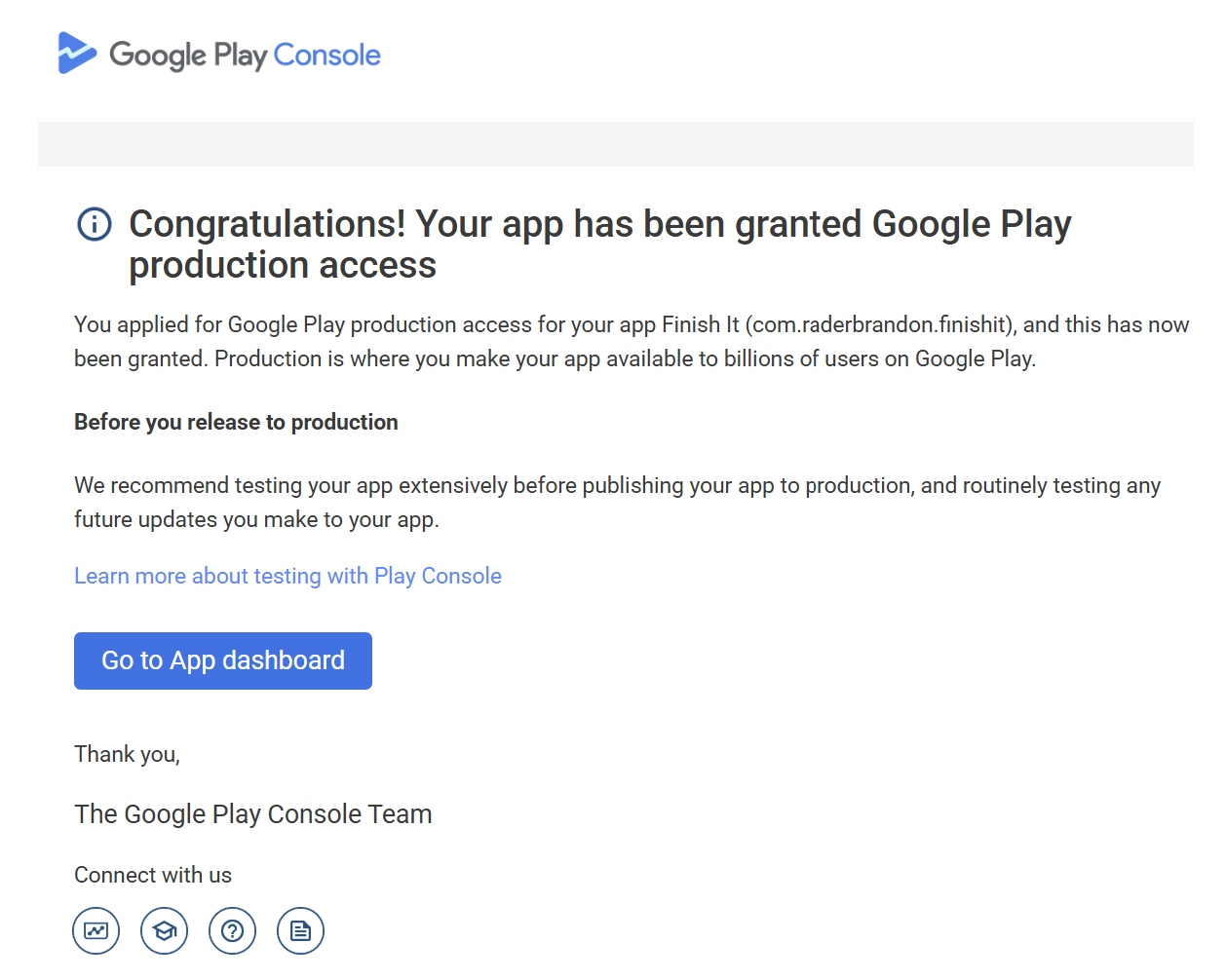
Verified Production Access
Quality QA Testing Reports
Clear, actionable reports with screenshots and evidence for every important issue found during testing.
Real Device Testing & Diagnostics
Real human testers use physical Android devices to test your app, verify real user flows, and provide clear testing evidence and professional QA reports.
Play Store Ready
Get your Android build approved on the first try. We create an audit-ready compliance profile that proves thorough quality assurance.
Affordable Compliance Cycles
Transparent plans built to satisfy Google Play Console guidelines for your Android build.
Loading Packages
Please wait while we fetch the best options for your region...
Frequently Asked Questions
Everything you need to know about passing your closed testing requirements.