12 Play Console app testers for Android apps in South Korea
Get 12 Play Console app testers in South Korea. Pass Google Play closed testing easily with our authentic 12 testers for 14 days Play Store service.
South Korea is not just a market. It is a high-speed, hyper-connected proving ground where apps either fly or fail in minutes.
With some of the fastest internet speeds on the planet, Korean users have zero patience for bugs. If your app stutters on a morning commute in Seoul, it will be uninstalled before the train hits the next station.
This intense environment makes getting your app onto the local store a high stakes game. Google knows this.
To even get a seat at the table, you must pass Google Play Closed Testing. This is not a casual beta run. It is a strict mandate to prove your software belongs on devices in such an advanced ecosystem.
Finding a team to test your app here is hard. Finding a reliable team is harder.
Why You Specifically Need 12 Testers for 14 Days
The rules are written in stone. For new personal developer accounts, Google demands real human testing before public release.
You need a core group of testers actively engaging with your app. They want to see 12 Testers for 14 Days. This continuous engagement proves your app does not just look good on day one, but actually works over a two-week lifespan.
Trying to cut corners here is a fatal mistake. Google's automated systems are incredibly sharp. They look for genuine usage patterns, real devices, and authentic interaction.
If you use fake accounts or cheap bots, your Play Store Closed Testing phase will be rejected. You will waste weeks of effort and risk getting your account flagged. Real people on real devices are your only safe path forward.
The Reality of Google Play Closed Testing in a Tech-Savvy Ecosystem
Launching an app in South Korea means you are competing for attention in a landscape dominated by massive gaming studios and polished lifestyle utilities. The standard is ridiculously high. When you initiate your Google Play Closed Testing, the data you gather must reflect this high standard. The testers you recruit need to simulate the exact behaviors of typical Korean smartphone users in their daily routines.
This means navigating complex menus, interacting with localized content, testing payment gateways if applicable, and ensuring the UI flows perfectly on the latest Samsung and LG devices that dominate the local market. The requirement of having 12 Testers for 14 Days is designed precisely for this reason. It forces developers to step back from the code and let real humans break things in unpredictable ways.
During these fourteen days, Google's algorithms are monitoring crash reports, ANR (Application Not Responding) rates, and overall stability metrics. If your testers just open the app and close it immediately, the engagement score will drop, and your application for production access will be denied. You need genuine sessions. You need people who will tap every button, read the dialogue boxes, and push the app to its memory limits while connected to varying network conditions.
Authentic Testing Services
Genuine Feedback: Real users provide actionable insights on UI/UX tailored to the Korean market.
Device Diversity: Testing on a wide array of physical Android devices, reflecting the actual hardware landscape.
Compliance Guaranteed: Naturally fulfills all requirements for Play Store Closed Testing without triggering spam filters.
Account Safety: Zero risk of developer account bans or policy strikes.
Bot Farms & Fake Activity
Zero Value: Automated scripts cannot tell you if your menu is confusing or if your translation is awkward.
Server Emulators: Activity originates from virtual machines with identical IP blocks, instantly flagged by Google.
Guaranteed Rejection: Fails the engagement checks, causing your production application to be denied.
High Risk: Severe chance of permanent suspension for your Google Play Console developer account.
It is tempting to ask friends and family to help out. But let us be honest. Can you find enough people who have the time, the right Android devices, and the dedication to open your app every single day for two straight weeks? Most developers quickly realize that managing a team of volunteers is like herding cats. They forget, they lose interest, or their devices are simply not compatible with your latest build. This is exactly where professional testing services become not just a luxury, but a strategic necessity for market entry.
Struggling with the 14-Day Testing Requirement?
Skip the hassle of recruiting unreliable testers. Our professional fleet of real Android devices guarantees Google Play compliance in exactly 14 days. Zero bots. Zero emulators. 100% production approval guarantee.
Understanding the Landscape: Professional vs DIY Testing
When approaching your Closed Testing requirements, you have a few options. Let us break down how they compare in the context of getting your Android app approved for the highly competitive South Korean market.
| Feature | Professional Service | DIY (Friends & Family) | Automated Bot Farms |
|---|---|---|---|
| Reliability | Extremely High | Low to Medium | Zero |
| Effort Required | Minimal | Very High (Constant nagging) | Low |
| Play Console Safety | 100% Safe | Generally Safe | High Risk of Ban |
| Market Relevance | High (Targeted demographics) | Low (Limited demographic spread) | None |
| Cost | Fixed Investment | "Free" (Costs massive time) | Cheap but Destructive |
| Approval Success | Guaranteed | Unpredictable | Almost Impossible |
Choosing the right method for your Play Store Closed Testing dictates how smoothly your launch will go. The 14-day period is not just a regulatory hurdle, it is a diagnostic tool for your business. If you use it correctly, you enter the market with a polished product ready for demanding users. If you try to cheat it, you will likely never enter the market at all, trapped in endless review cycles.
Comprehensive Preparation Checklist
Before you invite a single tester, your app must be fundamentally ready. South Korean users will not forgive a sloppy beta. Use this checklist to ensure your app is prepared for the rigorous 14-day evaluation period required by Google.
Initial App Setup & Localization
Technical Readiness
Play Console Configuration
Your Roadmap to Production Access
Navigating the Google Play Closed Testing phase requires a structured, patient approach. Here is the exact roadmap you should follow to ensure your app goes from beta to live without getting stuck in review limbo.
Step 1: Finalize the Release Candidate
Do not upload a broken build just to start the clock. Your app should be feature-complete and as bug-free as possible. The testers are there to find edge cases, not fundamental flaws that crash the app on startup. Make sure your app icon, screenshots, and descriptions are fully polished for the Korean market before submission.
Step 2: Configure the Closed Testing Track
Log into your Google Play Console. Navigate to the Testing section and select Closed Testing. Create a new release, upload your finalized App Bundle (AAB), and fill out all necessary release notes. Make sure you select the correct countries, specifically targeting South Korea if you want region-specific feedback to be prioritized.
Step 3: Onboard Your Testers
Once your release is approved for testing by Google, you need to add your testers. Input the Google account emails of your 12 testers. Send them the specific opt-in link provided by the Play Console. They must click this link, accept the invitation on their accounts, and download the app directly from the Play Store on their physical Android devices.
Step 4: Execute the 14-Day Testing Phase
This is the critical waiting period. For the next 14 days, your 12 testers must interact with the app in a meaningful way. They should open it daily, navigate through various screens, and simulate genuine user behavior. Monitor the Play Console dashboard closely for any crash reports or ANRs that occur during this extended time.
Step 5: Apply for Production Access
After 14 continuous days of successful testing, the Play Console will unlock the option to apply for production. You will need to fill out a detailed questionnaire detailing what you learned during the testing phase, how you interacted with testers, and what changes you made. Be extremely thorough and honest in your written answers.
Frequently Asked Questions
Understanding the nuances of the Google Play Closed Testing requirements is vital for a smooth launch. Below are the most common questions developers have when trying to navigate these rules, specifically focusing on the high-standards of the South Korean landscape.
Why does Google require 12 testers for 14 days?
Google implemented this rule for new personal developer accounts to drastically improve the quality of apps entering the Play Store. By forcing developers to undergo a rigorous two-week testing phase, Google ensures that only apps with proven stability and genuine human interaction make it to the public. This cuts down on spam apps, low-effort clones, and malware, creating a safer and more enjoyable ecosystem for users, particularly in high-demand markets like South Korea where expectations are paramount.
Can I use an emulator to fake the testing process?
Absolutely not. Google's device recognition algorithms are incredibly sophisticated and constantly updated. If they detect that all testing activity is coming from server-farm emulators, Android Studio virtual devices, or suspicious IP ranges, your testing phase will be completely invalidated. Worse, your developer account could be flagged for severe policy violations. The 14 days of testing must occur on real, physical Android devices connected to genuine residential networks to mimic real-world usage accurately.
What happens if a tester misses a day during the 14 days?
The core requirement is continuous, daily engagement. If your testers go completely dormant for a day or two, Google's automated systems may determine that the testing phase was inadequate and lacked real-world depth. While a single person missing a single day might not instantly fail the entire process, extended periods of inactivity across your tester pool will either restart the internal clock or lead to a hard rejection when you apply for production. Consistent, daily interaction from the whole group is the only way to guarantee approval.
Do the testers need to be physically located in South Korea?
While it is highly beneficial for accurate localization and cultural feedback, Google's strict baseline requirement for the Play Store Closed Testing does not mandate that the testers reside in the target launch country. The core technical requirement is 12 active users for 14 days regardless of geolocation. However, if your app is specifically designed for the Korean market, having local testers ensures they can properly evaluate localized features, region-specific payment gateways, and translation accuracy in a way foreign testers simply cannot.
How detailed should my production application be?
When the 14-day period concludes, you must answer a comprehensive questionnaire to formally apply for production access. Do not provide one-sentence or vague answers. Google reviewers read these manually to gauge your commitment. You need to provide a comprehensive summary of the testing process. Describe the specific feedback you received from the testers, the bugs that were identified during the two weeks, and exactly how you fixed them in subsequent builds. Detailed, thoughtful answers prove to Google that you took the testing phase seriously.
Can I update my app during the 14-day Closed Testing period?
Yes, you can and often should push updates if critical bugs are discovered by your team. Pushing an update shows active maintenance and responsiveness to tester feedback, which is exactly what Google wants to see. However, pushing an update does not magically restart the 14-day clock, provided your testers continue to engage with the new version seamlessly. Just ensure that any updates are meaningful and address actual issues found during the testing phase rather than just arbitrary code changes.
Why is it so hard to find reliable testers on my own?
Asking friends and family sounds easy in theory, but it rarely works in practice. People are busy with their own lives. Asking someone to remember to open a beta app every single day for two continuous weeks is a massive imposition. They often forget, get bored, or their phones might simply not be compatible with your app requirements. This leads to massive gaps in testing data, which ultimately results in Google rejecting your production application. Managing a volunteer testing team quickly becomes a stressful full-time job.
Does the size of my app matter for the testing phase?
The file size itself does not directly alter Google's rules, but it heavily impacts the tester experience. In markets like South Korea, users expect fast downloads and optimized storage management. If your app is unnecessarily large or bloated, testers might be reluctant to keep it installed for 14 days, leading to uninstalls before the period is over. Ensure your App Bundle is properly optimized, utilizing dynamic delivery features if necessary, to keep the footprint manageable and the testing process frictionless.
Are there specific testing requirements for gaming apps versus utility apps?
The baseline requirement of 12 Testers for 14 Days remains identical regardless of the app category. However, the nature of the engagement changes. For a utility app, testers might open it for two minutes to check a function. For a gaming app, Google expects longer session times, deeper navigation through menus, and interaction with various game states. If you are launching a mobile game in South Korea, your testers need to actually play the game to generate the session lengths and performance metrics Google expects from that category.
How do I handle crash reports during the testing period?
Crash reports (ANRs and exceptions) will appear in your Play Console dashboard. Do not ignore them. The testing phase is designed specifically to catch these errors. When a crash occurs, you should analyze the stack trace, identify the root cause, and ideally push a fix as a new release to the Closed Testing track. Documenting these crashes and how you resolved them is exactly the kind of information you need to include in your final production application questionnaire to demonstrate a successful testing lifecycle.
What if my app gets rejected after the 14 days?
If your application for production is denied, Google will typically provide a vague reason related to insufficient testing, lack of genuine engagement, or incomplete feedback loops. If this happens, you must essentially start the process over. You will need to gather your testers again, ensure they actually interact with the app daily this time, and complete another full 14-day cycle. This is a massive waste of time, which is why it is crucial to get it right the first time by using dedicated, reliable testing methods.
How do professional testing services ensure compliance?
Professional services operate using real people with physical, diverse Android devices. They manage the entire 14-day schedule internally, ensuring that each assigned tester logs in, interacts with the app meaningfully, and provides the necessary engagement metrics that Google looks for in the background. This completely removes the stress of managing volunteers on your end and guarantees that the activity data sent to the Play Console perfectly aligns with Google's stringent approval requirements, securing your path to production.
The journey to launching an Android app in South Korea is challenging, but mastering the Google Play Closed Testing phase is your crucial first step. By securing 12 Testers for 14 Days and ensuring genuine, active engagement, you lay the solid foundation for a successful, compliant, and highly polished app release. Do not leave your launch to chance. Prepare thoroughly, test rigorously, and enter the market with absolute confidence.
Our QA Process
Your journey to Google Play production access, simplified and automated.
Choose Package
Authenticate your account to initialize the 14-day QA fleet for your Android release.
Submit Link
Upload your testing link. We assign 12 verified users with real Android devices to download and test your Android release.
Active Testing
A dedicated testing supervisor is assigned to monitor progress while testers engage with your Android app and provide feedback throughout the testing period.
Get Approved
Our lab maintains active installations for two weeks straight, ensuring a clean track record and providing a QA compliance log for your release.
The Premium QA Advantage
Satisfy your Play Store Console testing obligations with our managed physical device fleet tailored for Android builds.
The 14-Day Production Guarantee
We complete the required 14-day closed testing process with real human testers and physical Android devices, while providing clear testing evidence and documentation throughout the process.
If Google specifically rejects production access due to insufficient testing engagement, you are covered by our free re-run or 100% refund guarantee, subject to our Refund Policy.
Verified Production Access
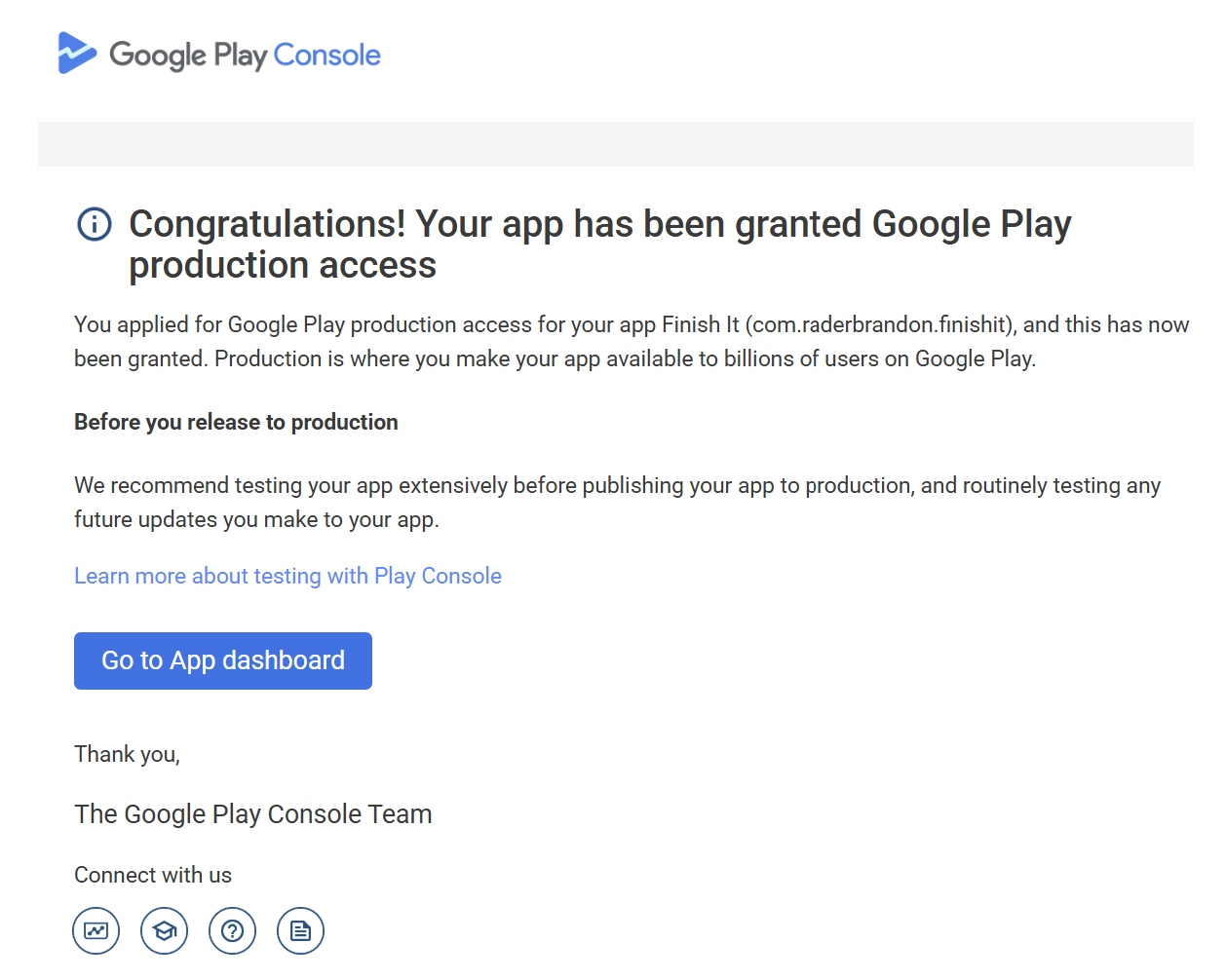
Quality QA Testing Reports
Clear, actionable reports with screenshots and evidence for every important issue found during testing.
Real Device Testing & Diagnostics
Real human testers use physical Android devices to test your app, verify real user flows, and provide clear testing evidence and professional QA reports.
Production Access Secured
Our structured 14-day closed testing process is designed to meet Google Play's production requirements for your Android release.
Simple Closed Testing Pricing
Select the plan that fits your Android app complexity.
Loading Packages
Please wait while we fetch the best options for your region...
Frequently Asked Questions
Everything you need to know about passing your closed testing requirements.