12 Play Console testers for Android app testing in Singapore
Need 12 Play Console testers in Singapore? Fulfill Google Play closed testing requirements with 12 testers for 14 days and launch on Play Store.
Launching a new mobile application in Singapore feels a bit like navigating the ERP gantries on the CTE during morning rush hour - you need everything to be perfectly synced, or you are going to hit a frustrating roadblock. When Google updated their developer policies to require 12 testers for 14 days before anyone can publish a brand new app, many independent developers in Singapore found themselves stuck in a strange kind of digital traffic jam. You have likely spent months building a brilliant app tailored specifically for the local market. Perhaps it is a slick new hawker center review platform, a specialized MRT transit tracker, or a localized fintech solution. However, you are now hitting a massive wall at the Play Console compliance stage. Getting real, reliable people to thoroughly test your app in Singapore for two straight weeks is surprisingly tough. People are busy, and relying on friends or family often leads to spotty engagement. This comprehensive guide breaks down exactly how to navigate this Google Play Closed Testing requirement without pulling your hair out. We will explore how to ensure your application reaches the local market smoothly, bypasses common pitfalls, and stays firmly on the right side of Google's complex algorithms.
The Real Cost of Skipping Proper Testing
Cutting corners on your Play Store Closed Testing is like skipping the foundation when building a new HDB flat - it might look fine for a quick minute, but the structural cracks will show up fast. Google's automated systems are incredibly sharp and unforgiving. They actively monitor engagement rates, daily session lengths, and even the IP addresses of your testers. If you try to fake the 12 Testers for 14 Days requirement using cheap emulators or automated bots, the Play Console will flag your developer account immediately. This does not just delay your launch; it can lead to outright, permanent bans. Real testing is not just a mandatory box to check; it is your ultimate safety net against a disastrous public release.
Why Localized Testers Matter So Much
Context is everything when it comes to mobile user experience. If your app is designed specifically for users in Singapore, having testers from the other side of the world will not give you the actionable feedback you actually need. Local testers instinctively understand the nuances of your specific market - like integrating local payment gateways, utilizing regional slang appropriately, or handling typical mobile network speeds while riding the East West Line underground. Furthermore, Google looks at regional relevance during Closed Testing. Matching your tester demographics closely to your intended target audience adds a massive layer of authenticity to your Play Console compliance efforts. This signals clearly to the reviewers that your app is a genuine product ready for the local ecosystem.
Navigating the New Era of Google Play Compliance
The landscape of Android app development has shifted dramatically over the past year. In the early days of the Play Store, publishing an app was a simple matter of uploading an APK and waiting a few hours. Today, the ecosystem is heavily regulated to protect consumers from malware, scams, and low-quality software. The introduction of the 12 testers for 14 days policy was a direct response to the flood of abandoned or broken apps cluttering the store. Google wants to see a proven track record of stability and user interest before they will grant you access to millions of potential downloaders.
For a developer in Singapore, this means you need a rock-solid strategy. The Google Play Closed Testing phase is no longer a mere technicality. It is a vital audition. During these 14 days, the Play Console is silently collecting a mountain of telemetry data. It watches how often the app crashes, how quickly it consumes battery life, and how users navigate your interface. If your app crashes frequently during this period, your chances of getting approved for a production release plummet. You must use this time not just to satisfy a numerical requirement, but to actively hunt down and squash bugs.
Furthermore, the quality of the feedback you receive matters immensely. When you finally apply for production access, you are required to answer detailed questions about your testing process. You need to explain what kind of feedback your 12 testers provided and, more importantly, what specific changes you made to the app based on that feedback. Vague answers like "the app is good" will not cut it. You need detailed, localized insights that prove you have taken the testing phase seriously.
The Hidden Challenges of Southeast Asian Market Penetration
Building an app for Singapore means you are operating in one of the most technologically advanced and highly competitive markets in Southeast Asia. Users here have incredibly high expectations for UI design, app performance, and data security. If your app feels clunky or confusing, users will simply uninstall it and find an alternative within seconds. This makes the testing phase even more critical.
You need testers who will push your app to its limits in real-world scenarios. How does your app handle transitioning from Wi-Fi in a shopping mall to cellular data on the street? Does the location tracking work accurately among the dense high-rise buildings of the CBD? These are edge cases that automated bots simply cannot test. Real human testers, navigating their daily lives in Singapore, will uncover the quirks and bugs that you, sitting in a quiet office or bedroom, would completely miss.
This is exactly why relying on a professional service to secure your 12 testers can be a game-changer. Instead of begging friends to open your app every day, you get a dedicated team of real users who understand their assignment. They will provide the consistent daily engagement that the Play Console demands, while also giving you the qualitative feedback you need to refine your product. This allows you to focus on what you do best - writing great code and building an amazing product.
Comparing Your Closed Testing Options
When facing the daunting task of finding testers, you generally have a few distinct paths you can take. Understanding the pros and cons of each will save you significant headaches down the line.
Authentic Managed Testing
You receive genuine feedback from real devices, perfectly mimicking natural human behavior. This creates consistent, daily engagement patterns that Google's algorithm trusts implicitly. You also get detailed, actionable bug reports you can actually read, understand, and fix. This guarantees full, stress-free compliance with the strict 12 Testers for 14 Days rule, resulting in significantly higher chances of quick, painless production approval.
Fake or Bot Testing
Automated scripts clicking randomly create highly suspicious usage patterns. This carries an extremely high risk of Google Play developer account suspension or permanent termination. You receive absolutely zero useful feedback on user experience, interface design, or real-world utility. Identical IP addresses and device signatures immediately trigger spam filters. Ultimately, it is a total waste of valuable time and money that indefinitely stalls your launch.
Breaking Down the Testing Methods
Let us look at a direct comparison of the various ways developers attempt to clear this hurdle.
| Feature | Premium Managed Service | DIY Friend Group Approach | Automated Bots / Click Farms |
|---|---|---|---|
| Account Safety | High | Medium | Very Low |
| Effort Required | Minimal | Massive | Low |
| Feedback Quality | Excellent | Highly Variable | None |
| Compliance Certainty | Guaranteed | Uncertain | Fails |
| Speed to Market | 14 Days exactly | Often 30+ Days | Indefinitely stalled |
| Stress Levels | Low | Very High | Extremely High |
Struggling with the 14-Day Testing Requirement?
Skip the hassle of recruiting unreliable testers. Our professional fleet of real Android devices guarantees Google Play compliance in exactly 14 days. Zero bots. Zero emulators. 100% production approval guarantee.
The Ultimate Google Play Closed Testing Checklist for Singapore
To ensure you do not miss any critical steps, follow this comprehensive checklist before, during, and after your testing phase.
Pre-Flight Checks and Initial Setup
Test Track Configuration and Optimization
Active Engagement and Monitoring Phase
Your Roadmap to Production in Singapore
Understanding the journey from a finished codebase to a live store listing is crucial for managing your expectations and timeline.
App Preparation and Policy Review
Before you invite a single tester, your app must meet all basic Google Play policies. This means strictly no deceptive behavior, proper and transparent data safety declarations, and a clean, intuitive user interface. Take the time to fill out your store listing details thoroughly and accurately. Think deeply about your local Singaporean audience - use localized screenshots, culturally relevant descriptions, and highlight features that matter to them.
Selecting and Onboarding Your 12 Testers
Gathering 12 reliable people who are willing to commit to testing your app for 14 straight days is by far the biggest logistical hurdle. You need individuals who will actually open the app daily, interact meaningfully with its core features, and provide structured feedback. Friends and family might offer to help, but they almost always forget to log in after the second day. This is exactly where leveraging a dedicated professional service saves you weeks of frustration and repeated failed attempts.
The 14-Day Active Testing Marathon
Once your testers officially opt-in and download the app, the 14-day clock begins ticking. Google Play Closed Testing requires continuous, verifiable engagement. If your testers download the app on day one and never open it again, you will absolutely fail the final review. You must monitor their activity carefully, send polite but firm reminders if you are managing them yourself, and keep a very close eye on the technical vitals and crash logs within the Play Console.
Submitting for Final Production Approval
After the mandatory 14 days have fully passed and you have gathered sufficient qualitative feedback, you can finally apply for production access. Google will ask you a series of very specific questions about your testing process. You need to provide detailed, well-thought-out answers about what specific feedback you received and exactly how you improved the app based on that data. Be thorough, be honest, and provide clear examples.
Frequently Asked Questions
Understanding the nuances of the Play Store Closed Testing requirements can be confusing. Here are detailed answers to the most common questions developers have when trying to launch their apps.
What exactly is the 12 Testers for 14 Days requirement?
Google introduced a strict policy requiring all new personal developer accounts created after November 2023 to conduct a thorough closed test before publishing an app to production. You must recruit a minimum of 12 individual testers who must opt-in to your test track. These testers must keep your app installed and actively engage with it on a daily basis for 14 consecutive days. This is designed to ensure apps are stable, functional, and offer genuine value before they are made available to the general public.
Why did Google implement these strict rules for new developers?
Over the years, the Google Play Store became cluttered with millions of low-quality, abandoned, or poorly functioning applications. This degraded the overall user experience and made it harder for high-quality apps to gain visibility. By enforcing the 12 Testers for 14 Days rule, Google is effectively raising the barrier to entry. They want to filter out spam developers and ensure that only serious creators who are willing to invest time in quality assurance can publish apps. It is a quality control measure that ultimately benefits both users and dedicated developers.
Can I just use my old phones or emulators to simulate 12 testers?
Absolutely not, and attempting to do so is a very fast way to get your developer account permanently banned. Google utilizes highly sophisticated device fingerprinting, IP tracking, and behavioral analysis algorithms. If they detect that multiple tester accounts are operating from the same physical location, using identical hardware signatures, or exhibiting robotic engagement patterns, they will flag your test as fraudulent. You must use real, distinct human users operating on normal consumer network conditions.
How does the Play Console track active engagement during the 14 days?
While Google does not publicly share the exact inner workings of their algorithm, it is widely known that they track several key metrics through the mandatory Play Services framework installed on all Android devices. They monitor daily active users, session durations, the frequency of app launches, and the occurrence of background crashes or Application Not Responding errors. A tester simply downloading the app and leaving it untouched will not register as active engagement and will cause you to fail the requirement.
What happens if a tester misses a day of testing?
Consistency is crucial. If one or two testers miss a single day, it might not immediately ruin your entire test, provided the overall group engagement remains high. However, if multiple testers fail to open the app for several days, the Play Console's automated systems will likely determine that your app is not retaining users. This will lead to a rejection when you apply for production access. This is why having a buffer, perhaps 15 or 20 testers, is highly recommended if you are managing the process yourself.
Do the testers absolutely need to be physically located in Singapore?
Technically, Google does not strictly mandate that your testers must reside in the exact country your app targets. However, from a practical and strategic standpoint, having local testers is vastly superior. If your app relies on Singaporean infrastructure, local payment methods, or specific geographic features, a tester in Europe cannot adequately evaluate it. Furthermore, a localized testing footprint looks much more authentic to Google's review team when they evaluate your application for regional release.
What kind of feedback does Google expect me to submit after the testing phase?
When you apply for production access after the 14 days, you will face a questionnaire. Google wants to see evidence that a real testing feedback loop occurred. You will need to summarize the core feedback your testers provided. More importantly, you must clearly explain how you actioned that feedback. For example, stating "Testers found the checkout button hard to see, so we increased its size and changed the color to high-contrast red in update version 1.2" is the exact type of detailed response they are looking for.
How can a professional testing service guarantee compliance?
A reputable testing service maintains a vast network of real, verified human testers with diverse Android devices. When you use a premium service, they assign dedicated individuals to your project who are contractually obligated to download, install, and actively interact with your app daily. Because these are real people using real phones on varied cellular networks, their activity perfectly mimics natural user behavior, easily satisfying Google's rigorous algorithmic checks and ensuring you pass the compliance phase.
Is it normal for the production review to take a long time after the 14 days?
Yes, it is completely normal. After you complete the 14 days of testing and submit your application for production access, the review process transitions from automated tracking to a manual review by Google's policy team. This manual review can take anywhere from two days to over a week, depending on their current backlog and the complexity of your app. Patience is key during this phase. Do not panic if you do not receive an immediate response.
What are the most common reasons for getting rejected after completing the closed test?
The most frequent reason for rejection is a lack of genuine, continuous engagement - meaning your testers simply did not use the app enough. Other common pitfalls include failing to provide detailed, specific answers in the final feedback questionnaire, having an excessive amount of unresolved crashes during the testing period, or violating core Google Play policies regarding data privacy or user safety. Ensuring high engagement and thoroughly documenting your bug fixes is the best way to avoid a frustrating rejection.
How We Deliver 12 Testers
A straightforward 4-step process to get your Android app approved.
Connect Account
Connect your Google account and choose your preferred closed testing package for your Android app.
Assign Testers
Share your Play Store opt-in URL. We immediately deploy 12 real testers to launch and review your Android app daily.
Daily QA Runs
Our crew initiates daily launch sessions on physical devices, verifying usability and logging crashes for your Android app.
Launch Ready
We continuously perform closed app testing for 14 days to help you meet Google Play production requirements. We also provide a compliance report.
Our Testing Infrastructure
Deploy your Android app onto real retail-grade handsets using our secure laboratory environment.
The 14-Day Production Guarantee
We complete the required 14-day closed testing process with real human testers and physical Android devices, while providing clear testing evidence and documentation throughout the process.
If Google specifically rejects production access due to insufficient testing engagement, you are covered by our free re-run or 100% refund guarantee, subject to our Refund Policy.
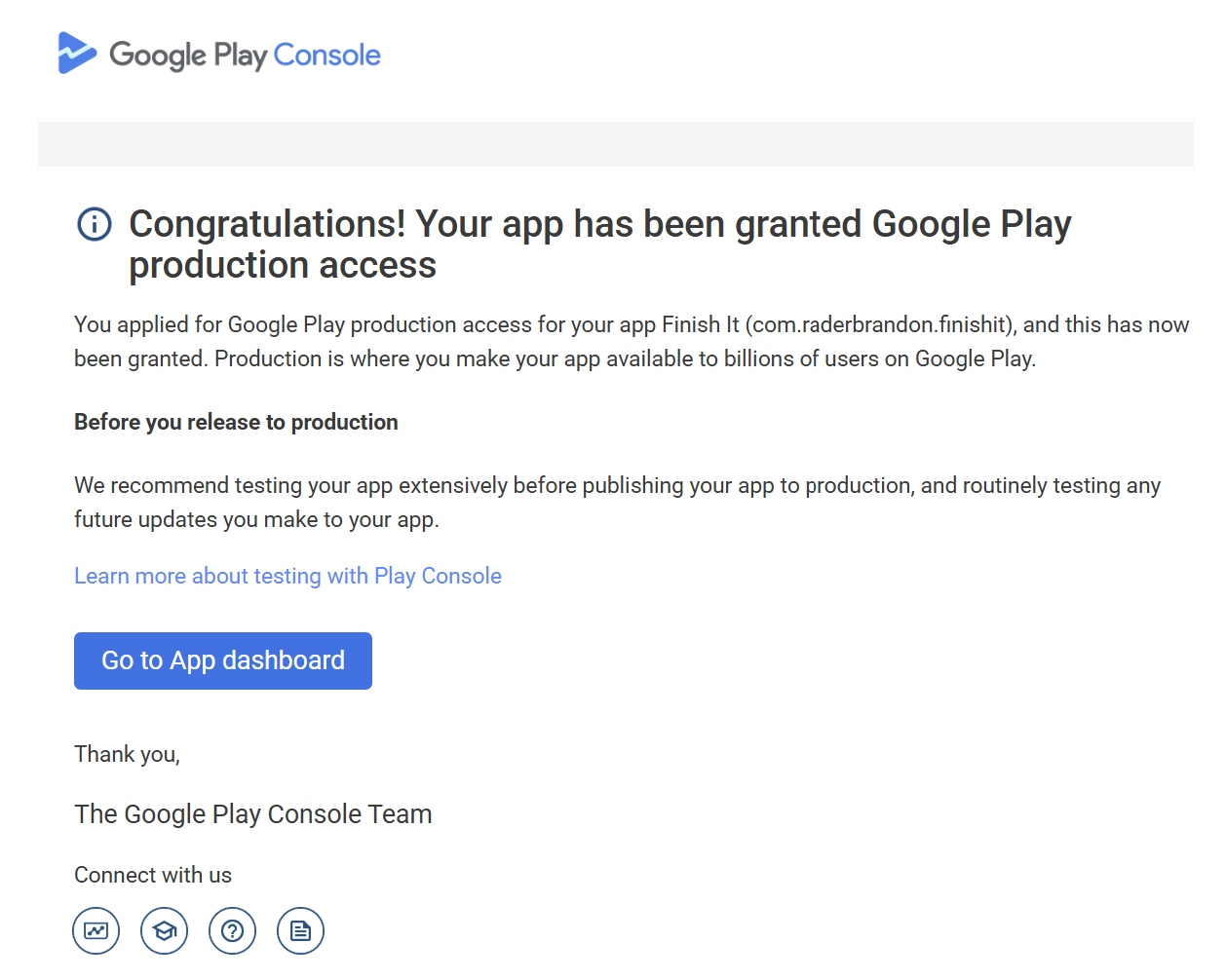
Verified Production Access
Quality QA Testing Reports
Clear, actionable reports with screenshots and evidence for every important issue found during testing.
Real Device Testing & Diagnostics
Real human testers use physical Android devices to test your app, verify real user flows, and provide clear testing evidence and professional QA reports.
Compliance Audit Passed
Transition your Android app to public production access with confidence. We deliver verified session logs and compliant Console activity.
One Cycle. Complete Approval.
Choose the ideal closed testing cycle for your Android release.
Loading Packages
Please wait while we fetch the best options for your region...
Frequently Asked Questions
Everything you need to know about passing your closed testing requirements.