Dedicated 12 Testers for 14 Days for Android Apps
Meet Play Console closed testing publishing requirements with 12 verified testers performing active daily interactions on real Android hardware and verified 14 day engagement for production access approval.
Google play closed testing requirements for QR Scanner apps apps
Google Play now requires developers with new personal accounts to run a closed test before they can publish an app. Specifically, you need at least 12 testers to be opted-in to your test for 14 consecutive days. This isn't just a suggestion; it's a hard requirement to get your app live.
This rule was put in place to improve the quality of apps on the Play Store. It acts as a filter, ensuring that developers are serious about their projects and have received at least some initial feedback. While the intention is good, it creates a significant hurdle. Finding 12 reliable people and making sure they stay opted-in for two full weeks can be a huge headache.
This guide will break down exactly what you need to do. We'll explore your options, the risks to avoid, and the simplest way to get this done so you can focus on what you do best: building great apps.
Why Google Cares About Your 14-Day Test
At first, this requirement can feel like a pointless delay. But there's a reason behind it. Google is trying to solve a few problems at once.
First, it helps reduce the number of low-effort or malicious apps. By making developers go through a testing phase, Google weeds out those who aren't committed. A scammer is less likely to organize a two-week testing period with real people.
Second, it encourages you to get real-world feedback. When actual users interact with your app, they'll find bugs and usability issues you missed. This initial testing phase can save you from a flood of one-star reviews after you launch. It forces a minimum level of quality control.
Finally, it confirms you are a legitimate developer who can follow the platform's rules. Think of it as your first test from Google. Passing it shows you can navigate the Play Console and are ready to be a part of the ecosystem.
Your Options for Finding 12 Testers
You have a few ways to tackle this requirement. Each comes with its own set of pros and cons.
- The DIY Method: You can try to find testers yourself. This usually means asking friends, family, or posting on social media and forums.
- Shady Bot Services: You can find cheap gigs on freelance sites that promise to meet the requirement using automated accounts or bots.
- A Managed Service: You can hire a professional service that provides a dedicated group of real, vetted testers to handle the entire process for you.
Let's break down how these three options really stack up.
Comparison: DIY vs. Fiverr Bots vs. A Dedicated Service
Choosing the wrong path can lead to delays, wasted money, or even getting your developer account banned. This table gives you a clear look at what to expect from each option.
| Feature | AppConsoleLab's Service | Finding Testers Yourself (DIY) | Fiverr Bots |
|---|---|---|---|
| Tester Quality | Real, vetted, experienced testers | Varies wildly (friends, family) | Fake accounts or bots |
| Google Policy Compliance | 100% compliant and safe | Generally safe, but hard to manage | Extremely high risk of account suspension |
| Time Investment | Minimal (about 15 minutes to set up) | Very high (hours of coordination) | Low, but the risk isn't worth it |
| Success Guarantee | Guaranteed to meet the requirement | No guarantee; people might drop out | No guarantee; Google may detect bots |
| Feedback Quality | Optional constructive feedback | Biased or low-effort feedback | None |
| Management | We handle everything | You have to chase people for 14 days | No management needed, but it's fake |
| Cost | Fixed, predictable price | "Free," but your time has value | Cheap, but you risk your entire account |
As you can see, while the DIY approach seems free, the time and stress involved are significant costs. And bot services are a gamble you should never take.
Continuous Engagement
Google's system doesn't just check for a one-time opt-in. It looks for a continuous 14-day period where at least 12 testers are part of your testing track. This means if someone opts out on day 10, your 14-day clock could reset for that 'slot.' A managed service ensures testers remain opted-in for the entire duration, providing a stable and reliable count that satisfies Google's requirement without any last-minute surprises.
One-Time Opt-In
The biggest risk with the DIY method is relying on a simple 'one-time opt-in.' You might get 12 friends to join on day one, but they can easily forget and leave the test, or clear their app data, or switch phones. This is a fragile setup. You become a project manager, constantly checking your list and reminding people to stay in the test. It's a distraction from your real work.
The Step-by-Step Path to a Successful Launch
Getting this done shouldn't be complicated. With a managed service, the process is straightforward and hands-off for you. Here is what the journey looks like from start to finish.
Submit Your App Details
We Recruit & Vet Testers
Tester Onboarding Begins
The 14-Day Clock Starts
Feedback & Reporting
Requirement Met, Ready to Publish
Struggling with the 14-Day Testing Requirement?
Skip the hassle of recruiting unreliable testers. Our professional fleet of real Android devices guarantees Google Play compliance in exactly 14 days. Zero bots. Zero emulators. 100% production approval guarantee.
The Dangers of Using Bots or Fake Testers
It can be tempting to look for a cheap, fast solution on a freelance marketplace. You'll see gigs promising '12 testers for $10' almost instantly. This is the fastest way to get your Google Play Developer account suspended.
Google's systems are incredibly sophisticated. They can easily detect suspicious activity, such as:
- Multiple testers joining from the same IP address or device farm.
- Accounts with no history of downloading or using other apps.
- Testers who opt-in and show no activity.
- Sudden spikes in tester sign-ups that look unnatural.
If Google flags your test for manipulative behavior, the consequences are severe. At best, your app will be rejected. At worst, your entire developer account—and any future accounts you try to create—will be terminated. For a one-time fee of $25, it's a risk that is never, ever worth taking. Don't gamble with your app's future. For more information on legitimate options, you can review a full breakdown of the Best Google Play Closed Testing Services Compared (2026).
Your Pre-Launch Checklist
Getting your app ready for the 14-day test is simple. Following these steps ensures the process goes smoothly from the moment you hand things over.
Phase 1: App and Console Prep
Phase 2: Hand-off and Monitoring
How to Confirm the Requirement is Met
The waiting is the hardest part. You'll want to know for sure when you've crossed the finish line. The Google Play Console gives you the information you need, but it can be a bit hidden.
You can track your progress on the Dashboard page for your app. Google has added a new section called 'Test your app before release' that shows your status. It will tell you how many testers you have and for how long the test has been running. Once you've met the criteria, this section will update, and you'll be prompted to apply for production access. For a detailed walkthrough with screenshots, check out our guide on How to Check Whether Your 14-Day Testing Requirement Is Complete.
Meeting this 12-tester, 14-day requirement is your final gate before launching. Navigating it correctly is key. Trying to manage it yourself is a major time sink, and using bots is a risk that can end your developer career before it starts. A dedicated, managed service is the most reliable and stress-free way to clear this hurdle and get your app published.
What if one of the 12 testers opts out during the 14 days?
This is a common concern with the DIY method. If a tester opts out and your count drops to 11, the 14-day clock can pause or even reset. Professional services like ours prevent this by over-recruiting (e.g., inviting 15 testers for 12 slots) to ensure you always have a buffer. If someone drops, another is ready to keep the count stable.
Do I need to provide instructions or feedback forms for the testers?
If you use a managed service, you don't have to. The service handles all communication and instructions for the testers. Their primary goal is to remain opted-in and meet Google's technical requirement. If you want specific feedback, that's often an add-on service you can request.
Can I update my app by uploading a new build during the 14-day test?
Yes, you absolutely can and should. The closed testing track is designed for this. You can push updates to your testers throughout the 14-day period to fix bugs or add features. This does not reset the 14-day clock and is considered a good practice.
How does Google know the testers are real people and not bots?
Google analyzes various signals. This includes the age and activity history of the Google account, the device profile, IP address, and engagement patterns. Real users have diverse device models, realistic usage history, and don't all sign up at the exact same second. Bot farms often fail on all these checks.
What is the difference between opt-in and active testing?
For this specific requirement, the most important metric is that the tester remains 'opted-in' for 14 consecutive days. This means they are officially part of your test group. While some level of app usage is good, Google's main check is for the continuous opt-in status. A tester doesn't need to use your app for hours every day to count.
After the 14 days are over, can I remove the testers?
Yes. Once the requirement is met and you have successfully applied for production access, you can close the test track or remove the testers from your email list. They are no longer needed to maintain your app's published status.
How We Deliver 12 Testers
How we deploy real devices and guarantee compliance for your release.
Connect Account
Sign in with Google to configure the closed testing environment for your Android build.
Assign Testers
Submit your Google Play Console testing link, and our team will assign qualified testers from our testing network to join your Android closed testing release.
Daily QA Runs
A QA supervisor monitors daily check-ins, ensuring 12 unique Android users engage with your Android build every single day.
Launch Ready
We guarantee 14 consecutive days of active user check-ins to satisfy Google's compliance policies, delivering an audit-ready PDF feedback report.
Our Testing Infrastructure
Experience a next-generation testing infrastructure built for Google Play compliance for your Android release.
The 14-Day Production Guarantee
We complete the required 14-day closed testing process with real human testers and physical Android devices, while providing clear testing evidence and documentation throughout the process.
If Google specifically rejects production access due to insufficient testing engagement, you are covered by our free re-run or 100% refund guarantee, subject to our Refund Policy.
Verified Production Access
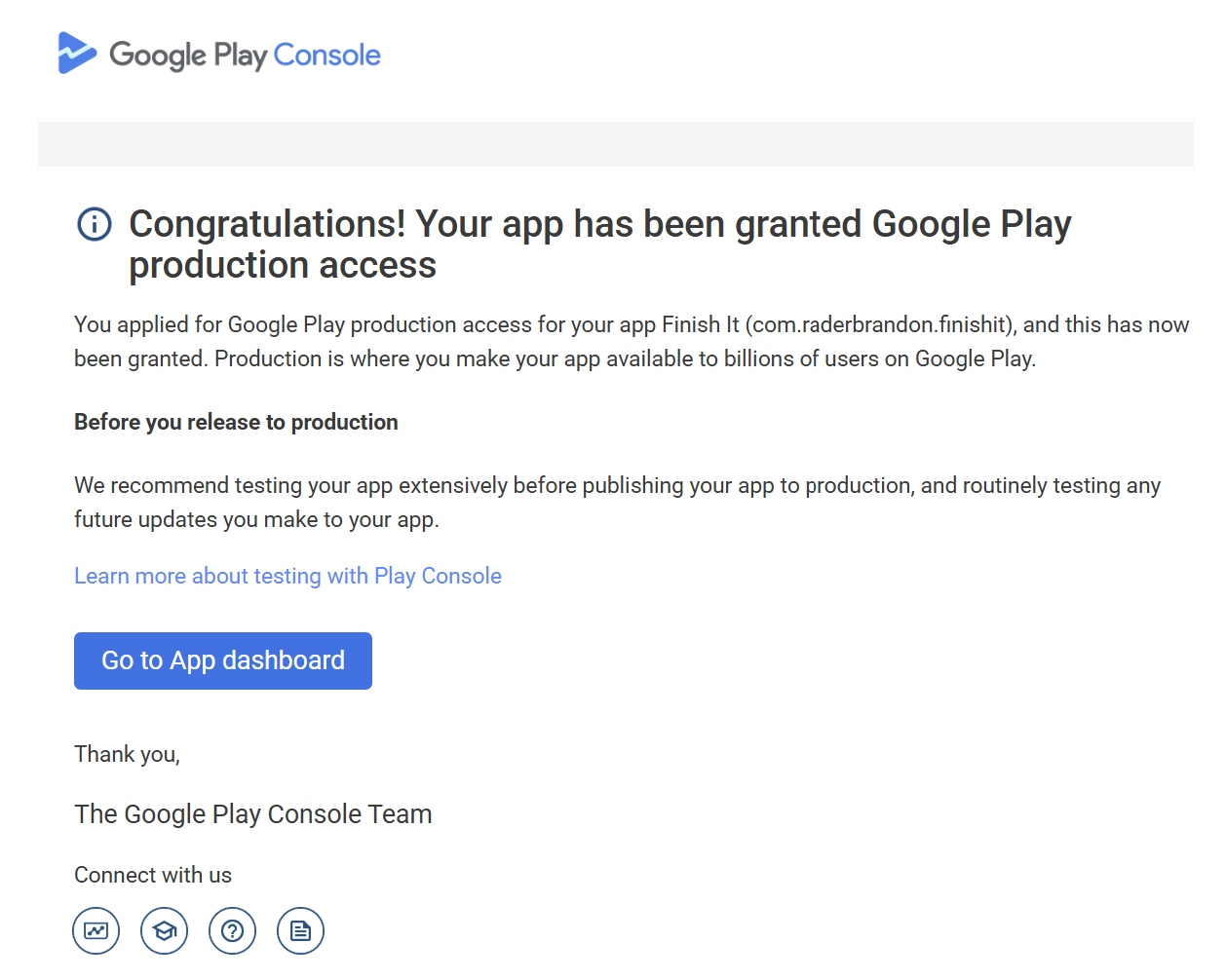
Quality QA Testing Reports
Clear, actionable reports with screenshots and evidence for every important issue found during testing.
Real Device Testing & Diagnostics
Real human testers use physical Android devices to test your app, verify real user flows, and provide clear testing evidence and professional QA reports.
Compliance Audit Passed
Get your Android build approved on the first try. We create an audit-ready compliance profile that proves thorough quality assurance.
Affordable Compliance Cycles
Transparent plans built to satisfy Google Play Console guidelines for your Android build.
Loading Packages
Please wait while we fetch the best options for your region...
Frequently Asked Questions
Everything you need to know about passing your closed testing requirements.