Reliable 12 Testers for Closed Testing for Android Apps
Comply with Google Play Console’s closed testing rules for your Ionic app worldwide with 12 verified testers performing active daily interactions on real Android hardware and verified 14 day engagement for production access approval.
Google Play requires developers with new personal accounts to run a closed test with at least 12 testers for 14 continuous days. This is a mandatory step before you can apply for production access and publish your app. Finding reliable people to fill these spots can be a major hurdle, but it's a problem with a clear solution.
This guide breaks down exactly what you need to do, the common pitfalls to avoid, and the most dependable way to meet Google's requirements without headaches.
Play console closed testing explained for Ionic
In late 2023, Google updated its policy for new developers. Previously, the rules were a bit more flexible, but now they are very specific. If you created your personal developer account after November 13, 2023, you must meet this testing requirement.
Here’s what it means in simple terms:
- 12 testers: You need a minimum of 12 people to join your closed test.
- Opt-In: These people must accept your invitation and "opt-in" to the test.
- 14 Continuous Days: The most important part. At least 12 people must remain opted-in for 14 days in a row. If someone leaves on day 5 and you drop to 19 testers, your 14-day clock might reset.
Google did this to improve the quality of apps on the Play Store and to discourage spam and low-quality applications. They want to see that you are a serious developer who has put your app through a basic quality assurance phase with real people. While this helps the ecosystem, it creates a real challenge for solo developers and small teams who don't have a network of 12 reliable friends ready to help.
The Pain of Finding and Managing Testers
Getting 12 people to agree to help sounds easy at first. But the reality is much different.
- Friends and Family: You ask your friends, your cousins, your parents. A few will say yes. Some will forget to click the link. Others will click it, then leave the test a few days later without telling you, resetting your progress. They mean well, but they have their own lives and don't understand how important that "continuous" 14-day period is.
- Online Communities: You might post on Reddit or in Facebook groups for developers. You'll get a mix of responses. Some are helpful people, but many are unreliable. You'll spend hours messaging people, sending links, and checking if they've actually joined. It's a huge time sink.
- The Risk of Scammers: The worst-case scenario is using testers from cheap gig sites. Many of these are bot farms that use the same devices or IP addresses. Google's systems are smart and can easily detect this kind of activity. Using these services can get your app rejected or, even worse, your entire developer account flagged or terminated. It's a risk that is never worth the small price.
The core problem isn't just finding 12 people; it's finding 12 reliable people who will stay opted-in for two full weeks without dropping out.
Your Options for Getting 12+ Testers
You have three main paths to get your group of testers. Let's compare them honestly so you can see the pros and cons of each. One path is safe and efficient, one is hard work, and one is a dangerous gamble.
| Feature | AppConsoleLab's Service | Finding Testers Yourself (DIY) | Fiverr Bots / Cheap Services |
|---|---|---|---|
| Reliability | Very High. We guarantee 14 continuous days of testing. | Low to Medium. People forget, get busy, or drop out. | Extremely Low. Often bots that Google detects and rejects. |
| Time Investment | Minimal. About 5 minutes to set up. We handle the rest. | Very High. Hours spent finding, managing, and begging. | Low. But the time you save is not worth the risk. |
| Risk of Failure | Zero. We guarantee you'll pass the requirement. | High. A single person leaving can reset your 14-day clock. | Very High. High chance of app rejection or account ban. |
| Stress Level | Low. Set it and forget it. Focus on your app. | High. Constant worry and checking on your testers. | High. The anxiety of potentially losing your account. |
| Cost | A fixed, one-time fee for a guaranteed result. | Free (if you don't count your time and sanity as a cost). | Seems cheap, but can cost you your entire developer account. |
| Real Testers | Yes. Real people on real, unique devices. | Yes, but their reliability is the main issue. | No. Almost always bots from a device farm. |
As you can see, trying to save a few dollars by using risky services or spending dozens of hours managing people yourself can easily backfire. A professional service is designed to solve this one specific problem perfectly. If you're looking for a service, our guide on the Best Google Play Closed Testing Services Compared (2026) offers a detailed look at the options.
Struggling with the 14-Day Testing Requirement?
Skip the hassle of recruiting unreliable testers. Our professional fleet of real Android devices guarantees Google Play compliance in exactly 14 days. Zero bots. Zero emulators. 100% production approval guarantee.
The Proven Roadmap to Publishing Success
Getting through the 14-day testing period is a clear, step-by-step process. If you follow these steps, you'll be on your way to production.
Prepare Your App & Store Listing
Create Your Closed Test
Build Your Tester List
Testers Opt-In & Start the Clock
Monitor Your Progress
Apply for Production
This process can feel complicated, but it's really about being organized and, most importantly, having testers you can count on.
Your Testing Checklist
To make things even simpler, here is a checklist to follow. Breaking it down into phases helps you focus on one thing at a time.
Phase 1: Setup and Configuration
Phase 2: Execution and Monitoring
Understanding What Google Actually Measures
There's a lot of confusion about what testers need to do. Do they have to download the app? Do they need to use it every day? This is a key point that can save you a lot of stress.
Requirement: Passive Opt-In
Best Practice: Active Feedback
The takeaway is simple: to satisfy Google, you need passive opt-ins. To build a better app, you want active feedback. A good testing service can provide both.
Getting your app published shouldn't be blocked by a logistical problem like finding testers. By understanding the requirement, avoiding risky shortcuts, and using a reliable solution, you can clear this hurdle quickly and get back to what you do best: building great apps.
Do I really need 12 testers? I saw some articles mention 12.
Yes, as of late 2023, the requirement for new personal developer accounts is a minimum of 12 testers. The rules have changed over time, so be sure you are following the most current guidelines from Google. Older accounts may have different requirements.
What happens if one of my testers leaves on day 10?
If your tester count drops below 12 at any point, Google may reset your 14-day continuous testing clock back to zero. This is the biggest reason why using unreliable testers is so frustrating. You need to get a new tester to join to get back to 12, and the 14-day period will start over.
Do the testers need to have Gmail accounts?
Yes, testers must use a Google account (which is typically a Gmail account) to opt-in to a closed test on the Google Play Store. They cannot use an Apple ID or a non-Google email address.
Can I use the same 12 testers for my next app?
Absolutely. Once you have a reliable group of testers, you can create a new email list for your next app's closed test and invite them again. This is another benefit of using a service—you have a go-to solution for every app you develop.
How long after the 14-day test can I publish my app?
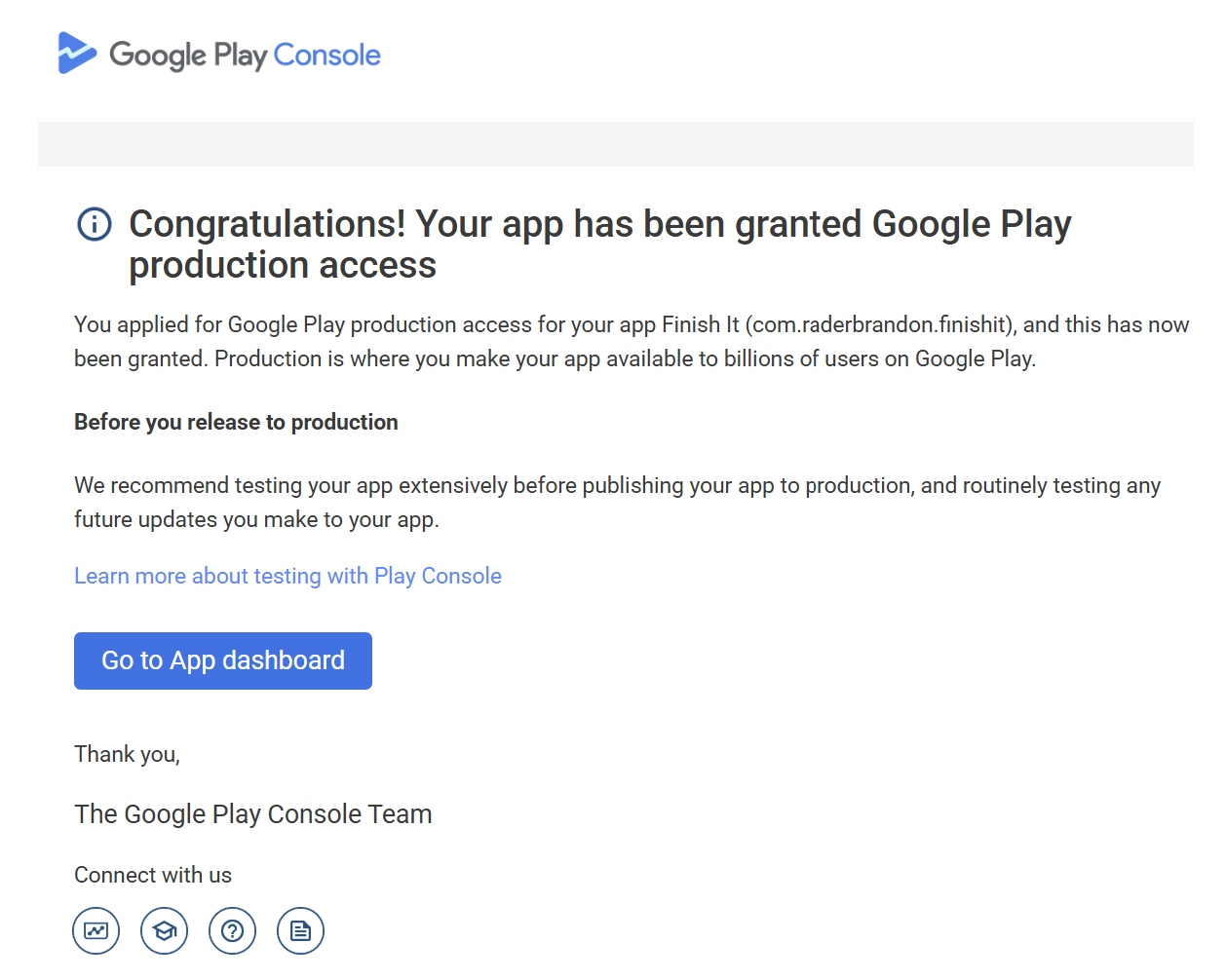
Once the 14-day requirement is met, a button or link to 'Apply for production' will appear in your Play Console. After you apply, your app goes into a final review by Google. This review can take anywhere from a couple of days to over a week. Once approved, you can publish immediately.
Is it safe to give my app to 12 strangers before its published?
Yes, it is generally safe. The closed test is done through the official Google Play Console, which is a secure system. Testers only get access to the specific version of the app you upload for the test. They do not get access to your source code or your developer account.
How We Deliver 12 Testers
Your journey to Google Play production access, simplified and automated.
Connect Account
Authenticate your account to initialize the 14-day QA fleet for your Ionic release.
Assign Testers
Upload your testing link. We assign 12 verified users with real Android devices to download and test your Ionic release.
Daily QA Runs
A dedicated testing supervisor is assigned to monitor progress while testers engage with your Ionic app and provide feedback throughout the testing period.
Launch Ready
Our lab maintains active installations for two weeks straight, ensuring a clean track record and providing a QA compliance log for your release.
Our Testing Infrastructure
Satisfy your Play Store Console testing obligations with our managed physical device fleet tailored for Ionic builds.
The 14-Day Production Guarantee
We complete the required 14-day closed testing process with real human testers and physical Android devices, while providing clear testing evidence and documentation throughout the process.
If Google specifically rejects production access due to insufficient testing engagement, you are covered by our free re-run or 100% refund guarantee, subject to our Refund Policy.
Verified Production Access
Quality QA Testing Reports
Clear, actionable reports with screenshots and evidence for every important issue found during testing.
Real Device Testing & Diagnostics
Real human testers use physical Android devices to test your app, verify real user flows, and provide clear testing evidence and professional QA reports.
Compliance Audit Passed
Our structured 14-day closed testing process is designed to meet Google Play's production requirements for your Ionic release worldwide.
Simple Closed Testing Pricing
Select the plan that fits your Ionic app complexity.
Loading Packages
Please wait while we fetch the best options for your region...
Frequently Asked Questions
Everything you need to know about passing your closed testing requirements.