Professional 12 Testers for Closed Testing for Android Apps
Satisfy Google Play closed testing tester requirements with 12 testers providing real diagnostic sessions from real Android devices and compliant 14-day testing activity for full production access approval.
Play store closed testing for First Time Publishers focused apps developers
If you have a new personal developer account, Google Play requires you to run a closed test before you can publish your app. The rule is specific: you need at least 12 people to be opted-in as testers, and they must stay opted-in for 14 days straight.
This isn't just a box to check. Google created this rule to stop the flood of low-quality or harmful apps. They want to see that real people are willing to install and try your app. It’s a quality-control step that helps everyone.
Many developers search for "professional 12 testers for closed testing," but it's important to know that 12 is not enough. The requirement is a firm 12. If you only have 12, your 14-day clock won't even start. You must have at least 12 testers opted-in continuously to satisfy Google's policy and get your app to production.
The Headache of Finding Testers on Your Own
Getting 12 real people to test your app sounds easy at first. Then you try it.
You could ask friends and family. But they might forget to opt-in, or they might not want to give you honest feedback because they don't want to hurt your feelings. They are busy with their own lives. Chasing them down for two weeks is exhausting.
So you turn to Reddit or Facebook groups. You post a message asking for help. You might get a few responses, but you can't be sure who they are. Are they real users? Are they bots? Will they install your app and then disappear a day later? Often, they will.
Managing this process yourself is a full-time job. You have to create a list, send out opt-in links, track who has joined, and constantly check if anyone has left. It takes a lot of time away from what you should be doing: improving your app.
Why "Continuous" is the Key Word
Google's rule says the test must run for 14 continuous days. This is the part that trips up most developers.
If you start with 22 testers and on day 5, three of them leave, your tester count drops to 19. At that moment, your 14-day timer stops. It might even reset completely. You then have to scramble to find new testers to get back to 12, and the clock starts all over again. This can lead to weeks or even months of delays. It's a frustrating cycle.
This is where the reliability of your testers becomes so important. You need people who will commit to staying opted-in for the full two weeks.
Don't Risk Your App with Cheap Bot Services
When you're stuck, those super-cheap testing services on sites like Fiverr can look tempting. They promise 12 testers for just a few dollars. It seems like a perfect fix.
But it’s a trap.
These services almost always use bots or virtual devices, not real people. They create dozens of fake Google accounts and run them from the same computer or server. They might all join your test from the same IP address range or show other unnatural patterns.
Google's review system is incredibly smart. It is designed to spot this kind of activity. When it sees 12 "testers" join at the exact same time from a known bot farm location, it raises a huge red flag.
The consequences can be serious. At best, your app will be rejected, and you'll be back at square one. At worst, Google could flag your developer account, making it much harder to get any future apps published. You could even face a permanent ban. It's simply not worth the risk to save a few dollars.
Active Testing
Passive Opt-in
The Smart Solution: A Professional Closed Testing Service
A professional closed testing service is the safest and most efficient way to meet Google's 12-tester requirement. Instead of using bots, a legitimate service maintains a community of real, verified people who are paid to test apps.
Here’s how it works:
- Real People, Real Devices: The service provides access to a pool of testers who use their own genuine Android phones.
- Managed Process: The service handles everything. They invite the testers, ensure they opt-in, and monitor the list to make sure you have at least 12 people for the full 14 days.
- Guaranteed Compliance: Because they use real people, the activity looks natural to Google's review system. They guarantee that the testers will remain opted-in for the entire period, so your 14-day clock never stops.
- Peace of Mind: You can stop worrying about finding and managing testers. You can focus on your app, knowing that the testing requirement is being handled correctly.
Choosing a reliable service is a key step. You can check out our comparison of the Best Google Play Closed Testing Services Compared (2026) to see how different options stack up.
How Different Options Compare
Making the right choice can save you weeks of delays and a lot of stress. Here's a simple breakdown of your options.
| Feature | AppConsoleLab's Service | Finding Testers Yourself | Fiverr Bots |
|---|---|---|---|
| Reliability | Very High. Testers are managed and guaranteed to stay for 14 days. | Low. People are unreliable, forget, or lose interest. | Very Low. High risk of being detected by Google. |
| Time Investment | Minimal. We handle everything for you in minutes. | Very High. Requires constant searching, inviting, and management. | Low. But the time saved is lost if your app is rejected. |
| Risk of Rejection | Very Low. Our process is designed to be compliant with Google's rules. | Medium. Depends on the quality and reliability of your testers. | Extremely High. Google's AI is built to catch this. |
| Quality of Feedback | Good. Testers are real users who can provide optional feedback. | Varies. Friends may not be honest; strangers may not care. | None. Bots don't provide feedback. |
| Cost | Fixed Price. A clear investment for a guaranteed result. | 'Free,' but costs you a lot of time and potential delays. | Cheap. But you get what you pay for, including the risk of a ban. |
Struggling with the 14-Day Testing Requirement?
Skip the hassle of recruiting unreliable testers. Our professional fleet of real Android devices guarantees Google Play compliance in exactly 14 days. Zero bots. Zero emulators. 100% production approval guarantee.
Our Step-by-Step Process for a Smooth Closed Test
We've designed our process to be as simple and hands-off for you as possible. You set it up once, and we take care of the rest, letting you know as soon as the 14-day period is complete.
Place Your Order
We Prepare the Testers
You Invite the Tester List
Testers Opt-In
We Monitor for 14 Days
Testing Complete!
Preparing Your App and Your Testers
Before you kick off the 14-day test, a little preparation goes a long way. Following these steps ensures the process is smooth for both you and the testers, and it helps you get the most out of the experience.
Phase 1: Getting Your App Ready
Phase 2: Launching and Managing the Test
How Do You Know When the 14 Days Are Done?
The Google Play Console offers a clear way to see if you've met the testing requirements. It can be a little hidden if you don't know where to look.
Once you have 12 testers who have been opted-in for 14 days, a notification will appear on your Dashboard in the Play Console. It will tell you that you can now apply for production access. There isn't a visible countdown timer, which can be confusing. The system simply tracks it in the background.
For a detailed walkthrough with screenshots, check out our guide on How to Check Whether Your 14-Day Testing Requirement Is Complete. It shows you exactly where to look so you know the moment you're ready to move forward.
Beyond the 14-Day Rule: The Real Value of Good Testers
Meeting Google's requirement is the main goal, but using real testers offers a bonus benefit: genuine feedback.
Because professional services use real people, you have an opportunity to get their thoughts on your app. They can report bugs you missed, point out confusing user interface elements, or suggest new features. This early feedback is gold. It allows you to fix problems before you launch to the public, leading to better reviews and a more successful app.
Don't just see this as a hurdle to jump over. See it as the first step in building a quality product that users will love. A small investment in good testing pays off big in the long run.
Why does Google require 12 testers and not 10 or 12?
Google set the number at 12 to create a meaningful barrier against spam and low-effort apps. A higher number requires a more significant effort, suggesting the developer is serious about their project. It also provides a slightly larger data set to ensure the app is stable before a public release.
What happens if a tester opts out on day 13?
If your tester count drops below 12 at any point, your 14-day clock will pause or reset. You will need to get a new tester to join to bring the count back to 12, and the 14-day countdown will start over from that point. This is the biggest risk of managing testers yourself.
Do I need to provide a new app build every day for 14 days?
No, you do not. You only need to have one active app bundle on the closed testing track. The requirement is about having testers opted-in to that track for 14 continuous days, not about you pushing updates.
Can I use testers from a different country?
Yes, absolutely. Google's requirement does not specify the geographic location of the testers. Using a global pool of testers is perfectly fine and can even help you see how your app performs on different networks and devices.
Do the testers need to open the app every day?
Google's official requirement is that the testers remain opted-in. While there is evidence that Google's systems may check for app installs to verify real users, there is no rule stating testers must open the app daily. However, using a service with real people who actually install the app is the safest approach.
Can I run an open test instead of a closed test to meet the requirement?
No. For new personal developer accounts, the requirement specifically calls for a closed test. An open test does not count toward the 12 testers/14-day rule. You must use the closed testing track in the Google Play Console.
Our QA Process
A straightforward 4-step process to get your Android app approved.
Choose Package
Connect your Google account and choose your preferred closed testing package for your Android app.
Submit Link
Share your Play Store opt-in URL. We immediately deploy 12 real testers to launch and review your Android app daily.
Active Testing
Our crew initiates daily launch sessions on physical devices, verifying usability and logging crashes for your Android app.
Get Approved
We continuously perform closed app testing for 14 days to help you meet Google Play production requirements. We also provide a compliance report.
The Premium QA Advantage
Deploy your Android app onto real retail-grade handsets using our secure laboratory environment.
The 14-Day Production Guarantee
We complete the required 14-day closed testing process with real human testers and physical Android devices, while providing clear testing evidence and documentation throughout the process.
If Google specifically rejects production access due to insufficient testing engagement, you are covered by our free re-run or 100% refund guarantee, subject to our Refund Policy.
Verified Production Access
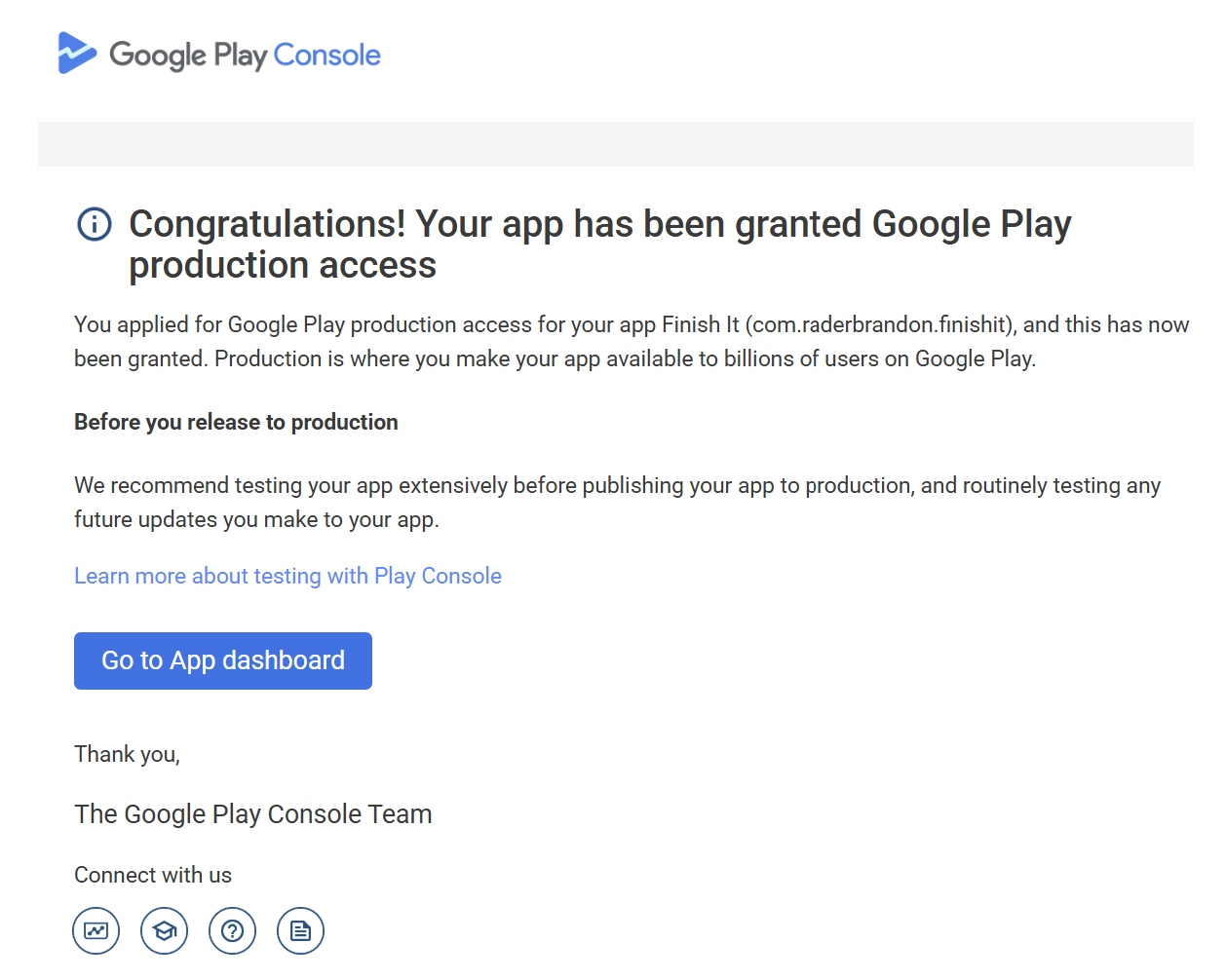
Quality QA Testing Reports
Clear, actionable reports with screenshots and evidence for every important issue found during testing.
Real Device Testing & Diagnostics
Real human testers use physical Android devices to test your app, verify real user flows, and provide clear testing evidence and professional QA reports.
Production Access Secured
Transition your Android app to public production access with confidence. We deliver verified session logs and compliant Console activity.
One Cycle. Complete Approval.
Choose the ideal closed testing cycle for your Android release.
Loading Packages
Please wait while we fetch the best options for your region...
Frequently Asked Questions
Everything you need to know about passing your closed testing requirements.