Reliable 12 Testers for Google Play for Android Apps
Clear Play Console closed testing eligibility for your AppGyver app worldwide using 12 unique testers for authentic daily engagement on actual Android smartphones and authentic 14 day testing activity to secure production access approval.
12 testers google play console: How to pass with AppGyver
Google Play now requires developers with new personal accounts to run a closed test with at least 12 testers for 14 continuous days. This rule is in place to make sure new apps are stable and to prevent low-quality or harmful apps from reaching the public.
For many developers, this is a major roadblock. Finding 12 people is hard. Getting them to stay opted-in for two straight weeks is even harder. This guide breaks down exactly how to meet this requirement without pulling your hair out. We'll cover where to find reliable testers, the common pitfalls to avoid, and why using a trusted service can save you a lot of time and stress.
Why This Rule Exists (And Why It's a Headache)
Google's goal is to protect users. Before this rule, anyone could upload an app and publish it almost immediately. This led to a lot of spam and malware on the Play Store. By forcing a testing period with real people, Google wants to see a basic level of commitment and quality from developers.
But for a solo developer or a small team, it's a huge challenge:
- Finding People is Tough: Your friends and family can only help so much. After one or two apps, they get tired of the requests.
- Keeping Them is Harder: People are busy. They might agree to help, forget to opt-in, or leave the test early, which can reset your 14-day counter.
- It's Time-Consuming: You have to create lists, send out links, and constantly check if people have joined. It's a management job you didn't sign up for.
- The Risk of Bad Testers: Using cheap, random testers from online forums can be risky. They might be bots, which Google can easily detect, potentially putting your account in jeopardy.
The rule is simple on paper but messy in practice. You need a reliable system to get it done right.
The Official Rules of the 14-Day Test
Let's get specific about what Google expects. Breaking any of these rules can mean you have to start the 14-day period all over again.
- A Minimum of 12 testers: You must have at least 12 individual people who have opted into your test. Not 19. It's a hard floor.
- 14 Continuous Days: The clock starts once you have 12 testers opted-in. They must all remain opted-in for 14 days in a row. If someone leaves on day 12 and you dip to 19 testers, your 14-day progress may be paused or completely reset until you get a new tester.
- Testers Must Opt-In: You can't just add 12 emails to a list and call it a day. Each person must receive the testing link, open it, and actively click to become a tester. This is a critical step many developers miss.
- Real People, Real Devices: Google's systems are designed to spot suspicious activity. Using virtual machines or a group of bots that all opt-in from the same IP address is a huge red flag. You need real people on real, individual Android devices.
While the official rule is 12 testers, you may see people searching for "reliable 12 testers for Google Play". This is often because finding even a dozen committed people feels like a huge win. But to be safe and meet Google's standard, you must aim for 12 and ideally have a few extra as a buffer.
Where to Find Reliable App Testers
You have three main options for finding your 12 testers. Each comes with its own set of benefits and risks.
The Risky Path: Fiverr Bots and Social Media Groups
Your first instinct might be to find a cheap gig on Fiverr or post in a Reddit or Facebook group. These services promise 12+ testers for a very low price. It sounds too good to be true, and it usually is.
Most of these cheap services use bots or a "click farm" of fake accounts. They will opt-in, but they won't stick around. Many will leave the test after just a day or two, causing your 14-day counter to reset. Worse, Google can detect this kind of fraudulent activity, which could lead to your app being rejected or your entire developer account being banned. It's a cheap solution that can have very expensive consequences.
The Hard Path: Finding Testers Yourself (DIY)
The "free" option is to find testers on your own. This means asking friends, family, coworkers, and anyone else you know with an Android phone.
This path gives you full control, but it costs you something more valuable than money: your time. You will spend hours building a list, sending emails, and then chasing people to make sure they clicked the opt-in link. You'll have to send reminders and check your Google Play Console daily to see if anyone has dropped out. It's a stressful and unreliable process. Most people find it nearly impossible to keep 12 people engaged for two full weeks.
The Smart Path: Using a Managed Testing Service
A managed testing service, like AppConsoleLab, is built specifically to solve this problem. These services maintain a community of real, verified testers who are ready to help.
When you use a managed service, you simply provide your app's testing link. The service handles everything else:
- Recruiting: They find and vet the 12+ testers for you.
- Management: They ensure every tester opts in and stays opted-in for the full 14 days.
- Guarantee: They guarantee the 14-day period will be completed successfully. If a tester drops out, they immediately replace them so your clock doesn't reset.
- Peace of Mind: You don't have to worry about a thing. You can focus on improving your app while the testing requirement is handled for you.
It's a paid service, but it saves you dozens of hours of work and eliminates the risk of using fake testers.
Comparison: Which Testing Method is Best for You?
| Feature | AppConsoleLab's Service | Finding Testers Yourself (DIY) | Fiverr Bots |
|---|---|---|---|
| Reliability | Very High. Testers are managed and guaranteed to stay. | Very Low. People are busy, forget, or lose interest. | Extremely Low. Bots and fake accounts often leave quickly. |
| Time Investment | Minimal. About 5 minutes to set up. | Extremely High. Many hours of outreach and management. | Low. But you'll spend more time fixing the problems they cause. |
| Risk of Ban | None. Uses real, verified people. | None. Assuming you know the people you're asking. | High. Google actively penalizes bot-like activity. |
| Cost | Fixed price. An investment in speed and safety. | Free. But costs you a lot of time and stress. | Cheap. But you get what you pay for. |
| Guaranteed Completion | Yes. The service ensures you pass the 14-day mark. | No. It's completely up to the goodwill of your friends. | No. They often disappear after payment. |
Step 1: Prepare Your App
Step 2: Create a Closed Test
Step 3: Create Your Tester List
Step 4: Upload Your App Bundle
Step 5: Share the Opt-In Link
Step 6: Monitor and Wait
Struggling with the 14-Day Testing Requirement?
Skip the hassle of recruiting unreliable testers. Our professional fleet of real Android devices guarantees Google Play compliance in exactly 14 days. Zero bots. Zero emulators. 100% production approval guarantee.
Common Mistakes That Will Reset Your 14-Day Counter
Getting through the 14-day test is like walking a tightrope. One small mistake can send you back to the beginning. Here are the most common errors developers make.
1. Starting with Exactly 12 testers
This is the biggest mistake. If you start with exactly 12 testers, you have zero margin for error. If even one person leaves the test for any reason, you drop to 19 and your progress stops. You then have to scramble to find a replacement, and the clock won't start again until you're back at 12.
Solution: Always start with a buffer. Aim for 22-25 testers. That way, if one or two drop off, you're still safely above the 12-tester minimum and your 14-day clock keeps ticking.
2. Assuming an Invite is an Opt-In
Simply adding someone's email to your tester list does not make them a tester. They are only counted once they open the opt-in link and formally agree to join. Many developers send the link and assume the job is done, only to find out days later that only a fraction of the people actually joined.
Solution: You need to track who has opted in. A good managed service does this for you. If you're doing it yourself, you'll need to send reminders and personally confirm with each person.
3. Pushing a Broken Update
During the 14-day period, you can still push updates to your app. However, if you push a new build that is unstable or crashes frequently, your testers will get frustrated and may leave the program. A sudden drop in testers after an update is a clear signal that something is wrong.
Solution: Test every new build thoroughly before releasing it to your closed testing track. Don't treat your 12 testers as your primary quality assurance team.
4. Not Communicating Clearly
If you just send a link with no context, people won't know what to do. They might not understand the importance of staying in the test for 14 days.
Solution: Briefly explain the process to your testers. Let them know you need them to remain opted-in for two weeks to help you launch your app. A little bit of communication goes a long way. Services like AppConsoleLab handle this communication for you, explaining the process to their testing community.
If you're ever unsure about your status, you can learn more about How to Check Whether Your 14-Day Testing Requirement Is Complete.
Phase 1: Pre-Launch Setup
Phase 2: Tester Management & Monitoring
Managed Testing vs. DIY Testing: A Deeper Look
Choosing how to find your testers is a big decision. It's a classic tradeoff between time and money. Let's break down the two main approaches.
The DIY Approach
The Managed Service Approach
Why Quality Testers Matter More Than Quantity
It's tempting to think that any 12 people will do. But the quality of your testers is important. Google's review process is a black box, but it's widely believed that their algorithms look for more than just a number. They look for signs of genuine engagement.
A group of 25 bot testers who opt-in and then never open the app looks suspicious. A group of 12 real testers who opt-in and maybe open the app once or twice sends a much healthier signal to Google. Real testers provide a layer of legitimacy that bots can't fake.
This is why choosing a reliable source for testers is so important. A good service provides people who are genuinely part of the Android ecosystem, not just burner accounts created to cheat the system. If you're looking for a reliable solution, it's worth exploring the Best Google Play Closed Testing Services Compared (2026) to see which one fits your needs.
Ultimately, Google's 12-tester rule is a gate you have to pass through. You can try to climb over it yourself, with all the risks and effort that entails, or you can use a service that has the key. By using a managed service, you turn a major obstacle into a simple item on your launch checklist, allowing you to get your app into the hands of real users faster.
What happens if a tester leaves before the 14 days are over?
Is the requirement really 12 testers or 12 testers?
Can Google detect if I use bots or fake testers?
Do my testers need to use the app every day for 14 days?
How long after the 14-day test can I publish my app?
Can I use the same 12 testers for multiple different apps?
How It Works
How we deploy real devices and guarantee compliance for your release.
Get Started
Sign in with Google to configure the closed testing environment for your AppGyver build worldwide.
App Submission
Submit your Google Play Console testing link, and our team will assign qualified testers from our testing network to join your AppGyver closed testing release.
14-Day Cycle
A QA supervisor monitors daily check-ins, ensuring 12 unique Android users engage with your AppGyver build every single day.
Production Access Approval
We guarantee 14 consecutive days of active user check-ins to satisfy Google's compliance policies, delivering an audit-ready PDF feedback report.
Why Choose AppConsoleLab
Experience a next-generation testing infrastructure built for Google Play compliance for your AppGyver release worldwide.
The 14-Day Production Guarantee
We complete the required 14-day closed testing process with real human testers and physical Android devices, while providing clear testing evidence and documentation throughout the process.
If Google specifically rejects production access due to insufficient testing engagement, you are covered by our free re-run or 100% refund guarantee, subject to our Refund Policy.
Verified Production Access
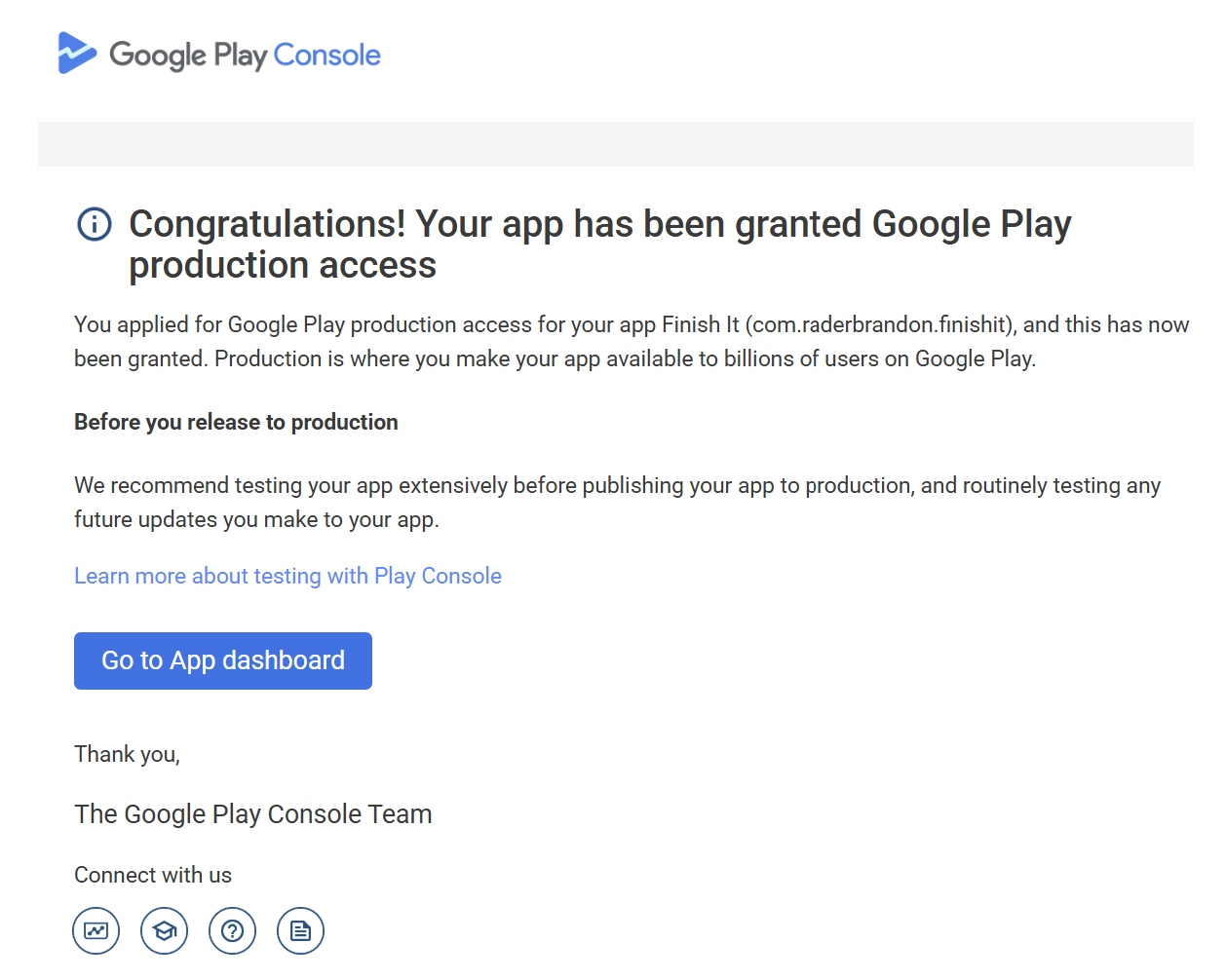
Quality QA Testing Reports
Clear, actionable reports with screenshots and evidence for every important issue found during testing.
Real Device Testing & Diagnostics
Real human testers use physical Android devices to test your app, verify real user flows, and provide clear testing evidence and professional QA reports.
Play Store Ready
Get your AppGyver build approved on the first try. We create an audit-ready compliance profile that proves thorough quality assurance.
Affordable Compliance Cycles
Transparent plans built to satisfy Google Play Console guidelines for your AppGyver build.
Loading Packages
Please wait while we fetch the best options for your region...
Frequently Asked Questions
Everything you need to know about passing your closed testing requirements.