Verified 12 Testers for Google Play in India
Comply with Google Play Console’s closed testing approval standards for your Godot app in India with 12 verified testers performing active daily interactions on real Android hardware and verified 14 day engagement for production access approval.
12 testers google play: Approval guide for Godot
Google now requires new personal developer accounts to test their app with at least 12 people for 14 consecutive days before they can publish. If you've searched for "Verified 12 Testers for Google Play," you're not alone, but the official number is 12. This rule was created to stop low-quality and spam apps from flooding the store, which is good for the ecosystem but a major hurdle for individual developers.
Getting 12 real people to install your app, keep it installed, and remain opted-in to your test for two full weeks is a lot harder than it sounds. This guide breaks down exactly what you need to do, the common mistakes to avoid, and the fastest way to get your app live.
Understanding the 12 Tester, 14-Day Rule
Let's get straight to the facts. This isn't just a suggestion from Google; it's a hard requirement. If you don't meet it, you can't apply for production access. Your "Publish app" button will remain grayed out.
Who Does This Affect?
This rule applies to you if:
- You created a personal developer account after November 13, 2023.
- You are trying to publish your first app on that account.
Organizations and established accounts generally don't face this specific 12-tester/14-day hurdle for every app, but using closed testing is still a best practice for everyone.
The Core Requirements Broken Down
The rule has two main parts. You need both to be successful.
- 12 testers: You must have a minimum of 12 individual people join your closed test. Not 19. It has to be 12 or more. These must be real people with active Google accounts.
- 14 Continuous Days: Those 12+ testers must remain "opted-in" to your test for 14 days in a row. This is the tricky part. If a tester leaves on day 5, the clock for that "slot" doesn't just pause—it might reset. Google's system needs to see a consistent group of testers over the full two-week period.
What does "opted-in" mean? It means a user has accepted your test invitation, is eligible to download the app, and hasn't left the testing program. They don't necessarily have to use the app every single day, but they must remain part of the test group in the Play Console's eyes.
Why Finding Testers Yourself Is So Difficult
On the surface, asking 12 people for help seems easy. In reality, it's a huge coordination challenge.
- Reliability: Friends and family promise to help, but they forget. They get busy. They might accidentally uninstall the app or leave the test, breaking your 14-day streak without telling you.
- Time: Managing 12 people is like herding cats. You'll spend hours sending reminders, checking if they've opted-in, and troubleshooting download issues. This is time you should be spending on improving your app.
- Finding People: If you don't have a large personal network, where do you find 12 people? Public forums are filled with scammers and people who won't stick around. You can't be sure if they are real or just bots.
The process is frustrating and can delay your launch by weeks or even months.
The Wrong Ways to Find Testers (And Why They Fail)
Many developers try to find shortcuts. These shortcuts often lead to more delays and can even put your entire Google Play Developer account at risk.
Mistake #1: Using Fiverr Bots or Cheap Services
This is the most dangerous path. You'll find gigs online promising "12 Google Play Testers for $50." These services almost always use bots or fake accounts.
Google's systems are smart. They can detect suspicious activity, like 12 accounts "testing" from the same IP address or using emulated devices. Using these services can get your app rejected and, in the worst case, your developer account terminated. A lifetime ban isn't worth saving a few dollars.
Mistake #2: "Test for Test" Swaps
Some developers try to organize swaps in online communities. "You test my app, and I'll test yours." While the intention is good, the execution is messy. People often download the app, get their own test credit, and then immediately leave your program. You have no way to enforce the 14-day rule, leading to a constantly churning list of testers where you never hit the continuous 14-day requirement.
Mistake #3: Relying Solely on Friends and Family
Your friends and family want to support you. That's great! But they are not professional testers. They might not give you honest feedback because they don't want to hurt your feelings. More importantly, they often don't understand the importance of staying in the test for 14 full days. Life gets in the way, and your app launch isn't their top priority.
Struggling with the 14-Day Testing Requirement?
Skip the hassle of recruiting unreliable testers. Our professional fleet of real Android devices guarantees Google Play compliance in exactly 14 days. Zero bots. Zero emulators. 100% production approval guarantee.
The Solution: A Verified, Managed Testing Service
A dedicated testing service, like AppConsoleLab, removes all the guesswork, risk, and frustration. Instead of you chasing 12 people, a service provides a pre-vetted group of real, reliable testers who understand the process. They are paid to follow the instructions, opt-in correctly, and stay for the entire 14-day period.
This is the fastest and safest way to meet Google's requirements. You submit your app, and the service handles the entire testing process, delivering a guaranteed result.
Comparing Your Options
| Feature | AppConsoleLab's Service | Finding Testers Yourself | Fiverr Bots |
|---|---|---|---|
| Success Rate | Guaranteed to meet the 14-day rule | Low; depends on reliability of others | Very low; often fails Google's checks |
| Account Risk | Zero risk; uses real, verified people | Low risk, but high frustration | Extremely High risk of account ban |
| Time Investment | Less than 15 minutes to set up | 10-12 hours of management & follow-up | A few minutes, but with huge consequences |
| Speed to Publish | Exactly 14 days after you start | Unpredictable; can take weeks or months | Can lead to permanent delays (ban) |
| Tester Reliability | Professionally managed and guaranteed | Unreliable; people forget or leave | Not real people; will be detected |
| Cost | A fixed fee for a guaranteed result | "Free" but costs you time and delays | Cheap, but can cost you your developer account |
How Our Verified Testing Process Works
We've simplified the entire journey into a few easy steps. You focus on your app; we'll handle the testers.
Submit Your App Details
We Prepare Your Tester Group
You Invite the Testers
Testers Opt-In for 14 Days
We Confirm Completion
You Apply for Production!
Setting Up Your Closed Test: A Quick Checklist
Getting your test track ready in the Google Play Console is the first practical step. Follow this guide to make sure everything is configured correctly.
Phase 1: Initial App Setup
Phase 2: Configuring the Test
Choosing How to Invite Your Testers
Google gives you two main ways to add testers to a closed track. Choosing the right one makes management much easier.
Email Lists (Recommended)
Google Groups
When considering different ways to get your app tested, it's helpful to see a full breakdown. For a deeper analysis, check out our guide on the Best Google Play Closed Testing Services Compared (2026).
How to Know When You're Done
After 14 long days, the big question is: 'Did it work?' Google doesn't send you a big congratulatory email. The signs are more subtle, and checking them can be confusing.
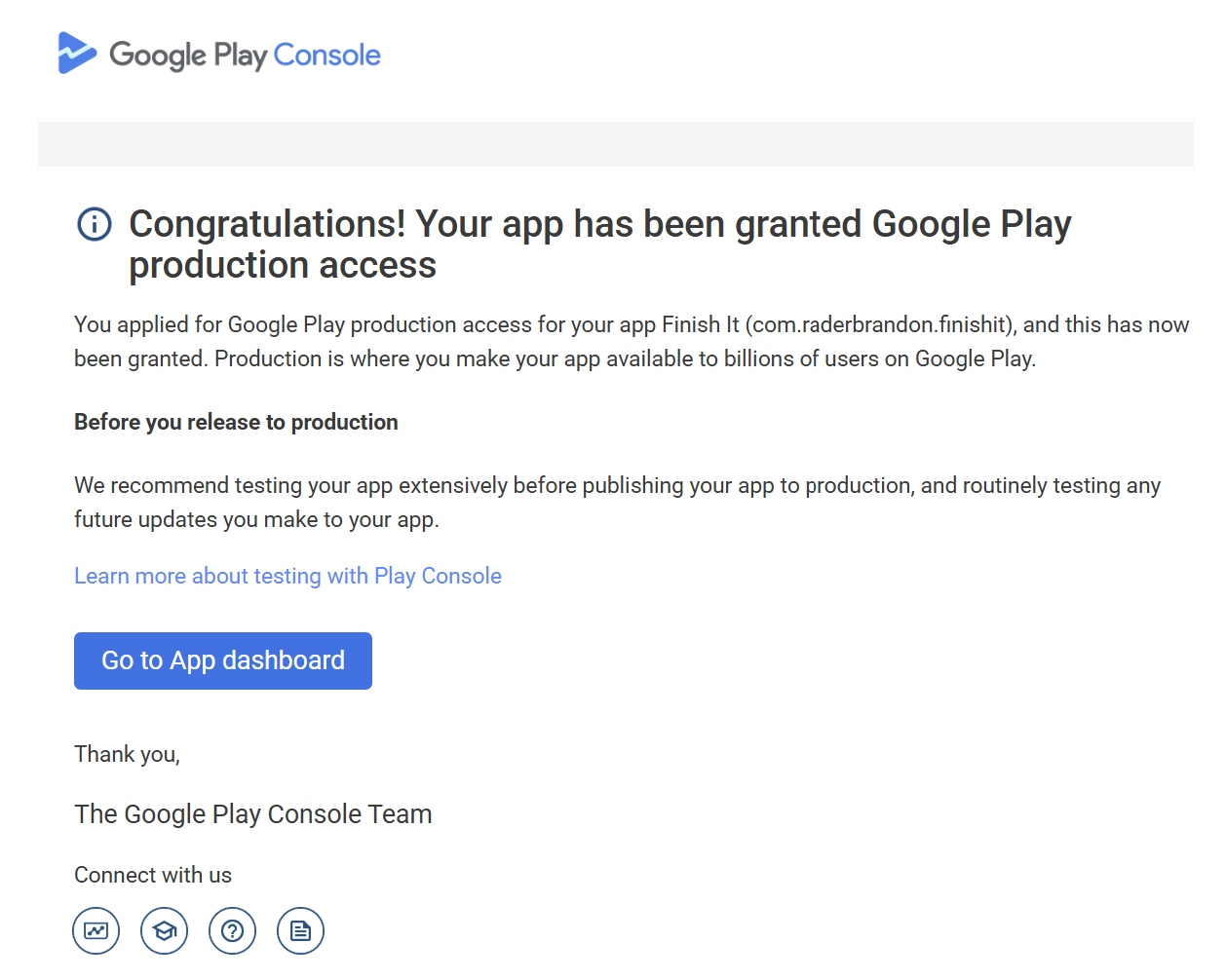
You need to look at the 'Dashboard' or the 'Publishing overview' section of your Google Play Console. If the testing requirement is met, the task will be marked as complete. You'll see a notice that you can now apply for production access. The 'Publish app' button, which was previously disabled, should now be active.
It can sometimes take Google 24-48 hours after the 14th day to update this status. If you're unsure whether the process is complete, we've written a detailed walkthrough. You can find it here: How to Check Whether Your 14-Day Testing Requirement Is Complete.
Don't let a simple testing requirement stop you from launching your app. While it's possible to do it yourself, the process is filled with potential delays and risks. Using a verified service is a small investment to guarantee your app gets through the final gatekeeper and onto the Google Play Store quickly and safely.
What happens if one of my 12 testers leaves before the 14 days are up?
If you are managing the test yourself, this is a major problem. You would need to find a new tester to replace them, and the 14-day clock for that 'slot' might reset, delaying your launch. A managed service like ours monitors the tester list daily and has backup testers ready to immediately replace anyone who drops off, ensuring your 14-day period continues uninterrupted.
Do I need to do this for every new app I want to publish?
Yes. For new personal developer accounts, this 12-tester, 14-day requirement applies to the first app you want to publish to production. After you have successfully published one app, Google's requirements may be less stringent for subsequent apps, but this initial hurdle is mandatory.
Can I use the same 12 people to test multiple apps?
Yes, you can. However, each app needs to go through its own separate 14-day closed testing period. The requirement is on a per-app basis, not a per-tester basis. You must set up a new closed test for each new application.
Do testers need to open and use the app every day?
No, testers do not need to use the app daily. The core requirement from Google is that they remain 'opted-in' to the test for 14 continuous days. This means they have accepted the test invitation and have not manually left the testing program. While engagement is good for feedback, it is not technically required to pass the 14-day check.
Why does Google have this 14-day rule anyway?
Google introduced this rule to improve the quality and safety of the Play Store. It acts as a barrier to entry for developers who create low-effort, spam, or malicious apps. By forcing a real-world testing period with a group of people, Google can gather early signals about an app's stability and legitimacy before it's available to the public.
My app is very simple. Do I still need to find 12 testers?
Yes. The requirement is not based on the complexity or category of your app. Whether it's a simple calculator or a complex game, any app published by a new personal developer account must meet the 12-tester, 14-day closed testing rule before it can be submitted for production review.
How We Deliver 12 Testers
Your journey to Google Play production access, simplified and automated.
Connect Account
Authenticate your account to initialize the 14-day QA fleet for your Godot release.
Assign Testers
Upload your testing link. We assign 12 verified users with real Android devices to download and test your Godot release.
Daily QA Runs
A dedicated testing supervisor is assigned to monitor progress while testers engage with your Godot app and provide feedback throughout the testing period.
Launch Ready
Our lab maintains active installations for two weeks straight, ensuring a clean track record and providing a QA compliance log for your release.
Our Testing Infrastructure
Satisfy your Play Store Console testing obligations with our managed physical device fleet tailored for Godot builds.
The 14-Day Production Guarantee
We complete the required 14-day closed testing process with real human testers and physical Android devices, while providing clear testing evidence and documentation throughout the process.
If Google specifically rejects production access due to insufficient testing engagement, you are covered by our free re-run or 100% refund guarantee, subject to our Refund Policy.
Verified Production Access
Quality QA Testing Reports
Clear, actionable reports with screenshots and evidence for every important issue found during testing.
Real Device Testing & Diagnostics
Real human testers use physical Android devices to test your app, verify real user flows, and provide clear testing evidence and professional QA reports.
Compliance Audit Passed
Our structured 14-day closed testing process is designed to meet Google Play's production requirements for your Godot release in India.
Simple Closed Testing Pricing
Select the plan that fits your Godot app complexity.
Loading Packages
Please wait while we fetch the best options for your region...
Frequently Asked Questions
Everything you need to know about passing your closed testing requirements.