Qualified Google Play Closed Testing Service in Pakistan
Fulfill Google Play Console’s closed testing approval standards for your AI Generated-generated app in Pakistan using 12 unique testers for authentic daily engagement on actual Android smartphones and authentic 14 day testing activity to secure production access approval.
12 testers for 14 days: Passing the test with AI Generated
If you have a new personal Google Play Developer account, you must run a closed test before you can publish your app. This test requires at least 12 people to be opted-in as testers for 14 continuous days. This rule is designed to improve app quality on the Play Store, but for solo developers and small teams, it can feel like a huge hurdle.
This guide explains what the requirement means, why it’s difficult to do on your own, and how a qualified Google Play closed testing service is the fastest and safest way to get your app published.
What is Google's 12 testers, 14-Day Rule?
Let's break down Google's policy into simple terms.
Since November 13, 2023, any developer with a newly created personal Play Console account must meet specific testing criteria before they can apply to release their app to the public.
Here are the exact conditions:
- 12 testers: You need a minimum of 12 individual people to sign up for your closed test.
- Opted-in: These 12 people must click your test link and agree to become a tester. Just sending an invite isn't enough.
- 14 Continuous Days: The most important part. You must maintain at least 12 opted-in testers for 14 days in a row. If your count drops to 19 on day 10, the 14-day clock may reset once you get a new tester.
Google added this step to fight the flood of low-quality or malicious apps. By forcing a real-world testing phase, they ensure developers are more committed and that apps have been seen by real users before going live. This helps protect users and increases the overall quality of the Play Store.
The Big Headache: Why Finding 12 testers is So Hard
Getting 12 friends to test your app sounds easy. In reality, it's a frustrating and time-consuming process.
The Social Challenge
Asking friends and family is the first step for most developers. But you quickly run into problems. People are busy. They might agree but forget to opt-in. They might not be comfortable installing an unpublished app from a link. You often have to chase them with reminders, which can feel awkward.
The Technical Hurdle
The process isn't just "click and install." A tester has to:
- Open your opt-in link.
- Be signed into the correct Google account.
- Click the "Become a Tester" button.
- Then go to the Play Store to download the app.
This multi-step process can confuse people who aren't tech-savvy. You end up spending more time as a tech support agent than as a developer.
The 14-Day Commitment
This is the biggest challenge. It’s one thing to ask someone to download an app. It's another thing to ask them to remain on a testing list for two straight weeks. People might leave the test accidentally, switch phones, or simply lose interest. Every time someone drops out, you have to scramble to find a replacement, and your 14-day timer could be at risk.
Managing this for 12 people—sending reminders, checking your tester count, and finding replacements—can become a job in itself. It pulls you away from what you should be doing: improving your app.
Three Ways to Get Your 12 testers (And Why Two Are Risky)
You have three main paths to meet Google's requirement. Let's look at each one.
Option 1: Finding Testers Yourself (The Hard Way)
This is the DIY approach. You can post in Reddit communities like r/AndroidAppTesters, join developer groups on Facebook, or ask people on X (formerly Twitter).
- Pros: It's free. You might get some genuinely interested users who provide good feedback.
- Cons: It is incredibly time-consuming and unreliable. You'll spend hours posting, messaging, and managing a spreadsheet of testers. The drop-off rate is very high. People from online forums have no obligation to stick around for 14 days. You might get 25 testers on day one and be down to 15 by day four, forcing you to start your search all over again.
Option 2: Using Fiverr Gigs or Bot Services (The Dangerous Way)
You'll see many cheap gigs on sites like Fiverr promising "12 Google Play testers fast." These are almost always a bad idea.
These services often use bots, fake accounts, or virtual machines to simulate testers. They are not real people using real devices. Google's systems are very good at detecting this kind of fraudulent activity.
- Pros: They are cheap and fast.
- Cons: You risk having your app rejected or, in the worst-case scenario, your entire developer account suspended. You get zero real feedback, and you violate Google's policies. It's a shortcut that can lead to a dead end.
Option 3: Using a Qualified Closed Testing Service (The Smart Way)
A professional testing service, like AppConsoleLab, is built specifically to solve this problem. These services maintain a community of real, verified people who are paid to test apps. They understand the 14-day requirement and the opt-in process.
- Pros: It's reliable and completely hands-off. You provide your test link, and they handle the rest. They guarantee you'll have 12+ testers for the full 14 days, replacing anyone who drops off. This saves you time, eliminates stress, and ensures you meet Google's rules safely. It's the only method that guarantees compliance without risk.
Comparing Your Options
Here’s a clear breakdown of how the three methods stack up.
| Feature | AppConsoleLab's Service | Finding Testers Yourself | Fiverr Bots |
|---|---|---|---|
| Reliability | ✅ Guaranteed 12+ testers for 14 days | ❌ Very high drop-off rate | ❌ Unreliable, often don't complete the term |
| Google Compliance | ✅ 100% Safe (uses real people) | ✅ Safe, but hard to manage | 🚨 High Risk of App Rejection/Suspension |
| Time Cost | ⏱️ 5 minutes to set up | ⏱️ 10-12+ hours of management | ⏱️ 10 minutes, but with huge risk |
| Real Feedback | 💬 Basic feedback & crash logs | 💬 Can be good, but inconsistent | 🚫 None |
| Success Rate | 🚀 Very High | 📉 Low to Medium | 📉 Very Low (due to policy violations) |
Struggling with the 14-Day Testing Requirement?
Skip the hassle of recruiting unreliable testers. Our professional fleet of real Android devices guarantees Google Play compliance in exactly 14 days. Zero bots. Zero emulators. 100% production approval guarantee.
How a Qualified Google Play Closed Testing Service Works
Using a dedicated service is straightforward. They've streamlined the process to make it as simple as possible for developers. Here’s what the journey looks like.
Sign Up and Submit Your App
Initial App Check
Tester Onboarding Begins
14-Day Active Monitoring
Test Completion Report
Apply for Production
This managed process removes all the guesswork and manual labor, letting you focus on your app. If you're weighing different providers, our detailed analysis of the best Google Play closed testing services compared (2026) can help you choose the right one.
Your Pre-Flight Checklist for a Smooth Test
Before you hand over your app link, make sure you have everything set up correctly in your Google Play Console. Following these steps will prevent delays.
Phase 1: Setting Up Your Test Track
Phase 2: Launching and Monitoring
Understanding Key Testing Concepts
Two ideas often cause confusion for developers. Let's clear them up.
Opt-In vs. Install
Continuous vs. Intermittent
Don't Just Meet the Requirement—Use the Opportunity
While the 14-day test can feel like a chore, it's also your first chance to get real-world data. Even without detailed written feedback, you can access valuable information in your Play Console.
Check the 'Crashes and ANRs' section. If your app is crashing on certain Android versions or devices, this is your chance to fix those bugs before your public launch. A high crash rate is one of the fastest ways to get bad reviews. This closed test acts as a free stability check, ensuring your app is solid before it reaches thousands of users.
Ultimately, a qualified testing service isn't just buying testers. It's buying certainty, speed, and peace of mind. It turns a frustrating roadblock into a simple, automated step on your journey to launching a successful app.
What happens if a tester drops out during the 14 days?
A qualified testing service will automatically detect the drop-off and assign a new tester from their pool to join your test. This ensures your tester count never falls below the required 12, so the 14-day clock continues without interruption. If you manage testers yourself, you have to find a replacement manually.
Do I need to give the testing service access to my Google Play Console?
No, and you should never give a third-party service your login credentials. All a legitimate testing service needs is the public opt-in link for your closed test. They handle the rest externally.
Can I update my app during the 14-day testing period?
Yes. You can push new builds (AABs/APKs) to your closed testing track at any time. Your opted-in testers will receive the update just like a normal app update. This is a great way to fix bugs that are discovered during the test.
Does using a testing service guarantee my app will be approved by Google?
No. A testing service only guarantees that you will meet the 12-tester, 14-day requirement. Your app must still pass Google's standard policy review, which checks for things like malware, deceptive content, and other policy violations. The service gets you to the review stage; passing it is up to your app's quality and compliance.
How do I know the testers are real people and not bots?
Reputable services have a transparent process and use real devices. They often recruit testers from various communities and verify their authenticity. In contrast, bot services often use virtual machines or emulators, which Google can detect. A key sign of a good service is a guarantee of compliance with Google's policies.
Is this testing requirement a one-time thing for my account?
Yes. Once your personal developer account has successfully completed this requirement for one app, you do not need to do it again for subsequent apps you publish from that same account. The requirement is tied to the account, not to each individual app.
How It Works
Your journey to Google Play production access, simplified and automated.
Get Started
Authenticate your account to initialize the 14-day QA fleet for your AI Generated release.
App Submission
Upload your testing link. We assign 12 verified users with real Android devices to download and test your AI Generated release.
14-Day Cycle
A dedicated testing supervisor is assigned to monitor progress while testers engage with your AI Generated app and provide feedback throughout the testing period.
Production Access Approval
Our lab maintains active installations for two weeks straight, ensuring a clean track record and providing a QA compliance log for your release.
Why Choose AppConsoleLab
Satisfy your Play Store Console testing obligations with our managed physical device fleet tailored for AI Generated builds.
The 14-Day Production Guarantee
We complete the required 14-day closed testing process with real human testers and physical Android devices, while providing clear testing evidence and documentation throughout the process.
If Google specifically rejects production access due to insufficient testing engagement, you are covered by our free re-run or 100% refund guarantee, subject to our Refund Policy.
Verified Production Access
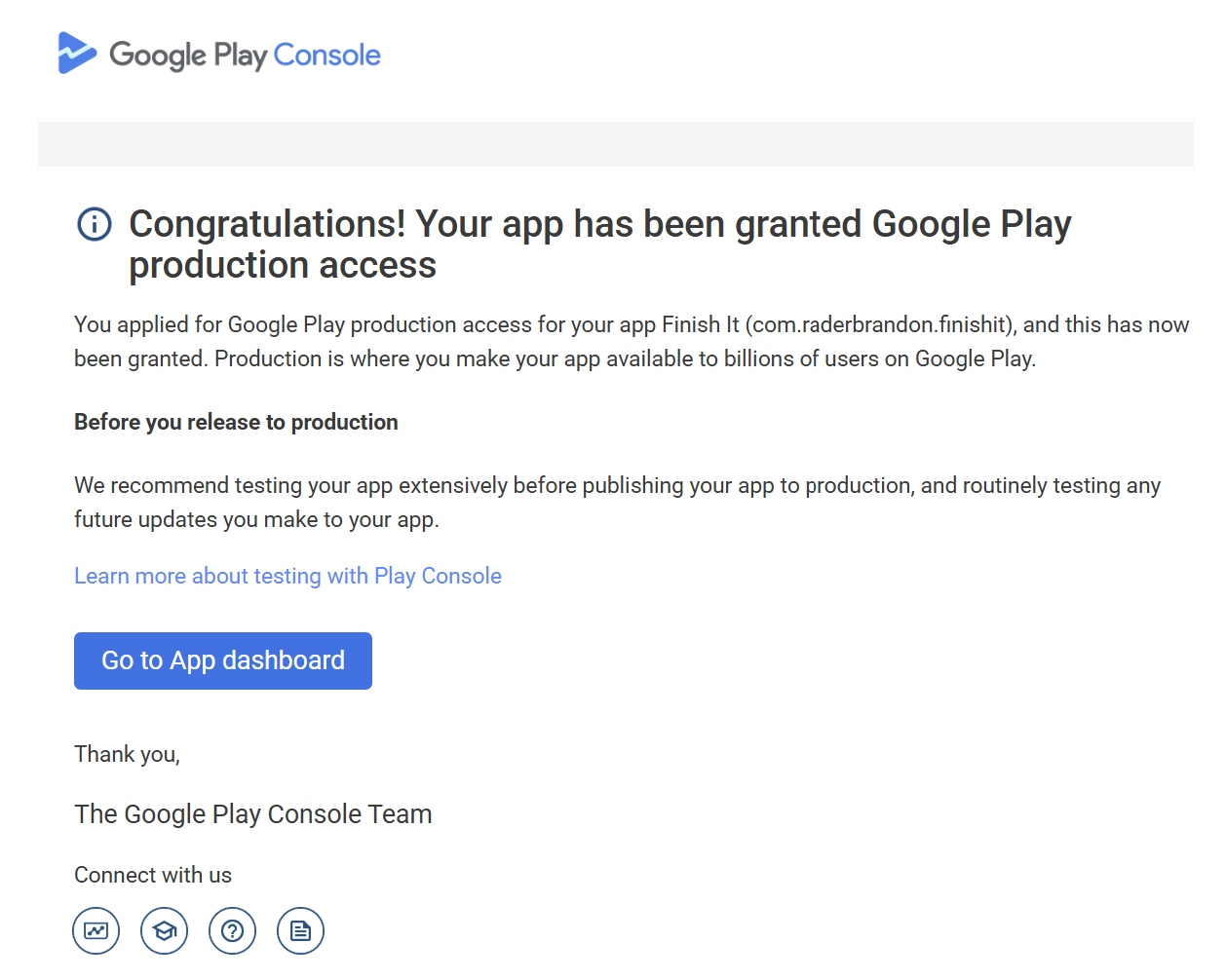
Quality QA Testing Reports
Clear, actionable reports with screenshots and evidence for every important issue found during testing.
Real Device Testing & Diagnostics
Real human testers use physical Android devices to test your app, verify real user flows, and provide clear testing evidence and professional QA reports.
Play Store Ready
Our structured 14-day closed testing process is designed to meet Google Play's production requirements for your AI Generated release in Pakistan.
Simple Closed Testing Pricing
Select the plan that fits your AI Generated app complexity.
Loading Packages
Please wait while we fetch the best options for your region...
Frequently Asked Questions
Everything you need to know about passing your closed testing requirements.