Get 12 Google Play testers for closed testing in Australia
Get 12 Google Play testers in Australia for Play Console closed testing. We provide 12 testers for 14 days to ensure your Play Store app gets approved.
You have poured your heart, soul, and countless hours of coding into your new Android app. The design is sleek, the bugs have been squashed, and you are finally ready to share it with the world. But right when you are about to hit the publish button, you hit a massive roadblock: Google Play Closed Testing requirements.
If you are an independent developer or a fresh startup, finding dedicated people to test your app for a straight two weeks feels like trying to find a needle in a haystack. You ask your friends, you beg your family members, and you even post on social media. Maybe you get a few people to install the app on day one, but getting them to actually keep it and engage with it every single day? That is where the dream usually falls apart.
This is not just a generic hoop to jump through. The Play Store Closed Testing phase is Google’s ultimate filter to ensure that only high-quality, functional, and user-friendly applications make it to the public store. If you are targeting the Australian market, the stakes are even higher. Australian users expect premium experiences, and Google's reviewers are looking for genuine local engagement.
That is exactly why you need a reliable, professional strategy to secure 12 Testers for 14 Days. In this comprehensive guide, we are going to dive deep into exactly why this testing phase matters, why localized testing in Australia is a game-changer, and how you can pass Google's strict requirements without losing your mind - or your developer account.
Why the "12 Testers for 14 Days" Rule Exists
Before we talk about the solution, let us understand the problem. Why does Google enforce this strict closed testing rule?
In the past, the Google Play Store was flooded with low-effort apps, quick clones, and sometimes even malicious software. To clean up the store and improve the overall user experience, Google implemented a mandatory testing phase for new personal developer accounts. They want proof that your app works in the real world, on real devices, in the hands of real people.
When you enroll in Google Play Closed Testing, Google monitors several factors behind the scenes. They are not just looking at a checklist that says "Yes, 12 people downloaded it." They are looking at:
- Daily Active Engagement: Are the testers opening the app throughout the 14-day period?
- Crash Reports and ANRs: Is the app freezing or crashing on different Android devices?
- Feedback Quality: Are you receiving genuine feedback that can be used to improve the app?
- Retention: Do the testers keep the app installed for the entire testing duration?
If you try to shortcut this system, Google will know. Their algorithms are incredibly sophisticated, which is why relying on sketchy, automated services is the fastest way to get your app rejected permanently.
Localized Testing: Why Australia?
If your app is built for a global audience, you might wonder if it matters where your testers are located. The short answer is: absolutely. But if your app is specifically tailored to the Australian market - perhaps a local food delivery service in Sydney, a fitness app for Melbourne surfers, or a tax calculator for the Australian financial year - having Australian testers is non-negotiable.
Cultural Context and User Expectations
Australian mobile users have specific preferences when it comes to app design, tone of voice, and functionality. They value straightforward, no-nonsense interfaces. A tester based in Australia can tell you if your app's language feels natural or if it comes off as too foreign. They can spot formatting errors in dates, currencies, and addresses that a tester from another country would completely miss.
Network and Infrastructure Testing
Mobile networks in Australia, like Telstra, Optus, and Vodafone, have their own quirks. Testing your app on local networks ensures that it handles connectivity issues, latency, and data usage gracefully. If your app requires location services, having testers physically located in Australia ensures your maps, GPS tracking, and local API integrations work flawlessly.
Google's Regional Algorithms
Google often looks favorably upon apps that show strong regional testing data before a local launch. If you want to rank well in the Australian Play Store, having a foundation of successful Play Store Closed Testing with Australian users sends a strong positive signal to the algorithm.
Real Human Testers
- Genuine Feedback: Real people click around, find unexpected bugs, and tell you what feels confusing.
- Natural Usage Patterns: Humans use apps at different times of the day, mimicking real-world behavior.
- Guaranteed Compliance: Real devices with active Google accounts pass all of Google's security checks.
- Constructive Criticism: You get actual insights into UX/UI improvements that matter.
Fake Bot Services
- Zero Value: Bots just install the app and sit idle, providing zero actionable feedback.
- Robotic Patterns: Google easily detects when 12 accounts all open an app at the exact same millisecond.
- High Risk of Ban: Using automated scripts violates Google's terms and will get your account terminated.
- Wasted Time: Even if you save a few dollars upfront, you lose weeks of time when your app gets rejected.
The Danger of Cutting Corners
It is tempting to go on a freelance marketplace and hire the cheapest service offering "guaranteed Play Store testing." But let us be clear: this is a massive risk.
Many of these cheap services use device farms. A device farm is a room full of hundreds of cheap Android phones connected to a single server, running automated scripts. They log in with fake Google accounts, download your app, and leave it running in the background.
Google is fully aware of device farms. They track the IP addresses, the device IDs, and the behavior of the accounts. If Google detects that your 12 Testers for 14 Days are actually bots sitting in a warehouse, your app will be rejected. Worse, your entire developer account could be flagged, meaning you will never be able to publish an app under that name again.
When it comes to Closed Testing, quality is vastly more important than speed. You need real people holding real phones, going about their daily lives, and interacting with your app naturally.
Struggling with the 14-Day Testing Requirement?
Skip the hassle of recruiting unreliable testers. Our professional fleet of real Android devices guarantees Google Play compliance in exactly 14 days. Zero bots. Zero emulators. 100% production approval guarantee.
How to Prepare for Your 14-Day Testing Window
Before you invite your 12 testers to begin their 14-day journey, you need to make sure your app is actually ready. If you launch a broken app into closed testing, your testers will just get frustrated, and you will waste your valuable testing window.
Here is exactly what you need to do to prepare:
Pre-Launch Technical Checks
Store Listing and Setup
Feedback Strategy
Comparing Your Testing Options
When deciding how to get your 12 Testers for 14 Days, you generally have three paths. Let us look at how they stack up against each other.
| Feature | Professional Service (Real Humans) | DIY (Friends & Family) | Bot Farms (Avoid) |
|---|---|---|---|
| Passes Google Guidelines | Yes, 100% compliant | Yes, usually | No, extremely risky |
| Reliability | High (Guaranteed 14 days) | Low (People forget) | High (But useless) |
| Quality of Feedback | Excellent, objective | Biased, mostly just "looks good" | None |
| Time Investment for You | Very Low | Very High (Constant nagging) | Low |
| Risk of App Rejection | Lowest | Medium (If they don't engage) | Guaranteed |
As you can see, relying on friends and family might seem free at first, but the hidden cost is the time you spend chasing them down. "Hey Dave, did you open my app today?" is not a message you want to send for 14 days straight. A professional service takes the stress out of Google Play Closed Testing.
The Roadmap to Production
So, how does the process actually work when you use a premium testing service to conquer the Play Store Closed Testing requirements? It is a structured, step-by-step journey designed to guarantee success.
Step 1: App Submission & Review
You finalize your APK or App Bundle and upload it to the Closed Testing track in your Google Play Console. Google performs a quick automated review to ensure it meets basic safety guidelines.
Step 2: Tester Onboarding
Once your app is approved for the closed track, you share your opt-in link. Our 12 real, verified Australian testers accept the invitation, download the app, and install it on their personal devices.
Step 3: The 14-Day Engagement Phase
This is the critical window. For 14 consecutive days, our testers keep the app installed. They open it, interact with the core features, and generate the natural usage data that Google's algorithm requires to see.
Step 4: Feedback Collection
Throughout the testing period, testers note down any bugs, confusing UI elements, or performance issues. You receive constructive, actionable feedback that you can use to polish your app.
Step 5: Apply for Production
After exactly 14 days of successful testing, the "Apply for Production" button in your Play Console unlocks. You submit your app for final review, armed with a flawless testing record.
Step 6: Launch to the Public!
Google reviews your final submission. Because you have proven that your app is stable and engaging through legitimate testing, your app is approved and goes live on the Google Play Store!
Maximizing the Value of Your Testers
Getting 12 people to test your app for 14 days is not just about ticking a box for Google; it is a golden opportunity to improve your product. Many developers waste this phase by just praying for the 14 days to pass so they can launch.
Instead, lean into the process. If a tester from Sydney tells you that your app's loading screen is too slow on mobile data, take that seriously. If a user in Brisbane is confused by your navigation menu, redesign it. The feedback you get during Google Play Closed Testing is often the most honest critique you will ever receive. Once your app is live in the store, bad feedback comes in the form of 1-star reviews that are very hard to recover from. It is much better to catch those issues now.
Furthermore, use this time to test your backend infrastructure. Are your servers handling the data correctly? Are your push notifications arriving on time? Is your database scaling properly, even with just 12 concurrent users? Treat these 14 days as a dress rehearsal for the main event.
Why Choose Our Australian Testing Service?
When you choose to work with a dedicated provider for your 12 Testers for 14 Days, you are buying peace of mind. Our network of Australian testers is comprised of everyday smartphone users - students, professionals, and tech enthusiasts who genuinely enjoy trying out new applications.
We manage the entire process. We ensure that exactly 12 users download the app. We monitor their engagement to make sure they are opening it regularly. We aggregate their feedback into a simple, easy-to-read report for you. You do not have to beg your friends, you do not have to risk your account with cheap bots, and you do not have to stress about waking up on day 13 to find out half your testers uninstalled the app.
We specialize in Play Store Closed Testing compliance. We know exactly what Google is looking for, and we deliver it flawlessly.
What happens if a tester uninstalls the app before 14 days?
If you are relying on friends, this is a huge problem that could reset your 14-day clock. When you use our professional service, we guarantee that all 12 testers will keep the app installed and remain active for the full duration. If a tester drops out due to a broken phone or unforeseen circumstances, we immediately replace them to ensure your compliance is not interrupted.
Do I need exactly 12 testers, or can I have more?
While the minimum requirement to satisfy Google's criteria is a specific number of continuous testers (historically 20, but currently structured around your specific account requirements like 12 testers for 14 days), having more is absolutely fine. However, we focus on providing exactly what you need to pass the requirement efficiently without overcomplicating the feedback loop.
Will the testers leave reviews on the Play Store?
During the closed testing phase, testers can leave private feedback directly to you as the developer. These do not appear as public reviews on your Play Store listing. This is designed so you can fix issues privately before the public sees your app.
How long does it take for Google to approve the app after the 14 days?
Once the 14-day period is complete and you apply for production, Google's final review typically takes anywhere from 1 to 7 days. Because you used real testers with genuine usage patterns, your app is much more likely to sail through this final review without any suspicious flags.
Do I need to update the app during the 14 days?
You are allowed to push updates during the closed testing phase if you want to fix critical bugs. However, updating the app does not reset your 14-day timer, as long as the testers update their version and continue engaging with it. We recommend only pushing essential updates to avoid disrupting the testing flow.
Conclusion: Cross the Finish Line with Confidence
Navigating the Play Store Closed Testing requirements does not have to be a nightmare. By understanding what Google is actually looking for - real engagement from real people on real devices - you can set yourself up for a smooth, successful launch.
If you are launching an app in Australia, leveraging local testers is the smartest move you can make. It ensures cultural relevance, tests local infrastructure, and provides a compliant, stress-free path through Google's strict gates.
Stop wasting time begging friends who will forget to open your app. Stop risking your entire developer account on shady bot farms. Invest in a professional 12 Testers for 14 Days service, gather real, actionable feedback, and get ready to finally see your app live on the Google Play Store. Your future users are waiting.
How We Deliver 12 Testers
Your journey to Google Play production access, simplified and automated.
Connect Account
Authenticate your account to initialize the 14-day QA fleet for your Android release.
Assign Testers
Upload your testing link. We assign 12 verified users with real Android devices to download and test your Android release.
Daily QA Runs
A dedicated testing supervisor is assigned to monitor progress while testers engage with your Android app and provide feedback throughout the testing period.
Launch Ready
Our lab maintains active installations for two weeks straight, ensuring a clean track record and providing a QA compliance log for your release.
Our Testing Infrastructure
Satisfy your Play Store Console testing obligations with our managed physical device fleet tailored for Android builds.
The 14-Day Production Guarantee
We complete the required 14-day closed testing process with real human testers and physical Android devices, while providing clear testing evidence and documentation throughout the process.
If Google specifically rejects production access due to insufficient testing engagement, you are covered by our free re-run or 100% refund guarantee, subject to our Refund Policy.
Verified Production Access
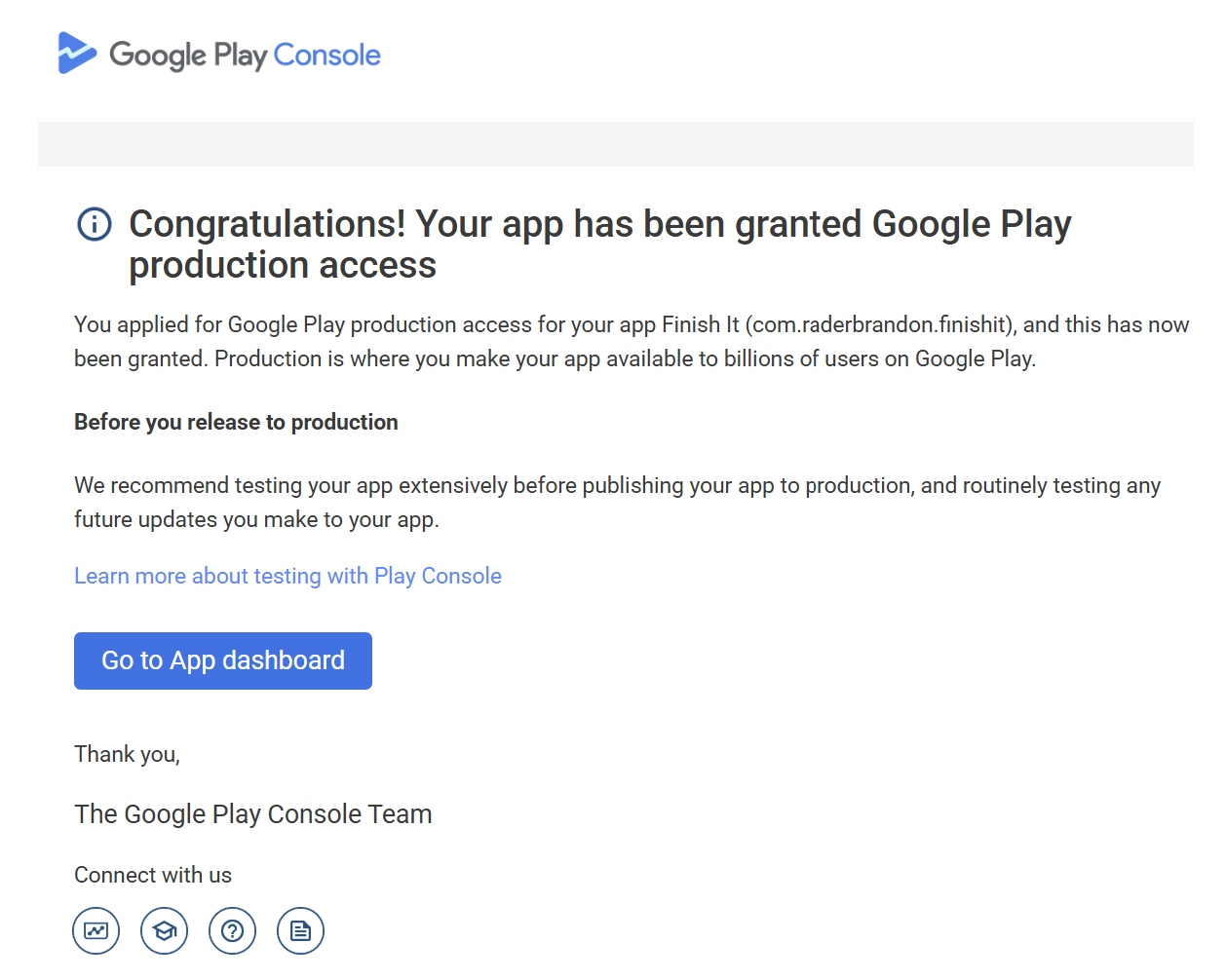
Quality QA Testing Reports
Clear, actionable reports with screenshots and evidence for every important issue found during testing.
Real Device Testing & Diagnostics
Real human testers use physical Android devices to test your app, verify real user flows, and provide clear testing evidence and professional QA reports.
Compliance Audit Passed
Our structured 14-day closed testing process is designed to meet Google Play's production requirements for your Android release in Australia.
Simple Closed Testing Pricing
Select the plan that fits your Android app complexity.
Loading Packages
Please wait while we fetch the best options for your region...
Frequently Asked Questions
Everything you need to know about passing your closed testing requirements.