Get 12 testers for Google Play closed testing across Canada
Get 12 testers for 14 days in Canada. Our verified Google Play testers fulfill all Play Console closed testing requirements for a fast Play Store launch.
Picture this: you are sitting in a coffee shop in downtown Toronto, or perhaps a cozy remote cabin in British Columbia, staring at your laptop screen. You have just poured the last six months of your life into developing a mobile application. It is sleek, it solves a real problem, and you are entirely convinced that users are going to absolutely love it. Your code is clean, your graphics are stunning, and your back-end architecture is robust enough to handle thousands of concurrent users. With a deep breath, you navigate to the developer console, ready to unleash your digital masterpiece onto the world.
But then, reality hits you like a blast of cold Arctic air. Before your application can be made available to the general public, you are confronted with a strict, non-negotiable barrier: Google Play Closed Testing. Suddenly, your dream of overnight success is put on hold. You are informed that you need a dedicated group of real people to install, use, and evaluate your app before Google will even consider opening the gates. You need to gather a specific cohort, often framed in strategic rollouts as finding at least 12 Testers for 14 Days, to gather critical, actionable feedback.
Why is this step so critical, and why is it causing so many independent developers and small studios to pull their hair out? The answer lies in Google's commitment to quality control. The Google Play Store is flooded with millions of applications, and a significant portion of them are broken, spammy, or simply unhelpful. To combat this, Google has instituted a mandatory testing phase designed to weed out the weak and elevate the strong. They want to see that your app doesn't just work in an emulator or on your personal smartphone, but that it performs reliably in the hands of everyday users.
Finding these users is a daunting task, especially if you are targeting a specific demographic like Canada. You cannot just ask your immediate family members or a few friends to download the app and ignore it. Google’s algorithms are highly sophisticated; they track daily engagement, crash reports, and actual usage metrics. If your testers simply install the app and never open it again, you will fail the requirement. You need real people who will interact with your software genuinely. This is where the challenge truly begins for most developers, turning the exciting final step of app creation into a grueling marathon of recruitment and management.
What Exactly is Google Play Closed Testing?
To truly understand how to conquer this hurdle, we must first dissect what Play Store Closed Testing actually entails. At its core, closed testing is a controlled beta environment. Unlike an open beta, where anyone browsing the store can stumble upon your app and download it, a closed test is strictly invite-only. You, as the developer, hold the keys. You must explicitly grant access to specific email addresses or Google Groups, allowing only those chosen individuals to download the pre-release version of your application.
This phase is not just a formality; it is a vital diagnostic tool. When a user participates in your closed testing track, they are shielded from leaving public reviews. This is a massive benefit for you. If a user encounters a fatal crash or a confusing user interface, their negative feedback goes directly to your developer dashboard, not to the public-facing Play Store page where it could permanently tank your app's rating before it even officially launches.
However, Google is not just watching to see if your app crashes; they are analyzing the overall health and viability of your product. They look at metrics such as how often the app is opened, how long users stay inside the app, and whether or not they are interacting with the core features. This is why the standard of requiring 12 Testers for 14 Days (or similar rigorous cohorts) is so incredibly difficult to achieve organically. You are essentially asking a dozen strangers to commit two weeks of their digital lives to testing your unfinished product, for free, without the promise of a polished experience.
Furthermore, Google uses this data to train their own discovery algorithms. If your closed testing phase shows high engagement and low crash rates, your app is more likely to be favored by the algorithm when you finally transition to the production track. Conversely, if your testers are inactive or your app is unstable, you may find your product buried on page fifty of the search results, completely invisible to your target audience. Mastering the Play Store Closed Testing process is, therefore, not just about getting published; it is about setting the stage for long-term commercial success.
The Strategy Behind "12 Testers for 14 Days"
You might be wondering, why focus on a cohort of 12 highly engaged testers over a 14-day period? In the realm of software testing and user experience (UX) research, there is a well-documented phenomenon regarding sample sizes. According to leading UX experts, testing with just five to eight users is often enough to uncover up to 80% of the most critical usability issues in any given design. By expanding that group slightly to 12 dedicated individuals, you create a robust safety net that catches both major bugs and subtle edge cases without overwhelming your development team with redundant feedback.
The 14-day duration is equally strategic. A user's first impression of an app is formed within seconds, but their long-term retention is determined by how the app fits into their daily routine. Over a two-week period, a tester will experience your app under various conditions. They will use it on different Wi-Fi networks, switch between cellular data and broadband, open it when their battery is low, and interact with it when they are distracted or in a hurry. This longitudinal testing is what separates a fragile prototype from a battle-tested consumer product.
Maintaining this level of engagement is the hardest part. The typical human attention span is remarkably short, and the novelty of a new app wears off quickly. By day three or four, a casual tester will likely forget your app even exists. To successfully complete the Closed Testing requirement, you need a strategy to keep these 12 testers coming back day after day. This involves sending push notifications, releasing minor updates to show progress, and actively soliciting feedback through surveys or direct communication. It is a full-time job in itself, which is why so many developers seek professional assistance to manage this crucial phase.
Why Target Canada for Your Initial Rollout?
If you are going to invest the time and resources into gathering a dedicated testing group, why specifically seek out users across Canada? The answer is that Canada represents one of the most ideal microcosm markets in the world for mobile application testing.
First and foremost, Canada is a highly diverse nation with a population that closely mirrors the global consumer base. You have major metropolitan hubs like Toronto, Vancouver, and Montreal, which boast high-speed internet infrastructure and a tech-savvy demographic. Simultaneously, you have vast rural areas with varying degrees of connectivity. If your app can perform seamlessly for a user navigating the Toronto subway system and for a user relying on satellite internet in rural Alberta, you can be confident in its global resilience.
Additionally, the Canadian device landscape is incredibly fragmented. While flagship Samsung and Google Pixel devices are popular, there is also a massive market for mid-range and budget Android smartphones from various manufacturers. Testing your app across this wide spectrum of screen sizes, processing powers, and Android OS versions is critical.
Finally, Canada’s bilingual nature (English and French) provides a unique opportunity to test the internationalization and localization features of your app. Even if your initial launch is only in English, ensuring that your UI can handle different text lengths and character sets is a crucial step for future expansion. Gathering 12 Testers for 14 Days from across different Canadian provinces gives you a comprehensive, stress-tested foundation that is impossible to replicate in a uniform, localized environment.
The Dangers of Cutting Corners: Real Users vs. Bots
When faced with the daunting task of finding and managing testers for two solid weeks, many developers are tempted by the dark side of the internet. A quick search will reveal dozens of shady services offering to fulfill your Play Store Closed Testing requirements for a suspiciously low price in a matter of hours. These services almost exclusively rely on automated bot farms or click-farms located halfway across the world.
Genuine Canadian Testers
Using real users located across Canada provides invaluable, qualitative feedback. Real humans will notice if a button is too small to tap, if the color contrast is difficult to read in the sunlight, or if the user flow simply doesn't make logical sense. They will interact with your app at random times of the day, simulating true organic behavior. Furthermore, when Google’s algorithms analyze the testing data, they will see natural device identifiers, valid Canadian IP addresses, and authentic usage patterns. This builds trust with the platform and sets your app up for a successful launch.
Automated Bot Farms
Bots do not care about your user interface. They are programmed scripts running on emulators or massive racks of cheap, tethered phones. They will repeatedly launch your app, click a predefined sequence of coordinates, and close it. While this might artificially inflate your daily active user count, it provides zero actionable feedback on the actual quality of your app. Worse yet, Google Play Protect and the Play Console algorithms are incredibly adept at detecting non-human behavior. If you are caught using bots for your Google Play Closed Testing, your developer account can be permanently banned.
The Ultimate Comparison: How We Stack Up
To make an informed decision about how to handle your closed testing phase, it is helpful to look at the different avenues available to you. Let's compare our dedicated Canadian testing service against the typical do-it-yourself (DIY) approach and the risky bot farm alternatives.
| Feature | Our Testing Service | DIY Approach | Bot Farms |
|---|---|---|---|
| User Authenticity | 100% Real Canadian Users | Friends & Family (Often biased) | Automated Scripts/Fake Accounts |
| Duration Compliance | Guaranteed 14-Day Engagement | Typically drops off after 3 days | Instant, artificial spikes |
| Actionable Feedback | Detailed bug reports & UI reviews | Vague or non-existent feedback | None |
| Risk of Account Ban | Zero (Fully compliant with terms) | Low to Medium (If users are inactive) | Extremely High |
| Device Diversity | Wide range of real Android devices | Limited to what your friends own | Emulators or identical cheap devices |
| Time Investment | Minimal (We handle everything) | Dozens of hours of micromanagement | Minimal, but highly destructive |
Struggling with the 14-Day Testing Requirement?
Skip the hassle of recruiting unreliable testers. Our professional fleet of real Android devices guarantees Google Play compliance in exactly 14 days. Zero bots. Zero emulators. 100% production approval guarantee.
Preparing Your App for the Testing Phase
Before you even begin recruiting your testers, your application needs to be in a state of readiness. You cannot simply upload a broken, half-finished prototype and expect your testers to piece together the puzzle. Proper preparation is the key to extracting maximum value from your Google Play Closed Testing period.
Technical Readiness
Eliminate Fatal Crashes: Ensure that the core functionality of your app does not cause hard crashes. Testers cannot evaluate an app that closes immediately upon opening.
Optimize App Size: Large, unoptimized APKs or App Bundles will deter testers from downloading, especially if they are on limited data plans.
Implement Analytics: Integrate tools like Firebase Crashlytics and Google Analytics to track user behavior and catch silent errors that testers might not actively report.
Store Listing Essentials
Draft a Clear Description: Even in closed testing, testers need to know what the app is supposed to do. Write a clear, concise description outlining the core features.
Create Basic Assets: Upload an icon and at least two or three screenshots. A professional-looking listing builds trust, even in the beta phase.
Define Privacy Policy: You must have a valid privacy policy URL linked in your Play Console, outlining how you handle user data.
Your Roadmap to a Successful App Launch
Navigating the Play Console and managing a testing cohort can feel like wandering through a maze. To help you visualize the process, here is a step-by-step roadmap of how the entire journey unfolds, from initial setup to final production launch.
Step 1: Console Configuration
Begin by creating a new release on the 'Closed Testing' track within the Google Play Console. You will need to upload your signed App Bundle (.aab) and fill out the necessary content rating questionnaires. This establishes the foundation for your test.
Step 2: Tester Onboarding
Once the release is approved by Google's initial automated review, we step in. We gather our cohort of dedicated Canadian users and securely add their email addresses to your authorized tester list. We provide them with clear instructions on how to opt-in and download the app.
Step 3: The 14-Day Engagement Period
This is the critical phase. For two solid weeks, our testers will actively use your application. They will explore different menus, test core features, and simulate real-world usage patterns to ensure compliance with the "12 Testers for 14 Days" engagement metric.
Step 4: Feedback Collection & Iteration
Throughout the testing period, we gather comprehensive feedback regarding bugs, UI/UX issues, and overall performance. You can use this data to push minor updates to the closed testing track, refining the app in real-time based on genuine user experiences.
Step 5: Applying for Production
After successfully completing the 14-day requirement with consistent engagement, the 'Apply for Production' button will unlock in your console. You submit your app for a final manual review by the Google team.
Step 6: Global Launch
Once Google approves your application, you can seamlessly promote your closed testing release to the Production track. Your app is now live, fully compliant, and ready to be downloaded by millions of users worldwide!
Conclusion: Embrace the Process for Long-Term Success
The Google Play Closed Testing requirement is often viewed as a frustrating roadblock by eager developers. However, when approached strategically, it is actually one of the most valuable phases of the entire development lifecycle. By committing to testing with real, engaged users across diverse regions like Canada, you are doing much more than just satisfying an algorithm.
You are actively stress-testing your architecture, refining your user interface, and ensuring that your product brings genuine value to the market. Relying on organic engagement - specifically tailoring a strategy around robust metrics like 12 Testers for 14 Days - protects your developer account from devastating bans and provides you with the insights needed to transform a good idea into an exceptional application. Don't let the final hurdle trip you up. Invest in real testing, listen to the feedback, and launch your app with the confidence that it is truly ready for the world stage.
Why do I specifically need testers from Canada?
While you can technically use testers from anywhere in the world, Canada offers a unique blend of diverse demographics, varied network infrastructures, and a wide array of Android devices. Testing with Canadian users provides a highly accurate simulation of a global rollout, ensuring your app is robust and adaptable to different real-world conditions.
What happens if a tester misses a day during the 14-day period?
Google's algorithms look for sustained, consistent engagement. If one or two users miss a single day, it may not trigger a failure, but widespread inactivity will absolutely cause your application for production to be rejected. This is why our service ensures continuous, daily engagement to guarantee compliance with the testing requirements.
Will these testers leave public reviews on the Play Store?
No. One of the primary benefits of the Google Play Closed Testing track is that feedback is kept entirely private. Any ratings or reviews submitted by your testers will only be visible to you within the Google Play Console. This protects your app's public reputation while you are still working out the bugs.
Can I update my app while the closed test is ongoing?
Yes, absolutely! In fact, it is highly encouraged. If testers discover a significant bug on day three, you can upload a new App Bundle to the closed testing track. Testers will receive the update, and the 14-day testing period will continue uninterrupted, demonstrating to Google that you are actively maintaining and improving your software.
How do you ensure the testers are real people and not bots?
We have built a proprietary network of verified, opted-in users located throughout Canada. We do not use emulators, VPNs, or automated scripts. Every single interaction with your application is performed by a real human being on a physical Android device, ensuring absolute compliance with Google's strict developer policies.
Our QA Process
How we deploy real devices and guarantee compliance for your release.
Choose Package
Sign in with Google to configure the closed testing environment for your Android build in Canada.
Submit Link
Submit your Google Play Console testing link, and our team will assign qualified testers from our testing network to join your Android closed testing release.
Active Testing
A QA supervisor monitors daily check-ins, ensuring 12 unique Android users engage with your Android build every single day.
Get Approved
We guarantee 14 consecutive days of active user check-ins to satisfy Google's compliance policies, delivering an audit-ready PDF feedback report.
The Premium QA Advantage
Experience a next-generation testing infrastructure built for Google Play compliance for your Android release in Canada.
The 14-Day Production Guarantee
We complete the required 14-day closed testing process with real human testers and physical Android devices, while providing clear testing evidence and documentation throughout the process.
If Google specifically rejects production access due to insufficient testing engagement, you are covered by our free re-run or 100% refund guarantee, subject to our Refund Policy.
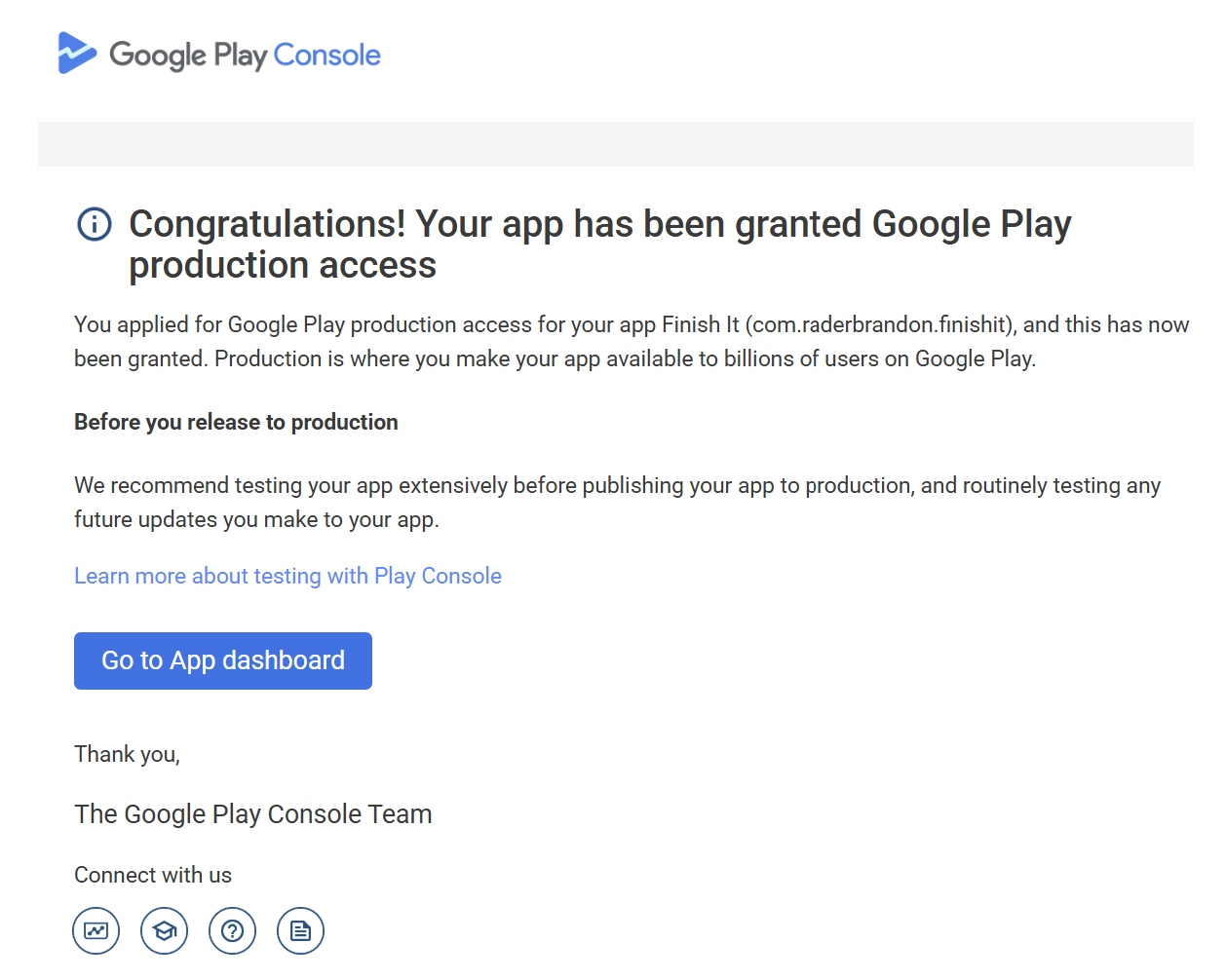
Verified Production Access
Quality QA Testing Reports
Clear, actionable reports with screenshots and evidence for every important issue found during testing.
Real Device Testing & Diagnostics
Real human testers use physical Android devices to test your app, verify real user flows, and provide clear testing evidence and professional QA reports.
Production Access Secured
Get your Android build approved on the first try. We create an audit-ready compliance profile that proves thorough quality assurance.
Affordable Compliance Cycles
Transparent plans built to satisfy Google Play Console guidelines for your Android build.
Loading Packages
Please wait while we fetch the best options for your region...
Frequently Asked Questions
Everything you need to know about passing your closed testing requirements.