Play Store testers for 14-day Android app closed testing in Belgium
Get Play Store testers in Belgium for 14-day Android app closed testing. Our 12 testers for 14 days ensure you pass Google Play closed testing fast.
Launching an app in Belgium means navigating a highly unique market divided among French, Dutch, and German speakers, but before you can even think about localization or user acquisition, Google demands you pass their rigid developer requirements. The Play Console policy strictly requires new developers to run a Google Play Closed Testing track with a very specific rule set. You must secure 12 Testers for 14 Days continuously before you are allowed to apply for production access. This is not merely an exercise in finding random people to tap around your screens; it is about proving to Google that your software is stable, safe, and entirely ready for the European digital market. If you rely on automated bots, emulators, or low-quality fake accounts, Google's sophisticated automated review systems will flag your app, resulting in outright rejections and wasted weeks of development time. Real, engaged testing is the only secure path forward to getting your app published and available to actual users.
Why the Belgium Market Requires High-Quality App Testing
The Belgian mobile ecosystem is highly competitive and split across distinct cultural and linguistic lines. When you prepare for your Play Store Closed Testing phase, you are not merely satisfying a bureaucratic checkbox for the Play Console. You are ensuring your app functions correctly on diverse mobile devices, fluctuating network conditions, and complex localization settings that are incredibly common in major cities like Brussels, Antwerp, and Ghent.
The Core Challenge of Finding Real Testers
Gathering friends and family might sound like an easy way to meet the 12 Testers for 14 Days requirement, but it rarely works in practice for serious developers. People simply forget to open the app every day, they delete it early to save storage space, or they fail to provide the active opt-in feedback that Google quietly monitors in the background. Finding reliable, dedicated testers who will keep your application installed and actively engage with it for two solid weeks is a massive operational hurdle.
Real Testing vs. Bot Automation
When developers realize how difficult it is to find committed testers, they often look for shortcuts. The internet is full of services promising cheap and instant testing, but these almost always rely on automation. Here is a breakdown of why real testers are essential compared to fake accounts.
Real Human Testers
Real testers use actual Android devices connected to genuine residential IP addresses. When they download your app, their behavior is naturally erratic and distinctly human. They will open the app at different times of the day, spend varying amounts of time on different screens, and interact with the UI in ways that automated scripts simply cannot replicate.
Furthermore, real human testers have established Google accounts with histories of regular Play Store usage, email activity, and web browsing. When Google reviews your Google Play Closed Testing data, they look for these signals of legitimacy. A real user provides authentic crash reports, meaningful feedback on usability, and proves to the Play Console algorithms that your app is engaging enough to be kept installed for the full two-week duration. This authentic engagement is exactly what clears the path for your production access approval.
Fake Bot Accounts
Bot automation relies on server farms, emulators, and datacenter IP addresses that are heavily blacklisted by major tech companies. These fake accounts are usually created in bulk, completely lacking the rich account history that Google expects from a normal user. They do not watch YouTube videos, they do not receive regular emails, and their interaction with your app is highly scripted and unnatural.
When bots are used for Play Store Closed Testing, they often install the app simultaneously, open it at the exact same intervals, and generate identical logs. Google's machine learning models are explicitly trained to detect these synthetic patterns. If your testing phase is flagged for artificial inflation, your developer account faces severe penalties. Your app will be rejected, you may be banned from submitting future apps, and you will have permanently damaged your standing within the developer ecosystem. It is a risk that is never worth taking.
Comparing Your Testing Options
Understanding the landscape of testing solutions is vital for your success. Below is a comprehensive comparison of different approaches to fulfilling the testing mandate.
| Feature | Professional Service | DIY Approach | Automated Bots |
|---|---|---|---|
| Tester Quality | High, vetted human users | Variable, depends on your network | Very low, purely synthetic |
| Account Legitimacy | Aged, active Google accounts | Standard personal accounts | New, empty, or flagged accounts |
| Compliance | Guaranteed policy adherence | High risk of drop-offs | Certain to trigger policy violations |
| Time Investment | Minimal developer effort required | Extremely time-consuming | Fast setup but leads to rejection |
| Cost Efficiency | Cost-effective given the guarantee | Free upfront, expensive in lost time | Cheap upfront, disastrous in the end |
| Feedback Quality | Actionable and detailed | Often superficial or nonexistent | Zero real feedback provided |
| Success Rate | Near perfect approval rates | Often requires restarting the test | Guaranteed failure and account bans |
Struggling with the 14-Day Testing Requirement?
Skip the hassle of recruiting unreliable testers. Our professional fleet of real Android devices guarantees Google Play compliance in exactly 14 days. Zero bots. Zero emulators. 100% production approval guarantee.
Pre-Launch Checklist for Your Android App
Before you invite a single user to test your app, you must ensure your Play Console is perfectly configured. Missing a step here can delay your launch by weeks. Follow this comprehensive checklist to prepare your application for a successful closed testing phase.
Initial Play Console Setup
Ensure all your contact information, business details, and identity verification steps are fully completed and approved by Google. An incomplete profile can halt your ability to publish tracks.
Upload high-quality screenshots, write a compelling description, and design an attractive app icon. Your store listing must look professional even during the testing phase, as testers will see this page when they opt in.
Set your app as free or paid, and carefully select the countries where your app will be available. If you are targeting Belgium specifically, ensure it is checked in your distribution list.
Technical Readiness
Compile your application into an Android App Bundle rather than a legacy APK. Ensure the bundle is signed correctly with your release key and that the version codes are incremented properly.
Upload your bundle to the internal testing track first to allow Google's Firebase test lab to run automated checks. Resolve any obvious crashes, accessibility issues, or security vulnerabilities before moving to closed testing.
Integrate a tool like Firebase Crashlytics or Sentry. You need to capture granular error data during the testing phase so you can fix bugs before applying for production access.
The Roadmap to Production Access
Navigating the transition from development to a live app on the Play Store requires a strategic approach. Here is the step-by-step roadmap to successfully completing your testing phase.
Step 1: Internal Quality Assurance
Before involving outside users, conduct rigorous internal testing. Install the app on multiple physical devices with different screen sizes and Android versions. Test all core functionalities, edge cases, and offline states. If your app targets users in Belgium, ensure that any bilingual features (French and Dutch) swap correctly without breaking the user interface.
Step 2: Configuring the Closed Test Track
Navigate to the Play Console and create a new closed testing release. Add your email lists or Google Groups containing your selected testers. Make sure the opt-in link is generated and ready to be shared. Double-check that your testing track is entirely separate from any open testing or production tracks you might have accidentally created.
Step 3: Initiating the 14-Day Period
Distribute the opt-in link to your testers. The crucial 12 Testers for 14 Days countdown begins only when the required number of users have successfully opted in and installed the application on their devices. Monitor the Play Console dashboard daily to ensure no testers have dropped off, which would reset your progress.
Step 4: Gathering and Implementing Feedback
During the two weeks, actively solicit feedback from your users. Encourage them to report bugs, suggest features, and comment on the overall user experience. Google wants to see that you are engaging with your testers. Release at least one update during this period to demonstrate that you are actively maintaining the software based on real-world usage.
Step 5: Submitting for Production Review
Once the fourteen days have concluded and the Play Console confirms your eligibility, carefully fill out the production access application. You will need to answer detailed questions about how you conducted your test, what feedback you received, and what changes you made. Be thorough, professional, and transparent in your answers to maximize your chances of immediate approval.
Frequently Asked Questions About Closed Testing in Belgium
Developers often encounter confusing scenarios when dealing with Play Console policies. We have compiled the most comprehensive answers to the most common questions regarding Google Play Closed Testing, ensuring you have all the information necessary to succeed.
What exactly is Google Play Closed Testing and why is it absolutely mandatory?
Google Play Closed Testing is a strict policy implemented by Google to improve the overall quality of applications available on the Play Store. In the past, the store was flooded with buggy, malicious, or poorly designed apps that ruined the user experience. To combat this, Google now mandates that all new personal developer accounts put their apps through a rigorous vetting process.
The core requirement is that you must gather a minimum number of real users (specifically the 12 Testers for 14 Days rule) to install and test your application continuously. This phase allows developers to identify crashes, fix usability issues, and ensure their app meets Google's high standards before it is exposed to the general public. It is not optional; you physically cannot click the button to apply for production access in the Play Console until this testing period has been successfully tracked and verified by Google's backend systems.
How does the 12 Testers for 14 Days rule apply to developers targeting the Belgium market?
The testing requirement applies universally to all new developer accounts, regardless of the specific country you are targeting. However, when your app is designed specifically for Belgium, the context of your testing becomes highly critical. Belgium has a unique demographic split between French, Dutch, and German speakers.
While Google does not strictly mandate that your testers must be physically located in Belgium, having testers who understand the local context is incredibly beneficial. They can verify that your localization is accurate, that local payment gateways function properly, and that regional regulations are met. The 12 Testers for 14 Days must keep the app installed without interruption. If even one tester uninstalls the app on day twelve, and you drop below the required threshold, your fourteen-day timer will stall or completely reset, causing massive delays to your launch schedule.
Can I use a VPN to simulate Belgian testers for my Play Store Closed Testing?
Using a Virtual Private Network (VPN) to simulate users in Belgium is a highly dangerous strategy that we strongly advise against. Google's fraud detection systems are incredibly sophisticated and they look far beyond simple IP addresses. They analyze the device's hardware identifiers, the account's historical GPS data, the mobile carrier network, and the overarching behavioral patterns of the Google account.
If Google detects that you are routing traffic through known commercial VPN servers to manipulate your Play Store Closed Testing data, they will flag your account for policy violation. This kind of deceptive behavior is exactly what the testing mandate was designed to prevent. Instead of trying to trick the system with VPNs, you should focus on sourcing authentic users who can genuinely engage with your application and provide the legitimate signals that the Play Console algorithms require for approval.
What happens if one of my testers uninstalls the app before the 14 days are over?
This is one of the most common and frustrating issues developers face during Google Play Closed Testing. The requirement dictates a continuous, unbroken period. If you start with exactly the minimum number of testers, and one person uninstalls the app, deletes their Google account, or factory resets their phone, your active tester count will drop below the threshold.
When this happens, the fourteen-day timer in your Play Console will pause or reset, depending on how long the deficit lasts. To protect against this, it is highly recommended to secure significantly more testers than the bare minimum. Aiming for twenty to thirty reliable testers ensures that natural attrition, accidental uninstalls, or device failures will not sabotage your entire testing timeline. Redundancy is the key to passing this phase smoothly.
How does Google detect fake testers or bot accounts during the review process?
Google utilizes advanced machine learning and massive datasets to distinguish between real humans and automated bots. They look at the "age" and health of the Google accounts opting into your test. A real user has a long history of downloading various apps, searching on Google, watching YouTube, and moving through physical geographic locations.
Bot accounts, on the other hand, are typically newly created, have zero legitimate activity history, and are often clustered on identical device models or datacenter IP addresses. Furthermore, bots interact with apps in predictable, algorithmic ways. They might open the app for exactly thirty seconds every day at the same time. Google's systems easily identify these unnatural engagement metrics. Using bots for your 12 Testers for 14 Days requirement will almost certainly result in your application being rejected for artificial engagement.
Does the location of my testers matter if my app is designed exclusively for the Belgian market?
From a strict policy compliance standpoint, Google does not currently enforce geographic restrictions on where your testers must reside to pass the closed testing phase. You could theoretically test an app meant for Belgium using users located in Canada or Australia, as long as they are real humans with authentic Google accounts.
However, from a quality assurance perspective, location matters immensely. An app designed for Belgium likely integrates with local services, utilizes specific currency formatting, and relies on precise geographic data. A tester outside the country will not be able to validate these core features effectively. While international testers can help you meet the baseline Play Store Closed Testing requirements, sourcing testers who actually understand the Belgian market will result in far superior feedback and a much stronger final product.
How should I handle the production access application after the 14 days are complete?
Once your fourteen-day period is successfully concluded, a button will unlock in the Play Console allowing you to apply for production access. This is a critical step that many developers rush, leading to unnecessary rejections. Google will ask you a series of detailed questions about your testing process.
You must explain how you recruited your testers, what specific feedback they provided, and exactly how you modified your app based on that feedback. Vague answers like "the app works fine" will be rejected by manual reviewers. You should provide concrete examples, such as, "Testers reported a navigation bug on the settings screen, which we resolved in version 1.0.4 by updating the routing logic." Providing thorough, professional answers demonstrates that you took the Google Play Closed Testing mandate seriously and used it to improve your software.
What kind of feedback are testers expected to leave during the closed testing period?
Feedback during the closed testing phase does not necessarily mean public reviews on the store listing, as those are hidden during this track. Instead, Google looks for private feedback submitted through the Play Store interface and telemetry data gathered by the Android system itself.
Testers should be encouraged to report any crashes, UI glitches, or confusing user flows directly to the developer. Furthermore, the passive feedback generated by simply using the app is crucial. Google monitors session lengths, crash rates, App Not Responding (ANR) errors, and battery usage statistics. If your app crashes constantly, even if you meet the 12 Testers for 14 Days rule, Google may still reject your production application because the telemetry indicates the software is unstable and unfit for public distribution.
Is Closed Testing required for all types of apps, including enterprise and internal business tools?
The closed testing requirement primarily targets new personal developer accounts publishing consumer-facing applications. If you are developing an internal business tool strictly for a specific enterprise, you might be using an enterprise developer account or distributing the app via Managed Google Play, which has different rules and often bypasses the standard testing mandates.
However, if you are a new developer trying to publish a B2B app or a productivity tool on the public Play Store, you are still subject to the exact same Play Store Closed Testing rules as a consumer gaming app. Google does not grant exemptions based on the niche or utility of the application. You must still prove stability and compliance through the mandatory testing period before you can generate public download links.
How can professional testing services guarantee compliance with Play Console policies?
Reputable, professional testing services operate by maintaining massive networks of real, vetted human users rather than relying on server farms or automated scripts. When you utilize a high-quality service, they match your app with actual people who use their personal, everyday smartphones to download and interact with your software.
Because these users are authentic, their engagement data perfectly matches what Google expects to see from a legitimate audience. They provide real crash logs, genuine usability feedback, and reliable daily opens that satisfy the 12 Testers for 14 Days requirement without triggering any of Google's fraud detection alarms. By handling the recruitment, monitoring, and retention of testers, these services allow developers to focus entirely on writing code and refining their product, eliminating the immense stress of managing the testing phase manually.
How It Works
A straightforward 4-step process to get your Android app approved.
Get Started
Connect your Google account and choose your preferred closed testing package for your Android app.
App Submission
Share your Play Store opt-in URL. We immediately deploy 12 real testers to launch and review your Android app daily.
14-Day Cycle
Our crew initiates daily launch sessions on physical devices, verifying usability and logging crashes for your Android app.
Production Access Approval
We continuously perform closed app testing for 14 days to help you meet Google Play production requirements. We also provide a compliance report.
Why Choose AppConsoleLab
Deploy your Android app onto real retail-grade handsets using our secure laboratory environment.
The 14-Day Production Guarantee
We complete the required 14-day closed testing process with real human testers and physical Android devices, while providing clear testing evidence and documentation throughout the process.
If Google specifically rejects production access due to insufficient testing engagement, you are covered by our free re-run or 100% refund guarantee, subject to our Refund Policy.
Verified Production Access
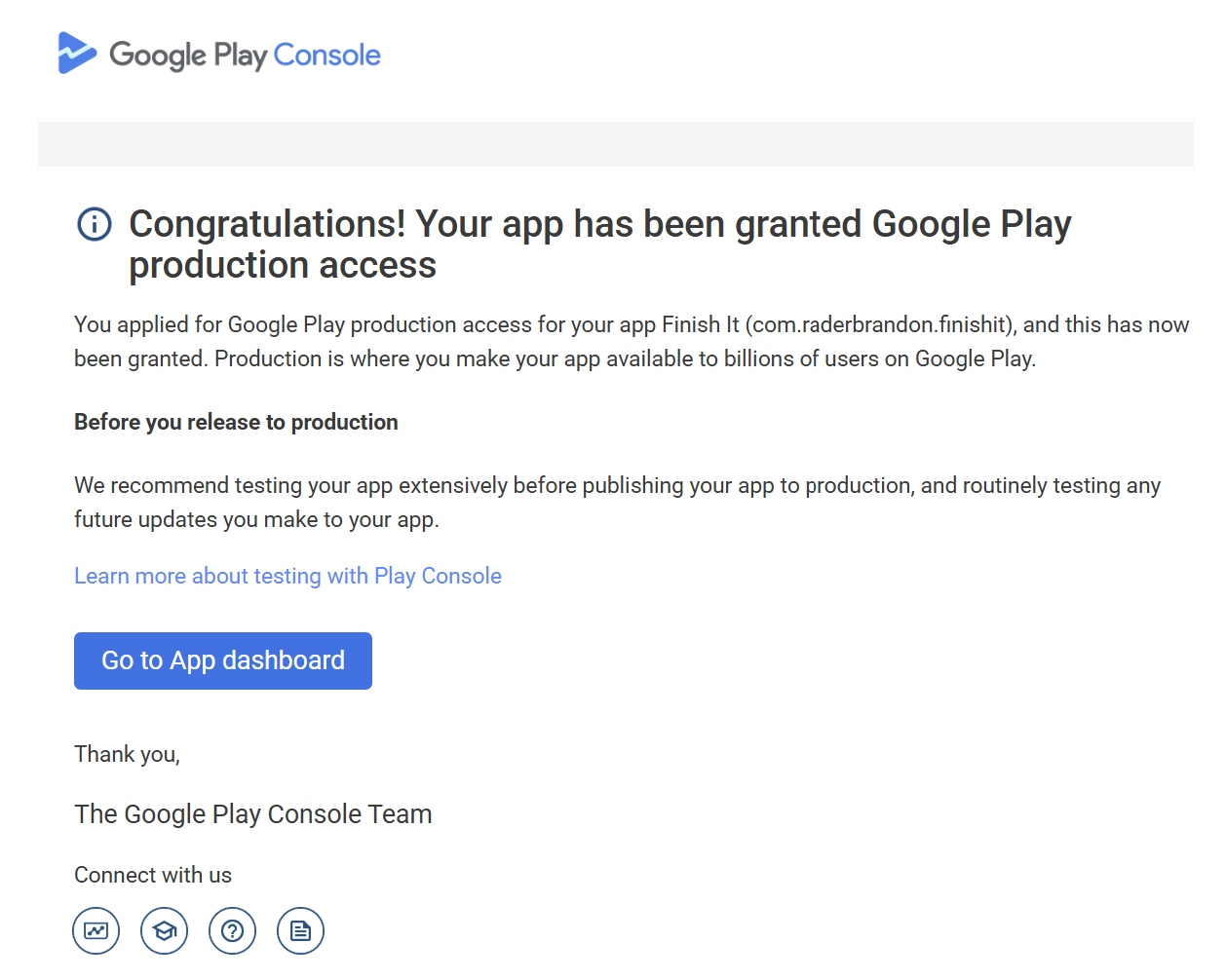
Quality QA Testing Reports
Clear, actionable reports with screenshots and evidence for every important issue found during testing.
Real Device Testing & Diagnostics
Real human testers use physical Android devices to test your app, verify real user flows, and provide clear testing evidence and professional QA reports.
Play Store Ready
Transition your Android app to public production access with confidence. We deliver verified session logs and compliant Console activity.
One Cycle. Complete Approval.
Choose the ideal closed testing cycle for your Android release.
Loading Packages
Please wait while we fetch the best options for your region...
Frequently Asked Questions
Everything you need to know about passing your closed testing requirements.