Play Store testers for 14-day Android app closed testing in Kenya
Hire Play Store testers in Kenya for Google Play closed testing. Secure your Play Console approval quickly with real 12 testers for 14 days.
Launching a mobile application in Kenya is much like opening a storefront in the bustling heart of Nairobi. You need the right product, a deep understanding of local culture, and the ultimate green light from the governing authorities. In the global digital ecosystem, that governing authority is Google. Before you can tap into the millions of active smartphone users across the Silicon Savannah, you must successfully navigate the strict Google Play Closed Testing policies. This process requires gathering real, dedicated users to rigorously test your app over a set period. It is far more than a simple administrative checkbox. It is the absolute foundation of your future success in the dynamic and highly competitive Kenyan digital market.
For independent developers and new publisher accounts, the mandate from Google is non-negotiable. You must demonstrate that your application provides genuine value and functions flawlessly on actual devices. Securing the required 12 Testers for 14 Days is often the most frustrating hurdle for creators. Without authentic local engagement, your app remains stuck in testing limbo, completely invisible to the vast audience you built it for.
Why Genuine Kenyan Testers Are Non-Negotiable
When you are engineering a digital solution specifically for the Kenyan audience, testing with local individuals is not merely a matter of Play Console compliance. It is about gathering critical insights into how your app performs under real-world conditions. You need to know how it behaves on major local networks like Safaricom, Airtel, or Telkom. You must understand if your UI makes sense to users accustomed to mobile money platforms like M-Pesa. Play Store Closed Testing demands this level of authentic, localized engagement to ensure your product is truly market-ready.
Google uses highly advanced algorithms to monitor testing activity. If their systems detect that you are using automated scripts, emulators, or farm accounts located halfway across the globe, your developer account faces immediate risks. Fake testing does not provide the qualitative feedback necessary to improve your app, and it directly violates Google policies. Using real, opt-in human testers from Kenya ensures that your feedback is valid, your metrics are clean, and your path to production is secure.
The Hidden Dangers of Bot Testing Networks
Many developers, feeling the immense pressure of impending launch deadlines, are unfortunately tempted by incredibly cheap online services promising instant and guaranteed testing compliance. These shady services almost always rely on automated bots, emulators, or massive click-farms located in entirely different continents. While they might seem like a quick, magical fix to your Google Play Closed Testing bottleneck, they are actually a massive, potentially catastrophic liability for your developer account and your brand reputation.
Authentic Human Testing
Genuine Device Usage: Real testers use their actual daily smartphones, exposing your app to a variety of screen sizes, battery conditions, and operating system versions commonly found in Kenya.
Organic Interaction: Human testers interact with your app naturally. They tap, swipe, pause, and explore your interface in completely unpredictable ways that bots simply cannot replicate.
Valid Session Lengths: Real users generate varied, highly realistic session lengths. Some might open the app for two minutes to check a feature, while others might spend twenty minutes exploring deeply, creating a healthy data profile.
Constructive Feedback: Human beings can tell you if your text is too small, if a particular button is confusing, or if the app crashes during a specific M-Pesa transaction step.
Compliance Guarantee: Authentic testing perfectly aligns with Google policies, ensuring your app moves smoothly from closed beta to full production without raising any red flags or security alerts.
Automated Bot Farms
Predictable Patterns: Bots operate on rigid, programmable scripts. They tap the exact same coordinates at the exact same intervals, creating a glaringly obvious pattern that Google security systems easily detect.
Geographic Mismatch: Fake testing services often route traffic through cheap VPNs. A sudden spike in testers supposedly from Kenya, but exhibiting latency typical of Eastern Europe, instantly triggers compliance audits.
Zero Actionable Feedback: A script cannot tell you that your color scheme is culturally inappropriate or that your onboarding tutorial is too complicated for the average user.
Account Termination Risk: Google does not just reject the app; they frequently suspend or permanently terminate developer accounts caught manipulating the testing process.
Wasted Time and Money: Paying for fake testers ultimately sets you back. You will lose the money spent, lose the two weeks of testing time, and have to start the entire process over with a damaged reputation.
Struggling with the 14-Day Testing Requirement?
Skip the hassle of recruiting unreliable testers. Our professional fleet of real Android devices guarantees Google Play compliance in exactly 14 days. Zero bots. Zero emulators. 100% production approval guarantee.
The Ultimate Roadmap to a Successful Kenyan Launch
Navigating the complexities of Closed Testing requires a structured, step-by-step approach. You cannot simply upload an APK file and hope for the best outcome. You need a highly deliberate strategy to attract, retain, and learn from your targeted testers. Here is the comprehensive journey to achieving strict compliance and launching your application with absolute confidence in the local market.
Phase 1: Deep Internal Alpha Quality Assurance
Before you even think about inviting external Kenyan testers, your app must be fundamentally sound. Conduct rigorous internal testing to eliminate any glaring bugs, broken links, or immediate crashes. Ensure that all core functionality is fully operational. Pay special attention to features specific to the local market, such as dual language support or seamless integration with local payment gateways and SMS APIs. A broken, frustrating app will quickly discourage even the most dedicated beta testers, leading to high drop-off rates and failure to complete your mandatory testing duration.
Phase 2: Crafting the Perfect Tester Pitch
You need to convince busy people to install an unreleased, potentially buggy application on their primary personal devices. Create a compelling narrative around why their specific feedback matters. Are you solving a unique problem for Nairobi daily commuters? Are you offering a revolutionary new way for local small business owners to track their daily inventory? Clearly communicate the direct value proposition. Set up dedicated communication channels, such as a localized WhatsApp group or a Telegram channel, which are immensely popular communication methods in Kenya, to foster a strong sense of community and direct access to the developers.
Phase 3: Initiating and Managing the 14-Day Cycle
Once your dedicated testers are recruited and their specific Google account email addresses are whitelisted in your Play Console, the critical monitoring phase officially begins. You must actively ensure that testers are actually opening, exploring, and using the app on a daily basis. Achieving the 12 Testers for 14 Days metric requires consistent, proactive engagement. Send polite, friendly reminders through your established community channels. Prompt them to try out specific new features, navigate to different screens, or complete certain simulated tasks within the app to keep their daily interactions varied, natural, and highly meaningful.
Phase 4: Gathering, Analyzing, and Triaging Feedback
The testing phase is not merely a passive waiting game to satisfy a Google requirement; it is an active, vital listening exercise. Relentlessly encourage your testers to report minor visual issues, suggest major workflow improvements, and share their completely honest opinions about the user experience. Use built-in in-app feedback tools if possible, or rely heavily on your community groups. Pay incredibly close attention to comments regarding performance on slower mobile networks, as data connectivity speeds can vary significantly across different urban and rural regions of Kenya. Document every single piece of feedback carefully.
Phase 5: Executing the Final Production Submission
After the continuous testing period has concluded successfully, you must meticulously compile your findings. The Play Console will require you to answer highly specific questions about the testing process you conducted, the exact nature of the feedback you received, and precisely how you implemented code or design changes based on that user feedback. Having a detailed, chronological log of real user interactions makes this intimidating step completely effortless. Submit your final production release request with absolute confidence, knowing that your app has been rigorously vetted, tested, and approved by actual Kenyan smartphone users.
Comprehensive Pre-Launch Checklist for Kenya
To guarantee that your app sails smoothly through the Play Store Closed Testing review process without unnecessary friction, you must be meticulously prepared. Missing a single, seemingly minor step can result in incredibly frustrating delays. Use this extensive, detailed checklist to ensure you have covered every possible angle before initiating your crucial beta test.
Technical Readiness and Optimization
App Bundle Optimization: Ensure your Android App Bundle is highly optimized to minimize the final download size. Mobile data costs can be a significant concern for many users in Kenya. A noticeably smaller app size significantly increases the likelihood of testers successfully installing and keeping your app on their devices.
Network Resilience and Caching: Verify that your application handles poor connectivity gracefully. It should not crash if the user drops from a stable 4G connection to a patchy 3G network in rural areas. Implement robust offline caching so the app remains partially functional during unexpected internet outages.
Extensive Device Compatibility: Test your app thoroughly on a remarkably wide range of devices, particularly the mid-range and budget Android smartphones that heavily dominate the Kenyan market. Ensure flawless performance on popular brands like Tecno, Infinix, Itel, and various Samsung Galaxy models.
Battery Consumption Audit: Run extensive background diagnostic checks to ensure your app does not drain the device battery excessively. Users are incredibly sensitive to battery life and will quickly uninstall any testing applications that consume too much power or run unnecessary background processes.
Memory Management Check: Budget smartphones often have strictly limited RAM. Ensure your app code does not cause memory leaks or severely sluggish performance when other common applications are open simultaneously in the background.
Play Console Configuration and Compliance
Accurate and Localized Store Listing: Prepare a compelling store listing with high-quality localized screenshots showcasing relevant features. Write an engaging description using terminology that resonates directly with the Kenyan audience, and select highly appropriate search keywords.
Privacy Policy Accessibility: Ensure you have a comprehensive, legally compliant privacy policy document hosted securely on a publicly accessible URL. This document must clearly state how you handle user data, which is a strict, non-negotiable requirement for the Play Console approval process.
Honest Content Rating Declaration: Complete the content rating questionnaire honestly, accurately, and thoroughly within the Google Play Console interface. Misrepresenting your app content, especially regarding violence, gambling, or sensitive topics, can lead to immediate and permanent account suspension.
Tester Email and Opt-in Management: Double-check that all tester email addresses are correctly entered into the designated closed testing track. More importantly, painstakingly verify that these users have actively clicked the testing invitation link and officially opted-in to the beta program.
Data Safety Form Completion: Accurately fill out the Data Safety section in its entirety, detailing exactly what user data your app collects, encrypts, and potentially shares. Absolute transparency here is critical for passing the final Google compliance review.
Community Management and Feedback Logistics
Dedicated Support Channel Setup: Establish a clear, highly accessible communication channel specifically for testers to report bugs and ask usage questions. WhatsApp Business groups or dedicated Telegram channels work exceptionally well for fast, informal communication in the Kenyan context.
Feedback Incentivization Strategy: Consider offering small, meaningful incentives for detailed, high-quality bug reports or feedback. Providing mobile airtime tokens or guaranteeing early access to premium features upon launch greatly boosts daily engagement rates.
Daily Engagement Prompt Schedule: Plan out a structured, calendarized schedule of daily prompts, questions, or mini-tasks to send directly to your testers. This ensures they interact with different sections of the app consistently throughout the entire duration.
Crash Reporting Tool Integration: Implement a robust, industry-standard crash reporting tool, such as Firebase Crashlytics or Sentry, to automatically capture, categorize, and deeply analyze any technical failures that occur silently on tester devices.
Feedback Consolidation System: Create a centralized digital spreadsheet or utilize a professional bug tracking tool like Jira or Trello to organize all the incoming user feedback. This makes it significantly easier to address issues systematically before your final public launch.
Evaluating Your Testing Strategies
When deciding exactly how to acquire testers for your software application, you generally have three primary options: doing it yourself by leveraging your personal network, hiring a dedicated professional testing service, or risking everything on cheap bot networks. Here is a perfectly clear, objective breakdown of what each approach truly entails.
| Feature | Professional Service | DIY (Friends & Family) | Bot Networks |
|---|---|---|---|
| User Authenticity | 100% Real Humans | 100% Real Humans | 0% (Automated Scripts) |
| Geographic Targeting | Highly Specific | Limited to your personal network | Often masked or highly unreliable |
| Testing Consistency | Guaranteed daily engagement | Highly variable and unreliable | Consistent but easily detected |
| Quality of Feedback | Detailed, actionable, objective | Often biased, lacking technical depth | Non-existent |
| Compliance Risk | Zero risk | Low risk (if they participate daily) | Extremely high risk of suspension |
| Time Investment | Minimal effort required | Requires constant nagging and follow-up | Fast setup, but leads to account bans |
| Cost Effectiveness | High value for guaranteed results | Free financially, but costs heavy time | Complete waste of money |
Frequently Asked Questions About Closed Testing in Kenya
Navigating the complex, constantly updating rules of Google Play Closed Testing can be incredibly confusing and overwhelming for developers. We have compiled the most detailed, comprehensive answers to the most common questions developers constantly ask when attempting to target the lucrative Kenyan market.
What exactly is the '12 Testers for 14 Days' requirement, and does it realistically apply to everyone?
The specific phrase '12 Testers for 14 Days' refers to a critical performance milestone that many independent developers must reach to conclusively prove their mobile app is genuinely ready for a broad public release. Historically, and for many new personal developer accounts, Google strongly mandates that you must have a dedicated group of opted-in testers who continuously use your app for consecutive days. If you are operating under different corporate account conditions or specific enterprise rules, the exact numerical requirement might slightly vary, but the fundamental principle remains completely identical: Google aggressively demands a sustained period of authentic, localized software testing. If you are specifically targeting Kenya, it is highly recommended that these specific testers are actually located physically in Kenya to provide highly relevant feedback on local network conditions and unique user behavior. Falling short of this metric, for instance, having testers install the app but never actually open it, will absolutely result in your production application being firmly rejected.
How does Google accurately know if my testers are actually physically located in Kenya?
Google utilizes a massive, interconnected array of highly sophisticated data points to accurately determine a user location and the overall authenticity of their Google account. They absolutely do not just look at the raw IP address, which can easily be spoofed by anyone using a cheap internet VPN. Google deeply analyzes the account historical usage data, the primary language settings, the device registered timezone, actual GPS location data if permissions are granted, detailed network carrier information such as detecting Safaricom or Airtel mobile SIM cards, and the specific Play Store region permanently associated with the user payment profile. If you hire a shady service that promises Kenyan testers, but those Google accounts were created yesterday in a totally different country and are suddenly routing artificial traffic through a Nairobi VPN server, Google fraud detection algorithms will flag the malicious activity immediately. This is exactly why you must always rely on genuine, long-established users who physically reside in your target African market.
What happens if a tester accidentally misses a day during the testing period?
Absolute consistency is arguably the most critical factor in Play Store Closed Testing. While Google exact internal compliance algorithms are a closely guarded corporate secret, the overarching mandatory requirement is continuous, demonstrable daily engagement. If one or two isolated testers occasionally miss a single day, it might not immediately disqualify your entire testing phase, provided the overall group engagement metrics remain exceptionally high. However, if a statistically significant portion of your testing pool goes completely dormant, uninstalls the application, or simply fails to open it for several consecutive days, the testing timer will essentially reset automatically. You will then be frustratingly forced to recruit a batch of brand new testers and start the agonizing waiting period all over again from scratch. This is precisely why we heavily emphasize the absolute need for a strong, proactive communication strategy, using tools like WhatsApp to send friendly, daily prompts to your testing group to ensure they remain highly active.
Can I simply use my friends and family in Nairobi to fulfill the testing requirements?
Yes, absolutely. Using friends, extended family, and professional work colleagues located in Nairobi, Mombasa, Kisumu, or anywhere else within Kenya is a perfectly valid and fully policy-compliant way to conduct your beta testing. However, the DIY approach comes with massively significant logistical and personal challenges. Friends and family are often just doing you a personal favor, meaning they are significantly less likely to treat the rigorous testing process with the required professional seriousness. They might happily install the app on day one and completely forget about its existence by day three. You will inevitably find yourself constantly nagging them to open the app, which can severely strain personal relationships. Furthermore, friends and family often provide heavily biased feedback; they might falsely tell you the app is wonderful just to avoid hurting your feelings, whereas you desperately need brutal, objective, and highly technical criticism to actually improve the software product before a major public launch.
Why should I explicitly pay for a professional testing service instead of finding users on local social media groups?
While you certainly can attempt to painstakingly recruit testers organically through popular Kenyan Facebook groups, local tech forums, or regional Reddit communities, the manual process is incredibly time-consuming and fraught with extreme unreliability. When you recruit completely random strangers online, you have zero verifiable guarantee that they will actually opt-in correctly, download the app successfully, or use it consistently for the required days. You will spend countless hours managing messy spreadsheets, verifying email addresses manually, and sending desperate reminders to people who frequently ignore your messages entirely. A highly professional service completely eliminates this massive administrative burden. We provide guaranteed, heavily pre-vetted, real human testers who thoroughly understand the specific assignment. We actively manage the daily engagement, ensure strict compliance with Google complex metrics, and deliver structured, highly actionable feedback, allowing you to focus entirely on what you actually do best: writing excellent code and improving your core application.
What kind of feedback does Google strictly expect me to gather during the closed testing phase?
When you finally apply for official production access after your testing days are completely up, Google will aggressively ask you specific, detailed questions about your testing process. They genuinely want to know exactly what you learned and precisely what you changed based on user input. You passionately need to gather feedback directly related to app stability, user interface navigation, technical performance on slow Kenyan networks, and core feature utility. You absolutely must be able to demonstrate clearly to Google that you actively listened to your testers. For example, if multiple testers reliably reported that a specific confirmation button was totally unresponsive on standard Tecno mobile devices, you should be able to document that exact feedback and explain exactly how you patched the software issue in your final production release code.
How do I securely and properly handle mobile money testing during the closed testing phase?
Integrating digital mobile money solutions like M-Pesa is a deeply critical requirement for many successful Kenyan applications, but extensively testing these financial features requires extreme caution and technical precision. During your closed testing phase, you should absolutely never ask your external beta testers to use their own real money to test live, unproven financial transactions. Instead, you must correctly implement the official Safaricom Daraja API sandbox environment. This safe environment beautifully allows your testers to artificially simulate complex payment flows, trigger fake STK pushes, and seamlessly verify transaction confirmation screens without actual financial funds ever changing hands. Ensure your app interface clearly communicates to the testers that they are actively operating in a safe, completely simulated financial environment. Once you have successfully validated the entire complex payment workflow through extensive closed testing feedback, you can carefully switch your application API keys over to the live production environment immediately prior to your official public launch.
What is the exact, technical difference between Internal, Closed, and Open testing tracks in the Play Console?
Google Play offers a highly structured, multi-tiered approach to app deployment and testing. 'Internal Testing' is the very first stage, designed strictly and exclusively for your immediate development team of up to one hundred people. It allows for incredibly rapid deployment and completely bypasses many of the standard Google automated review processes, making it ideal for checking initial, highly unstable software builds. 'Closed Testing' is the critically mandatory middle tier for new developers, strictly requiring you to explicitly invite a specific group of external users to trial a much more stable version of the app. These users must be explicitly invited via their exact Google account email addresses. Finally, 'Open Testing' allows absolutely anyone browsing the Google Play Store to casually find and voluntarily join your public beta program. While Open Testing is fantastic for gathering widespread, global feedback, you absolutely cannot progress to Open Testing or full Production until you have successfully and provably completed the strict, non-negotiable requirements of the Closed Testing phase.
If my app is tragically rejected after the testing period, what are my immediate next required steps?
Facing an official rejection after a grueling, highly stressful testing period is incredibly frustrating for any developer, but it is definitely not the end of your development journey. Google will typically provide an automated but detailed email cleanly outlining the specific policy reasons for the application rejection. Common reasons include drastically insufficient tester engagement, failure to adequately or comprehensively answer the production application questionnaire, or completely unresolved policy violations discovered late during the manual review. Your immediate, crucial next step is to carefully analyze this specific feedback. Do not simply click the resubmit button blindly. You absolutely must address the technical root cause of the rejection. This usually means dedicating time to releasing a brand new app update to your closed testing track that perfectly fixes the highlighted issues, aggressively recruiting a fresh batch of highly engaged, reliable testers, and initiating a brand new continuous testing cycle to conclusively prove to Google that your application now unquestionably meets their incredibly stringent quality and compliance standards.
Are there any specific cultural or deeply localized design elements I should aggressively test for in the Kenyan market?
Absolutely. True, highly successful software localization in Kenya goes far beyond simply translating text into another language. During your closed testing phase, you should actively solicit aggressive feedback on your visual language and fundamental user interface assumptions. For instance, mobile data conservation is a massive, daily priority for many Kenyan smartphone users; testers should carefully evaluate if your app is unnecessarily image-heavy or aggressively auto-playing large videos that rapidly consume precious mobile data allowances. Furthermore, while formal English is widely used in business, tastefully incorporating localized slang or colloquial Swahili, commonly known as Sheng, in casual consumer apps can significantly boost organic user engagement, but it absolutely must be tested thoroughly to ensure it sounds entirely authentic and not awkwardly forced by a foreign developer. Your local beta testers are your ultimate cultural compass, use their deep insights to continually refine your color palettes, application iconography, and overall brand tone to ensure your application truly and authentically resonates with the highly specific local demographic you are targeting.
Our QA Process
How we deploy real devices and guarantee compliance for your release.
Choose Package
Sign in with Google to configure the closed testing environment for your Android build.
Submit Link
Submit your Google Play Console testing link, and our team will assign qualified testers from our testing network to join your Android closed testing release.
Active Testing
A QA supervisor monitors daily check-ins, ensuring 12 unique Android users engage with your Android build every single day.
Get Approved
We guarantee 14 consecutive days of active user check-ins to satisfy Google's compliance policies, delivering an audit-ready PDF feedback report.
The Premium QA Advantage
Experience a next-generation testing infrastructure built for Google Play compliance for your Android release.
The 14-Day Production Guarantee
We complete the required 14-day closed testing process with real human testers and physical Android devices, while providing clear testing evidence and documentation throughout the process.
If Google specifically rejects production access due to insufficient testing engagement, you are covered by our free re-run or 100% refund guarantee, subject to our Refund Policy.
Verified Production Access
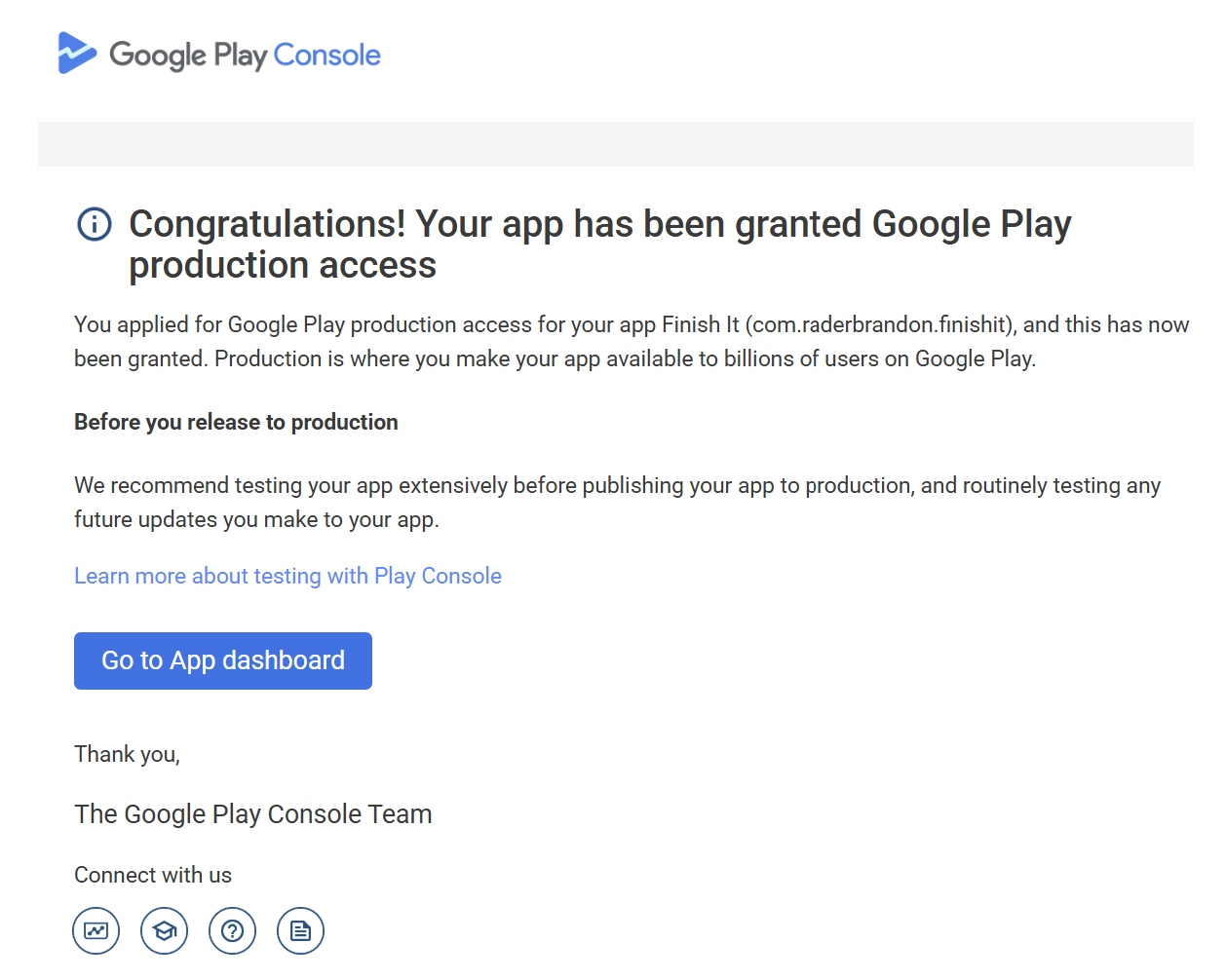
Quality QA Testing Reports
Clear, actionable reports with screenshots and evidence for every important issue found during testing.
Real Device Testing & Diagnostics
Real human testers use physical Android devices to test your app, verify real user flows, and provide clear testing evidence and professional QA reports.
Production Access Secured
Get your Android build approved on the first try. We create an audit-ready compliance profile that proves thorough quality assurance.
Affordable Compliance Cycles
Transparent plans built to satisfy Google Play Console guidelines for your Android build.
Loading Packages
Please wait while we fetch the best options for your region...
Frequently Asked Questions
Everything you need to know about passing your closed testing requirements.