Play Store testers for 14-day Android app closed testing in New Zealand
Hire Play Store testers in New Zealand for Google Play closed testing. Get 12 testers for 14 days to meet Play Console production access rules.
New Zealand isn't just known for its breathtaking landscapes and cinematic mountains. In the tech industry, this island nation is secretly the world's favorite beta-testing sandbox. Due to its isolated geography, highly engaged English-speaking demographic, and incredibly high smartphone penetration, massive tech giants regularly soft-launch their digital products here before a global rollout. If you are developing an Android application, deploying your initial build to Kiwi users provides a pristine, highly representative environment to gather unvarnished, authentic feedback.
Beyond just being a brilliant strategic move for user retention, testing here directly aligns with modern compliance mandates. Before you can hit the production track, you have to navigate the strict Google Play Closed Testing rules. Sourcing real, localized users from New Zealand ensures your app handles varied network conditions and real-world usage patterns, setting you up for a flawless global debut.
Decoding Google Play Closed Testing Requirements
Navigating the Play Console can feel like wandering through a legal maze. Google recently introduced stringent quality control measures to prevent buggy, malicious, or low-effort apps from flooding the market. The core mandate requires new personal developer accounts to run a comprehensive closed test before they can even apply for production access.
This means you must secure real human testers who will keep your app installed and actively engage with it. While the exact numbers can vary based on your specific developer track or legacy status, hitting metrics like 12 Testers for 14 Days or the standard 20-tester benchmark is non-negotiable. Google's automated systems and human reviewers scrutinize these test tracks. They look for genuine device signatures, natural usage sessions, and real opt-in behavior. Failing to provide authentic testing data will result in a rejected production application, forcing you to start the entire grueling process over from day one.
Real vs. Fake Testing: Protecting Your Developer Account
When faced with strict Play Store Closed Testing deadlines, developers sometimes panic and turn to shady shortcuts. However, Google's fraud detection algorithms are incredibly sophisticated, and attempting to bypass human testing is a massive risk. Here is a detailed breakdown of why real testing in New Zealand matters immensely compared to synthetic alternatives.
Authentic Testing in New Zealand
Real users in New Zealand provide genuine, chaotic interaction data. They download your app from the official Play Store link over real WiFi and cellular networks, open it at random times of the day, and navigate through your UI naturally. They will scroll at different speeds, use different accessibility settings, and stress-test your backend infrastructure organically.
This natural behavior generates authentic crash reports, legitimate ANR logs, and real battery usage statistics. Google's systems recognize the diverse residential IP addresses, varied device models ranging from budget Androids to flagship devices, and natural session lengths.
More importantly, real users provide qualitative, actionable feedback. They will tell you if your onboarding flow is confusing, if a button is too small to tap, or if the core loop of your game is boring. This rich qualitative data is exactly what Google wants to see when you answer their comprehensive production application questions at the end of your testing cycle.
The Danger of Bot Farms
Bot farms and cheap click-farm services rely entirely on emulators, data center VPNs, and automated scripts. They might quickly spin up server instances to simulate 12 Testers for 14 Days, but the data trail they leave behind is highly suspicious and easily identifiable by Google's security team.
Google can effortlessly detect when multiple supposed testers share the same data center IP block, have zero prior Play Store purchase history, or interact with your application using identical robotic timing. If the Play Console flags your test track as synthetic or manipulated, your developer account could face severe, irreversible penalties, including shadowbans or permanent termination.
Furthermore, bots do not leave meaningful feedback. When Google inevitably asks you to summarize the exact user feedback you received during your Closed Testing phase, you will have absolutely nothing substantial to say, practically guaranteeing a devastating rejection of your final production rollout.
The 14-Day Timeline: What Actually Happens?
Securing Play Store testers for 14-day Android app closed testing in New Zealand is not a passive process. It is a highly dynamic, two-week journey of continuous monitoring, rapid iteration, and user communication. Here is the exact roadmap of what you should expect during a fully compliant testing cycle.
Day 1: Opt-In and Initial Installation
Your carefully vetted testers in New Zealand receive the official Google Play opt-in link. They accept the digital invitation, join the exclusive testing program, and download your application directly to their personal, everyday Android devices. This critical initial phase establishes the foundational baseline of your Google Play Closed Testing compliance. It is absolutely crucial that testers do not uninstall the app after this first launch, as retention is heavily monitored.
Day 3: Organic Engagement and Crash Reports
By the third day, your testers have had time to explore the core features and navigation flows of your application. If there are critical logical bugs, annoying UI glitches, or weird compatibility issues specific to older Android versions, they will begin to surface here. You should be closely monitoring your Play Console for automated crash logs and ANR alerts. This is also the period when testers might start providing early, raw feedback on the overall initial user experience.
Day 7: The Midpoint Evaluation and Updates
You have officially reached the halfway mark of your high-stakes Closed Testing journey. At this stage, you should have a very solid understanding of your app's technical stability in a live environment. Testers are opening the app periodically, simulating natural consumer usage. If you need to push a minor patch to fix annoying bugs discovered in the first week, you can deploy a new release to the closed testing track. Testers will receive this update naturally through the Play Store infrastructure.
Day 10: Deep Dive Feedback Collection
With the core technical foundation stabilized and major crashes resolved, the primary focus shifts heavily to qualitative feedback. You should actively encourage your New Zealand testers to provide detailed thoughts on the app's core value proposition, aesthetic design, and overall usability. This written feedback is absolute gold, not just for genuinely improving your app, but for proving beyond a shadow of a doubt to Google that you ran a legitimate, user-focused test.
Day 14: Final Review and Production Application
The mandatory 14-day continuous period finally concludes. Your testers have successfully retained the app on their devices and engaged with it appropriately over two weeks. You can now proudly gather all the quantitative data, such as stability metrics and retention graphs, alongside the qualitative data and user feedback. You will use this comprehensive arsenal to fill out the grueling production access questionnaire in the Play Console. Having real New Zealand testers makes answering these questions straightforward, truthful, and highly convincing.
Struggling with the 14-Day Testing Requirement?
Skip the hassle of recruiting unreliable testers. Our professional fleet of real Android devices guarantees Google Play compliance in exactly 14 days. Zero bots. Zero emulators. 100% production approval guarantee.
Comparison: Professional Service vs DIY vs Bots
When it comes to meeting the Play Store Closed Testing requirements, developers generally have three distinct paths to choose from. Let us compare them meticulously across crucial metrics to help you make an informed, strategic decision for your New Zealand launch.
| Feature | Professional Service | DIY (Friends & Family) | Bot Farms |
|---|---|---|---|
| Account Safety | Maximum safety. Uses real, strictly vetted human testers with established, aged Google accounts and real device histories. | High safety, assuming your personal friends actually follow through and use their primary, real smartphones. | Extremely dangerous. High probability of immediate account termination and permanent developer bans. |
| Reliability | Guaranteed completion. Professional testers are contractually obligated to keep the app installed for the full continuous duration. | Low reliability. Well-meaning friends often forget to open the app, lose interest, or accidentally uninstall it early. | Extremely high failure rate. Synthetic bots get detected and ruthlessly purged by Google mid-test. |
| Feedback Quality | Detailed, highly actionable feedback tailored specifically to your app's unique functionality, layout, and visual design. | Often heavily biased or overly polite. Generic statements like "Looks great!" do not help you fix underlying structural UX issues. | Zero qualitative feedback. Automated bots physically cannot evaluate user interfaces or provide emotional insights. |
| Time Investment | Minimal developer effort. You simply hand over the opt-in link, and the service fully handles the massive logistics and monitoring overhead. | Extremely high. You have to constantly harass and remind 20 different busy people to interact with your application daily. | Minimal setup time, but all the time supposedly saved is entirely lost when you have to appeal a definitively rejected app. |
| Geographic Targeting | Can specifically, reliably source active testers located in New Zealand for targeted localized validation. | Severely limited to wherever your immediate personal network happens to live, lacking true geographic focus. | Usually routed through cheap, easily identifiable VPNs that Google effortlessly flags as highly suspicious activity. |
| Compliance | Perfectly and intentionally aligns with all nuanced Google Play Closed Testing mandates and spirit of the rules. | Technically compliant on paper, but practically very difficult to execute perfectly without accidental drop-offs. | Completely, intentionally violates all core Google Play Developer Policies and Terms of Service. |
Pre-Launch Prep: The Ultimate New Zealand Testing Checklist
Before you boldly invite a single human tester from Auckland, Wellington, or Christchurch to download your unreleased application, you must ensure your Play Console environment is perfectly, flawlessly configured. A single careless misstep here can prevent your testers from joining or delay your crucial 14-day clock from officially starting.
Console Configuration and Legalities
Complete your App Content declarations entirely and honestly. This exhaustive process includes submitting a valid privacy policy URL, completing the data safety form, declaring your target audience, and finalizing your global content ratings.
Ensure your primary store listing is fully localized for English (New Zealand) or general English. It must be populated with high-quality, accurate screenshots, a compelling short description, and a comprehensive long description.
Upload a properly signed, release-ready App Bundle to the active Closed Testing track. Avoid using temporary debug APKs for this highly scrutinized phase.
Tester Management and Access
Create a dedicated Google Group or an organized email list specifically for your incoming New Zealand testers to manage their centralized access efficiently and securely.
Navigate to the "Testers" tab within your Closed Testing track, carefully add your newly created Google Group, and explicitly save the sweeping changes to the console.
Locate and copy the unique "Join on Android" and "Join on Web" opt-in URLs provided by the Play Console, as these are the exact lifelines your testers need.
Technical App Readiness
Implement robust, production-grade crash reporting tools like Firebase Crashlytics to meticulously monitor application stability and fatal exceptions during the intense test.
Ensure your application does not require overly complex backend configurations or whitelist approvals that might block fresh testers from accessing the core functionality immediately upon first launch.
Double-check and completely verify that any in-app purchases, paywalls, or subscription flows are properly configured for the Google Play billing sandbox environment, ensuring testers are never charged real money.
Frequently Asked Questions (Deep Dive)
Navigating the immense complexities of Android app testing and international compliance can generate a massive amount of questions. Here is an extensive, highly detailed deep dive into the absolute most common inquiries developers have regarding testing in New Zealand and successfully meeting Google's notoriously strict mandates.
Why should I specifically test my app in New Zealand instead of massive markets like the US or UK?
New Zealand is widely and historically considered the ultimate test market for software, digital products, and video games. It is a geographically isolated, English-speaking market with consumer behavior that is virtually identical to massive western markets like the United States, Canada, and the United Kingdom. However, because the total population is significantly smaller, it is drastically cheaper to acquire users, run targeted ad campaigns, and gather concentrated data. If a major feature fails catastrophically in New Zealand, you can fix it quietly without burning your brand reputation before a high-stakes launch in North America. Furthermore, Kiwi users are generally highly tech-savvy and extremely vocal, providing high-quality, actionable feedback that is absolutely perfect for fulfilling your strict Play Store Closed Testing requirements.
Does Google really track if testers keep the app installed for the entire 14 days?
Yes, Google's internal tracking capabilities are incredibly comprehensive and relentless. The Play Console backend monitors the exact second a user opts into your testing program, the moment they download the app, their daily retention status, and their session lengths. If testers uninstall your app on day five, or if they download it and literally never open it again, Google's automated systems will immediately flag the test as incomplete, artificial, or invalid. You must fiercely maintain the required number of active installations for the entire continuous 14-day period to even qualify for the privilege of requesting production access.
I heard I need 20 testers, but some forums mention 12 Testers for 14 Days. Which is the real requirement?
The standard baseline requirement for the vast majority of new personal developer accounts created after November 2023 is exactly 20 testers for 14 continuous days. However, the Google Play ecosystem is massive and fluid. Sometimes developers running highly specific internal tracks, utilizing massive enterprise accounts, or transitioning legacy applications might look at different analytical benchmarks like 12 Testers for 14 Days for specific localized QA sprints or phased rollouts. Regardless of the exact numerical threshold your specific console dashboard prominently demands, the underlying foundational principle remains exactly the same - you absolutely need real, consistent human engagement over a consecutive two-week period. Always check your specific Play Console dashboard for your exact, personalized mandated numbers.
What happens if a tester accidentally uninstalls my app or breaks their phone on day 12?
If your total active tester count drops even slightly below the required minimum threshold (for example, dropping to 19 active testers when a strict 20 are required), your delicate 14-day continuous clock might be completely reset to zero, or your final application for production access might be heavily scrutinized and subsequently rejected. This precise scenario is exactly why relying on unreliable friends and family is incredibly risky for your business timeline. Professional testing services mitigate this massive risk by consistently over-provisioning testers - providing a generous buffer of extra users - to ensure that even if one or two people drop off due to broken phones, stolen devices, or pure accidents, your baseline compliance remains perfectly intact and uninterrupted.
Can I just use a cheap VPN to pretend I have testers located in New Zealand?
Using a commercial VPN to fraudulently simulate geographic diversity is a massive, deliberate violation of Google Play Developer policies and represents a fast track to getting your entire developer account permanently terminated. Google analyzes vast, unfathomable amounts of data, including hardware identifiers, historical Google account behaviors, network latency anomalies, and behavioral patterns. A fresh, newly created Google account connected via a known commercial data center VPN IP address, behaving exactly like an automated script, will be instantly recognized as fraudulent activity. Always, without exception, use real human users geographically located in your target testing region.
How do I effectively collect the required feedback from my testers to show Google?
Google explicitly expects you to have a clear mechanism for gathering user feedback and to tangibly act upon it. You can seamlessly collect feedback through several integrated channels - setting up a dedicated support email address, integrating sophisticated in-app feedback forms, or heavily utilizing the private feedback feature built directly within the Google Play Store interface (which is strictly only visible to you, the developer). When you finally apply for production access, you will be required to write a detailed, thoughtful summary of the exact feedback you received and explain how it fundamentally influenced your final release candidate build. Having concrete, real-world examples from authentic New Zealand users makes this normally daunting step effortless.
Do my recruited testers need to open the app every single day for all 14 days?
While daily, obsessive usage is excellent for your metrics, Google does not strictly require every single individual tester to open the app every single day, as that simply does not reflect natural human behavior for the vast majority of application categories (like utility apps or calculators). However, there absolutely needs to be a clear, undeniable pattern of genuine, distributed engagement across your entire testing cohort. If 20 people simultaneously download your app on day one and absolutely nobody ever opens it again for two consecutive weeks, Google's review team will inevitably view the test as highly suspicious or conclude your app has disastrously terrible retention, which could severely negatively impact your final production application.
Am I allowed to update my app's code during the middle of the 14-day closed testing period?
Yes, in fact, Google actively encourages iterative development. If your observant testers in New Zealand find a critical login bug on day three, you should absolutely fix the underlying code, generate a brand new App Bundle, and push a rapid update directly to the closed testing track. This proactive behavior powerfully demonstrates to Google that you are actively monitoring the live test and tangibly improving the product based on real-world usage data. Crucially, pushing a standard update does not reset your 14-day compliance clock, provided your dedicated testers keep the app installed and seamlessly update to the new version organically.
What should I do if my production access application surprisingly gets rejected after waiting the full 14 days?
If Google unfortunately rejects your production application, they usually provide a somewhat vague, generalized reason heavily related to insufficient testing procedures or a profound lack of genuine user engagement. You cannot simply smash the re-apply button immediately. You will be forced to meticulously run another complete, agonizing 14-day testing cycle. To successfully avoid a devastating second rejection, you must drastically and fundamentally change your approach - usually by permanently abandoning shady bot farms or highly unreliable friends, and finally investing in a reputable professional service that guarantees high-quality, authentic user interactions and detailed, verifiable qualitative feedback.
Is it actually safe to share my unreleased app with a third-party professional testing service?
Yes, provided you exclusively use a highly reputable, legally established agency. True professional services do not ever need invasive access to your proprietary source code, nor do they need your sensitive Google Developer account login credentials. You simply provide them with the standard public Google Play opt-in link and add their verified, secure tester emails to your Google Group. The entire testing process happens safely and securely through the official, encrypted Google Play infrastructure, ensuring your valuable intellectual property remains completely protected while you rapidly achieve your compliance goals.
How does localization work if I am testing in New Zealand but my actual main market is the United States?
New Zealand officially uses standard English (often incorporating standard UK spelling conventions, but it is incredibly adaptable and accustomed to US English media). If your app is primarily designed for the massive United States market, you absolutely do not need to rewrite your entire app's vocabulary for localized Kiwi slang. Testing in New Zealand provides a fantastic, highly rigorous baseline for general English-speaking UI/UX validation. If your navigation menus, onboarding screens, and core functionalities intuitively make sense to an average user in Auckland, they will almost certainly make perfect sense to a user in New York, Los Angeles, or London.
Will testing in a small market like New Zealand permanently affect my app's global algorithmic ranking later?
Absolutely not. All closed testing data, including the invaluable written ratings and star reviews left by your active testers, is completely, unconditionally private and visible strictly only to you within the secure confines of the Play Console. It absolutely does not affect your crucial public App Store Optimization (ASO) scores, nor does it establish a permanent geographic bias for your app's future global distribution algorithms. Once you successfully graduate to the highly coveted production track, you start completely fresh with a clean slate publicly, elegantly allowing you to launch globally or target entirely different regions with zero negative historical carryover from your closed beta phase.
What specific kind of applications are best suited for a New Zealand soft launch strategy?
Virtually every single app category greatly benefits from rigorous testing in this specific market. However, consumer-facing applications, highly competitive social media platforms, complex mobile games, secure fintech apps, and intricate e-commerce tools are particularly exceptionally well-suited. Because the national demographic is intensely connected and overwhelmingly digital-first, they are truly excellent at rapidly spotting friction points in complex user flows, such as clunky account creation steps, payment processing glitches (when tested in a secure sandbox environment), and frustrating multiplayer matchmaking delays.
Can my chosen testers accidentally leave public reviews during the closed test that ruin my launch?
No, this is completely impossible by design. During an official Google Play Closed Testing phase, any and all reviews, critiques, or star ratings left by your testers are safely routed directly to a private, hidden feedback dashboard exclusively within your personal Play Console. They will never, under any circumstances, appear on the public, indexed Google Play Store listing. This is a truly massive structural advantage, as it allows you to aggressively solicit and receive harsh, critical feedback about early embarrassing bugs without permanently destroying your public reputation before you have even officially launched your product to the wider world.
How quickly can a professional service realistically start my mandatory 14-day test?
Highly reputable professional services can typically fully onboard your project and seamlessly deploy your app to their established tester network within a blazing fast 24 to 48 hours. In reality, the most time-consuming bottleneck is usually on the developer's end - meticulously ensuring the Play Console is correctly configured, all policy forms are signed, and the app has successfully passed Google's initial, sometimes lengthy, automated review for the closed testing track. Once your unique opt-in link is fully live and functional, professional testers based in New Zealand can begin downloading and naturally interacting with your app almost instantaneously, officially starting your countdown clock.
Do I need to pay New Zealand testers directly for their time?
If you are attempting a DIY approach, you would likely have to incentivize people personally, which can become complicated and blurry regarding Google's policies on incentivized ratings. However, when you partner with a professional testing service, they handle all the complex compensation, management, and legal agreements with their vetted tester network directly. You simply pay a flat, predictable fee for the comprehensive service, completely insulating yourself from the administrative nightmare of micro-managing and paying 20 different individuals across international borders.
What is the absolute most common reason developers fail the 14-day test?
The single most incredibly common point of failure is undoubtedly poor tester retention caused by using uncommitted friends or low-quality bot services. Developers frequently reach day 10, only to discover that five of their friends casually uninstalled the app to save storage space, instantly invalidating the entire multi-week test. The second most common failure is a complete lack of verifiable user feedback. Developers finish the 14 days but have absolutely nothing to write in the production application regarding what they learned or how they improved the app, leading Google reviewers to rightfully conclude the test was purely performative rather than a genuine quality assurance effort.
Our QA Process
A straightforward 4-step process to get your Android app approved.
Choose Package
Connect your Google account and choose your preferred closed testing package for your Android app.
Submit Link
Share your Play Store opt-in URL. We immediately deploy 12 real testers to launch and review your Android app daily.
Active Testing
Our crew initiates daily launch sessions on physical devices, verifying usability and logging crashes for your Android app.
Get Approved
We continuously perform closed app testing for 14 days to help you meet Google Play production requirements. We also provide a compliance report.
The Premium QA Advantage
Deploy your Android app onto real retail-grade handsets using our secure laboratory environment.
The 14-Day Production Guarantee
We complete the required 14-day closed testing process with real human testers and physical Android devices, while providing clear testing evidence and documentation throughout the process.
If Google specifically rejects production access due to insufficient testing engagement, you are covered by our free re-run or 100% refund guarantee, subject to our Refund Policy.
Verified Production Access
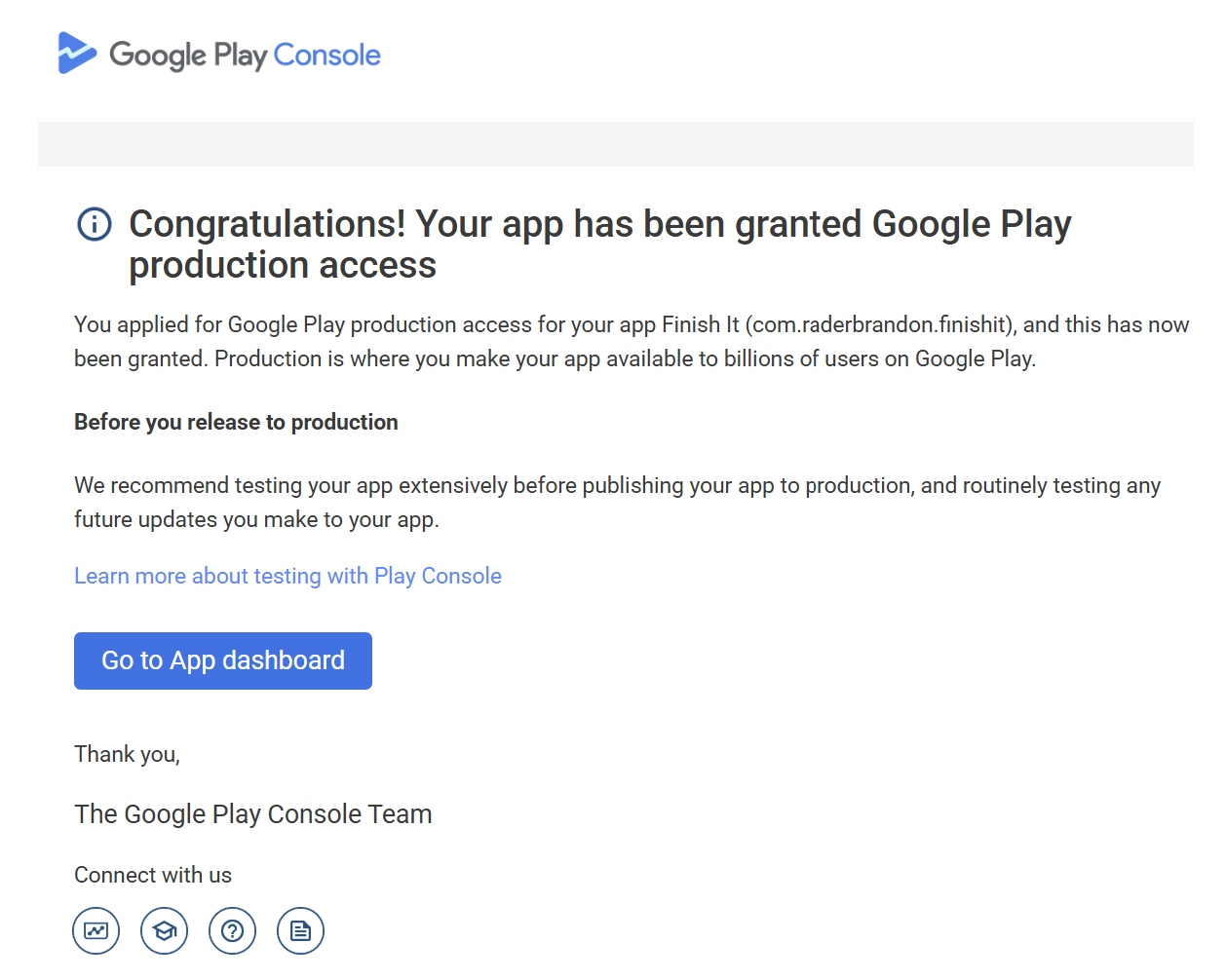
Quality QA Testing Reports
Clear, actionable reports with screenshots and evidence for every important issue found during testing.
Real Device Testing & Diagnostics
Real human testers use physical Android devices to test your app, verify real user flows, and provide clear testing evidence and professional QA reports.
Production Access Secured
Transition your Android app to public production access with confidence. We deliver verified session logs and compliant Console activity.
One Cycle. Complete Approval.
Choose the ideal closed testing cycle for your Android release.
Loading Packages
Please wait while we fetch the best options for your region...
Frequently Asked Questions
Everything you need to know about passing your closed testing requirements.