Play Store testers for 14-day Android app closed testing in Saudi Arabia
Secure active Play Store testers in Saudi Arabia for Google Play closed testing. Meet Play Console guidelines easily with 12 testers for 14 days.
Launching a mobile application in Saudi Arabia is a bit like setting up a premium specialty coffee shop in the heart of Riyadh. You can source the finest beans, design the most elegant interior, and hire the best baristas, but if the local community does not resonate with the flavor profile, your doors will close faster than you can pour a single espresso. The exact same principle applies to mobile applications and digital products. You cannot simply compile code, upload an APK file to the developer dashboard, and hope for the best. To survive the rigorous and highly automated quality checks, you need to understand and navigate the complexities of Google Play Closed Testing correctly. This means engaging real people, specifically gathering 12 Testers for 14 Days, to genuinely interact with your app. Saudi Arabia boasts a highly connected, tech-savvy, and mobile-first population. Passing the testing phase in this specific demographic requires absolute compliance, deep cultural alignment, and a strategic approach to user acquisition right from the beta phase.
Why the Saudi Market Demands Authentic App Testing
Saudi Arabia is rapidly transforming its digital infrastructure under the ambitious Vision 2030 initiative, and the digital economy is booming at an unprecedented rate. For developers, this means massive financial opportunity but also fiercely saturated competition across all categories. When you prepare for Play Store Closed Testing, you must remember that the platform algorithms are watching closely.
Google is actively cracking down on fake bot traffic and synthetic engagement. If your initial testing data looks artificial, your app will face immediate rejection, or worse, a complete account ban. Real, human engagement is the absolute only way to build trust with the Play Console and prove that your application brings genuine value to the end user.
Decoding the 12 Testers for 14 Days Rule
The mandate set by the platform is clear but incredibly often misunderstood by new developers. You need a dedicated, focused group of individuals to interact with your application over a continuous two-week period. This is not about just downloading the application file and letting it sit idle on a device memory bank.
For successful Google Play Closed Testing, your testers must regularly open the app, navigate through various complex screens, and provide legitimate, actionable feedback. If you rely on cheap automation farms or generic click scripts, the glaring lack of real session durations will trigger a red flag immediately.
Real Engagement vs Bot Traffic
Authentic Local Testing
Real testers in Saudi Arabia will experience your app just like everyday consumers. They connect via local Wi-Fi or major cellular networks, creating varied and legitimate IP footprints. They leave honest feedback, encounter genuine bugs, and have session lengths that perfectly mimic natural human behavior. This is exactly what the review team looks for to greenlight a launch.
Automated Bot Farms
Bots use generic VPNs or known data center IPs that security systems flag instantly. They click the exact same buttons in the precise same sequence, generating predictable, highly robotic patterns. The session durations are identical, and they provide zero actionable text feedback. Using these automated services is a guaranteed fast track to getting your entire developer account suspended permanently.
Struggling with the 14-Day Testing Requirement?
Skip the hassle of recruiting unreliable testers. Our professional fleet of real Android devices guarantees Google Play compliance in exactly 14 days. Zero bots. Zero emulators. 100% production approval guarantee.
The Ultimate Checklist for App Testing Compliance
Preparing for a localized launch requires meticulous attention to detail. Every single step you take leading up to the closed testing phase will dictate the smoothness of your final production review.
Initial Console and App Setup
Tester Onboarding in Saudi Arabia
Monitoring the 14-Day Cycle
Your Roadmap to a Successful App Launch
Understanding the journey from beta to production is critical. It is not merely a waiting game, it is an active process of iteration, monitoring, and improvement.
Preparation and Opt-In Phase
The very first phase involves getting your application fundamentally ready and gathering your dedicated focus group. You need to identify real people to fulfill your 12 Testers for 14 Days requirement. Once you have the absolute right audience, you will distribute the secure, platform generated opt-in link. This ensures everyone is properly registered in the ecosystem, authenticated by the platform, and ready to safely download the application to their personal devices.
Active Engagement and Monitoring
This is where the actual testing magic happens. Over the next continuous two weeks, your selected testers will use the app organically. They will navigate through your nested menus, test your core functionalities, and generate the vital usage data that Google Play Closed Testing demands. Consistent, varied, and daily human interaction is absolutely crucial during this critical window to establish trust and prove application stability.
Feedback Collection and Iteration
As the testing phase actively progresses, your testers should regularly report unexpected bugs and share their honest thoughts on the overall user experience. You will use this invaluable qualitative feedback to make vital code adjustments and interface tweaks. This specific step proves to the automated review systems that you are actively maintaining the software, prioritizing user safety, and striving for high quality.
Final Review and Production Release
After the mandatory 14 days are successfully up, you will compile all the accumulated testing data and formally submit your application for the final production review. With a verified history of genuine engagement, a thoroughly tested product, and a clean crash log, you can confidently apply for production access and finally launch your app to the broader Saudi market with immense success.
Analyzing Testing Methodologies for the Saudi Market
The exact approach you take to secure Play Store testers in Saudi Arabia will heavily influence your app future viability. Developers often find themselves choosing between several different methodologies, each with its own distinct set of advantages and catastrophic risks. Let us thoroughly compare the most common methods developers use to meet the rigid Google Play Closed Testing requirements.
| Feature | Premium Testing Service | DIY Family Sourcing | Automated Bot Farms |
|---|---|---|---|
| Tester Authenticity | 100% Real Human Users | High, but hard to maintain | Absolute Zero (Synthetic) |
| Location Accuracy | Geo-Targeted to Saudi Arabia | Highly Variable | Spoofed via generic VPN |
| Time Investment | Minimal effort for developer | Extremely High and tedious | Low initial effort |
| Risk of Account Ban | Very Low | Moderate | Extremely High |
| Feedback Quality | Detailed, actionable, localized | Basic and often biased | None whatsoever |
| Console Compliance | Guaranteed to meet standards | Hit or miss based on effort | Guaranteed to fail review |
When you opt for a premium service that strategically connects you with real, verified testers, you are directly investing in the long term longevity of your application. DIY sourcing - such as persistently asking friends, family, or coworkers - can technically work initially, but getting 12 individual people to genuinely commit to daily, thorough testing for a full two weeks is incredibly difficult. People simply forget, they get caught up in their busy lives, they upgrade their phones, and your mandatory testing streak is permanently broken. Bot farms, on the other extreme hand, are a complete and total waste of financial resources. They put your entire developer account identity at severe risk of permanent suspension.
Expanding on the Play Store Closed Testing Requirements
To truly grasp the sheer magnitude of the 12 Testers for 14 Days rule, we must meticulously break down exactly what the platform is evaluating behind the scenes. The digital ecosystem is evolving rapidly. It is no longer just a simple repository for executable files. It is a highly curated, heavily moderated environment that fiercely prioritizes digital safety, practical utility, and maximum user satisfaction.
When your application enters the rigorous testing phase, the system silently monitors several critical key metrics. First, it deeply analyzes installation retention rates. If all testers magically install the application simultaneously and then immediately uninstall it an hour later, this signals a massive, undeniable problem. Second, it evaluates session frequency and duration. Are users organically opening the app multiple times a day, or did they open it exactly once on day one and absolutely never again? Third, it rigorously checks for device and hardware diversity. Having exactly 12 testers using the precise same model of an outdated Android emulator is highly suspicious and easily flagged. Real users living and working in Saudi Arabia will inherently have a massive mix of the latest flagship devices, mid range smartphones, and various other diverse Android hardware configurations.
Furthermore, the raw geographical telemetry data matters immensely. If you are specifically targeting the Saudi market, but absolutely all of your testing traffic originates from data centers in Eastern Europe or North America, the backend algorithms will immediately flag the activity as heavily manipulated. Absolute authenticity in geographic location is a foundational, critical component of passing the Google Play Closed Testing compliance checks. Without it, you are simply wasting your time.
Comprehensive Frequently Asked Questions
What exactly does the 12 Testers for 14 Days requirement mean for new developers targeting Saudi Arabia?
The 12 Testers for 14 Days rule is an incredibly strict, non-negotiable policy implemented by the platform to absolutely ensure that all newly submitted applications undergo rigorous, human-led quality assurance before they are made available to the general public. Specifically, it heavily mandates that you must have a minimum of 12 distinct, properly opted-in individuals who install and actively engage with your digital product for a continuous, unbroken period of 14 consecutive days. This is not a casual suggestion, it is a hard, foundational requirement for all newly created personal developer accounts. During this critical period, the recruited testers must interact with the application in a way that perfectly mimics normal, everyday human behavior. They should open the app natively, navigate its various features, test edge cases, and ideally, provide constructive, actionable feedback through the official channels. If the automated systems detect that the testers are inactive, or if the engagement looks even slightly artificial, your application will be instantly denied production access, forcing you to start over.
Why is it so critically important to have testers specifically located physically in Saudi Arabia?
Having testers physically located within your exact target demographic is absolutely vital for both strict policy compliance and actual, tangible product quality. Saudi Arabia has a highly unique digital landscape, with very specific cultural nuances, distinct language preferences, and highly localized regional network behaviors. When you utilize testers who are actually based in Saudi Arabia, you ensure that your application performs flawlessly on local internet service providers and that the user interface genuinely makes sense to the local population. From a strict compliance perspective, the platform actively tracks the geographic distribution of your beta testers. If your application is clearly designed for the Saudi market but all underlying testing data originates from completely unrelated regions using cheap VPNs, it raises a massive, immediate red flag for deceptive, manipulative behavior. Genuine, verified local testing deeply validates the authenticity of your application purpose and greatly increases your chances of approval.
Can I use automated bots or engagement scripts to quickly pass the Google Play Closed Testing phase?
Absolutely and unequivocally not. Attempting to bypass the Play Store Closed Testing requirements using automated bot farms, engagement scripts, or click farms is one of the most dangerous, fatal mistakes a new developer can possibly make. The platform employs highly advanced, constantly evolving machine learning algorithms specifically designed to detect synthetic traffic and fake engagement. Bots typically exhibit highly mechanical, repetitive patterns, use known, flagged data center IP addresses, and utterly fail to generate organic crash reports or varied, natural session lengths. If the system identifies that your 12 testers are actually just automated scripts, your application will be rejected immediately without question. Furthermore, the platform takes this specific violation very seriously and will often permanently ban your entire developer account identity, completely preventing you from ever publishing an application again under that name. The catastrophic risks completely outweigh any perceived short term convenience.
How do I effectively ensure that my independent testers are actually active every single day?
Ensuring daily, consistent activity requires a complex combination of clear communication, proper motivational incentives, and utilizing the absolute right testing management platform. If you are attempting to source testers entirely independently, you must maintain constant, daily contact with them, sending persistent reminders and explicitly asking for specific feedback on different features each and every day. However, this is an incredibly time consuming process and very often leads to severe tester fatigue and high drop off rates. The most effective, reliable way to absolutely ensure consistent daily engagement is to leverage a professional testing service that comprehensively manages the entire tester pool for you. These premium services have robust systems in place to meticulously verify that each individual tester is opening the app, interacting with the core mechanics, and perfectly meeting the stringent criteria set by the platform for the full, mandatory 14-day duration.
What actually happens if a tester misses a day or accidentally uninstalls the app during the 14 days?
If a tester misses a single day of engagement or accidentally uninstalls the application before the 14-day period is fully complete, it can severely jeopardize your entire testing phase. The platform strict guidelines require a continuous, unbroken streak of daily engagement from the absolute minimum required number of testers. If your active count drops below the necessary threshold of 12 active users at any point, the 14-day internal clock may instantly reset, brutally forcing you to start the entire exhaustive process over from day one. This is exactly why it is always highly recommended by industry professionals to recruit significantly more than the bare minimum of 12 testers. Having a healthy buffer of extra, highly active testers ensures that if one or two people unavoidably drop off, lose their phones, or encounter catastrophic device issues, your core testing group remains solidly intact, and your hard earned progress toward Play Store Closed Testing compliance is completely protected.
Does the testing feedback absolutely have to be written in Arabic if the app is designed for Saudi Arabia?
While the platform itself does not strictly mandate at a policy level that the feedback submitted through the private testing track be written in a specific language, having extensive feedback in Arabic is incredibly highly beneficial when heavily targeting the Saudi market. Genuine, well written Arabic feedback immediately demonstrates to the review team that real, local users are actively engaging with your application. Moreover, the actual, underlying value of the closed testing phase is to tangibly improve your final product. Receiving detailed feedback in the native language of your exact target audience allows you to instantly identify embarrassing localization errors, broken right to left UI layout issues, and deep cultural misalignments that a non native speaker or automated translation tool would easily overlook. Authentic, highly localized feedback is a massive, undeniable indicator of a high quality, fully compliant testing process.
How long does it typically take for the platform to review the app after the 14 days are finally complete?
Once you have successfully, verifiably completed the grueling 14 days of continuous, unbroken testing with your dedicated group of 12 testers, you will finally be allowed to submit your application for a comprehensive final production review. The duration of this final review process can vary significantly depending on several complex factors, including the overall technical complexity of your application, the specific sensitive device permissions it requests, and the current global volume of submissions being actively handled by the human review team. Typically, developers can reasonably expect the review to take anywhere from a few business days to well over a full week. During this critical time, the platform manually and automatically evaluates your entire application against their massive list of developer program policies. Ensuring that your testing phase was robust, diverse, and undeniably authentic is the absolute best way to facilitate a smooth, fast, and successful review process, getting your app into the hands of real users faster.
The Testing Pipeline
A straightforward 4-step process to get your Android app approved.
Sign In
Connect your Google account and choose your preferred closed testing package for your Android app.
Opt-In URL
Share your Play Store opt-in URL. We immediately deploy 12 real testers to launch and review your Android app daily.
Testing Begins
Our crew initiates daily launch sessions on physical devices, verifying usability and logging crashes for your Android app.
Compliance Complete
We continuously perform closed app testing for 14 days to help you meet Google Play production requirements. We also provide a compliance report.
Why Developers Trust Us
Deploy your Android app onto real retail-grade handsets using our secure laboratory environment.
The 14-Day Production Guarantee
We complete the required 14-day closed testing process with real human testers and physical Android devices, while providing clear testing evidence and documentation throughout the process.
If Google specifically rejects production access due to insufficient testing engagement, you are covered by our free re-run or 100% refund guarantee, subject to our Refund Policy.
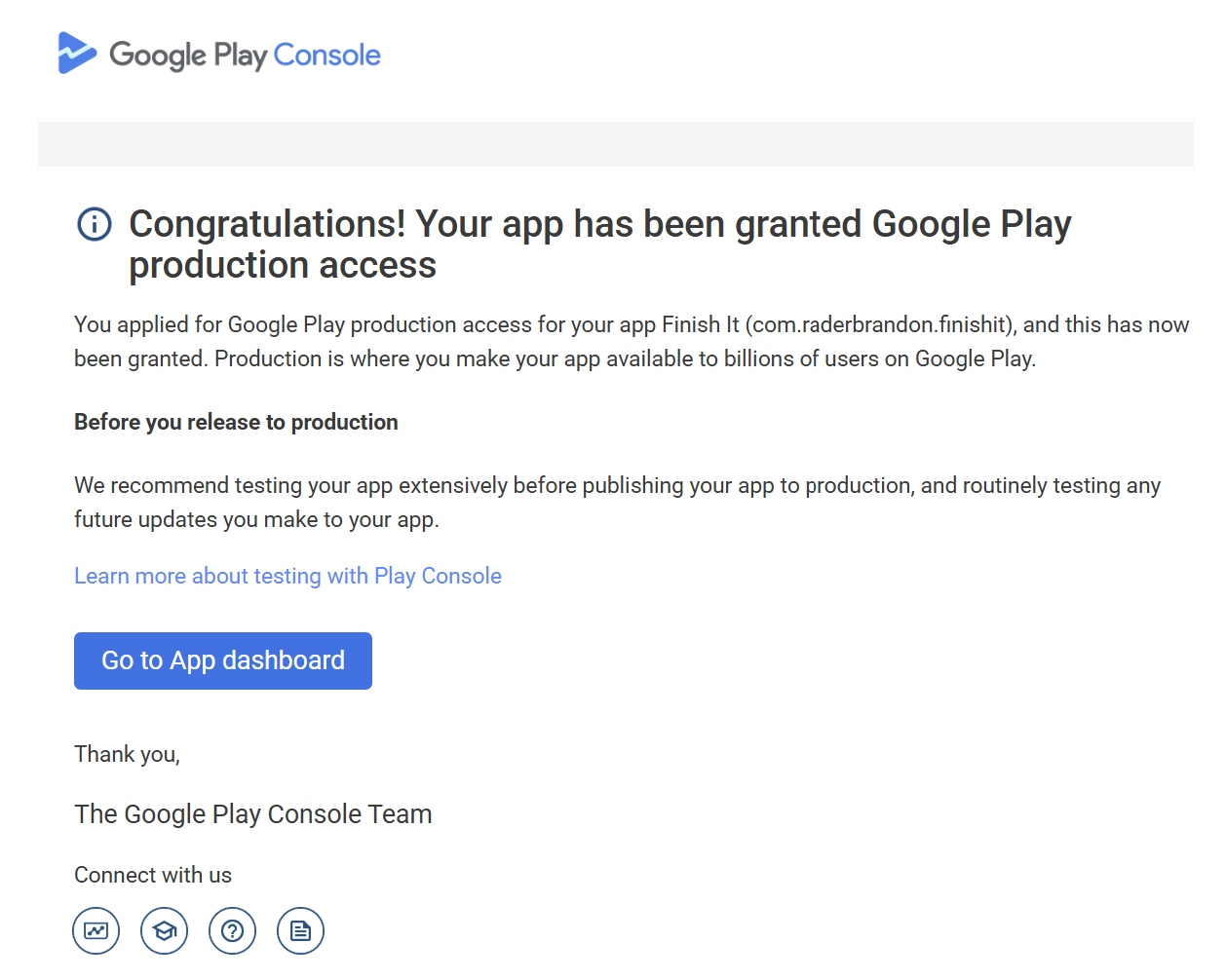
Verified Production Access
Quality QA Testing Reports
Clear, actionable reports with screenshots and evidence for every important issue found during testing.
Real Device Testing & Diagnostics
Real human testers use physical Android devices to test your app, verify real user flows, and provide clear testing evidence and professional QA reports.
Guaranteed App Approval
Transition your Android app to public production access with confidence. We deliver verified session logs and compliant Console activity.
One Cycle. Complete Approval.
Choose the ideal closed testing cycle for your Android release.
Loading Packages
Please wait while we fetch the best options for your region...
Frequently Asked Questions
Everything you need to know about passing your closed testing requirements.