Play Store testers for 14-day Android app closed testing in Thailand
Get Play Store testers in Thailand for Google Play closed testing. Secure 12 testers for 14 days to clear Play Console rules and launch your app.
Navigating the vibrant app market in Thailand is like setting up a street food stall in Bangkok - you need to know exactly what the locals crave before you open for business. Launching an app here without proper feedback is a recipe for disaster. That is exactly where Google Play Closed Testing comes into the picture. It acts as your safety net, ensuring your application resonates with Thai users, speaks their language culturally, and functions flawlessly on the diverse range of Android devices popular in the region.
When you prepare for your Play Store Closed Testing, you are not just ticking a compliance box. You are building trust with a highly engaged audience. Thailand has one of the most mobile-first populations in Southeast Asia. If your app crashes or feels disconnected from local preferences, users will bounce instantly. Getting real, culturally aware testers from Thailand during your closed testing phase means you catch those subtle UX issues before they trigger negative public reviews.
Why Quality Matters More Than Just Numbers
The requirement for 12 Testers for 14 Days is a crucial hurdle for many developers. While finding a dozen people might sound easy, finding the right people is a completely different challenge. Google is aggressively cracking down on synthetic testing environments and fake accounts. If the algorithm detects that your testers are bots sitting in a server farm halfway across the world, your app will face rejections or even account suspensions.
You need genuine users who interact naturally with your app over two weeks. This organic engagement is what signals to Google that your app is legitimate and ready for the public. Choosing real testers over automated solutions is the only sustainable way to pass the Google Play Closed Testing phase without putting your developer account at risk.
Real Thai Testers
Real users in Thailand provide authentic engagement patterns that Google trusts. They download your app on their personal devices, navigate through the screens intuitively, and spot localization issues that automated scripts miss. This genuine activity ensures your account remains in good standing, while providing actionable feedback on interface and usability that genuinely improves the final product before the public launch.
Bot Farms and Fake Accounts
Using automated scripts or fake accounts is a fast track to developer account termination. Google utilizes sophisticated artificial intelligence to spot irregular engagement patterns, such as multiple accounts using the same internet protocol address or identical device fingerprints. It is a massive risk simply not worth taking, as recovering a banned developer profile is notoriously difficult and can effectively kill your entire software business overnight.
The True Cost of Taking Shortcuts
Many developers try to cut corners by using unverified services or begging friends to install their application. Let us break down how different approaches compare when aiming for a successful launch in a competitive environment.
| Feature | Premium Testing Service | DIY and Friends | Bot Farms |
|---|---|---|---|
| Authentic Engagement | High - Real users interact naturally | Variable - Often forget to open the app | Zero - Predictable and flagged behavior |
| Cultural Feedback | Excellent - Deep understanding of Thai market | Good - But limited in scope and numbers | None - Scripts cannot evaluate culture |
| Compliance Guarantee | Strong - Meets all strict Google policies | Weak - High risk of tester drop-offs | None - High risk of account bans |
| Time Investment | Minimal - Handled entirely by professionals | Massive - Constantly chasing people down | Minimal - But always results in total failure |
Struggling with the 14-Day Testing Requirement?
Skip the hassle of recruiting unreliable testers. Our professional fleet of real Android devices guarantees Google Play compliance in exactly 14 days. Zero bots. Zero emulators. 100% production approval guarantee.
Your Comprehensive Pre-Launch Checklist for Thailand
Before you even think about submitting your application for Google Play Closed Testing, there is an immense amount of preparation required. The Thai digital ecosystem is incredibly unique, possessing its own set of distinct user behaviors, technological preferences, and cultural nuances. A generic, one-size-fits-all approach simply will not cut it when trying to penetrate this lucrative market. You must ensure every single technical parameter, cultural element, and regulatory compliance detail is perfectly aligned before inviting users to participate. Failing to prepare adequately will only lead to wasted time, frustrated testers, and a highly probable rejection from the review team. Here is an exhaustive, step-by-step checklist to guide your preparations and ensure your app is genuinely ready for scrutiny.
Technical Readiness and Optimization
Localization and Cultural Adaptation
Compliance and Privacy Verification
Marketing and Store Listing Strategy
The Strategic Roadmap to Play Store Approval
Transitioning your app from a raw development build to a fully approved, publicly available listing in the Thai marketplace is a complex, multi-stage journey that requires meticulous planning and flawless execution. It is not merely about writing clean code and compiling a file, it is about navigating a rigorous, policy-driven evaluation process designed to weed out subpar software. Following a haphazard approach will only lead to unnecessary delays and immense frustration. By adhering to this highly detailed, structured roadmap, you can maneuver through the strict Google Play Closed Testing requirements smoothly, efficiently, and with the utmost confidence that your application will ultimately be approved for global distribution.
Phase 1: Deep Preparation and Rigorous Internal Testing
Before you even invite a single external user, your application must undergo a brutal internal vetting process. Gather your development team, quality assurance engineers, and internal stakeholders to hunt down and squash any major application-breaking bugs. This phase is about establishing a solid baseline of stability. You must also finalize your store listing assets, ensuring your app icon, screenshots, and promotional videos are highly polished and tailored specifically to capture the attention of the Thai audience. Set up your testing tracks within the developer console and double-check all release management configurations.
Phase 2: Initiating the Crucial Closed Testing Phase
This is the pivotal moment where you roll out your application to a carefully vetted, highly reliable group of local testers. The strict requirement of maintaining 12 Testers for 14 Days begins the exact moment these users successfully install the application. It is absolutely vital that these testers are not just passive statistics, they must actively engage with your application, navigate its core features, and simulate genuine user journeys daily. You must orchestrate this phase carefully, providing clear instructions to your testing cohort about what specific aspects of the application need the most attention and rigorous evaluation.
Phase 3: Active Monitoring, Analysis, and Rapid Iteration
Once your app is securely in the hands of your designated testers, you enter a critical period of intense observation. You must keep a relentless, eagle-eyed focus on your crash reporting dashboards and performance monitoring tools. Collect every single piece of qualitative feedback regarding user experience, interface glitches, or subtle localization errors. When testers report legitimate issues, you must act swiftly and decisively. Push out necessary updates and patches to the closed testing track, demonstrating clearly to Google that your development cycle is highly active, incredibly responsive, and dedicated to continuous improvement.
Phase 4: Navigating the Final Review and Production Rollout
After successfully completing the mandatory two-week testing period with consistent, undeniable engagement from your cohort, you will unlock the ability to apply for full production access in the console. You will need to carefully fill out a comprehensive questionnaire detailing your specific testing methodology, the exact feedback you received, and the concrete improvements you implemented. Once Google reviews and enthusiastically approves your detailed submission, the gates are finally open. You can confidently promote your application to the production track, knowing it has been properly battle-tested by real users in Thailand.
Phase 5: Post-Launch Optimization and Continuous Growth
Gaining approval is not the end of the development journey, it is merely the beginning of an entirely new chapter. Post-launch, you must maintain the exact same level of extreme vigilance. Monitor public user reviews meticulously, responding promptly and professionally to user concerns and feature suggestions. Track your key performance indicators relentlessly, such as retention rates, daily active users, and monetary conversion metrics. Use this immense wealth of live data to strategically plan your future updates and feature expansions, ensuring your application remains highly relevant and fiercely competitive in the dynamic Thai mobile ecosystem.
Frequently Asked Questions About the Testing Process
The landscape of application publishing is constantly shifting, and developers frequently encounter complex scenarios that require clear, authoritative guidance. Navigating the regulatory hurdles can feel overwhelming without the right information at your disposal. Below, we comprehensively address the most pressing, highly nuanced questions regarding strict compliance, genuine tester engagement, and the specific intricacies of the Play Store Closed Testing ecosystem.
Why is it absolutely critical to source my testing group specifically from Thailand rather than using a global pool?
The geographical origin of your testers plays a massive, undeniable role in both the quality of your localized feedback and your standing with Google's complex evaluation algorithms. If your application is specifically designed for, marketed to, and monetized within the Thai market, having genuine local testers is the only logical approach to ensure the app meets strict local cultural expectations, idiomatic language nuances, and user interface preferences. Furthermore, Google analyzes the geographic distribution of your testing cohort very closely. If an app is slated for launch heavily in Southeast Asia but all the testing data originates from Eastern Europe or North America, it raises an immediate and severe red flag in their automated review systems. Having genuine testers physically located in your target market adds immense credibility to your closed testing phase, drastically reducing the chances of algorithmic rejection and ensuring a much smoother transition to the highly coveted production track.
What are the exact consequences if a tester uninstalls the application or fails to open it before the mandatory period is completed?
Google's strict policy requires continuous, uninterrupted engagement during the entire testing duration. The metric is not just about the initial download, it is fundamentally about sustained, verifiable activity over a two-week period. If a significant portion of your testers uninstall the application, clear the app data, or simply leave it completely dormant on their device without opening it, the testing phase will be flagged as inherently insufficient. This directly results in the invalidation of your entire testing cycle, forcing you to start the clock over from day one. You will have to recruit an entirely new batch of reliable testers and wait another fourteen days. This is precisely why relying on uncommitted friends or cheap, low-quality services is a massive gamble that rarely pays off. Reliable, dedicated testers who completely understand their crucial obligation to interact with the app daily are absolutely essential for a successful outcome.
Is it possible to use a Virtual Private Network or device emulators to simulate a testing environment based in Thailand?
The answer is an absolute, categorical no. Google employs some of the most sophisticated, state-of-the-art fraud detection systems in the entire world. These highly advanced systems are specifically designed to easily detect virtual private network usage, proxy servers, software emulators, and synthetic device fingerprints. They track intricate metrics you simply cannot spoof easily, such as hardware identifiers, network latency patterns, and the historical activity of the Google accounts participating in the test. Attempting to trick the system with these deceitful tactics will almost certainly lead to immediate detection. The consequences are incredibly severe, your application will be instantly rejected, and your entire developer account could face a permanent, unappealable suspension. Trying to bypass the established rules is simply never worth sacrificing your entire development business.
Could you elaborate on how the 12 Testers for 14 Days rule is actively monitored and strictly enforced by the platform?
The foundational policy mandates that a specific threshold of unique, explicitly opted-in users must maintain your application on their active, primary mobile devices for fourteen consecutive days. Google monitors this actively through the proprietary services framework installed securely on every modern Android device globally. They track precisely when the app is installed, exactly when it is opened, the exact duration of the usage sessions, and crucially whether the app remains installed on the device. They cross-reference this vast amount of data with the overall health and history of the individual accounts participating in the test to absolutely ensure they belong to real human beings and not freshly created, automated bot accounts. This sustained, highly verifiable engagement is exactly what proves to the platform that your application offers tangible value, possesses immense technical stability, and is genuinely ready to be offered to the general public without causing widespread user frustration.
How should I properly handle unexpected crashes or major bugs that are discovered midway through the mandatory testing period?
Discovering a bug during testing is exactly what the rigorous process is primarily designed for, so you absolutely should not panic when it happens. If a critical issue arises unexpectedly, you should immediately develop a comprehensive fix and push a new update directly to your closed testing track. Your dedicated testers will seamlessly receive the update through the platform just like a normal user would in the real world. Pushing these vital updates does not reset your mandatory timer, provided that the testers keep the app installed and continue to engage with it regularly. In fact, clearly demonstrating that you are actively monitoring crash logs, responding constructively to user feedback, and deploying iterative software improvements is viewed highly favorably by the review team when they evaluate your final application for production access. It definitively proves that you are a responsible, highly capable developer committed to maintaining a high-quality user experience.
Does successfully passing the closed testing phase guarantee that my app will be successful in the highly competitive Thai market?
Passing the mandatory closed testing phase is simply a regulatory hurdle, not any sort of guarantee of ultimate commercial success. It merely proves to the platform that your app is technically stable, fully compliant with their baseline policies, and meets a bare minimum threshold of acceptable quality. To achieve actual, lucrative market success in Thailand, you absolutely need a highly robust marketing strategy, continuous user acquisition efforts, and a steadfast commitment to ongoing product development. You must actively leverage the invaluable feedback gained during your testing phase to refine your user acquisition funnel, meticulously optimize your store listing for much better conversion rates, and build highly requested features that solve real, tangible problems for local Thai users. The initial testing phase provides a highly solid foundation, but the true, grueling work of building a highly profitable, sustainable software business truly begins only once you hit the public production track.
The Testing Pipeline
How we deploy real devices and guarantee compliance for your release.
Sign In
Sign in with Google to configure the closed testing environment for your Android build.
Opt-In URL
Submit your Google Play Console testing link, and our team will assign qualified testers from our testing network to join your Android closed testing release.
Testing Begins
A QA supervisor monitors daily check-ins, ensuring 12 unique Android users engage with your Android build every single day.
Compliance Complete
We guarantee 14 consecutive days of active user check-ins to satisfy Google's compliance policies, delivering an audit-ready PDF feedback report.
Why Developers Trust Us
Experience a next-generation testing infrastructure built for Google Play compliance for your Android release.
The 14-Day Production Guarantee
We complete the required 14-day closed testing process with real human testers and physical Android devices, while providing clear testing evidence and documentation throughout the process.
If Google specifically rejects production access due to insufficient testing engagement, you are covered by our free re-run or 100% refund guarantee, subject to our Refund Policy.
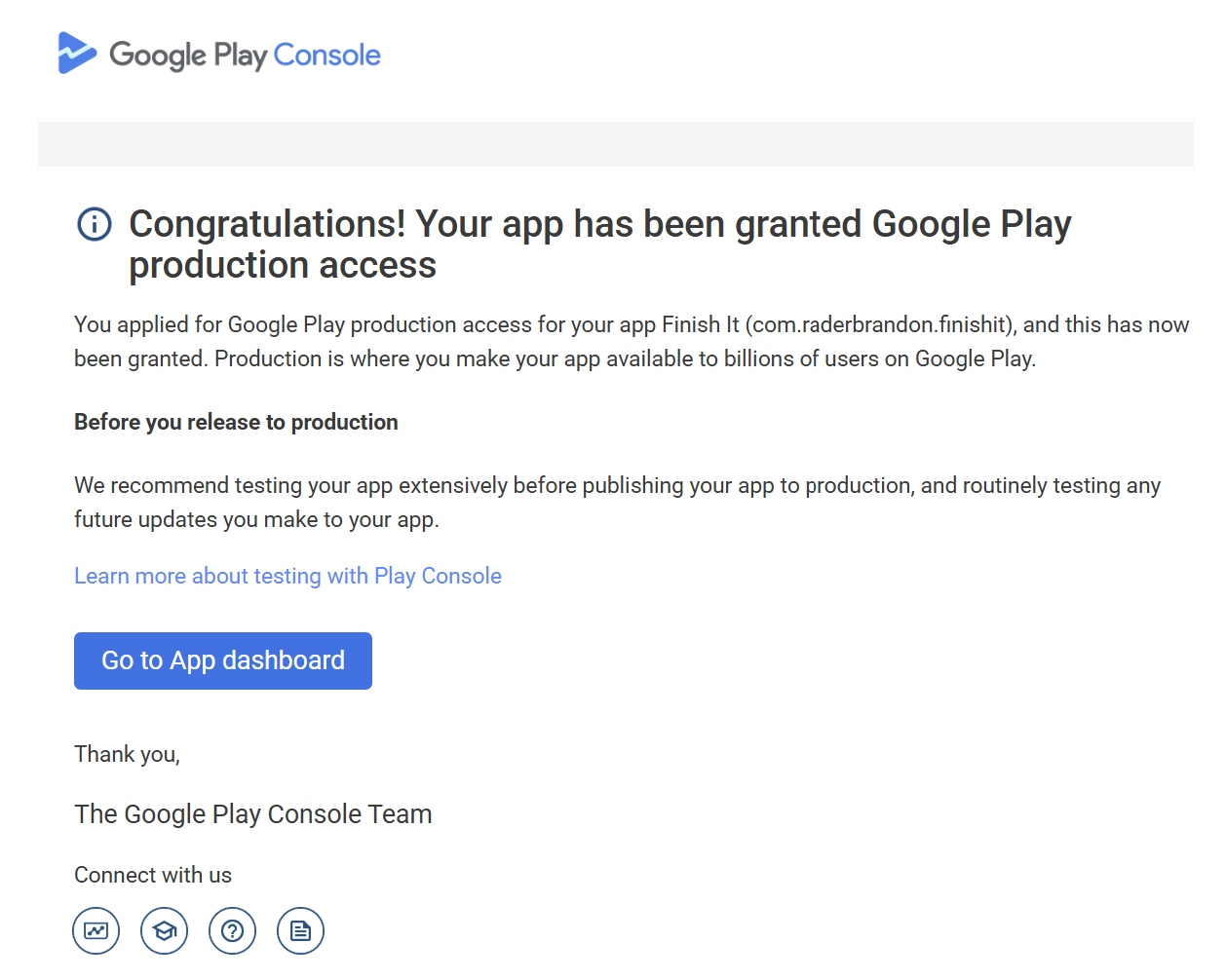
Verified Production Access
Quality QA Testing Reports
Clear, actionable reports with screenshots and evidence for every important issue found during testing.
Real Device Testing & Diagnostics
Real human testers use physical Android devices to test your app, verify real user flows, and provide clear testing evidence and professional QA reports.
Guaranteed App Approval
Get your Android build approved on the first try. We create an audit-ready compliance profile that proves thorough quality assurance.
Affordable Compliance Cycles
Transparent plans built to satisfy Google Play Console guidelines for your Android build.
Loading Packages
Please wait while we fetch the best options for your region...
Frequently Asked Questions
Everything you need to know about passing your closed testing requirements.