Play Store testers for 14-day Android app testing for Israel
Hire Play Store testers in Israel for Google Play closed testing. Fulfill Play Console mandates safely with real 12 testers for 14 days.
Israel is known globally as the Startup Nation. The tech ecosystem here moves at breakneck speed, with brilliant apps launching every single day. But even the most cutting-edge Israeli developers run into a massive brick wall right at the finish line: Google Play Closed Testing. Suddenly, your fast-paced launch is paused because you need to find real humans to test your app for a straight two weeks.
It feels like trying to run a marathon in flip-flops. You have built a flawless product tailored for the vibrant Israeli market, but you are stuck hunting down friends and family to meet Google's strict requirements. Finding dedicated Play Store testers for 14-day Android app testing for Israel is not just a checkbox; it is a serious hurdle that demands real, active users to satisfy the Play Console algorithms.
Why 14 Days of Testing Changes Everything
Google did not implement these rules just to annoy you. The goal is simple: keep low-quality apps out of the store. By forcing developers to engage in rigorous Google Play Closed Testing, the Play Store ensures that only stable, user-friendly applications see the light of day. But for a solo developer or a small startup in Tel Aviv, sourcing consistent testers is a massive drain on time and resources.
Whether you are aiming for the classic setup or looking at alternative setups like 12 Testers for 14 Days for specific updates, the core challenge remains. The testers cannot just download the app and forget it. They must actively engage, keep the app installed, and interact with it daily. If they drop off on day 10, your entire testing period resets, and you are back to square one.
Real Israeli Testers
Real users provide genuine feedback and organic interactions that Google's algorithms love. They open the app at different times, use different devices, and ensure your app meets all Play Store Closed Testing standards without triggering any automated security flags in the Play Console. This natural variety is exactly what Google wants to see.
Fake Bot Testing
Bots try to trick the system with automated clicks and spoofed device data. Google's advanced security systems easily spot this fake, repetitive behavior, leading to immediate account bans, lost developer fees, and your app being permanently removed from the store ecosystem. It is a risk that is never worth taking.
The Hidden Costs of Doing It Yourself in a Fast-Paced Economy
Many developers in Israel try the DIY route first because it seems like the most logical, budget-friendly approach. You post on local Facebook groups, ask your LinkedIn network, or beg your extended family to download your latest creation. At first, it seems like a great, cost-effective idea. People are supportive, they click your opt-in link, and you see your tester count rise in the Play Console. But the reality of Google Play Closed Testing quickly sets in, and it is usually an absolute nightmare for the developer.
First, there is the reliability issue. Your friends might download the app, but will they remember to open it every single day for two full weeks? Probably not. People get busy, they travel, they have demanding jobs, or they simply forget about your app buried on the fourth page of their home screen. Every time a tester goes inactive, your compliance score drops in the eyes of Google. The algorithm is constantly monitoring for genuine, continuous engagement. If your testers only open the app on day one and day fourteen, Google will reject your production application outright. You cannot fake engagement with people who do not care about the testing process.
Second, there is the device diversity problem. Google wants to see your app running on various Android versions, screen sizes, and phone models to ensure broad compatibility. If all your friends work in tech and have the exact same flagship device, the testing data looks highly unnatural. True testing requires a mix of old phones, new phones, tablets, and different network conditions. When you rely on a small circle of peers, you almost always lack the hardware diversity required to prove your app is stable across the vast Android ecosystem.
Finally, there is the massive mental toll. You should be spending these crucial 14 days fixing actual bugs, refining your marketing strategy, planning your user acquisition, and preparing for your grand launch. Instead, you are acting as an unpaid babysitter, sending daily WhatsApp reminders to your testers and stressing over whether they are actually using the app. This is not how you build a successful startup in a highly competitive market like Israel. The opportunity cost of wasting two weeks chasing unmotivated testers is far higher than the cost of hiring professionals. You end up burning out before your app is even live.
Struggling with the 14-Day Testing Requirement?
Skip the hassle of recruiting unreliable testers. Our professional fleet of real Android devices guarantees Google Play compliance in exactly 14 days. Zero bots. Zero emulators. 100% production approval guarantee.
Navigating the Play Console Compliance Maze
Understanding the Play Console is like trying to read a complicated map in the dark while someone is moving the landmarks. The rules are incredibly strict, the documentation can sometimes be vague, and the penalties for breaking the rules are severe. Google uses sophisticated AI and machine learning algorithms to monitor your testing phase. They are looking for natural user behavior, varied session lengths, organic touch patterns, and genuine feedback loops. If they detect anything suspicious, your app launch will be delayed indefinitely, or worse, your entire developer account could be terminated.
When you hire professional Play Store testers for 14-day Android app testing for Israel, you are not just buying superficial downloads. You are making a strategic investment in compliance and peace of mind. Real testers understand the assignment completely. They know they need to keep the app installed, interact with various features, navigate through different screens, and provide the constructive feedback that Google expects to see before granting production access. They know how to generate the kind of organic usage data that proves to Google your app is ready for the public. This level of professionalism is what separates successful launches from failed attempts.
Comparing Testing Methods
| Feature | Professional Service | DIY Network | Bot Farms |
|---|---|---|---|
| Guaranteed 14-Day Retention | Yes, fully guaranteed by contract | Very rare to achieve | No, bots are banned quickly |
| Genuine User Behavior | Yes, natural human patterns | Varies greatly among friends | No, highly repetitive patterns |
| Play Console Compliance | 100% compliant with all rules | Unpredictable and risky | 0% compliant |
| Device and OS Diversity | High diversity across hardware | Usually low and uniform | Spoofed and easily caught |
| Developer Stress Level | Zero, we handle everything | Very High, constant nagging | Maximum panic and fear |
| Risk of Account Ban | None, completely safe | Low to medium | Extremely High and permanent |
| Detailed Feedback Provided | Yes, actionable daily insights | Rarely useful or honest | None whatsoever |
The Ultimate Pre-Launch Checklist for the Israeli Market
Before you invite a single tester or submit your app for Google Play Closed Testing review, you need to ensure your foundation is absolutely solid. A failed testing phase is often the result of poor preparation rather than bad testers. If your app is fundamentally broken, even the best testers cannot save your launch. Use this comprehensive checklist to get your app ready for the big leagues and ensure a smooth journey through the Play Console.
App Optimization and Localization
Play Console Configuration
The Journey to Production Access: A Strategic Roadmap
Getting your app from a raw APK file to a fully published product on the global Play Store is a complex journey. It requires patience, strategy, and the right testing partners to navigate the hurdles. Here is exactly what the roadmap looks like when you do it correctly, avoiding the common pitfalls that trap inexperienced developers.
Internal Polishing and Quality Assurance
Before going anywhere near closed testing, run the app through your internal team and rigorous QA processes. Fix the obvious bugs, optimize the core user loop, and ensure the app delivers on its basic promises. This is your chance to catch embarrassing errors before Google sees them.
Tester Onboarding and Initial Distribution
Distribute your app to your dedicated Play Store testers for 14-day Android app testing for Israel. Ensure they have clear instructions on what features to focus on, but allow them the freedom to explore naturally. Make sure they successfully download and open the app on day one.
The 14-Day Continuous Marathon
Monitor your testers' progress in the Play Console. Ensure daily engagement, collect crash reports, analyze user retention graphs, and gather qualitative feedback. Do not panic if minor bugs are found; that is exactly the point of this rigorous testing phase.
Iterative Updates and Bug Fixes
If necessary, push small, stable updates during the testing phase to address critical issues found by your testers. This demonstrates to Google that you are an active, responsible developer who values user feedback and is capable of maintaining the app.
Applying for Official Production Access
Once the 14 days are successfully completed with high retention and engagement, compile your feedback and submit your detailed application for production access to Google. Answer their qualitative questions thoroughly and demonstrate how testing improved your app.
Market Launch and Aggressive Scaling
Celebrate your approval and launch your app to the vibrant Israeli market and beyond. Begin executing your user acquisition strategy with the confidence that your app is stable, fully compliant, and ready for thousands of real users.
Securing Your App's Future in the Competitive Israeli Landscape
The app market in Israel is notoriously unforgiving, but it is also incredibly rewarding for those who get it right. Consumers here expect high-quality, polished experiences from day one. You have spent months, maybe years, developing a product that solves a real problem, disrupts an industry, or provides genuine entertainment. Do not let a procedural, bureaucratic hurdle like Google Play Closed Testing be the reason your app fails to launch.
By securing professional, dedicated testers, you eliminate the guesswork from your launch strategy. You guarantee that your app meets all of Google's strict requirements, and you free up your own highly valuable time to focus on what really matters: marketing your product, securing investment, scaling your backend infrastructure, and preparing for your next big feature update. The 14-day testing period should not be a roadblock that causes you anxiety; it should be the runway that launches your app to massive success.
Every single day you spend chasing inactive friends or begging strangers on the internet to test your app is a day your competitors are pulling ahead in the market. Invest in a proper, professional testing strategy, ensure your compliance is airtight from the very beginning, and watch your app climb the charts in the Play Store without the looming fear of rejection. Success in the app stores is about momentum, and a failed testing phase kills momentum instantly.
Why is it so exceptionally hard to find testers for the Israeli market?
Israel is a fast-paced, high-stress environment where people highly value their free time. Asking 20 busy professionals or students to commit to testing an unfinished, potentially buggy app every single day for two full weeks is a massive favor. Most independent developers simply do not have a personal network willing to put in that level of consistent, daily effort without financial compensation. Friends will do it for a day, but they will not do it for fourteen.
Can I use automated testing bots, emulators, or VPNs to pass the 14-day requirement quickly?
Absolutely not under any circumstances. Google's fraud detection algorithms are incredibly sophisticated and constantly evolving. They analyze device telemetry, IP addresses, screen interaction patterns, typing speeds, and session lengths. Using bots or emulators will inevitably result in your app being permanently rejected, and your entire developer account being suspended without the possibility of a refund or appeal. It is the fastest way to ruin your developer career.
What exactly does the phrase '12 Testers for 14 Days' refer to in the developer community?
While Google's standard, publicly stated requirement for new personal developer accounts is 20 testers, the phrase '12 Testers for 14 Days' is often used in developer forums and communities to describe specific testing thresholds, legacy account requirements, or enterprise variations of Closed Testing. Regardless of the exact numerical headcount required by your specific account tier, the 14-day continuous, unbroken engagement rule remains the absolute core of Google's quality assurance policy.
What happens if a tester misses a day of testing or uninstalls the app early?
Google requires continuous, uninterrupted engagement to prove that your app retains user interest. If a significant portion of your testers go inactive, fail to open the app, or uninstall it before the full 14 days have elapsed, the Play Console will flag your testing phase as incomplete. You will be forced to recruit new testers and restart the entire 14-day marathon from day one, delaying your launch significantly and wasting weeks of your time.
How do professional testing services ensure strict compliance with Google's rules?
Professional testing services utilize real human beings operating real Android devices on real cellular and Wi-Fi networks. These testers are trained to interact with your application naturally. They explore different screens, leave the app running in the background for varying lengths of time, test push notifications, and provide the exact type of detailed crash reports and qualitative feedback that Google's manual reviewers and automated systems want to see. They do not take shortcuts.
Is this closed testing phase legally required for all new apps launched in Israel?
Yes, any new personal developer account created globally after November 2023 must go through the mandatory Play Store Closed Testing phase before they are permitted to publish any application to production. This is a worldwide policy enforced strictly by Google, and there are no exceptions or workarounds based on geographic location, app category, or target demographic.
Can I push code updates to my app during the active 14-day testing period?
Yes, and Google actually encourages this behavior. Releasing small, stable updates during the testing phase demonstrates that you are actively monitoring crashes, responding to user feedback, and improving the product. However, you must be careful not to push a major, breaking update that causes the app to crash on launch, as this will prevent your testers from opening the app and could reset your 14-day continuous engagement streak.
How should I answer the production access questions after the 14 days are over?
When your 14 days are complete, Google will ask you a series of specific questions about what you learned during the testing phase. You must answer these thoroughly and honestly. Detail the specific bugs you found and fixed, summarize the feedback you received regarding the user interface, and explain how the testing period improved the overall quality of your app. Vague or one-sentence answers will likely result in your application being rejected.
Will Google review my app manually after the closed testing is finished?
Yes, after you complete the 14-day period and submit your application for production access, your app will undergo a comprehensive review. This involves both automated security scans and manual reviews by Google personnel. They will evaluate your app for policy compliance, stability, and overall quality based on the data gathered during your closed testing phase, as well as the answers you provided in your production access application.
What is the most common reason apps fail the closed testing phase?
The most common reason for failure is a lack of continuous tester engagement. Developers often focus solely on hitting the initial number of testers but fail to realize that those testers must actively open and use the app every day for two weeks. If the Play Console detects a huge spike in activity on day one followed by near silence for the next thirteen days, the application for production access will be denied due to insufficient testing data.
Do I need to keep the testing track open after I am approved for production?
While you are not strictly required to keep the initial closed testing track active once your app is fully launched, it is highly recommended. Using the closed testing track for future updates allows you to catch new bugs before they reach your entire user base. It is a best practice that professional developers use to maintain high app ratings and ensure ongoing stability in the competitive market.
The Testing Pipeline
Your journey to Google Play production access, simplified and automated.
Sign In
Authenticate your account to initialize the 14-day QA fleet for your Android release.
Opt-In URL
Upload your testing link. We assign 12 verified users with real Android devices to download and test your Android release.
Testing Begins
A dedicated testing supervisor is assigned to monitor progress while testers engage with your Android app and provide feedback throughout the testing period.
Compliance Complete
Our lab maintains active installations for two weeks straight, ensuring a clean track record and providing a QA compliance log for your release.
Why Developers Trust Us
Satisfy your Play Store Console testing obligations with our managed physical device fleet tailored for Android builds.
The 14-Day Production Guarantee
We complete the required 14-day closed testing process with real human testers and physical Android devices, while providing clear testing evidence and documentation throughout the process.
If Google specifically rejects production access due to insufficient testing engagement, you are covered by our free re-run or 100% refund guarantee, subject to our Refund Policy.
Verified Production Access
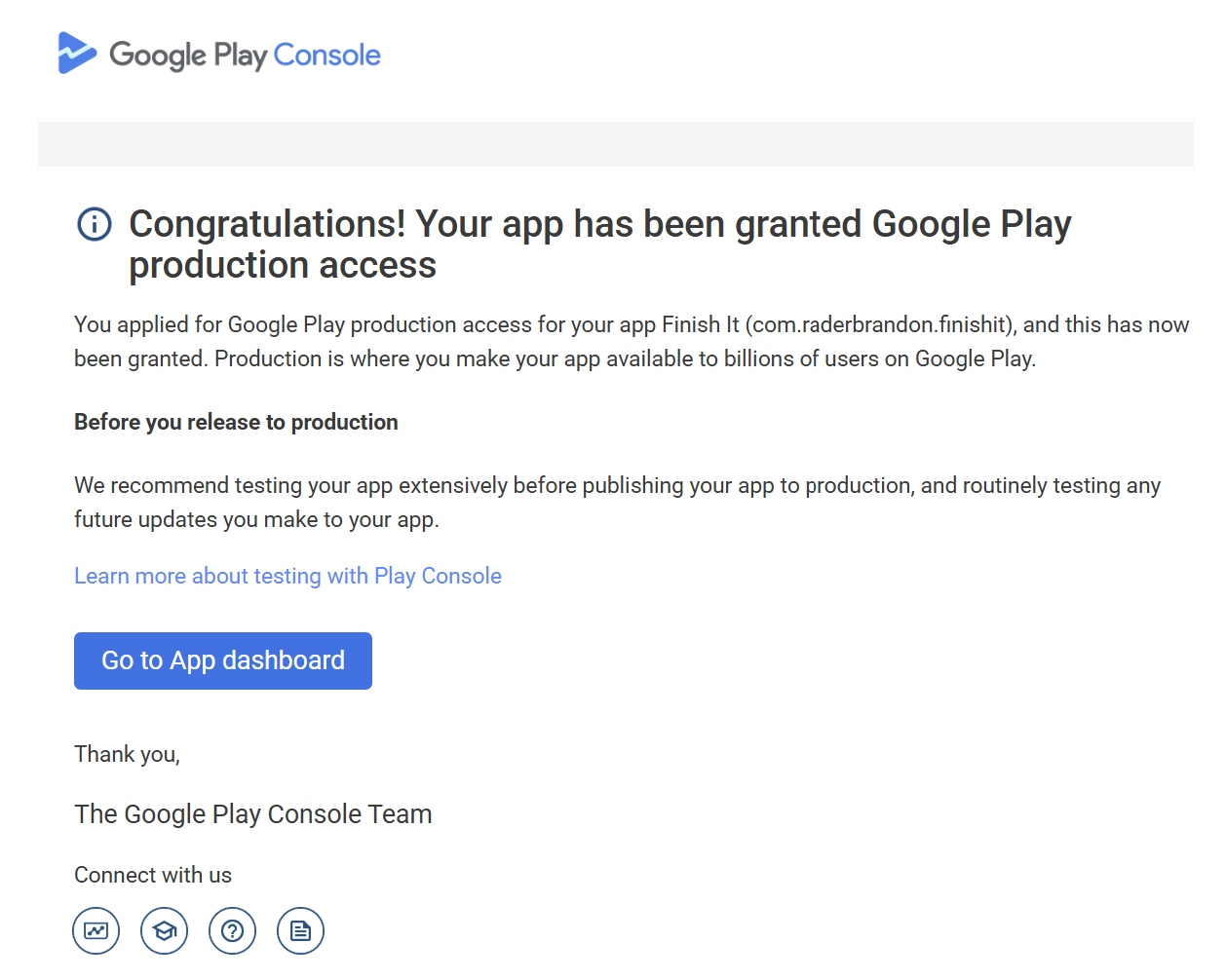
Quality QA Testing Reports
Clear, actionable reports with screenshots and evidence for every important issue found during testing.
Real Device Testing & Diagnostics
Real human testers use physical Android devices to test your app, verify real user flows, and provide clear testing evidence and professional QA reports.
Guaranteed App Approval
Our structured 14-day closed testing process is designed to meet Google Play's production requirements for your Android release.
Simple Closed Testing Pricing
Select the plan that fits your Android app complexity.
Loading Packages
Please wait while we fetch the best options for your region...
Frequently Asked Questions
Everything you need to know about passing your closed testing requirements.