Play store testers for 14-day Android app testing in Canada
Hire active Play Store testers in Canada. Meet the Play Console closed testing rule with 12 testers for 14 days and get your Google Play app published.
Picture this: You are sitting in a dimly lit coffee shop in downtown Toronto. The snow is falling heavily outside, your overpriced coffee is getting cold, but you do not even care. You have just finished writing the final line of code for your dream Android app. You hit "build," watch the progress bar fill up, upload your shiny new APK to the Google Play Console, and get ready to share it with the world. But then, a wild, frustrating roadblock appears on your screen. Google demands that you run a Closed Testing track. Specifically, they want a group of real people to opt-in and test your app for a straight two weeks before you are even allowed to click the production button.
For many indie developers, freelancers, and small app studios across Canada, this moment feels like a bucket of ice water dumped directly on their heads. Finding people to actually download, keep, and interact with a beta app every single day is much harder than it sounds. You might think you can just ask your mom, your cousin living out in Vancouver, and a few guys from your Friday night hockey team. But what happens when half of them forget to open the app on day three?
Google notices. They track daily opt-ins and active installs with pinpoint accuracy. If your testers drop off, your testing phase fails, and you are sent right back to the starting line. This is where the magic of having a dedicated team of Play Store testers for your 14-day Android app testing in Canada comes into play. You do not just need random email accounts; you need real people, holding real phones, connected to real Canadian cellular networks. You need a rock-solid strategy to cross this digital desert without dying of thirst.
Why the Canadian Market Demands Genuine Testing
Canada is a incredibly unique beast when it comes to mobile apps and digital software. We have extremely high smartphone penetration, but our users are notoriously picky. If an app drains the battery while someone is waiting for a bus in the freezing cold weather, or if the user interface is sluggish on a mid-range phone, a Canadian user will uninstall it faster than you can say "maple syrup."
When you engage in Google Play Closed Testing, you are not just ticking a mandatory bureaucratic box for a massive tech corporation. You are getting an invaluable sneak peek into how actual humans will react to your life's work. If your app crashes when switching between Wi-Fi and mobile data on the TTC subway in Toronto, or while driving through a dead zone in the Rockies, you desperately want to know about it before you launch to the public.
Some naive developers try to take shortcuts to save time. They look for sketchy, ultra-cheap services offering "12 Testers for 14 Days" for five dollars, completely oblivious to the fact that those "testers" are actually just a rack of automated, jailbroken phones sitting in a basement halfway across the globe. Google's security algorithms are incredibly smart. They look at IP addresses, device activity patterns, and Google account histories. If they sniff out a bot farm, your developer account could be banned permanently. That is a massive risk no serious app creator should ever take.
Real Canadian Testers
Finding genuine users means your app is installed on actual, everyday devices. These people carry their phones in their pockets, connect to local Wi-Fi networks in Montreal, Halifax, or Calgary, and use your app exactly the way a normal person would. They find real bugs, provide human feedback, and most importantly, they satisfy Google's strict Play Store Closed Testing policies without raising any security red flags. Your app gets a healthy, realistic run-through, and your precious developer account stays perfectly safe.
Bot Farms & Fake Accounts
Using automated scripts or fake accounts is a guaranteed recipe for absolute disaster. Bots do not interact with your app naturally. They open it for exactly five seconds at the exact same time every single day. Google's advanced security systems can spot this robotic behavior almost instantly. Not only will your testing phase be rejected, but your entire developer account could be suspended for life. Furthermore, bots cannot tell you if your buttons are too small or if your text is hard to read.
Decoding the 14-Day Challenge
Let us break down exactly what Google wants from you in plain English. When you finally enter the testing phase, the digital clock starts ticking. For 14 straight days, your testers must remain opted into your test track. They must keep the app installed on their primary devices. If they uninstall it to free up space for a new game or a video, they are no longer counted towards your total.
It sounds simple on paper, but human behavior is wildly unpredictable. Let us say you beg 25 of your closest friends to help you out. On day one, everyone is super excited and supportive. By day five, three people get new phones and completely forget to reinstall your app. On day nine, four more people accidentally delete it while clearing up storage space. Suddenly, your active tester count drops below the required threshold, and your 14-day streak is violently broken. You have to start all over again, wasting another two weeks of your life.
This is exactly why relying on a professional, managed service to handle your Play Store Closed Testing is a total game-changer. When you hire dedicated testers, it is their actual job to keep your app installed. They are monitored, managed, and guaranteed to stick around for the entire duration. You can sleep peacefully at night knowing that your 14-day streak is completely safe and sound.
The Myth of "Just Getting 12 Testers"
You might have seen old advice online or watched outdated YouTube tutorials talking about getting "12 Testers for 14 Days". While the exact number of required testers can fluctuate depending on your account type and exactly when you created it (Google currently demands 20 testers for personal developer accounts created after November 2023), the core philosophy remains the exact same. Whether the number is 12, 15, or 20, the real challenge is not just the quantity of people, it is the consistency of their actions.
Google wants to see a healthy, stable, and active testing environment. They want to absolutely ensure that your app is not going to crash and burn as soon as it hits the public store. By enforcing this strict testing period, they are protecting their massive user base from broken, buggy, and malicious software. But as a developer, you need a reliable, stress-free bridge to cross this gap.
| Feature | Professional Testing Service | DIY (Friends & Family) | Bot Farms |
|---|---|---|---|
| Account Safety | 100% Safe (Real Devices) | Safe, but highly unreliable | Extreme Risk of Ban |
| Consistency | Guaranteed 14-day retention | Huge drop-off rate | Suspiciously robotic |
| Feedback Quality | Detailed, actionable insights | Vague ("Looks good man!") | Zero feedback |
| Stress Level | Zero | Very High | Constant fear of suspension |
| Canadian IPs | Yes, authentic local networks | Yes (if they live there) | No, usually foreign VPNs |
Struggling with the 14-Day Testing Requirement?
Skip the hassle of recruiting unreliable testers. Our professional fleet of real Android devices guarantees Google Play compliance in exactly 14 days. Zero bots. Zero emulators. 100% production approval guarantee.
How Google Analyzes Your Test Data Behind the Scenes
Many developers mistakenly believe that Google is just counting heads. They think that as long as the dashboard shows 20 people opted in, everything is fine. This is a massive misunderstanding of how the Google Play Console actually works.
Behind the scenes, Google is monitoring Android Vitals. They are looking at your App Not Responding (ANR) rates. They are tracking how many times your app crashes. They are looking at battery usage, network request failures, and memory leaks. If your app is constantly crashing on the devices of your testers, Google's automated systems will flag your app as unstable. Even if you have the required number of testers for the full 14 days, Google can still deny your production access if the quality of the app is deemed too low.
This is why having real users testing your app on real devices is so critical. Real users will navigate through the app in unpredictable ways, triggering edge cases and exposing hidden bugs that you, the developer, never even thought of. By catching these issues during the Closed Testing phase, you can push updates and improve your Android Vitals before the final review.
Preparing Your App for the Big Test
Before you even think about inviting your first tester, your app needs to be 100% ready. You cannot just throw a broken, half-finished prototype into a Closed Testing track and hope for the best. If your app crashes immediately on startup, your testers will not be able to interact with it, and Google will not give you the green light to proceed.
You need to polish your app, set up your store listing properly, and make sure all of your legal and privacy policies are fully in order. Think of the testing phase as a highly critical dress rehearsal. The audience might be small, but the performance still needs to be absolutely flawless.
App Functionality & Technical Readiness
Console Configuration & Compliance
The Psychology of App Testing
Why do we test apps in the first place? It is not just about finding technical bugs in the code. It is fundamentally about understanding human psychology. When a user in Vancouver downloads your app, they are looking to solve a specific problem, learn something new, or be entertained. If your app's navigation is confusing, they will feel frustrated. If the buttons are too small, they will feel annoyed.
Real human testers can tell you things that a computer script never could. A bot cannot tell you that your chosen color scheme hurts their eyes when looking at the screen at night. A bot cannot tell you that your checkout process feels untrustworthy or confusing. A bot cannot tell you that the core concept of the app makes intuitive sense.
When you get real people to actively participate in your Google Play Closed Testing, you are gathering invaluable psychological data. You might discover that users are repeatedly tapping on a static image because they mistakenly think it is a button. You might find out that your opening tutorial is way too long and people are frantically skipping it. These are the kinds of profound insights that turn a mediocre, forgettable app into a top-charting success.
Navigating the Canadian Digital Landscape
Canada is a massive, geographically diverse country. We have bustling, high-tech cities and extremely remote rural areas. A user testing your app on a blazing fast 5G connection in downtown Toronto will have a drastically different experience than a user relying on a spotty 3G connection in a small town in northern Ontario.
When you use real testers spread across the country, you get a beautiful, highly accurate cross-section of data. You find out exactly how your app handles slow or dropping networks. You see if your location-based services work properly across multiple different time zones. You ensure that your app is truly ready for the entire Canadian market, from the Atlantic coast to the Pacific coast.
This level of extreme thoroughness is exactly what Google wants to see. When their automated systems eventually review your app's performance metrics during the testing phase, they are looking for stability across vastly different environments. A robust, well-tested app sails through the final review process with flying colors, while a poorly tested app gets stuck in a loop of rejections.
Day 1: The Exciting Rollout
Your app is successfully published to the Closed Testing track. The testers receive their secure invite links, opt into the testing program, and download the app directly from the official Google Play Store to their personal devices. The critical 14-day countdown officially begins.
Day 2-7: Initial Exploration & Bug Hunting
Testers open the app, create their user accounts, and navigate through your main features. They aggressively check for obvious bugs, broken links, spelling errors, and UI glitches. You will likely receive your very first batch of early feedback during this window, allowing you to push a quick update.
Day 8-13: Sustained Engagement & Vitals Monitoring
This is the exact phase where DIY testing usually falls apart, but professional testers shine brightly. The team continues to keep the app installed on their active devices. They open it periodically to ensure Google clearly registers active, daily usage, keeping your 14-day streak perfectly intact and your Android Vitals healthy.
Day 14: Crossing The Finish Line
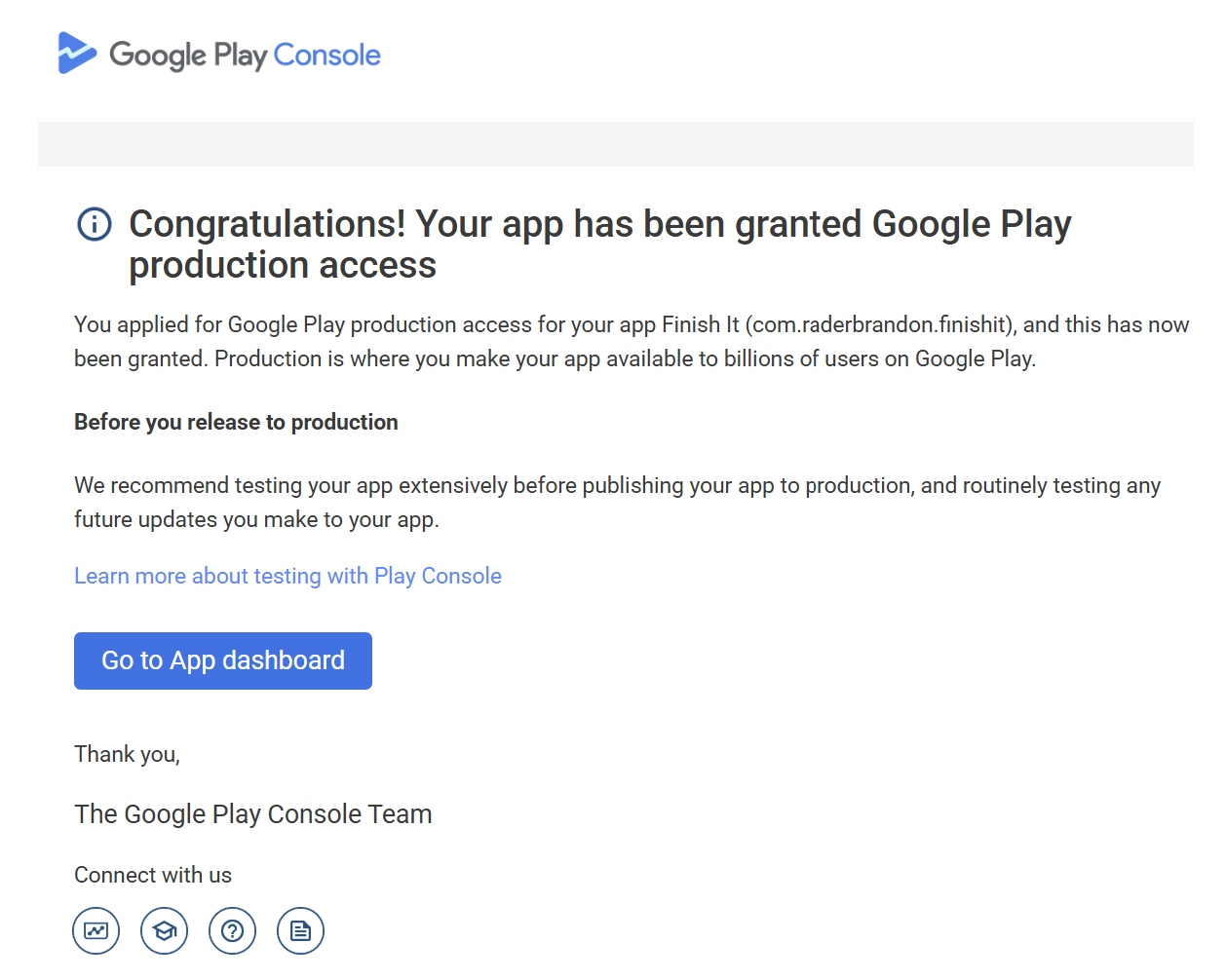
The final day arrives! The mandatory testing period is successfully completed. The testers provide their final, detailed thoughts on the user experience, and you gather the necessary feedback to confidently fill out Google's required production questionnaire. You are now fully ready to apply for production access.
What Happens After the 14 Days Are Up?
Hitting the 14-day mark is a massive, celebrated achievement, but the journey is not quite over yet. Google does not just automatically publish your app to the world the second the clock strikes midnight. You have to actively manually apply for production access in the console.
When you do this, Google will ask you a series of highly specific questions. They will want to deeply know how you gathered your testers, what specific kind of feedback you received, and exactly what changes you made to the app's code or design based on that feedback.
If you used a fake bot farm, you will have absolutely nothing of value to say here, and your answers will look incredibly suspicious. But if you used real testers for your Play Store Closed Testing, you will have an absolute goldmine of information. You can confidently explain that a tester in Calgary found a rare bug on the login screen, and you fixed it in version 1.2. You can tell them that users loved the dark mode feature but wanted larger fonts. Providing detailed, honest, and specific answers proves to the human reviewers at Google that you took the testing phase very seriously.
Do Not Let Your Hard Work Go to Waste
You have poured your heart, your soul, your late nights, and countless hours into building your Android app. Do not let all of that incredible effort die quietly in the testing phase just because you could not find enough reliable people to keep it installed on their phones.
The Canadian app market is hungry for innovative, well-built, and highly optimized software. By investing in a proper, professionally managed testing phase, you are setting yourself up for massive long-term success. You are ensuring that your app is exceptionally stable, beautifully user-friendly, and fully compliant with all of Google's rigorous rules.
Say a final goodbye to the immense stress of begging your friends, family, and coworkers to help you out. Say goodbye to the terrifying fear of getting your entire developer account banned for using shady bot networks. Embrace the ultimate peace of mind that comes with knowing your 14-day testing period is being handled by real, dependable, and dedicated professionals.
Get your app tested the right way, get it quickly approved by Google, and get it into the eager hands of the millions of users who are waiting for it. The finish line is much closer than you think. Let us cross it together and launch your app to the top of the charts.
Do I really need testers specifically from Canada if my app is launching globally?
While Google does not strictly mandate that your testers must reside in your target country, having local testers provides significantly more accurate feedback regarding local cellular networks, regional device settings, and cultural nuances. If you are specifically targeting the Canadian market, utilizing Canadian testers is highly recommended for the best possible results.
What happens if one of the testers accidentally uninstalls the app on day 10?
If you are relying solely on friends and family, you immediately lose your progress and have to start over. If you use a professional testing service, they have strict fallback protocols and extra testers on standby to ensure your minimum active count never drops below Google's required threshold, keeping your 14-day streak completely safe.
Does the old '12 Testers for 14 Days' rule still apply today?
Google's policy recently shifted to require 20 testers for 14 straight days for all newly created personal developer accounts. However, the core requirement of consistent, daily engagement remains the exact same regardless of the number. A premium testing service easily adapts to whatever specific quota your unique account requires.
How do I answer Google's questions when finally applying for production access?
When you utilize real human testers, you will receive genuine, actionable feedback at the end of the testing campaign. You simply use this feedback to honestly and thoroughly answer Google's final questionnaire. You can mention specific UI bugs that were found and explain exactly how you addressed them, which easily proves your test was legitimate.
Can my Google developer account actually get banned for using a testing service?
If you use a cheap service that blatantly employs automated bots or scripts to fake engagement, yes, you are at a very high risk of being permanently banned. If you use a premium, reputable service that uses real people with actual devices on legitimate cellular networks, you are completely safe and fully compliant with all Google Play Closed Testing policies.
Do the testers need to leave a public review on the Play Store?
No. During the Closed Testing phase, any reviews left by testers are completely private and only visible to you inside the Google Play Console. They do not affect your public rating when the app finally launches. Their main job is to provide direct feedback and keep the app actively installed.
How It Works
A straightforward 4-step process to get your Android app approved.
Get Started
Connect your Google account and choose your preferred closed testing package for your Android app.
App Submission
Share your Play Store opt-in URL. We immediately deploy 12 real testers to launch and review your Android app daily.
14-Day Cycle
Our crew initiates daily launch sessions on physical devices, verifying usability and logging crashes for your Android app.
Production Access Approval
We continuously perform closed app testing for 14 days to help you meet Google Play production requirements. We also provide a compliance report.
Why Choose AppConsoleLab
Deploy your Android app onto real retail-grade handsets using our secure laboratory environment.
The 14-Day Production Guarantee
We complete the required 14-day closed testing process with real human testers and physical Android devices, while providing clear testing evidence and documentation throughout the process.
If Google specifically rejects production access due to insufficient testing engagement, you are covered by our free re-run or 100% refund guarantee, subject to our Refund Policy.
Verified Production Access
Quality QA Testing Reports
Clear, actionable reports with screenshots and evidence for every important issue found during testing.
Real Device Testing & Diagnostics
Real human testers use physical Android devices to test your app, verify real user flows, and provide clear testing evidence and professional QA reports.
Play Store Ready
Transition your Android app to public production access with confidence. We deliver verified session logs and compliant Console activity.
One Cycle. Complete Approval.
Choose the ideal closed testing cycle for your Android release in Canada.
Loading Packages
Please wait while we fetch the best options for your region...
Frequently Asked Questions
Everything you need to know about passing your closed testing requirements.