Play Store testers for 14-day Android app testing in Colombia
Hire Play Store testers in Colombia for Google Play closed testing. Fulfill Play Console mandates safely with real 12 testers for 14 days.
Picture yourself standing in the middle of a bustling plaza in Medellín or Bogotá holding a brand-new gadget. It works perfectly in your lab, but out here? The internet connection fluctuates, the slang is different, and the way people interact with technology reflects a unique cultural rhythm. Launching an Android app in Colombia without local feedback is exactly like that. You might have built a flawless piece of software, but if you do not validate it with actual people in the region, you are flying completely blind.
To get your app into the hands of real users, you have to cross a massive bridge built by Google. The tech giant recently changed the rules for new developer accounts. Now, before you can hit that glorious publish button, you are required to run a strict Google Play Closed Testing track. This means you need a dedicated group of real people to install, use, and provide feedback on your app for two straight weeks. It is not merely a formality, it is a vital quality assurance phase. Finding reliable Play Store testers who understand the local nuances of Colombia can be the difference between a massive hit and a silent flop.
Why 14 Days Make or Break Your Colombian Launch
The requirement of having 12 testers for 14 days (or 20 testers depending on your specific setup and account type) is designed to filter out the noise. Google wants to see sustained, meaningful engagement. In a diverse market like Colombia, user behavior can vary wildly from the coastal cities to the mountainous inland regions. A two-week window gives your test group enough time to experience your app in their daily routines, exposing bugs that only appear on specific local mobile networks or older Android devices popular in the region.
If you try to rush this process, the Play Console algorithms will notice. They track crash rates, uninstalls, and daily active usage. A sudden spike of activity that drops to zero on day three is a massive red flag. By maintaining a steady testing environment over a full fortnight, you prove to the platform that your software is stable, useful, and ready for a broader audience.
The Quality Divide: Authentic Feedback vs. Automated Bots
When faced with strict Play Store Closed Testing rules, some developers look for shortcuts. It is tempting to buy cheap, automated bot services that promise instant results. However, this approach is incredibly risky and rarely ends well, especially for localized launches in places like Colombia.
Authentic Colombian Testers
Real human beings living in Colombia bring invaluable insights. They will test your app on actual local cellular networks like Claro, Movistar, or Tigo. They use a wide variety of devices, from older budget phones to modern flagships, perfectly mirroring the real market. Most importantly, they interact with your app naturally. They will catch weird translation errors in your Spanish localization, tell you if a UI element feels confusing, and provide qualitative feedback that no machine could ever generate. This genuine engagement sends positive signals to the Play Console.
Automated Bot Farms
Bot farms use emulators or device farms located in random countries. They blindly click through screens without any logical pattern. They cannot tell you if your app's Spanish feels unnatural to a Colombian user. They do not simulate real-world battery drain or network drops on a bus ride through Bogotá. Worse, Google's advanced security systems are excellent at detecting non-human behavior. If your testing phase is flagged for using bots, your developer account could be restricted, suspended, or permanently banned, destroying months of hard work instantly.
| Feature | Authentic Local Testing | DIY / Friends & Family | Automated Bots |
|---|---|---|---|
| Market Relevance | Extremely High (Targeted) | Moderate (Usually biased) | Zero |
| Feedback Quality | Detailed, actionable | Often polite, lacking depth | None |
| Compliance Risk | Zero (Fully compliant) | Low | Extremely High (Ban risk) |
| Network Reality | Real Colombian ISPs | Limited to a few Wi-Fi networks | Data center IP addresses |
Struggling with the 14-Day Testing Requirement?
Skip the hassle of recruiting unreliable testers. Our professional fleet of real Android devices guarantees Google Play compliance in exactly 14 days. Zero bots. Zero emulators. 100% production approval guarantee.
Ultimate Pre-Launch Checklist for the Colombian Market
Before you invite your 12 testers for 14 days, you need to make sure your app is actually ready to be tested. The Closed Testing phase is a dress rehearsal for production. If you show up in your pajamas, the critics (and Google) will not be kind. Here is a comprehensive guide to preparing your digital product for a successful trial run in Colombia.
Technical Readiness & Stability
Before handing your app over, integrate robust crash analytics like Firebase Crashlytics. You need to know exactly which line of code failed when a user in Cali tries to open your payment screen on an older Android 9 device.
Test your application under poor network conditions. Colombia has excellent infrastructure in major cities, but mobile data can be spotty in rural areas or during transit. Ensure your app handles timeouts gracefully without crashing or freezing.
Run profiling tools to ensure your app is not draining the battery in the background. High battery consumption is a primary reason users uninstall apps within the first few days of testing.
Ensure your manifest file correctly targets the varied screen sizes and hardware capabilities prevalent in the South American market. Do not assume everyone is using the latest premium flagship device.
Localization & Cultural Fit
Review all text elements. Spanish varies greatly by region. Ensure your copy avoids slang that might be confusing or inappropriate in Colombia. A professional localizer can help adapt your tone to match local expectations perfectly.
If your app deals with money, ensure you display the Colombian Peso (COP) correctly, using the appropriate thousands separators. Format dates and times according to local standards.
If you rely on third-party services like maps or payment gateways, verify that they are fully operational and legal to use within Colombian borders. Ensure API keys are active for the region.
Play Console Compliance Prep
Draft your title, short description, and full description. Prepare screenshots and a high-resolution icon. Even in the testing phase, presenting a professional store page builds trust with your early adopters.
Host a clear, accessible privacy policy online and link it in your Play Console setup. You must explain exactly what data you collect and how you handle it, strictly adhering to regional data protection guidelines.
Complete the mandatory content rating survey honestly. Misrepresenting your app's content to get a lower age rating is a quick way to get rejected during the review process.
The 14-Day Roadmap: From Upload to Production
Navigating the Google Play Closed Testing period is not a passive activity. You cannot just upload your bundle, sit back, and wait for two weeks. It requires active management, daily monitoring, and rapid iteration. Here is the exact path you will follow from the moment you initiate your test to the day you finally launch to the entire Colombian public.
Day 1: The Initial Rollout
You finalize your app bundle, upload it to the Play Console, and configure your testing track. You invite your dedicated team of local users via their Google accounts. The waiting begins as Google reviews the submission. Once approved, your participants download the very first build.
Days 2 to 4: The Reality Check
Your participants begin interacting with the software. This is when the most obvious, critical bugs surface. You closely monitor your analytics dashboards. Are users struggling to get past the login screen? Are images failing to load on specific cellular networks? You gather this initial wave of data eagerly.
Days 5 to 7: Triage and Patching
Based on the early feedback, you identify the most pressing issues. You might need to push a quick update to fix a crash that happens exclusively on older Samsung devices. You upload a new version to the testing track. Your users automatically receive the update and verify that the problem is solved.
Days 8 to 10: Deep Dive Engagement
With the major bugs squashed, your participants can finally explore the deeper, more complex features of your application. They start providing qualitative feedback. Does the user interface feel intuitive? Is the gamification aspect actually fun? You start compiling notes for future feature enhancements.
Days 11 to 13: Stability Confirmation
The finish line is in sight. Your app should now be running smoothly with no major crashes or freezes. You ask your participants to perform stress tests, rapidly tapping buttons, switching between Wi-Fi and mobile data, or aggressively backgrounding the app. You need to ensure absolute resilience.
Day 14: Final Review and Production Prep
The two-week requirement is fulfilled. You review the complete analytics profile. You have demonstrated sustained, crash-free engagement to the Play Console algorithms. You confidently draft your production release notes, double-check your localized store listing, and submit your application for the final public review.
Frequently Asked Questions About Testing in Colombia
We know that navigating the strict Google Play Closed Testing rules can feel overwhelming, especially when trying to target a specific country. We have compiled the most common questions developers ask when trying to secure reliable Play Store testers and pass the crucial 14-day evaluation period. These answers will help clarify the process and keep your launch on track.
Why did Google introduce the 14-day testing rule for new accounts?
Google implemented this strict requirement to drastically improve the overall quality of software available on their platform. In the past, many developers would upload buggy, unfinished, or even malicious software. By forcing new creators to run a rigorous testing phase, Google ensures that only committed developers who care about user experience are able to publish. It filters out low-effort submissions and protects end-users from downloading broken products.
Do I absolutely need testers physically located in Colombia?
Technically, the Play Console does not mandate that your participants live in the specific country you are targeting. However, if your application is designed for the Colombian market, featuring local payment gateways, specific geographic content, or culturally nuanced language, having local people review it is absolutely critical for your success. Feedback from someone in Europe will not help you realize that your app crashes when connected to a specific mobile provider in Bogotá.
How do I find 12 to 20 reliable people to help me?
Finding a dedicated group is often the hardest part. You can try reaching out to friends, family, or colleagues, but they may lack the technical eye needed to give useful feedback. Many developers turn to professional platforms or specialized communities that connect creators with real, vetted users who understand the requirements of the 12 testers for 14 days rule and are committed to providing daily engagement.
What happens if a user misses a day of testing?
The Play Console tracks daily active usage. If a few participants miss a single day, it is generally not a catastrophic failure. However, if engagement drops significantly or if multiple people stop opening the app entirely, Google’s algorithms may flag your trial run as invalid. The goal is to demonstrate sustained, consistent usage over the entire fortnight. Consistency is much more important than raw hours spent in the app.
Can I just pay a service to use bots and get it over with?
Using automated bot farms is strongly discouraged and highly dangerous for your developer account. Google employs sophisticated security measures to detect non-human interaction patterns, emulator usage, and suspicious IP addresses. If you are caught using fake engagement to bypass the Google Play Closed Testing requirements, your app will be rejected, and your entire developer account could face a lifetime ban. It is never worth the risk.
What kind of feedback should I be looking for?
You want a mix of quantitative and qualitative data. Quantitatively, you need to monitor crash logs, ANR (App Not Responding) rates, and battery usage statistics in your dashboard. Qualitatively, you should ask your participants about the user interface clarity, the logic of the navigation flow, and whether the localized Spanish text feels natural and correct.
Do I need to update my application during the two-week period?
It is not strictly required to push an update, but it is highly recommended if bugs are discovered. Pushing an update shows Google that you are actively maintaining the software and responding to issues. If you do update the app, ensure your participants download the new version promptly so they can continue their daily engagement on the latest build.
How do I opt-in my participants?
Once you have set up your track in the console, you will add the email addresses of your chosen individuals to a list. Google will generate a specific opt-in link. You must send this link to your participants. They will click it, accept the invitation to become a tester, and then they will be able to download your software directly from the store, just like a normal user would.
What if my app gets rejected after the testing period?
If your app is rejected during the final review, Google will usually provide a specific reason related to their policy guidelines. The time you spent testing was not wasted, you now have a solid baseline. You must address the exact policy violation or technical issue they highlighted, upload a compliant version, and submit it for review again.
Is there a difference in testing for different regions within Colombia?
Yes, depending on your app's purpose. An app designed for rural farmers will face entirely different network conditions and device constraints than a high-end food delivery app aimed at residents of El Poblado in Medellín. Understanding these micro-demographics is why having a diverse, locally sourced group is incredibly valuable for a successful national launch.
Can I test a paid app using this method?
Yes, but it adds a layer of complexity. If your application costs money to download, you will need to provide promo codes to your participants so they can install it for free. Alternatively, you can use a free version for the trial phase and implement the paywall or paid features later, though testing the actual purchasing flow is a crucial step that should not be skipped.
Will my participants see my app's store listing?
Yes. When they click the opt-in link, they are directed to a specialized version of your store page. This is why it is highly recommended to have your localized title, description, and screenshots fully prepared before you begin. It helps them understand the context of the software they are about to evaluate.
How long does it take Google to review the initial testing track submission?
The initial review process can take anywhere from a few hours to several days, up to a week in some cases. You cannot begin counting your 14 days until the app is approved and your participants have successfully downloaded it. Always factor this initial review buffer into your launch timeline to avoid unnecessary stress.
Does the size of my app matter for the testing phase?
While size does not explicitly violate any rules, a massive download size can deter users, especially in areas with slower internet speeds or strict data caps. Keep your initial bundle as optimized and compressed as possible. If your app requires downloading gigabytes of additional assets on the first launch, make sure your participants are aware and connected to Wi-Fi.
How can I prove to Google that I completed the requirements?
You do not need to submit a written report or manually prove anything. The entire process is tracked automatically through the Play Console backend. Google's systems monitor the daily active installs, crash rates, and user engagement metrics directly from the devices running your software. All you need to do is ensure the engagement remains consistent throughout the entire period.
What should I do if a tester's device is too old to run my app?
If a tester's device does not meet your minimum API level requirements, they simply will not be able to install the app from the Play Store. This is actually good feedback. It tells you that a portion of the Colombian market might be excluded from using your product. You then have to decide whether to lower your minimum API requirement and optimize for older devices, or accept that those users are outside your target demographic.
Can I run multiple closed testing tracks at the same time?
Yes, the Google Play Console allows you to run multiple closed testing tracks simultaneously. You could theoretically have one track dedicated exclusively to testers in Colombia and another track for a different region. This is useful for A/B testing localized features, but remember that each track requires its own dedicated management and active participant group to be effective.
The Testing Pipeline
How we deploy real devices and guarantee compliance for your release.
Sign In
Sign in with Google to configure the closed testing environment for your Android build.
Opt-In URL
Submit your Google Play Console testing link, and our team will assign qualified testers from our testing network to join your Android closed testing release.
Testing Begins
A QA supervisor monitors daily check-ins, ensuring 12 unique Android users engage with your Android build every single day.
Compliance Complete
We guarantee 14 consecutive days of active user check-ins to satisfy Google's compliance policies, delivering an audit-ready PDF feedback report.
Why Developers Trust Us
Experience a next-generation testing infrastructure built for Google Play compliance for your Android release.
The 14-Day Production Guarantee
We complete the required 14-day closed testing process with real human testers and physical Android devices, while providing clear testing evidence and documentation throughout the process.
If Google specifically rejects production access due to insufficient testing engagement, you are covered by our free re-run or 100% refund guarantee, subject to our Refund Policy.
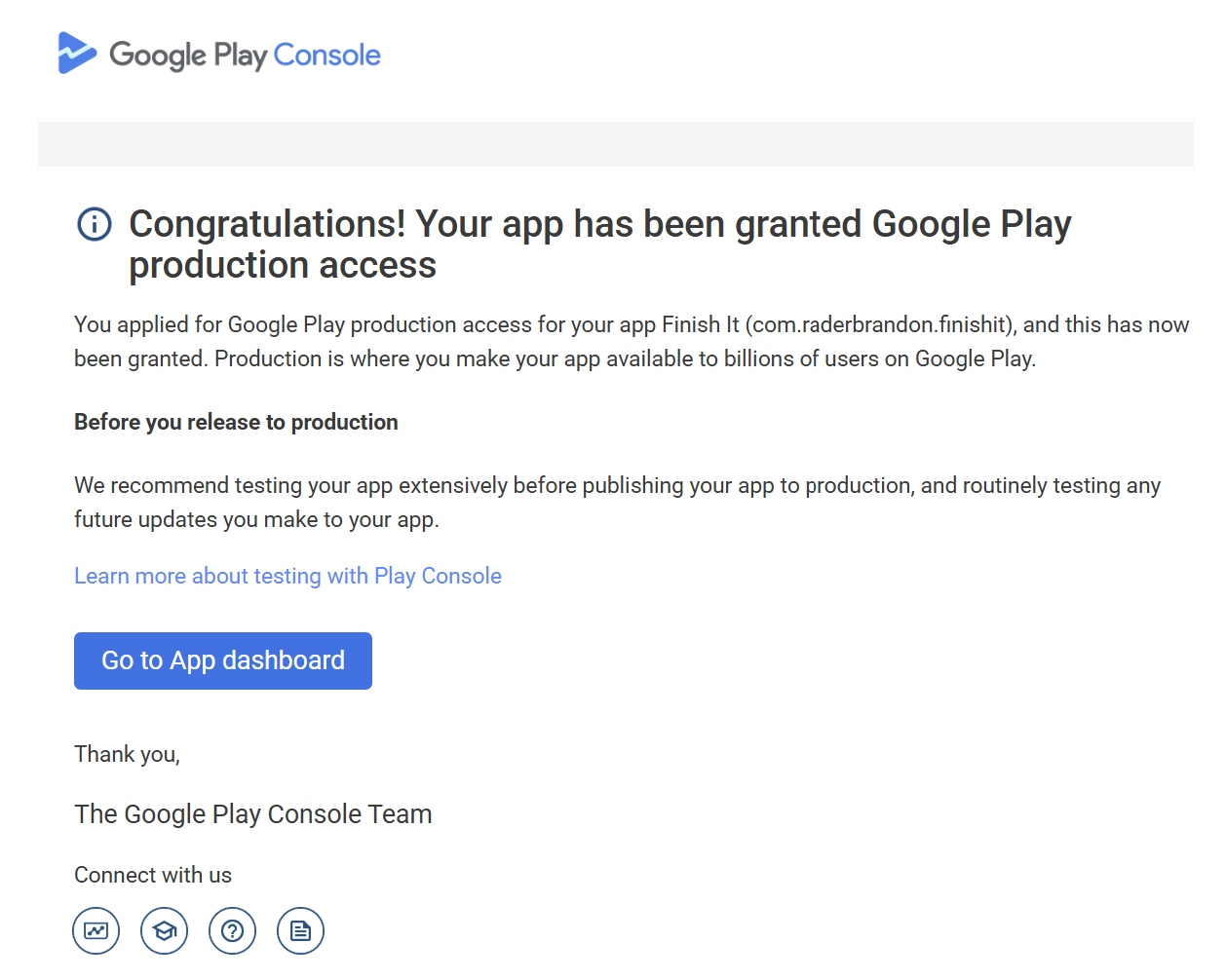
Verified Production Access
Quality QA Testing Reports
Clear, actionable reports with screenshots and evidence for every important issue found during testing.
Real Device Testing & Diagnostics
Real human testers use physical Android devices to test your app, verify real user flows, and provide clear testing evidence and professional QA reports.
Guaranteed App Approval
Get your Android build approved on the first try. We create an audit-ready compliance profile that proves thorough quality assurance.
Affordable Compliance Cycles
Transparent plans built to satisfy Google Play Console guidelines for your Android build.
Loading Packages
Please wait while we fetch the best options for your region...
Frequently Asked Questions
Everything you need to know about passing your closed testing requirements.