Play Store testers for 14-day Android app testing in Ecuador
Hire Play Store testers in Ecuador for Google Play closed testing. Secure your Play Console approval quickly with real 12 testers for 14 days.
Ecuador is quickly becoming a hot spot for mobile app innovation in Latin America, but getting your app onto the Google Play Store is no longer as simple as clicking a button. Nestled right on the equator, this country has a rapidly expanding digital economy. If you want your app to thrive here, you have to play by Google's strict new rules. Recently, Google introduced a rigorous requirement for new developers: you must run a thorough test phase before going public. It sounds like a headache, but it is actually a smart move to make sure your app works perfectly on local networks like Claro or Movistar. To get the green light, you need real people testing your app continuously. This is where finding reliable Google Play Closed Testing participants in Ecuador becomes a huge hurdle for many independent creators.
Why Real Ecuadorian Testers Matter
Google wants to see authentic engagement, not just ghost accounts downloading your app and doing nothing. When you set up your Play Store Closed Testing, the algorithm monitors how testers interact with your app. Are they opening it daily? Are they navigating through the menus? If your testers are sitting in a totally different timezone or using automated scripts, Google's systems will catch it. You need real Ecuadorian users because they provide local context. They will experience your app on the exact devices and cellular networks your future customers will use. Plus, if Google notices suspicious activity, they might reject your production access, sending you back to square one.
Authentic Testing
Real users in Ecuador mean authentic feedback. These testers download your app on their personal Android phones, use it in real life situations, and provide the usage data Google requires. They help you meet the criteria naturally, ensuring your Play Console dashboard shows active, daily engagement. This organic interaction is exactly what the review team looks for before approving your app for production.
Bot Farms & Fake Accounts
Using automated bots or emulator farms is a massive risk. Google's systems are incredibly smart and can easily detect when testing data is being spoofed. Bots do not tap screens like humans, they do not use varying IP addresses across local Ecuadorian cities, and they certainly do not leave helpful feedback. Relying on fake testing services often leads to delayed approvals or even account suspensions.
The Challenge of Meeting Google's Demands
Many developers are surprised when they read the fine print in the Play Console. The rules are strict and the timeline is unforgiving. You might see outdated advice online talking about needing 12 Testers for 14 Days, but the current mandate for personal developer accounts is even more demanding. You have to gather a dedicated group to opt in and actively test your application for two full weeks.
Finding this group on your own in Ecuador can feel like a full time job. You might ask friends, family, or coworkers, but keeping them engaged for 14 straight days is tough. People get busy, they forget to open the app, or they uninstall it to save space on their phones. If even a few people drop out or stop engaging, your testing phase could be marked as incomplete, forcing you to start the clock all over again. Developers who try to shortcut this step often find themselves frustrated and delayed by weeks or even months. The persistence required to keep a group of people opening an unfinished app every single day is substantial, which is why having a streamlined strategy is so critical.
Struggling with the 14-Day Testing Requirement?
Skip the hassle of recruiting unreliable testers. Our professional fleet of real Android devices guarantees Google Play compliance in exactly 14 days. Zero bots. Zero emulators. 100% production approval guarantee.
Comparing Your Testing Options
When you are ready to start your Closed Testing phase, you generally have three paths. You can do it yourself, hire a professional service, or take a risky gamble on cheap bot traffic. Let us break down how these options compare so you can make the best choice for your app's future.
| Feature | Professional Service | DIY (Friends & Family) | Bot Farms |
|---|---|---|---|
| User Authenticity | 100% Real Devices | Real Devices | Emulators/Fake IPs |
| Daily Engagement | Guaranteed for 14 days | Highly unreliable | Automated/Flagged |
| Play Console Compliance | Meets all Google policies | Often falls short | Extremely high risk |
| Local Ecuadorian IPs | Yes, locally sourced | Yes, if they live there | Spoofed via VPNs |
| Effort Required | Minimal, hands off | High, constant nagging | Low, but dangerous |
| Approval Success Rate | Very High | Moderate | Very Low |
| Actionable Feedback | Detailed and useful | Vague or non-existent | None whatsoever |
| Time to Market | Fast and predictable | Slow and uncertain | Indefinitely delayed |
The Step by Step Testing Roadmap
Navigating the Google Play Console can be confusing, especially if this is your first app launch. Ensuring every setting is perfectly configured is essential for a smooth rollout in Ecuador. Here is a clear, step by step roadmap to get your app tested and approved without the usual headaches.
Prepare Your App Release
First, ensure your app is fully functional and free of major bugs. You need to upload your Android App Bundle (AAB) to the Play Console and fill out all the necessary store listing details, including your privacy policy and content ratings. This step forms the foundation of your Google Play presence.
Set Up the Closed Track
Navigate to the testing section in your Play Console and create a new closed testing release. You will need to add the email addresses of your testers to the approved list. If you are using a professional service, they will provide this list of verified Ecuadorian testers for you, saving you a massive amount of time.
Start the 14-Day Clock
Once your app is reviewed and approved for the closed track, your testers can download it. The 14 day period officially begins when they opt in and install the app. During this time, they need to actively use the application, tapping through menus and generating real usage data on their local devices.
Monitor Daily Engagement
Keep an eye on your Play Console dashboard. You want to see consistent daily active users. If you partnered with a reliable testing team, you can relax knowing they are handling the daily engagement requirements. If you went the DIY route, this is the time to start messaging your friends to remind them to open the app.
Gather and Apply Feedback
Testing is not just about keeping the app open, it is about finding flaws. Collect feedback from your testers regarding UI issues, crashes, or confusing navigation. Make adjustments to your code if necessary. Google likes to see that you are actively responding to user input during this phase.
Apply for Production
After 14 days of successful, continuous testing, the Play Console will unlock the option to apply for production access. You will answer a few questions about how you gathered feedback and what changes you made. With a solid testing phase behind you, approval is usually just around the corner, opening the door to the entire Ecuadorian market.
Essential Pre-Launch Checklist
Before you add a single tester, make sure your app and console are completely ready. Missing a small detail can delay your entire launch timeline, frustrating both you and your potential users. Use this comprehensive checklist to ensure you are fully prepared for your Play Store Closed Testing phase.
Play Console Configuration
App Quality and Stability
Tester Management
Frequently Asked Questions
Understanding Google's intricate testing rules can be incredibly tricky, especially with policies changing frequently. Here are some of the most common, detailed questions developers have when trying to launch their apps successfully in Ecuador.
Why did Google introduce these strict testing rules for new developers?
Google introduced these rigorous rules to drastically improve the overall quality of apps on the Android platform. By requiring a robust testing phase with real users, they weed out low effort, spammy, or broken applications before they ever reach the public store. This builds trust with end users and ensures that developers are serious about maintaining their software over the long term. It essentially acts as a quality filter to keep the Play Store reliable.
Can I just use a VPN to pretend my testers are located in Ecuador?
No, this is highly discouraged and incredibly dangerous for your developer account. Google's systems are extremely sophisticated and can easily detect commercial VPNs, proxies, and data center IP addresses. If they catch you spoofing locations to manipulate your testing data, they can, and often will, suspend your developer account entirely. It is always better to use real, local users living in Ecuador to provide genuine network data.
What exactly happens if a tester uninstalls the app before the 14 days are completely over?
If testers uninstall the app or simply stop engaging with it daily, Google's automated systems may determine that your testing phase was unsuccessful. The core requirement is continuous, active engagement for the entire duration. If your active user numbers drop below the required threshold, you will likely be forced to recruit new people, reset the tracker, and restart the entire 14 day testing period from day one.
I read somewhere on an old forum that I only need 12 Testers for 14 Days. Is that true today?
No, that is outdated information that frequently misleads new developers. While some older forums or guides might mention needing 12 Testers for 14 Days, Google's official policy for personal developer accounts created after November 2023 clearly states you need a minimum of 20 unique testers opted in for 14 consecutive days. Always follow the most current Play Console guidelines to avoid frustrating rejections.
How do professional closed testing services actually work behind the scenes?
Professional services manage a large, vetted network of real people with real Android devices. When you hire them, they assign actual users from their pool to opt into your closed track, download your app, and interact with it daily. They manage all the complex logistics, ensure consistent engagement across the 14 days, and provide the authentic data Google requires for approval, saving you massive amounts of time.
What specific kind of feedback does Google expect me to collect from my testers?
Google wants to see that you are actively improving your app based on actual user experience. While they do not have a human read every single message between you and your testers, they do ask you to thoroughly summarize the feedback you received when you apply for production access. You should be prepared to explain what bugs were found, what features you tweaked, and how the app improved during the testing window.
Is it fundamentally harder to get an app approved in Ecuador compared to other regions?
The core testing requirements and technical thresholds are exactly the same globally. However, having local testers in Ecuador ensures that your app functions properly on regional telecom networks and correctly handles local currency or language nuances if applicable. Local testing provides a vastly superior end product, even if the Google approval process is standardized worldwide.
Am I allowed to update my app while the closed testing phase is actively running?
Yes, you can absolutely push updates to your closed testing track, and it is actually highly encouraged if you find critical bugs that need fixing. Releasing an update shows Google that you are actively maintaining the app and responding to user feedback. However, making an update does not restart your 14 day clock, as long as your active testers install the new update and continue engaging with the app daily.
How long does the final production review take after I finish the 14 days?
Once you complete the rigorous 14 days and submit your detailed application for production, Google's internal review team takes over. This final manual review process can take anywhere from a few days to over a week, depending on their backlog. To avoid unnecessary delays, ensure your application details are thorough, honest, and clearly outline the testing process you followed.
Do I need to pay the testers myself if I find them independently?
If you are sourcing testers on your own through friends, family, or local community boards in Ecuador, payment is entirely up to your personal arrangement with them. However, offering a small incentive is often the only reliable way to ensure they actually open the app every single day for two weeks. Professional services roll tester compensation into their flat fee, simplifying the process for you.
What should I do if my application for production access gets rejected by Google?
If your application is rejected, Google will usually provide a specific reason in the Play Console or via email. Often, it is due to a lack of genuine daily engagement or insufficient feedback collection during the test. You will need to address the specific issues they highlight, which typically involves recruiting a new, more reliable batch of testers and running the 14 day testing cycle again.
Can I run closed testing on multiple apps at the exact same time?
Yes, there is no limit to the number of apps you can have in the closed testing phase simultaneously within your Play Console account. However, keep in mind that each individual app requires its own distinct group of 20 active testers engaging with it daily. Managing multiple testing phases concurrently can be incredibly resource intensive if you are doing it without a professional service.
Does the testing phase impact my App Store Optimization (ASO) or public ranking?
The closed testing phase itself does not directly impact your public search ranking or App Store Optimization because your app is not yet publicly visible. However, the feedback you gather during this time allows you to refine your app's performance, fix crashes, and polish the user interface. A more stable app at launch will lead to better public reviews later, which absolutely boosts your long term ASO.
Will Google know if I use an automated script to open the app on my computer?
Yes, Google's fraud detection algorithms are deeply integrated into the Android operating system. They track incredibly granular data points like battery drain patterns, touch input randomness, IP address history, and sensor data. An automated script running on an emulator behaves completely differently than a human holding a phone. Using scripts is a guaranteed way to get flagged and potentially banned from the developer program entirely.
Is it necessary for my testers to leave written reviews on the Play Store during testing?
During the closed testing phase, testers can leave private feedback directly through the Play Store interface, which only you can see in the Play Console. These reviews do not become public when your app launches. While private reviews are helpful for gathering feedback, the most critical metric Google tracks is the silent, daily usage and engagement data generated by the app running on their devices.
Our QA Process
A straightforward 4-step process to get your Android app approved.
Choose Package
Connect your Google account and choose your preferred closed testing package for your Android app.
Submit Link
Share your Play Store opt-in URL. We immediately deploy 12 real testers to launch and review your Android app daily.
Active Testing
Our crew initiates daily launch sessions on physical devices, verifying usability and logging crashes for your Android app.
Get Approved
We continuously perform closed app testing for 14 days to help you meet Google Play production requirements. We also provide a compliance report.
The Premium QA Advantage
Deploy your Android app onto real retail-grade handsets using our secure laboratory environment.
The 14-Day Production Guarantee
We complete the required 14-day closed testing process with real human testers and physical Android devices, while providing clear testing evidence and documentation throughout the process.
If Google specifically rejects production access due to insufficient testing engagement, you are covered by our free re-run or 100% refund guarantee, subject to our Refund Policy.
Verified Production Access
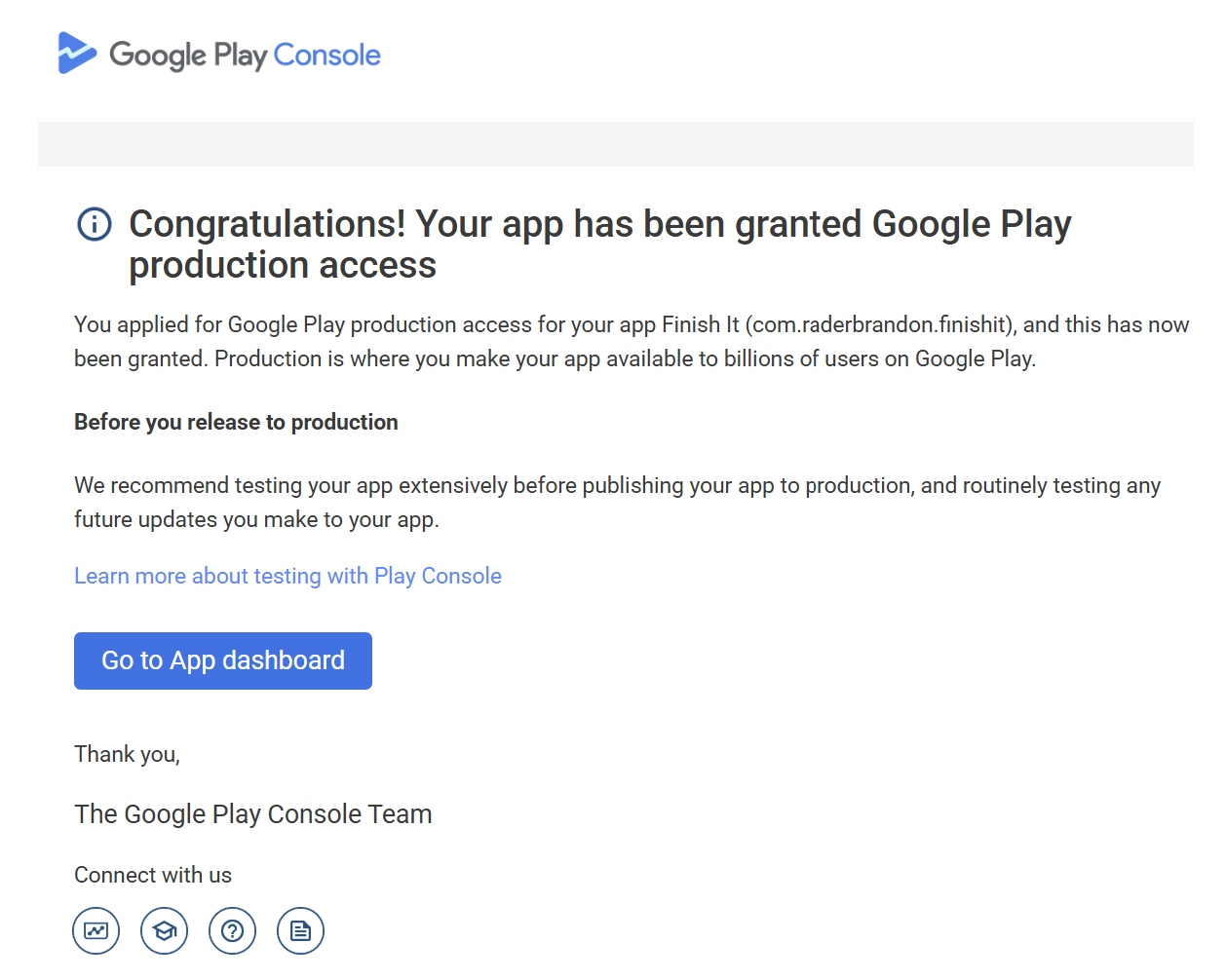
Quality QA Testing Reports
Clear, actionable reports with screenshots and evidence for every important issue found during testing.
Real Device Testing & Diagnostics
Real human testers use physical Android devices to test your app, verify real user flows, and provide clear testing evidence and professional QA reports.
Production Access Secured
Transition your Android app to public production access with confidence. We deliver verified session logs and compliant Console activity.
One Cycle. Complete Approval.
Choose the ideal closed testing cycle for your Android release.
Loading Packages
Please wait while we fetch the best options for your region...
Frequently Asked Questions
Everything you need to know about passing your closed testing requirements.