Play store testers for 14-day Android app testing in France
Secure France-based Play Store testers for Google Play closed testing. Complete the Play Console 12 testers for 14 days rule with real app testers.
Imagine you are trying to bake the perfect, flaky French croissant from scratch. You would not just throw some cheap dough into a cold oven and hope for the best. You need the right high-fat butter, the exact ambient temperature, a precise folding technique, and most importantly, someone who actually knows what an authentic croissant tastes like to tell you if you got it right. Launching an Android app in France is exactly like that baking process. You can write the cleanest, most efficient code in the world, design a beautiful interface, and build an incredible backend server. But if you do not have real people testing it in the actual environment where it will be used, your app will likely fall flat the moment it goes public.
Google knows this reality all too well, which is why they introduced incredibly strict new rules for releasing applications. If you want to get your app onto the Play Store today, you cannot just click the "publish" button and wait for the money to roll in. You have to pass the rigorous Google Play Closed Testing phase. This means you need a dedicated group of real, engaged testers to use your app for two straight weeks. It is not just about checking boxes on a digital form; it is about proving to Google that your app brings genuine value, stability, and safety to actual human beings.
For many indie developers and small startups, finding these reliable testers is the absolute hardest part of the entire development lifecycle. You might have seen frustrated developers on forums searching desperately for "12 Testers for 14 Days" online, trying to scrape together anyone they can find just to meet the bare minimum requirements. But when your specific target market is France, just grabbing random people from across the globe will not cut it. You need real users who understand the local culture, the nuanced language differences, and the high expectations of the French consumer market.
In this comprehensive guide, we are going to walk you through everything you need to know about Play Store Closed Testing, why authentic feedback is the only way to succeed, and exactly how to get your app ready for its big, successful debut in the European market.
What Exactly is Google Play Closed Testing?
Let us take a step back and break down what Google is actually asking you to do, and why they are asking you to do it. The Google Play Closed Testing requirement is a mandatory, unavoidable step for all new personal developer accounts created after late 2023. Before you can even apply for production access (which is the status that means anyone in the world can search for and download your app), you have to successfully run and complete a closed test.
The rule sounds simple enough on paper but it is notoriously tough in practice: you must have a minimum of 20 testers opted-in to your closed test, and they must test your app continuously for 14 days. During this two-week marathon, these testers cannot just download the app and forget about it. They should be actively opening the application on different days, clicking around through your menus, trying out various features, finding hidden bugs, and experiencing the app just like a normal, everyday user would.
Why did Google decide to implement such a strict roadblock? The answer is simple: the Play Store was getting completely flooded with low-quality, broken, and sometimes maliciously harmful apps. By forcing developers to go through this mandatory 14-day testing period, Google acts as a strict bouncer at an exclusive club. They are actively keeping the junk out, raising the overall quality of the ecosystem, and making sure only well-tested, high-quality apps make it inside to their users.
When you run a proper Closed Testing phase, you are gathering essential, life-saving data for your app. Does your app immediately crash when someone tries to create an account using a specific email provider? Does the text look weird and misaligned on a specific Samsung Galaxy device that happens to be super popular in Paris right now? Does the battery drain excessively when the app runs in the background? This two-week window is your golden opportunity to catch those embarrassing, critical mistakes in private, long before they can ruin your public rating and destroy your launch momentum.
The Danger of Taking Shortcuts: Real vs. Fake Testing
When faced with the massive challenge of finding 20 reliable testers, some developers understandably panic. They go to sketchy internet forums, dark web marketplaces, or shady social media groups and buy "guaranteed" testing services that use automated bots, emulators, or overseas click-farms. Let us be incredibly clear: this is the fastest, most surefire way to get your entire Google developer account banned permanently.
Google’s detection systems are incredibly smart and constantly evolving. They meticulously track device IDs, IP addresses, geographic locations, usage patterns, screen tapping behavior, and deep engagement metrics. If their algorithm sees 20 "users" all logging in at the exact same time every day, scrolling for exactly ten seconds without ever clicking a secondary button, and then logging out, they know instantly that it is a fake test.
Here is a detailed look at why real users will always win against the bots, and why trying to cheat the system is a recipe for disaster.
Genuine Human Testers
Real people bring chaotic, unpredictable, and highly valuable behavior to your app. They will click buttons in the wrong order, misunderstand your complex menus, swipe when they should tap, and try to use your app while riding the Paris Metro with a terribly spotty internet connection. This real-world chaos is exactly what you want!
When you use genuine human testers for your Play Store Closed Testing, Google's analytics see organic, healthy engagement. They see a diverse range of physical devices, varying session lengths (sometimes 2 minutes, sometimes 20 minutes), and real crash reports generated by actual human error. More importantly, real users give you actual, written feedback you can read and understand. They will explicitly tell you if your French translation sounds like a robot wrote it, or if your checkout process is way too confusing for a normal person to navigate.
Automated Bots & Click Farms
Bots do not care about your app's success or failure. They are simply programmed scripts running on virtual machines, or they are operated by a wall of hundreds of old, cheap phones sitting in a basement halfway across the world. They do not read your carefully crafted text, they do not understand your innovative features, and they definitely do not care if your app is actually good or bad.
When you intentionally use bots to try and cheat the 14-day testing requirement, you are playing a very dangerous game with your livelihood. Google's machine learning algorithms are specifically designed to spot this artificial, rigid behavior. If you get caught (and you likely will), your app will be rejected without appeal, and your entire developer account could be suspended forever. Even if you somehow magically slip past Google's automated defenses, you will be launching an app that has never been touched by a real human, leading to immediate crashes and devastating 1-star reviews from your very first real customers.
Why Your Testers Must Match Your Market
If you are dedicating your time and money to launching an app designed specifically for people living in France, it makes absolutely zero sense to have it tested by people who have never set foot in the country and do not speak a word of the language. Localization is vastly more complex than just plugging your English text into Google Translate and hoping it makes sense; it is about deep cultural context and understanding user expectations.
For example, French mobile users have extremely specific expectations when it comes to digital privacy, user tracking, and data protection, heavily influenced by the strict regulations of the GDPR and the local CNIL authority. They expect transparent cookie banners and clear explanations of why you need their camera permissions. They also have ingrained preferences for how dates are formatted (DD/MM/YYYY), how currency is displayed (placing the Euro symbol after the number, like 10,50 €), and even the tone of voice used in the app. Using the informal "tu" instead of the formal "vous" in a banking app, for instance, would completely alienate a French user.
When you invest in real Play Store testers for 14-day Android app testing in France, you are getting a comprehensive cultural audit right alongside your technical one. Local testers will catch things that you, sitting in an office thousands of miles away, might have completely missed. They will let you know if a phrase sounds too colloquial, if a specific feature just does not align with their daily habits, or if your app's color scheme culturally signifies something you did not intend. This localized feedback is the difference between an app that just exists, and an app that truly resonates and succeeds.
Struggling with the 14-Day Testing Requirement?
Skip the hassle of recruiting unreliable testers. Our professional fleet of real Android devices guarantees Google Play compliance in exactly 14 days. Zero bots. Zero emulators. 100% production approval guarantee.
Comparing Your Testing Options
When you are finally ready to start your Closed Testing phase, you generally have three distinct paths you can take to reach the finish line. You can try to do it all yourself by begging friends, you can use a dedicated professional service, or you can risk your entire business on cheap bots. Let us compare these options side-by-side so you can see exactly why doing it the right way is worth the investment.
| Feature | Professional Service | DIY (Friends & Family) | Bot Farms |
|---|---|---|---|
| Account Safety & Security | High (100% compliant with Google) | High (Safe, but risky for compliance) | Extremely Low (High risk of permanent ban) |
| Developer Effort Required | Minimal (You focus on coding) | Very High (Constantly chasing people) | Minimal (But stressful) |
| Quality of Feedback | Detailed, actionable, and objective | Biased, overly polite, usually unhelpful | Absolutely none |
| Market Relevance | Targeted (e.g., Real users in France) | Random / Limited to your immediate circle | Random / Spoofed IP addresses |
| 14-Day Consistency | Guaranteed daily usage and engagement | High failure rate; people forget to log in | Artificial, easily flagged by Google |
| App Store Success Odds | High probability of approval | Medium probability of approval | Near zero probability |
As you can clearly see from the breakdown, relying on your friends, family, and coworkers is an uphill battle. They love you, so they will tell you the app is great even when it crashes every five minutes. Plus, getting 20 people you personally know to remember to open your specific app every single day for two straight weeks is like trying to herd cats. A professional service takes all of that stress off your shoulders, guaranteeing the necessary numbers, the required engagement, and the high-quality feedback, keeping your account entirely safe and compliant.
Pre-Launch Preparation: Getting Ready for Testers
Before you send out a single invite link or allow a tester into your application, you need to make absolutely sure your digital house is in order. You only get one chance to make a strong first impression, even when you are just running a beta test. If your app is completely broken, confusing, or unappealing on day one, testers will get instantly frustrated and stop using it, which completely ruins your required 14-day continuous engagement streak.
Here is a comprehensive checklist to ensure you are fully prepared and optimized for your Google Play Closed Testing phase.
App Foundation & Core Stability
Check for obvious crash loops. Do not just test the "happy path." Open the app, navigate through every single obscure menu, turn off your wifi mid-load, and try to actively break the app yourself before you give it to anyone else.
Ensure the core function actually works perfectly. If it is a messaging app, the messages must send and receive instantly. If it is a mobile game, the tutorial and first level must be fully playable without glitching. Do not ask people to test an empty, broken shell.
Optimize your overall app size. French users, like users anywhere, will not want to download a massive 500MB file just to test a simple utility app. Compress your heavy images, remove unused assets, and clean up your code.
Deep Localization for France
Verify all translations with a human. Do not rely solely on automated tools like Google Translate or basic AI prompts. Have a native French speaker thoroughly check the main screens for proper context, tone, and slang.
Format dates, times, and numbers correctly. Remember that France uses a comma for decimals, spaces for thousands (e.g., 1 000,50 €), and the 24-hour clock system is heavily preferred in digital interfaces.
Check all European legal requirements. Ensure your privacy policy is easily accessible, clearly written, and fully complies with strict European data laws before you collect any user information.
Play Console & Listing Setup
Fill out your entire store listing completely. Do not leave placeholder text. Add a high-quality icon, clear and descriptive screenshots showing the UI, and a compelling, well-written description in perfect French.
Set up your valid privacy policy URL in the Google Play Console. This is a strict, mandatory requirement before Google will allow you to start any form of testing track.
Complete the mandatory content rating questionnaire honestly and accurately to avoid sudden app removals or age-restriction penalties later on down the line.
The Structured Journey to the Play Store
So, how does this whole intimidating process actually work from start to finish? It is not just about blindly flipping a switch and hoping Google approves you. It is a highly structured, multi-step journey that requires patience, communication, and extreme attention to detail. Here is the exact roadmap you will follow to get your app off of your local computer and into the hands of eager users all across France.
Step 1: Internal Testing & Console Setup
Before the 14-day clock even begins to tick, you must successfully upload your signed app bundle (AAB) directly to the Google Play Console. You should run a quick, private internal test with just yourself and your co-founders to make sure the download works, the app boots up properly, and the fundamental architecture is sound. You finalize your public store listing and make sure all the boring but essential legal and policy boxes are fully checked.
Step 2: Recruiting and Onboarding Your Testers
This is where you gather your crucial audience. Because you are targeting the French market, you need real, verified users based physically in France with active, healthy Google accounts. You carefully add their specific email addresses to your designated testing track in the console and send them the official opt-in link so they can download the app safely.
Step 3: The 14-Day Testing Marathon
The critical clock starts right now. For the next two consecutive weeks, your testers need to actively engage with your app on a daily or near-daily basis. They should be purposefully testing different features, actively looking for visual bugs or logic errors, and providing written feedback. You must monitor this phase closely from your dashboard, responding quickly to any massive crash reports and preparing minor update patches if absolutely necessary.
Step 4: Gathering, Analyzing, and Applying Feedback
As the grueling 14 days finally wrap up, you collect all the valuable insights you have earned. What specific UI elements did the French users hate? What new features did they absolutely love? Did they find a game-breaking bug on a specific Xiaomi device? You take this raw feedback, sit down at your keyboard, fix the documented issues, and build a significantly better, more stable version of your app.
Step 5: Applying for Official Production Access
Once the 14 days are successfully completed and you have demonstrably addressed the user feedback by updating your app, you fill out the detailed application for production access inside the Play Console. Google's review team will manually look over your testing data, read exactly how you responded to the user feedback, verify that the engagement was real, and make their final decision.
Step 6: The Grand Public Launch
Congratulations! Google has officially approved your application. You can now confidently move your release track over to production. Your app is now live on the Google Play Store, completely searchable, and ready to be downloaded by millions of potential new users across France and the rest of the world.
The Real, Hidden Value of the 14-Day Test
A lot of stressed-out developers look at the Play Store Closed Testing requirement as nothing more than a massive, unnecessary headache. They view it as a frustrating hurdle that Google arbitrarily put in their way just to slow down their launch timeline. But if you take a step back and shift your perspective, this mandatory 14-day period is actually one of the greatest gifts a developer can receive.
Think about the alternative: when you launch an application blindly without testing it properly, the very first people who find your embarrassing bugs are your actual, paying customers. They will not take the time to send you a polite, detailed email telling you how to fix the code. They will just immediately uninstall the app and leave a devastating one-star review that says, "This app is total garbage, it crashes every single time I try to log in, do not download." Once you get a few of those brutal reviews early on, your app's algorithm ranking is basically dead in the water. No one wants to download a one-star app.
The 14-day closed test gives you a highly secure, safe sandbox to play in. It allows you to make your biggest, most embarrassing mistakes in total privacy. Your testers are specifically there to help you improve, not to harshly judge you on the public stage. When a tester finds a critical bug, it is a massive victory, because it means one less real customer will ever have to experience that bug in the real world.
Furthermore, when you focus specifically on acquiring testers in France, you are fine-tuning your product for that specific demographic. You are learning exactly what visual aesthetics they prefer, what specific wording makes them trust your brand with their data, and what features they actually use versus what they ignore. By the time you finally hit that big red "Publish" button, you are not just guessing anymore. You know for a fact that your app is good because real, representative people have already shown you that it is good.
Don't Let Your Hard Work Go to Waste
You have likely spent months, maybe even years, learning complex coding languages, designing intuitive user interfaces, and building your dream application from the ground up. You have poured your heart, your soul, and your late nights into this project. Do not let all of that incredible hard work go to waste just because you tried to cut a few corners at the very end of the race.
The strict requirement for Play Store testers for 14-day Android app testing in France is not going away anytime soon. If anything, Google is only getting stricter and more vigilant with their quality control measures. The absolute best thing you can do for the long-term health of your app, and for your own peace of mind, is to fully embrace the testing process.
Find real, engaged users. Listen carefully to their honest feedback. Fix the bugs they take the time to find. It certainly takes a little more time, and it definitely takes a little more effort than buying a bot script, but the financial and reputational payoff is massive. A stable, culturally localized, well-tested app will get significantly better reviews, rank much higher in the store's search results, and ultimately make you a lot more money in the long run.
Frequently Asked Questions
Navigating the complexities of the Google Play Console can be incredibly confusing for both new and veteran developers alike. Here are some of the most common questions we hear regarding the rigorous closed testing process.
Can I just use my personal friends and family for the 14-day test?
Technically speaking, yes. If you can actually find 20 reliable friends with Android phones who are genuinely willing to use your app every single day for 14 days, you can use them. However, most developers quickly find that friends forget to log in after day three, and they rarely provide honest, critical feedback because they do not want to hurt your feelings. Using a professional service ensures guaranteed engagement and objective critiques.
What actually happens if a tester forgets and misses a day during the 14-day period?
Google explicitly requires continuous, uninterrupted testing. If multiple testers drop off, lose interest, or simply stop opening the app for days at a time, Google's automated systems may flag the test as insufficient and reject your production application. This is exactly why having dedicated, financially motivated, or highly reliable testers is absolutely critical to successfully passing the review phase on the first try.
I read something online about a '12 Testers for 14 Days' rule, is that true or accurate?
The current, firmly established standard requirement from Google for all new personal developer accounts is a minimum of 20 testers for 14 days. You may frequently see older blog articles, outdated forum posts, or highly specific enterprise edge cases mentioning different numbers like "12 Testers for 14 Days", but you should always plan, prepare, and execute your strategy to secure at least 20 active participants to ensure 100% full compliance with Google's current terms of service.
Do all of my chosen testers strictly have to be located inside France?
If your app is specifically targeting the French consumer market, utilizing localized testing is highly recommended for the best possible results. While Google technically accepts valid testers from anywhere in the world, having actual local users ensures that your app functions correctly on regional cellular networks, complies with local data expectations, and that your French translations make perfect sense in cultural context.
What happens next if Google reviews my app and rejects my production application after the test?
If you unfortunately get rejected after the 14 days, Google will usually provide a generalized reason in your Play Console dashboard. Often, it is because their algorithm did not see enough genuine, varied engagement during the test period, or because your app still contains obvious, critical bugs that you failed to fix. You will need to carefully address the cited issues, gather your testers again, run another full 14-day Closed Testing phase from scratch, and then reapply.
Our QA Process
Your journey to Google Play production access, simplified and automated.
Choose Package
Authenticate your account to initialize the 14-day QA fleet for your Android release.
Submit Link
Upload your testing link. We assign 12 verified users with real Android devices to download and test your Android release.
Active Testing
A dedicated testing supervisor is assigned to monitor progress while testers engage with your Android app and provide feedback throughout the testing period.
Get Approved
Our lab maintains active installations for two weeks straight, ensuring a clean track record and providing a QA compliance log for your release.
The Premium QA Advantage
Satisfy your Play Store Console testing obligations with our managed physical device fleet tailored for Android builds.
The 14-Day Production Guarantee
We complete the required 14-day closed testing process with real human testers and physical Android devices, while providing clear testing evidence and documentation throughout the process.
If Google specifically rejects production access due to insufficient testing engagement, you are covered by our free re-run or 100% refund guarantee, subject to our Refund Policy.
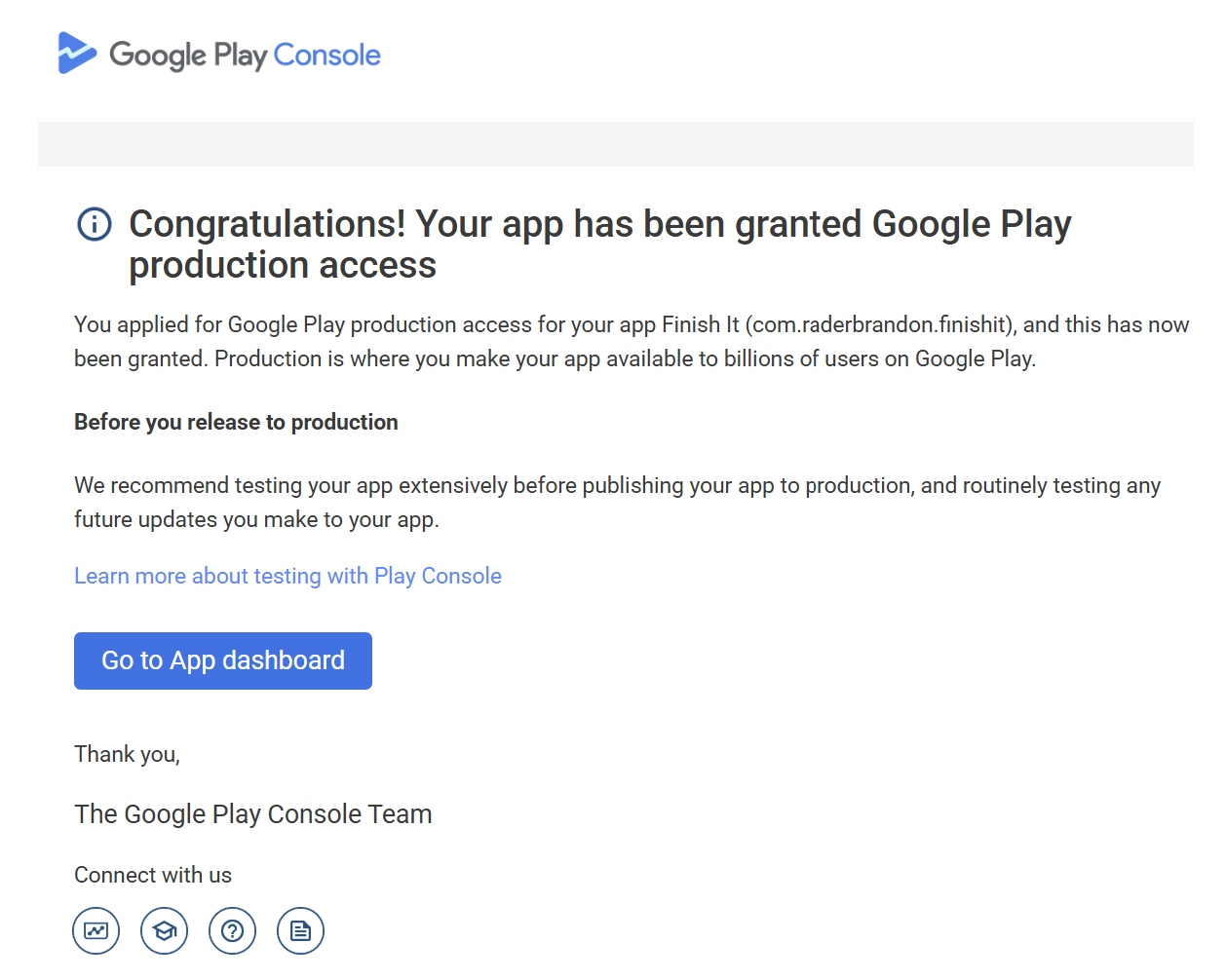
Verified Production Access
Quality QA Testing Reports
Clear, actionable reports with screenshots and evidence for every important issue found during testing.
Real Device Testing & Diagnostics
Real human testers use physical Android devices to test your app, verify real user flows, and provide clear testing evidence and professional QA reports.
Production Access Secured
Our structured 14-day closed testing process is designed to meet Google Play's production requirements for your Android release.
Simple Closed Testing Pricing
Select the plan that fits your Android app complexity.
Loading Packages
Please wait while we fetch the best options for your region...
Frequently Asked Questions
Everything you need to know about passing your closed testing requirements.