Play Store testers for 14-day Android app testing in France
Find real Play Store testers in France for Play Console closed testing. Fulfill the 12 testers for 14 days policy with trusted Google Play testers.
Picture this: you have spent the last eight months pouring your heart and soul into a brand-new Android app. The design is sleek, the code is bug-free, and you are finally ready to introduce it to the world. But there is a massive roadblock standing in your way. If you want to launch on the Play Store today, you cannot just click a button and go live. Google has introduced a mandatory hurdle that is tripping up developers left and right. You need real people to test your app, and if you are targeting the French market, finding the right Play Store testers for 14-day Android app testing in France is an absolute necessity.
Why is this so specific? The French mobile app market is uniquely demanding. French users expect high-quality localization, intuitive user interfaces, and flawless performance. If your app feels like a cheap translation or if it crashes on a local network, French users will not hesitate to uninstall it. But before you even get to worry about user retention, you have to get past Google's strict gatekeepers. The Google Play Closed Testing policy requires you to have a dedicated group of testers actively engaged with your app for two straight weeks.
Many developers think they can just ask a few friends or family members to download their app. While that might work for a tiny hobby project, it is a recipe for disaster if you are serious about your launch. Your friends will probably open the app once, say "Looks great!", and never open it again. Google's algorithms are smart. They track engagement, session length, and actual usage during this testing phase. If they see that your testers are not really using the app, your production access application will be rejected. This is why you need a structured, professional approach to Play Store Closed Testing.
Let's dive deep into exactly what it takes to conquer this challenge, why you need real French testers, and how you can guarantee your app gets approved on the very first try.
Real Local Feedback vs. The Dangerous Bot Farm Trap
When faced with the daunting task of finding testers, many developers panic. They head over to shady freelance websites and see offers promising "100 testers for five dollars." It sounds too good to be true, and that is because it is. These services use automated bots or click-farms to simulate downloads. Buying fake testers is the quickest way to get your Google Developer account permanently banned.
Authentic French Testers
Genuine Engagement: Real testers in France will actually open your app, navigate through its features, and use it as a normal consumer would. They generate the authentic session data that Google is looking for.
Valuable Local Insights: A real tester can tell you if your French translation feels natural or if your date formats are confusing. They provide context that no automated script ever could.
Guaranteed Compliance: When real human beings test your app from genuine devices, you are playing by Google's rules. Your chances of getting approved for production access skyrocket.
Fake Bot Farms
Zero Real Interaction: Bots just download the app and sit idle. They do not click buttons, they do not read text, and they generate zero meaningful engagement metrics.
High Risk of Account Bans: Google's fraud detection systems are incredibly advanced. If they detect that all your testers are coming from a single IP block or using emulators, your developer account is toast.
Wasted Time and Money: Even if you do not get banned, Google will reject your app at the end of the 14 days, forcing you to start the entire process all over again.
The choice is incredibly clear. If you value your time and the future of your app, you must avoid fake testing services at all costs. You need a reliable source of real people who understand your target audience and will provide the metrics required to satisfy the Google Play Closed Testing requirements.
Decoding the Google Play Closed Testing Requirements
If you created your personal Google Play Developer account after November 13, 2023, you are subject to the new testing rules. Google implemented these changes to clean up the Play Store. For years, the store was flooded with low-quality, spammy, and malicious apps. By forcing developers to go through a rigorous testing phase, Google ensures that only functional, well-designed apps make it to the public.
The core rule states that you need at least 20 testers opted-in to your closed track for 14 continuous days. However, you will often hear developers talking about 12 Testers for 14 Days as a minimum baseline for certain legacy accounts or specific niche updates, but the standard remains strict. Regardless of the exact number your specific console dashboard demands, the principle is the same: consistent, daily engagement over a two-week period.
During this time, Google is monitoring several key factors:
- Opt-in Rate: Did the testers actually click the link and join the testing program on the web or via the Play Store app?
- Installation: Did they successfully download and install the app on a supported Android device?
- Retention: Did they keep the app installed for the full 14 days, or did they delete it after five minutes?
- Active Usage: Did they open the app multiple times throughout the two-week period? Did they navigate through different screens and trigger various events?
- Feedback: Did they submit any crash reports, ANRs (Application Not Responding), or private feedback through the developer console?
Furthermore, the answers you provide when applying for production access are heavily scrutinized. Google expects you to detail exactly how you collected feedback, what that feedback entailed, and what modifications were made to the app as a result. If you simply write "No bugs found, app is perfect," you are raising a massive red flag. Reviewers know that no first version of an application is completely flawless. They want to see a genuine iterative process. By having a structured testing phase with real users, you will naturally generate a long list of minor UI tweaks, performance enhancements, and usability improvements that you can proudly present in your application, proving beyond a shadow of a doubt that your testing was rigorous and legitimate.
If you are targeting users in France, having testers located in France adds an incredible layer of validity to your application. It shows Google that your app is relevant to the market you intend to serve.
Struggling with the 14-Day Testing Requirement?
Skip the hassle of recruiting unreliable testers. Our professional fleet of real Android devices guarantees Google Play compliance in exactly 14 days. Zero bots. Zero emulators. 100% production approval guarantee.
The Cultural Nuances of the French App Market
Why does it matter if your testers are in France? Let's talk about the French mobile ecosystem. France boasts one of the most mature and lucrative mobile markets in Europe. Millions of French consumers use their smartphones daily for banking, shopping, gaming, and socializing. But they are also highly critical consumers.
If your app is entirely in English, or if it uses a poorly translated version of French (often referred to as "Franglais" or machine translation), local users will immediately lose trust. A real French tester will catch these subtle errors. They will tell you if your phrasing sounds too formal (using "vous" when "tu" is more appropriate for a casual gaming app) or if your checkout process feels unfamiliar compared to standard French e-commerce practices.
Furthermore, network conditions in rural France differ from those in central Paris. A diverse group of real testers spread across the country will help you identify performance bottlenecks that you would never find testing on an emulator in your bedroom. This is why securing dedicated Play Store testers for 14-day Android app testing in France is not just a regulatory hurdle; it is a vital step in product development.
The Financial Impact of a Delayed Launch
Every day your app is stuck in testing limbo is a day you are not generating revenue, acquiring users, or building brand awareness. For startups and independent developers, cash flow is critical. If your initial closed testing phase fails because you relied on unreliable friends or got caught using fake bots, you don't just lose 14 days. You lose the time it takes to find new testers, wait for another app review, and run the 14-day cycle all over again. A single rejection can easily delay your launch by an entire month.
In a competitive market like France, timing is everything. Perhaps you built your app to capitalize on a specific seasonal event, a major sports tournament in Paris, or a new legal regulation in the EU. Missing your launch window because of a technicality in the Play Store Closed Testing process can be devastating to your business plan. Investing in a professional testing service is not just an expense; it is an insurance policy for your launch timeline. It guarantees that on day 15, you are ready to hit the "Publish" button and start your marketing campaigns with absolute confidence.
Comparing Your Testing Strategies
You have a few different paths you can take to get your app tested. Let's break down the pros and cons of each approach so you can make an informed decision for your launch.
| Feature | Professional Testing Service | DIY (Friends & Family) | Bot Farms / Cheap Gigs |
|---|---|---|---|
| Real Human Testers | Yes, verified individuals | Yes, but highly biased | No, automated scripts |
| Consistent Engagement | Yes, guaranteed by the service | Rarely, usually just one open | None at all |
| Google Policy Compliance | 100% compliant and safe | Compliant, but often fails metrics | Massive violation of policies |
| Constructive Feedback | Yes, actionable bug reports | "It looks nice!" | None |
| Time Investment Required | Very low (Service handles it) | Extremely high (Constant nagging) | Low |
| Risk of App Rejection | Nearly zero | Very high (Due to inactivity) | 100% rejection or account ban |
As you can see, trying to manage a testing group yourself is exhausting. You have to constantly remind your friends to open the app, and it strains relationships. Using a professional service that specializes in Play Store Closed Testing takes the stress off your shoulders, allowing you to focus on marketing and preparing for your big launch.
Your Comprehensive Pre-Launch Checklist
Before you invite a single tester to download your app, you must ensure that your foundation is rock solid. If you start your 14-day clock with a broken app, your testers will have a terrible experience, and you will waste valuable time. Use this comprehensive checklist to prepare.
Developer Console Configuration
App Stability and Performance
Localization and French Market Readiness
Marketing and User Acquisition Alignment
By meticulously going through this checklist, you guarantee that when your testers finally get their hands on your app, they are experiencing the best possible version of it. This leads to better engagement metrics and a smoother approval process.
The 14-Day Roadmap to Production Access
Understanding the exact sequence of events during your closed testing phase will alleviate much of the anxiety associated with launching an app. Here is your roadmap to success.
Step 1: The Alpha Release
First, you will upload your App Bundle to the Closed Testing track in the Google Play Console. You will need to wait for Google's initial review process, which can take anywhere from a few hours to a few days. Once approved, your app is officially in the closed testing phase.
Step 2: Onboarding the Testers
Next, you will add the email addresses of your testers to the designated testing list. You will then share the unique opt-in URL with them. It is crucial that every single tester clicks this link, accepts the invitation, and downloads the app directly from the Google Play Store on their Android device.
Step 3: The 14-Day Engagement Period
This is where the magic happens. Over the next two weeks, your testers must actively use the app. They should open it regularly, explore different features, and ideally, provide feedback through the Play Store's private feedback mechanism. You can monitor crash reports in your console during this time.
Step 4: Applying for Production
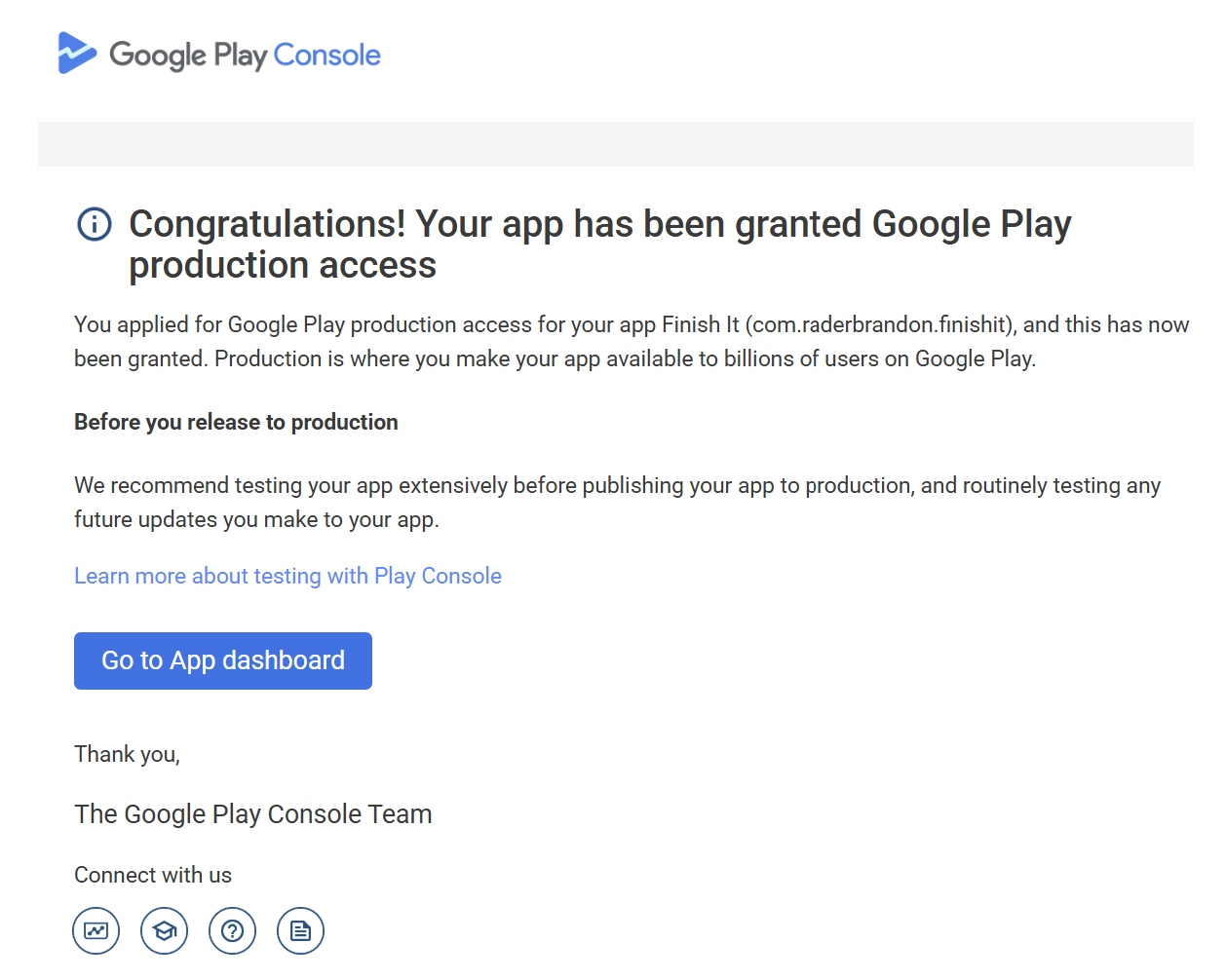
Once the 14 days have passed and the requirements are met, a button will illuminate in your Play Console dashboard allowing you to "Apply for Production." You will need to answer several questions about your testing process, the feedback you received, and the changes you made. Take this application seriously; Google manually reviews these answers.
When you partner with a premium testing service, Steps 2 and 3 are completely handled for you. You don't have to worry about whether someone forgot to open the app on day seven, because professional testers are committed to providing the exact engagement metrics Google requires.
Maximizing the Value of Your Testing Phase
The primary goal of the 14-day test is, of course, to satisfy Google's requirements and get your app published. However, savvy developers know that this period is a goldmine of information. Instead of just treating it as a bureaucratic hurdle, treat it as a vital beta test.
If your testers report that a specific screen takes too long to load, investigate it immediately. If they find the onboarding tutorial confusing, rewrite it. Every fix you implement during the closed testing phase is one less negative review you will receive when your app is publicly available.
Moreover, when you apply for production access, Google will ask you to detail the feedback you received and how you acted upon it. If you can clearly demonstrate that you listened to your testers and improved the app based on their suggestions, your chances of approval are practically guaranteed. Saying "My testers found no bugs" actually looks suspicious to Google reviewers. No app is perfect. Highlighting minor UI tweaks or bug fixes proves that your testing phase was authentic and valuable.
Why 12 Testers for 14 Days is a Myth (And What You Actually Need)
You might have seen the phrase 12 Testers for 14 Days floating around developer forums. It is important to clarify this. While some older accounts or enterprise setups might have different thresholds, the standard requirement for all new personal developer accounts is firmly set at 20 testers.
Aiming for exactly the minimum number is incredibly risky. What if one tester drops their phone in a lake? What if another suddenly loses internet access for a week? If you drop below the threshold at any point during the two weeks, your 14-day clock resets to zero. This is why professional services always provide a buffer. By recruiting 25 or 30 testers, you ensure that even if a few drop off, you will comfortably clear the minimum requirement without any stressful delays.
Final Thoughts on Conquering the French Market
Launching an Android app is an incredible achievement. It takes creativity, technical skill, and immense perseverance. Do not let the final hurdle of Closed Testing break your momentum. By understanding the rules, respecting the local culture, and choosing the right testing strategy, you can smoothly transition from development to a successful, lucrative launch in France.
Remember, the goal is not just to get on the store; it is to thrive there. High-quality testing ensures that when a French user downloads your app, they are greeted with a polished, professional, and engaging experience. Invest in proper testing today, and reap the rewards of a successful app tomorrow.
Can I use testers from outside of France if I want to launch there?
Yes, Google does not strictly mandate that your testers must reside in the country you are targeting. However, having local French testers is highly recommended because they can provide essential feedback on localization, cultural relevance, and regional network performance that international testers simply cannot offer.
What happens if a tester uninstalls the app before the 14 days are up?
If a tester uninstalls the app or opts out of the testing program, they no longer count towards your minimum required number. If your total active tester count drops below 20, the 14-day timer will pause or reset. This is why it is crucial to have a buffer of extra testers to ensure you stay above the threshold.
Do I need to update my app during the 14-day closed testing period?
It is not strictly required to push an update during the 14 days, but it is highly beneficial. Pushing a minor update to fix bugs reported by testers shows Google that you are actively maintaining the app and responding to feedback, which looks great on your final production application.
Will Google know if I use a bot farm to get testers?
Absolutely. Google has sophisticated algorithms that analyze device IDs, IP addresses, session durations, and interaction patterns. Bot farms create highly unnatural data patterns that are instantly flagged by Google's systems, leading to app rejection and potential developer account termination. Always use real human testers.
How long does it take for Google to review my application for production access?
Once you complete the 14 days of testing and submit your application for production access, the review process typically takes anywhere from a few days to a week. During this time, human reviewers will read your answers regarding the testing feedback and evaluate your app's overall quality and compliance.
Can I run open testing and closed testing at the same time?
No, for new personal developer accounts, you must successfully complete the mandatory 14-day closed testing phase and get approval for production access before you can utilize the open testing track. Closed testing is the foundational requirement that unlocks all other distribution methods on the Play Store.
Is there a difference in testing requirements for enterprise accounts vs personal accounts?
Yes. The strict 20 testers for 14 days rule primarily applies to personal developer accounts created after November 13, 2023. Enterprise or corporate accounts have different verification processes and testing thresholds, though maintaining high-quality apps remains a universal requirement across all account types.
The Testing Pipeline
A straightforward 4-step process to get your Android app approved.
Sign In
Connect your Google account and choose your preferred closed testing package for your Android app.
Opt-In URL
Share your Play Store opt-in URL. We immediately deploy 12 real testers to launch and review your Android app daily.
Testing Begins
Our crew initiates daily launch sessions on physical devices, verifying usability and logging crashes for your Android app.
Compliance Complete
We continuously perform closed app testing for 14 days to help you meet Google Play production requirements. We also provide a compliance report.
Why Developers Trust Us
Deploy your Android app onto real retail-grade handsets using our secure laboratory environment.
The 14-Day Production Guarantee
We complete the required 14-day closed testing process with real human testers and physical Android devices, while providing clear testing evidence and documentation throughout the process.
If Google specifically rejects production access due to insufficient testing engagement, you are covered by our free re-run or 100% refund guarantee, subject to our Refund Policy.
Verified Production Access
Quality QA Testing Reports
Clear, actionable reports with screenshots and evidence for every important issue found during testing.
Real Device Testing & Diagnostics
Real human testers use physical Android devices to test your app, verify real user flows, and provide clear testing evidence and professional QA reports.
Guaranteed App Approval
Transition your Android app to public production access with confidence. We deliver verified session logs and compliant Console activity.
One Cycle. Complete Approval.
Choose the ideal closed testing cycle for your Android release.
Loading Packages
Please wait while we fetch the best options for your region...
Frequently Asked Questions
Everything you need to know about passing your closed testing requirements.