Play store testers for 14-day Android app testing in Germany
Hire German Play Store testers to pass Google Play closed testing. Get 12 testers for 14 days to meet Play Console rules and launch your app quickly.
Imagine this scenario: You have just poured the last nine months of late nights, countless cups of coffee, and serious financial resources into developing what you believe is the perfect Android application. You have meticulously localized the user interface perfectly for the German market, ensured absolute compliance with strict European data privacy laws, and you are finally ready to hit that glorious "publish" button on the Google Play Console. The marketing campaign is primed, your social media teasers are live, and the anticipation is building. But then, right at the finish line, you hit a massive roadblock - a flashing, unskippable requirement from Google demanding you complete a rigorous closed testing phase before you can even think about going public.
If you are a new developer setting up a personal account, you are suddenly staring down the barrel of Google's strict quality assurance mandate. You cannot simply bypass this step. You cannot just ask your mom, your roommate, or a couple of casual friends to tap around the app for five minutes and call it a successful test. Google’s algorithms are highly sophisticated. They monitor session lengths, interaction depths, crash logs, and daily retention rates to see if your testers are genuinely engaging with your application over a sustained period. This is the unseen filter that halts the momentum of thousands of independent developers and ambitious startups every single month, leaving their projects stuck in development purgatory.
The German mobile market is incredibly lucrative but notoriously demanding. Smartphone users in vibrant tech hubs from Berlin and Munich to Hamburg and Frankfurt expect applications to be flawless, lightning-fast, and completely secure from day one. If you launch a buggy, untested app in this region, you will not just get a few bad reviews; your app will be uninstalled in seconds, permanently damaging your domain reputation and sinking your algorithmic ranking in the Play Store search results. That is exactly why Play Store Closed Testing exists - to act as a necessary gatekeeper, protecting end-users from half-baked, frustrating software experiences.
However, finding dedicated people who will actually commit to opening your app every single day, poke around the intricate menus, and deliberately try to find hidden bugs is a monumental task when you do not already have an established, loyal audience to draw from. When you are trying to conquer the DACH (Germany, Austria, Switzerland) region, you need testers who understand the cultural nuances, linguistic subtleties, and high expectations of your target demographic. Finding reliable individuals to participate in your Closed Testing phase is not just a frustrating administrative checkbox exercise; it is an absolutely critical step in refining your product for a sophisticated and wealthy European audience.
Unpacking the Infamous "12 Testers for 14 Days" Benchmark
While many developers hear vague whispers on forums about various testing requirements, the harsh reality of gathering consistent user feedback often hits like a ton of bricks. Let's talk about the specific keyword constraint many developers anxiously search for: finding 12 Testers for 14 Days. (Note: While Google's baseline rule for new personal accounts actually demands 20 testers, securing a dedicated core group of engaged individuals is the foundational challenge developers face).
When Google updated its developer policies to enforce these strict testing rules, the overarching goal was simple: raise the bar for app quality ecosystem-wide. The tech giant wants to ensure that every app hitting its digital shelves has been thoroughly vetted by real, breathing human beings rather than just passing automated compiler checks. The requirement mandates that a specific number of testers must be actively opted into your closed test track and must retain the app on their physical devices for a continuous, uninterrupted period of fourteen days.
Why exactly fourteen days? Because human behavior with software is wonderfully unpredictable. On day one, a tester might just open the app, admire the sleek login screen, and close it. By day five, they might finally try to use a core feature, like uploading a photo or submitting a form, and encounter a bizarre freezing issue. By day twelve, they might realize that leaving the app running in the background drains their battery unusually fast. A full two-week window provides enough time for users to organically integrate the app into their daily digital routines. This extended duration exposes edge cases, memory leaks, and performance bottlenecks that you simply cannot simulate in a controlled, sterile development environment.
For developers targeting Germany, the challenge is uniquely twofold. Not only do you need people to download the app, but you need them to stay engaged and active. German consumers value their digital privacy and device storage space highly. Convincing a random group of people to keep an unknown, unreleased application on their personal smartphones for two full weeks requires a massive level of trust, transparent communication, and constant coordination. If even a handful of your testers lose interest, uninstall the app on day ten to free up storage space, or fail to open it regularly, Google's dashboard will ruthlessly flag the inactivity. You could easily find yourself right back at square one, forced to recruit a new batch of testers and restart the entire fourteen-day clock from zero.
Real Humans vs. Automated Bots: The Quality Divide
In the desperate rush to bypass these strict requirements and launch as quickly as possible, many frustrated developers turn to the dark side of the internet. They seek out shady, black-hat services that promise instant testing compliance for a few dollars. These services offer fleets of automated scripts, device emulators, and bot farms designed to artificially inflate your tester count and simulate fake activity. While this might seem like a tempting shortcut to cross the finish line, it is a catastrophic mistake that can lead to permanent, career-ending consequences.
Genuine Human Testers
Real human testers bring invaluable, irreplaceable qualitative feedback to the table. When a real person in Germany tests your app, they tap with imperfect timing, they navigate confusing menus incorrectly, and they experience your app exactly how your future paying customers will. They provide actionable insights, such as "The checkout button is hard to read on smaller screens," or "The German translation in the settings menu feels unnatural and poorly phrased." This is what true Google Play Closed Testing is all about - improving the actual product before it goes live. Real users help you build a solid foundation, ensuring that your launch day is met with glowing positive reviews, high retention rates, and organic growth. They are your first true advocates.
Automated Bot Farms
Bots do not care about your user interface. They do not get frustrated by slow loading times, nor do they care if your app's core functionality is completely broken or nonsensical. A bot farm simply uses automated scripts to ping Google's servers periodically, creating a fragile illusion of activity. Google's fraud detection systems are powered by some of the most advanced machine learning algorithms on the planet. They can easily detect unnatural interaction patterns, uniform session lengths, identical device signatures, and clustered IP addresses. If you are caught using fake testers to manipulate the system, Google will summarily reject your app, permanently terminate your developer account, and ban you from the platform entirely. It is an existential risk that simply is not worth taking.
Preparing Your App for the German Market
Before you invite a single tester to evaluate your application, you must ensure that your digital house is in immaculate order. The German market is highly competitive, and first impressions matter immensely. If you present a half-finished, buggy prototype to your closed testing group, they will likely abandon the process out of sheer frustration, wasting your time and theirs. Proper preparation is the key to maximizing the immense value of your testing phase and ensuring your testers stick around for the full duration.
Localization and Cultural Fit
Technical Readiness and Stability
Legal and Privacy Compliance (Crucial for Germany)
When your application strictly meets all these detailed criteria, it confidently transitions from being a mere hobbyist project to a professional product ready for critical, real-world evaluation.
Struggling with the 14-Day Testing Requirement?
Skip the hassle of recruiting unreliable testers. Our professional fleet of real Android devices guarantees Google Play compliance in exactly 14 days. Zero bots. Zero emulators. 100% production approval guarantee.
The True Economics of App Testing: Why Doing It Yourself Fails
Many independent developers, operating on shoestring budgets, believe they can save money by managing the entire Google Play Closed Testing process themselves. They turn to social media, posting desperate pleas on Reddit, Facebook groups, Discord servers, or local tech forums, desperately hoping to find kind-hearted volunteers. However, managing human beings is incredibly time-consuming, emotionally draining, and often yields remarkably poor results. Let's break down the hidden costs of various testing approaches.
| Approach | Time Investment required | Quality of Feedback | Risk Level of Failure | Overall Reliability Rating |
|---|---|---|---|---|
| DIY / Social Media Hustle | Extremely High (Endlessly chasing people) | Very Low (Most won't respond or care) | Medium (High churn and drop-off rate) | Poor |
| Friends and Family Network | Low (Easy to ask initially) | Biased (They won't be brutally honest) | High (Often forget to open the app) | Unreliable |
| Cheap Automated Bot Services | Low (Instant setup with a credit card) | Zero (No actual human feedback provided) | Critical (Immediate account ban risk) | Disastrous |
| Professional Testing Services | Minimal (Completely handled for you) | High (Detailed, actionable bug reports) | Zero (Fully compliant with Google's terms) | Excellent |
When you try to manually manage the requirement of finding 12 Testers for 14 Days (or 20 testers) on your own, you instantly become a full-time project manager instead of a visionary developer. You have to constantly message people, awkwardly reminding them to open the app, begging them not to uninstall it to save space, and manually tracking their daily activity in spreadsheets. If three people get busy with life and drop out on day twelve, your entire test fails, and your launch is delayed by another month.
Investing in a specialized, professional testing service eliminates this massive headache entirely. It guarantees compliant, continuous engagement from real users, allowing you to focus your finite energy and time on what you actually do best: writing great code, polishing features, and improving your application's core value proposition.
Navigating the Process: Your Testing Roadmap
Understanding the bureaucratic, multi-layered maze of the Google Play Console can be deeply daunting for first-time publishers. To help you clearly visualize the journey from compiling your final build to celebrating a successful production launch, we have broken down the entire process into clear, highly actionable steps.
Step 1: Finalize Your App Bundle
Compile your polished, release-ready Android App Bundle (AAB). Ensure that all debug flags are turned off, unneeded resources are shrunk, and that your app is properly digitally signed with your official developer release certificate.
Step 2: Setup the Closed Testing Track
Navigate to the Google Play Console dashboard. Create a new Closed Testing track and upload your AAB. Diligently fill out all necessary store listing details, including localized German descriptions, high-resolution screenshots, and a compelling, eye-catching app icon.
Step 3: Onboard Your Testers
Collect the Google account email addresses of your testing group. Add these specific emails to the approved testers list in the Play Console. Provide your testers with a clear, direct opt-in link so they can officially join the program and securely download the app to their devices.
Step 4: The 14-Day Evaluation Period
This is the critical, nerve-wracking waiting period. Your testers must actively use the app, explore different features, and report any bugs or crashes they encounter. Consistent, daily engagement is absolutely required to satisfy Google's strict algorithmic checks.
Step 5: Apply for Production Access
Once the gruelling 14-day requirement is successfully met and the dashboard updates, a button will unlock in your Play Console allowing you to apply for production access. You will need to carefully submit a brief questionnaire detailing exactly how you tested the app and what specific changes you made based on the user feedback received.
Step 6: Launch and Scale in Germany
After Google manually reviews your application and your testing data, your app will be officially approved for public release. You can now confidently publish your app to the broader German market and aggressively begin your user acquisition and marketing campaigns.
The Deep Value of Market Penetration in Germany
Why go through all this immense trouble specifically for the German market? Germany represents the absolute largest economy in Europe and boasts one of the highest smartphone penetration rates globally. German mobile users are widely known for their high purchasing power, their brand loyalty, and their strong willingness to spend real money on premium apps, in-app purchases, and valuable recurring digital subscriptions.
However, this lucrative market is also characterized by a notoriously high degree of skepticism toward poorly designed, intrusive, or unstable software. A successful, well-received launch in Germany can easily serve as a powerful, profitable springboard for dominating the rest of Europe. By willingly undergoing rigorous Play Store Closed Testing with real local users, you are not just ticking a frustrating bureaucratic compliance box; you are actively, intelligently adapting your product to seamlessly meet the incredibly high standards of a very wealthy demographic.
Think about the math: Every single bug you fix during the closed testing phase is a stinging 1-star review you permanently prevent upon public launch. Every confusing, cluttered menu you redesign is a frustrated user you successfully convert into a loyal, paying customer. The fourteen-day testing period effectively forces you to slow down, look critically at your own work through fresh eyes, and refine the rough edges. It is a necessary crucible that forcefully separates amateur, throwaway apps from professional, market-ready software solutions that generate real revenue.
Embracing this rigorous process with genuine, dedicated testers ensures that your app is rock-solid stable, intuitively user-friendly, and fully optimized for success. It definitively proves to Google's manual reviewers that you are deeply committed to the Android ecosystem's overall health, and more importantly, it proves to your future German customers that you deeply respect their valuable time and their device's finite resources.
Conclusion: Securing Your Spot in the Play Store
The journey to successfully launching an Android app has never been more heavily guarded or rigorously policed. Google's stringent new testing policies are deliberately designed to filter out the endless noise of low-effort clone apps and elevate high-quality, dedicated developers. While securing consistent, reliable testers for fourteen continuous days can often feel like scaling a sheer mountain without a harness, it is an entirely achievable goal when approached strategically and professionally.
Do not gamble your hard-earned developer account's reputation - and months of your life's work - on shady bot farms, automated scripts, or incredibly unreliable social media volunteers who will abandon you on day twelve. Invest in real, verifiable human testing. Gather genuine, critical feedback, fix the glaring bugs before the general public ever sees them, and launch your application with the absolute confidence that it is ready to thrive and dominate in the highly competitive German marketplace. Your future success depends on the foundation you build today.
Why does Google explicitly require a 14-day closed testing period?
Google boldly implemented this strict rule to drastically reduce the sheer number of low-quality, buggy, or outright malicious apps entering the Play Store ecosystem. By forcing independent developers to gather a specific number of testers for two full, continuous weeks, Google systematically ensures that apps undergo real-world, varied usage over an extended period. This extended timeframe allows necessary time for hidden edge-case bugs, battery drain issues, and memory leaks to surface naturally before the app is ever made available to the general, unsuspecting public.
Can I use automated testing tools or emulators instead of real people?
Absolutely not. Google's developer policies explicitly and strictly forbid the use of automated bot farms, emulators, or scripted services to fake user testing engagement. Their highly sophisticated fraud detection algorithms monitor nuanced interaction patterns, deep device hardware signatures, and network routing behaviors. If you are caught attempting to use fake testers to bypass the requirements, your app will be immediately rejected, and your entire developer account will likely face a permanent, unappealable ban from the platform.
What actually happens if a tester uninstalls the app before the 14 days are over?
If a designated tester uninstalls the application or manually opts out of the testing program before the full fourteen-day period is successfully complete, they will immediately no longer count towards your active tester requirement metric. If your total number of active, opted-in testers drops below Google's required minimum threshold at any point, Google's automated systems will swiftly pause or completely reset your 14-day testing clock, ruthlessly forcing you to find replacements and start the entire waiting period over again.
Does my app need to be 100% feature-complete before entering closed testing?
While your app certainly does not need to have every single long-term planned feature fully implemented, it absolutely must be highly functional, stable, and completely free of game-breaking crashes. Core navigation, authentication systems, and primary marketed features should work seamlessly. If you submit a bare-bones, fragile prototype that crashes immediately upon opening, your testers will physically not be able to interact with it, and Google's manual reviewers will eventually deny your request for production access due to poor quality.
Why is localizing specifically for the German market so incredibly important during this testing phase?
German consumers have uniquely high expectations regarding strict data privacy (GDPR compliance), exact language accuracy, and clean user interface design. If your app feels like a cheap, machine-translated port, local testers will struggle to engage with it meaningfully and will lose trust quickly. Localizing correctly before testing begins ensures that you receive valuable feedback on the app's actual core functionality, rather than wasting the testing period dealing with constant complaints about confusing translations or non-compliant data collection practices.
How We Deliver 12 Testers
A straightforward 4-step process to get your Android app approved.
Connect Account
Connect your Google account and choose your preferred closed testing package for your Android app.
Assign Testers
Share your Play Store opt-in URL. We immediately deploy 12 real testers to launch and review your Android app daily.
Daily QA Runs
Our crew initiates daily launch sessions on physical devices, verifying usability and logging crashes for your Android app.
Launch Ready
We continuously perform closed app testing for 14 days to help you meet Google Play production requirements. We also provide a compliance report.
Our Testing Infrastructure
Deploy your Android app onto real retail-grade handsets using our secure laboratory environment.
The 14-Day Production Guarantee
We complete the required 14-day closed testing process with real human testers and physical Android devices, while providing clear testing evidence and documentation throughout the process.
If Google specifically rejects production access due to insufficient testing engagement, you are covered by our free re-run or 100% refund guarantee, subject to our Refund Policy.
Verified Production Access
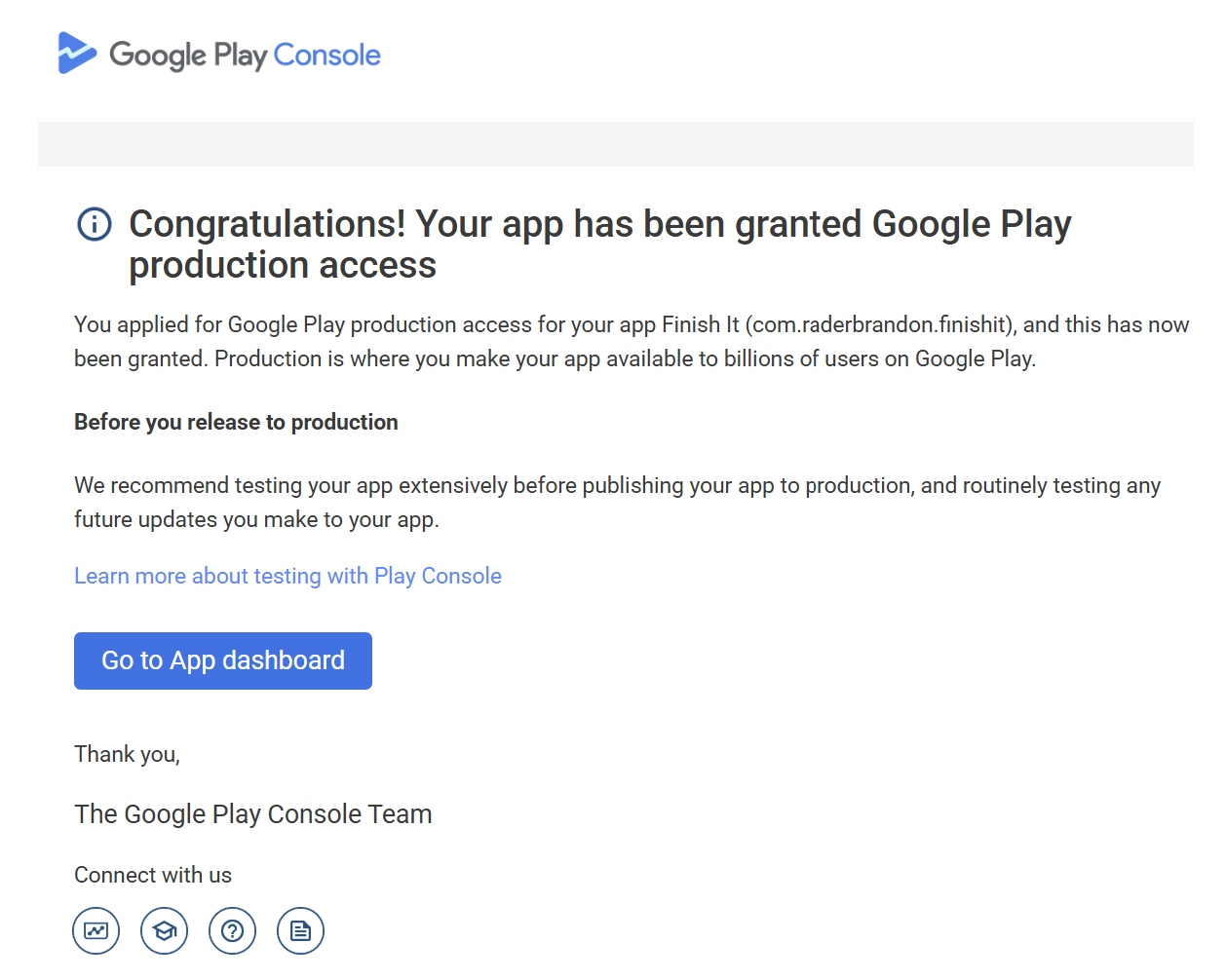
Quality QA Testing Reports
Clear, actionable reports with screenshots and evidence for every important issue found during testing.
Real Device Testing & Diagnostics
Real human testers use physical Android devices to test your app, verify real user flows, and provide clear testing evidence and professional QA reports.
Compliance Audit Passed
Transition your Android app to public production access with confidence. We deliver verified session logs and compliant Console activity.
One Cycle. Complete Approval.
Choose the ideal closed testing cycle for your Android release in Germany.
Loading Packages
Please wait while we fetch the best options for your region...
Frequently Asked Questions
Everything you need to know about passing your closed testing requirements.