Play Store testers for 14-day Android app testing in Nigeria
Find real Play Store testers in Nigeria for Google Play closed testing. Fulfill Play Console requirements securely with 12 testers for 14 days.
Nigeria is a rapidly growing mobile-first powerhouse. The vibrant tech scene in places like Lagos is booming, and ambitious developers are launching brilliant new applications every single day. But there is a silent hurdle that stops many of these apps before they even reach the public market. That hurdle is Google's strict developer policy. Getting your app live is no longer just about writing flawless code and having a great idea. It is about proving to Google that actual human beings can install and use your app without it crashing on their devices.
This brings us to the very specific, often frustrating requirement of securing Play Store testers for 14-day Android app testing in Nigeria. If you try to cheat the system, skip steps, or rush the process, your app stays locked in the developer console. Your hard work remains hidden from the very users who need it. We are going to break down exactly how you can pass this testing phase smoothly, keep your account safe, and finally get your app published for the world to see.
The Core Rule: Google Play Closed Testing Explained
Google wants quality over quantity. To enforce this, they created the Google Play Closed Testing phase for all new developer accounts. This is a mandatory sandbox period where your app must be tested by real people over a continuous two-week span. You might see developers online looking for things like "12 Testers for 14 Days" to meet older or misunderstood metrics, but the current golden rule is actually 20 testers for 14 continuous days.
During this time, testers need to actually open the app. They cannot just download it on day one and forget about it. Google actively tracks the daily opt-ins and active usage metrics. If testers drop off or if their devices look suspicious, your testing phase will fail. For developers in Nigeria, finding a reliable group of friends or colleagues who will remember to open a test app every day for two weeks is surprisingly difficult. This is why understanding the strict rules of Play Store Closed Testing is your most critical pre-launch step.
Real vs. Bot Testers: What Google Actually Wants
When developers get desperate to meet the testing numbers, they sometimes turn to cheap bot services found on shady forums. This is a massive mistake. Google's algorithm is incredibly smart and can easily spot fake activity. Here is a clear breakdown of why you must use real humans for your testing phase.
Real Human Testers
Using real people means your app gets tested on actual, everyday smartphones. Real testers have unique Google accounts with a natural history of downloading apps, watching YouTube, and sending emails. They use varying internet connections, from MTN to Airtel, which mimics true user behavior. When real users interact with your app, Google sees normal session lengths, organic screen clicks, and legitimate crash reports. This builds massive trust with the Play Console. Real testers provide the kind of authentic engagement that guarantees your app will pass the review process without raising any red flags from Google's automated security systems.
Fake Bot Testers
Bot testers are simply automated scripts running on massive server farms or desktop emulators. They all tend to use the same type of data center IP addresses and show zero natural Google account history. Bots will open your app at the exact same time every day, click the exact same buttons in the same sequence, and never explore new features or settings. Google's advanced security systems can spot this robotic behavior almost instantly. If you use bots, your app will be rejected, and your entire developer account could be permanently banned without any chance to appeal. It is a high-risk gamble that simply is not worth taking.
The Ultimate Pre-Launch Checklist for the Nigerian Market
Before you invite a single tester to try your application, you need to make sure your app and your Play Console account are completely ready. Skipping these administrative steps will lead to a rejected application, wasting your full two weeks of testing.
Account and App Preparation
Ensure your Google Play Console account is fully verified. If you are registering your developer account from Nigeria, make sure your identity documents, address verification, and bank details are highly accurate and match your official developer name exactly.
Google takes user privacy very seriously. You must accurately declare what user data your app collects, how it is encrypted in transit, and whether users can easily request data deletion from within the app interface.
Your app needs a high-quality icon, a clear description, and at least three professional screenshots. Even though the app is only in closed testing, these graphic assets must look fully complete and follow all of Google's metadata policy guidelines.
Technical Readiness
Google requires all new apps and updates to target the latest Android API level. Check your build settings in Android Studio or your chosen framework to ensure you are fully compliant before generating and uploading your App Bundle.
Do not invite external testers until you have run the app extensively yourself. Fix any immediate startup crashes, broken login screens, or infinite loading loops. Testers simply cannot test an app that does not open past the splash screen.
Opt into Play App Signing immediately. This allows Google to manage your app signing key securely in their cloud, which is a strict requirement for publishing the modern Android App Bundle format on the store.
Struggling with the 14-Day Testing Requirement?
Skip the hassle of recruiting unreliable testers. Our professional fleet of real Android devices guarantees Google Play compliance in exactly 14 days. Zero bots. Zero emulators. 100% production approval guarantee.
Your Roadmap to Passing Play Store Closed Testing
Getting through the 14-day period is a demanding journey. It requires daily patience, constant monitoring, and strict adherence to the rules. Here is the exact step-by-step roadmap you need to successfully clear this hurdle and reach production.
Upload Your Initial Release
Create a new release in the Closed Testing track on the Play Console. Upload your verified Android App Bundle. Make sure your release notes clearly state what the app does, even if it is just an initial beta version with limited features.
Gather Your Testing Group
You need real people with active accounts. Compile a list of valid Gmail addresses from your testers. Add these emails to your testing track in the console. Remember, whether you are aiming for 12 Testers for 14 Days or the mandatory 20, they must be highly reliable people.
Distribute the Opt-In Link
Once Google automatically approves your closed testing release, they will generate a specific opt-in web link. Send this link directly to your testers. They must click it on an Android device, accept the testing invitation, and then download the app directly from the official Google Play Store.
Monitor Daily Engagement
For the next 14 days, your testers must keep the app installed on their phones and open it regularly. Check your Play Console dashboard every single day to ensure the opt-in numbers do not drop below the required threshold of twenty users.
Apply for Production
After 14 consecutive days of successful testing, a button will unlock in your dashboard allowing you to apply for production access. You will need to answer detailed questions about how you gathered feedback and what specific code improvements you made.
Comparing Testing Options
Developers often wonder how to actually get these testers. You have three main options available to you: doing it yourself, paying for cheap bots, or using a professional testing service. Let us look at how they stack up against each other.
| Feature | Professional Service | DIY (Friends & Family) | Bot Services |
|---|---|---|---|
| Overall Pass Rate | Very High | Medium | Extremely Low |
| User Authenticity | Real Devices | Real Devices | Emulators |
| Effort Required | Minimal | High (Constant nagging) | Low |
| Risk of Account Ban | Safe | Safe | Very High |
| Speed to Start | Immediate | Slow | Immediate |
| Quality of Feedback | Actionable | Minimal | None |
Doing it yourself is completely free but highly exhausting. You will spend two weeks constantly begging your friends to open your app. Bot services are very cheap but incredibly dangerous. Professional services offer the perfect balance of real human testers, minimal stress, and guaranteed compliance.
Frequently Asked Questions
Understanding the deep nuances of Google Play Closed Testing can be overwhelming. We have compiled the most detailed answers to the specific questions Nigerian developers ask us every single day.
Why is Google enforcing this 14-day testing rule for new developers?
Google introduced this strict rule to aggressively clean up the Play Store. In the past, absolutely anyone could upload a low-quality, broken, or even malicious app instantly. This flooded the app store with spam, making it extremely hard for users to find genuinely good applications. By forcing new personal developer accounts to undergo Google Play Closed Testing, Google ensures that the developer is actually serious about their product. The 14-day period proves that the app has baseline functionality, does not crash constantly, and has been verified by real users. For a vibrant and growing market like Nigeria, this means the apps that do make it to the store are of much higher quality, which builds long-term trust with local mobile consumers.
Do I really need 20 testers, or is 12 Testers for 14 Days enough?
This is a very common point of confusion among new developers. You will often see developers searching for phrases like "12 Testers for 14 Days" because they heard a rumor or saw outdated advice on a developer forum. The official, strict policy from Google requires exactly 20 testers opted in continuously for 14 days. If you only have 12 testers, your 14-day clock will not even begin counting in the console. You must have a minimum of 20 real Google accounts opted in at all times. If even one person uninstalls the app on day ten, dropping your count to 19, your test might fail, and you will have to start the entire 14 days all over again. Always aim for a solid buffer - get 25 to 30 testers if possible.
How does Google know if my testers are from Nigeria or another country?
Google Play tracks the location of the Google accounts used by the testers very closely. It looks at the current IP address, the region setting of the Google Play account itself, and the mobile network currently being used. However, Google does not strictly mandate that all your testers must be located in Nigeria for a Nigerian app, unless your app is completely geo-restricted in its specific release settings. That being said, having local Nigerian testers is incredibly beneficial for your app's success. They will test your app on local cellular networks like Globacom or Airtel, they will experience the real-world internet speeds of Lagos or Abuja, and they will provide user feedback that is highly relevant to your exact target market.
What happens if a tester forgets to open the app for a day?
Google expects continuous engagement, but their systems are relatively realistic about standard human behavior. If one tester forgets to open the app on a Tuesday, your entire test will not instantly fail. However, if the vast majority of your testers download the app on day one and never open it again for the rest of the two weeks, Google will definitely notice this lack of engagement. The algorithmic system looks for natural, organic usage patterns. Testers should aim to open the app for at least a few minutes every couple of days. This consistent activity proves to the Play Console that the app is genuinely being evaluated, which is the entire core purpose of Play Store Closed Testing.
Can I use multiple Google accounts on the same phone to act as different testers?
Absolutely not. This is one of the absolute easiest ways to get caught and heavily penalized by Google. Google Play Services is deeply integrated into the Android operating system at a system level. Google can easily detect the unique hardware footprint (IMEI, MAC address, Android ID) of the device. If twenty different Google accounts suddenly opt into your closed test from the exact same physical smartphone within an hour, Google will immediately flag this as highly fraudulent behavior. The testers must be on completely separate, distinct physical devices. Trying to cheat the testing system this way is a guaranteed path to having your app rejected and your developer account permanently suspended.
Why does my production application get rejected even after completing the 14 days?
Completing the 14-day continuous period is only step one of the process. After the time is fully up, you must actively apply for production access in the console. Google will ask you a series of very detailed questions about your testing process. They will ask exactly how you found your testers, what specific feedback you received, and what exact technical changes you made to the app based on that feedback. If you provide short, generic answers like "the app is good" or "no bugs found," Google will almost certainly reject your application. You must provide thoughtful, detailed responses that prove a genuine testing phase occurred. You need to show that the Google Play Closed Testing phase was actually useful for improving your product.
How do professional testing services provide real users?
Legitimate testing services do not use automated bots, server scripts, or Android emulators. Instead, they manage massive, organized communities of real people across the globe who are willing to test new apps in exchange for small financial rewards or community perks. When you hire a professional testing service, they distribute your specific opt-in link to these actual human beings. These testers use their own personal Android phones, their own established Google accounts, and their own natural internet connections. This ensures that the testing data sent back to Google is one hundred percent authentic, keeping your account entirely safe while perfectly fulfilling all the strict requirements of Play Store Closed Testing.
Is it safe to pay for a testing service to pass the closed testing phase?
It is entirely safe as long as you meticulously choose a reputable service that explicitly guarantees real human testers. The danger only ever comes from cheap, unverified services that use automated scripts, botnets, or server farms to fake app installations and engagement. Google is incredibly good at catching fake engagement data. But if you pay a premium service that genuinely organizes real people to download and test your app, you are completely safe from penalties. In fact, many professional development agencies and busy freelancers use these services because managing twenty uncoordinated people manually is a massive waste of their highly valuable coding time.
What should I do if my developer account gets banned?
If your Google Play Developer account is banned, you are in a very difficult situation. Google rarely reverses account bans related to fraudulent testing or severe policy violations. If you truly believe it was an honest mistake, you can file a formal appeal through the Google Play Console help center. You must be exceedingly polite, highly detailed, and provide any hard proof you have that you followed the rules. However, the best strategy by far is pure prevention. Never use bots, never use fake accounts on one device, and never try to bypass the Play Store Closed Testing rules. Following the guidelines from day one is infinitely easier than trying to recover a permanently banned account.
How long does Google take to review the app after the 14 days are over?
Once you finish your 14 days and submit your detailed application for production, Google initiates a thorough manual review process. Unlike standard app updates for established accounts which might be approved in a few short hours, the review for a brand new developer graduating from closed testing takes much longer. You can expect to wait anywhere from three to seven full business days. During this extended time, actual human reviewers at Google are checking your app for basic policy compliance, reviewing your written answers about the testing feedback, and verifying the authenticity of the engagement data. Be patient, do not cancel the rollout to try again, and keep an eye on your email for any updates from Google.
Our QA Process
A straightforward 4-step process to get your Android app approved.
Choose Package
Connect your Google account and choose your preferred closed testing package for your Android app.
Submit Link
Share your Play Store opt-in URL. We immediately deploy 12 real testers to launch and review your Android app daily.
Active Testing
Our crew initiates daily launch sessions on physical devices, verifying usability and logging crashes for your Android app.
Get Approved
We continuously perform closed app testing for 14 days to help you meet Google Play production requirements. We also provide a compliance report.
The Premium QA Advantage
Deploy your Android app onto real retail-grade handsets using our secure laboratory environment.
The 14-Day Production Guarantee
We complete the required 14-day closed testing process with real human testers and physical Android devices, while providing clear testing evidence and documentation throughout the process.
If Google specifically rejects production access due to insufficient testing engagement, you are covered by our free re-run or 100% refund guarantee, subject to our Refund Policy.
Verified Production Access
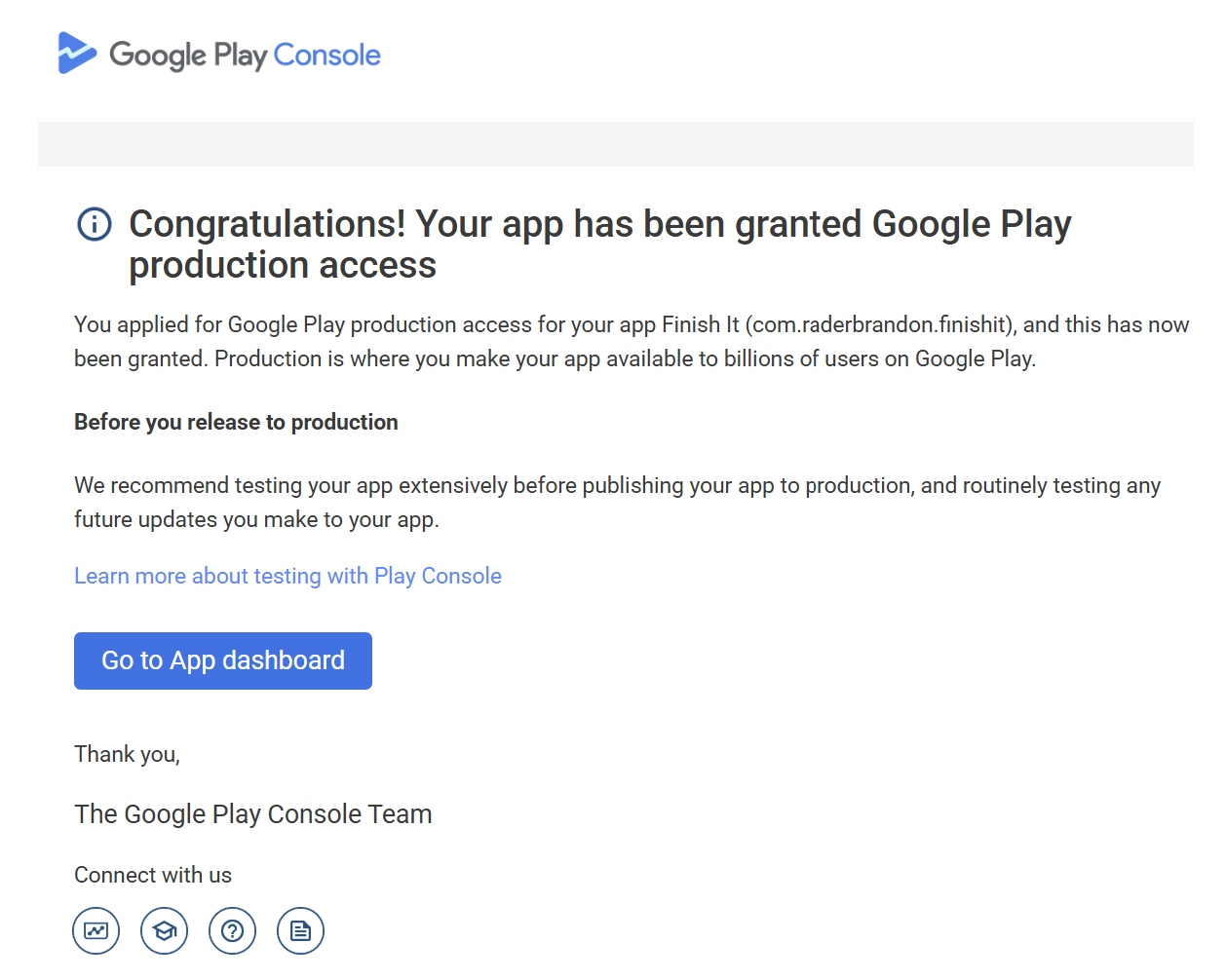
Quality QA Testing Reports
Clear, actionable reports with screenshots and evidence for every important issue found during testing.
Real Device Testing & Diagnostics
Real human testers use physical Android devices to test your app, verify real user flows, and provide clear testing evidence and professional QA reports.
Production Access Secured
Transition your Android app to public production access with confidence. We deliver verified session logs and compliant Console activity.
One Cycle. Complete Approval.
Choose the ideal closed testing cycle for your Android release.
Loading Packages
Please wait while we fetch the best options for your region...
Frequently Asked Questions
Everything you need to know about passing your closed testing requirements.