Play store testers for 14-day Android app testing in the UK
Pass Play Console closed testing in the UK with our 12 testers for 14 days service. Hire real Google Play testers to secure Play Store production access.
If you are launching an Android app in the United Kingdom, you are stepping into one of the most competitive and critical mobile landscapes in the world. The UK audience is notoriously unforgiving of sluggish interfaces, confusing navigation, and battery-draining background processes. Yet, before your application can even be judged by this discerning crowd, you must first face a formidable digital gatekeeper: Google Play Closed Testing. It is not merely about getting a handful of people to hit the download button; it is about unequivocally proving to Google that your app is stable, genuinely engaging, and fully primed for a widespread public rollout. If you think you can simply purchase cheap bot traffic, or beg a few distant relatives to install your unreleased game, you are setting yourself up for an immediate and frustrating rejection. The Play Store's evaluation algorithms are sharper than ever, and they are specifically calibrated to look for authentic, sustained human engagement during your mandatory testing period.
Navigating the waters of app publication requires more than just good code; it demands strategic testing. This guide will walk you through exactly how to secure real Play store testers for 14-day Android app testing in the UK, why bypassing shortcuts is essential for your developer account health, and how to prepare your digital product for a flawless launch.
The Hidden Mechanics of Google Play Closed Testing
To truly understand what you are up against, you need to look under the hood of Google’s testing requirements. In recent times, Google introduced strict guidelines to filter out low-effort, spammy, or broken apps from cluttering their marketplace. A core pillar of this quality control is the closed testing phase.
Historically, developers could simply upload an APK and hit publish. Today, if you have a newly created personal developer account, you are mandated to run a closed test. The famous benchmark that many developers strive to meet - often referred to as needing 12 Testers for 14 Days, though requirements can scale - is designed to simulate a mini-launch. During these two weeks, your app is placed under a microscope. Google isn't just counting heads; they are measuring how these users interact with your software.
Do they open the app once and delete it? Do they experience frequent crashes? Are they spending a reasonable amount of time on your core features? These are the behavioral signals that determine whether your app gets the green light for production access. When your target market is the UK, having testers physically located in the region provides the most accurate and valuable data, as they test your app on local networks, localized devices, and with regional expectations.
The Perils of Artificial Engagement
When faced with a strict 14-day timeline, the temptation to take shortcuts can be overwhelming. The internet is flooded with shady services offering "guaranteed" testing numbers for a few dollars. However, relying on these artificial means is a dangerous game that can jeopardize your entire project.
Real UK Testers
Authentic Behavior: Real users tap, scroll, pause, and interact with your app in unpredictable, human ways that Google's algorithm recognizes as legitimate.
Valuable Feedback: They provide actionable insights, pointing out confusing UI elements, typos in British English, or slow loading times on UK mobile networks.
Compliance Guaranteed: Real engagement ensures you pass the Play Store Closed Testing phase without triggering automated fraud flags.
Device Diversity: Genuine users test your app across a wide spectrum of actual Android devices popular in the UK, from high-end Samsungs to budget Motorola phones.
Bot Farms & Fake Accounts
Predictable Patterns: Bots often execute robotic, linear actions - like opening the app, waiting exactly 10 seconds, and closing it - which Google easily detects as fraudulent.
Zero Feedback: Automated scripts cannot tell you if your onboarding tutorial is confusing or if your color scheme is unappealing.
Account Risk: Using fake testers violates Google's terms of service and can lead to permanent bans for your entire developer account.
Emulated Environments: Bots typically run on server-based emulators, providing zero real-world performance data regarding battery usage or network connectivity.
As you can see, the choice between real and fake is not just about the quality of feedback; it is about the very survival of your app on the platform. Google Play Closed Testing relies heavily on data integrity. If the system detects a spike of 20 downloads from a single IP address block in a remote server farm, your 14-day test is as good as failed.
Preparing Your App for the Discerning UK Market
Before you invite a single tester to try your app, you must ensure that your house is in order. A half-baked app will frustrate users, leading to uninstalls that negatively impact your testing metrics. The UK market expects polish, privacy, and performance.
Pre-Test Optimization
Localize Your Content: Ensure all text uses British English spelling (e.g., 'colour' instead of 'color', 'optimise' instead of 'optimize'). Small details build trust.
Verify GDPR Compliance: The UK has strict data protection laws. Ensure your privacy policy is accessible, clear, and explicitly states how user data is handled. Implement proper cookie and tracking consent banners.
Optimize for Low-Bandwidth: While the UK has excellent 5G in cities, rural areas may rely on slower connections. Ensure your app handles offline states and slow loading gracefully.
Technical Readiness
Integrate Crash Reporting: Tools like Firebase Crashlytics are essential. You need to know exactly when and why the app crashes during the testing phase.
Finalize the Store Listing: Your app icon, screenshots, and description should be polished. This sets the right expectation for your testers before they even download the app.
Set Up In-App Feedback: Make it extremely easy for testers to report bugs or suggest improvements directly from within the app, reducing friction.
By diligently checking off these items, you transform your app from a rough draft into a compelling beta product. This preparation respects your testers' time and drastically increases the likelihood of a successful evaluation.
Struggling with the 14-Day Testing Requirement?
Skip the hassle of recruiting unreliable testers. Our professional fleet of real Android devices guarantees Google Play compliance in exactly 14 days. Zero bots. Zero emulators. 100% production approval guarantee.
Your 14-Day Roadmap to Production Access
Successfully completing the testing requirement is a journey. It requires active management, not passive waiting. Here is a clear roadmap of what your 14 days should look like when utilizing real UK testers.
Days 1-3: The Onboarding Phase
During the initial days, your primary goal is to get all testers safely onboarded. You will send out the invite links, ensure they can access the app through the Google Play Store, and monitor the initial installation metrics. Expect some technical hiccups, such as testers needing to ensure they are logged into the correct Google account.
Days 4-7: Active Engagement
This is the critical window where your testers should be exploring the core functionality of your app. You want to see them creating accounts, completing levels, or making mock purchases. Google is monitoring this sustained activity. Monitor your crash logs daily and prepare hotfixes if critical, blocking bugs are discovered.
Days 8-11: Gathering Deep Feedback
By the second week, testers have settled in. Now is the time to actively solicit feedback. Send them brief surveys or ask specific questions about new features. Their insights into the user interface and overall experience are invaluable at this stage.
Days 12-14: The Final Push
Ensure that your testers remain engaged right up to the final day. Remind them to open the app a few more times. Gather the last bits of feedback, finalize your bug reports, and prepare your application for its official transition into the production track.
Following this structured approach ensures that you don't just passively "survive" the testing period, but rather, you actively leverage it to build a significantly better product.
Decoding the Competitive Landscape of Testing Solutions
When it comes to sourcing testers, developers generally have three options: hiring a professional service, doing it themselves (DIY), or resorting to risky bot networks. Let's break down how these approaches compare.
| Feature | Professional Service (Real UK Testers) | DIY (Friends & Family) | Bot Networks |
|---|---|---|---|
| User Authenticity | High (Real devices, real behavior) | High (But limited pool) | Zero (Automated scripts) |
| Geographic Targeting | Exact (UK-specific) | Variable (Depends on your network) | Often masked or inaccurate |
| Feedback Quality | Excellent (Objective and detailed) | Poor (Often biased or too polite) | None |
| Compliance Safety | 100% Safe | Safe | Extremely Risky (Account ban likely) |
| Time Investment | Low (Handled by the service) | Very High (Chasing people down) | Low |
| Cost | Moderate investment | Free (But costs time) | Very cheap (But costs your account) |
The table clearly illustrates that while begging friends and family is free, it is incredibly time-consuming and often yields biased feedback. Your mother is unlikely to give you a harsh but necessary critique of your app's navigation. Professional services that provide real, engaged testers offer the best balance of safety, quality, and time-saving convenience, especially when targeting a specific demographic like the UK.
Why Regional Metrics Matter to Google
You might wonder why it matters where your testers are located, as long as they test the app. Google's algorithms are increasingly sophisticated and heavily weight regional relevance. If your app is designed for restaurant delivery in London, but all your testers are located in a different continent, it raises immediate red flags in the Play Store Closed Testing system.
Google wants to see that your app functions perfectly in its intended environment. Real UK testers provide vital localized data. They interact with the app using local carriers like EE, Vodafone, or O2. They use local time zones, local currency formats, and they expect a certain standard of privacy compliance (GDPR). When Google sees a healthy cluster of engaged users organically interacting with your app within the target region, it significantly boosts your app's trust score.
Furthermore, acquiring 12 Testers for 14 Days from the actual region you intend to launch in helps you gauge true market interest. If your UK testers find the app confusing or unhelpful, it is a strong indicator that the broader UK public will feel the same way. This localized beta test is your safety net, preventing a disastrous public launch.
Final Thoughts on Conquering the Play Store
Launching an app is a monumental achievement, but getting it past Google's strict requirements is an entirely separate challenge. The closed testing phase is not an obstacle to be bypassed; it is a vital crucible that hardens your app for the real world. By investing in genuine Play store testers for 14-day Android app testing in the UK, you are investing in the long-term viability and success of your digital product.
Do not risk your hard work, your code, and your developer account on cheap tricks or automated bots. Embrace the feedback of real users, refine your app based on their insights, and step into the UK mobile market with confidence and a fully compliant, production-ready application.
Frequently Asked Questions (FAQ)
Why exactly does Google require 14 days of closed testing?
Google implemented the 14-day requirement to combat the influx of low-quality, spam, and malicious apps on the Play Store. The two-week period allows Google's automated systems to monitor user engagement, track crash rates, and ensure the app provides a genuinely valuable and safe experience for real users before it is unleashed to the general public.
Can I just use my friends and family for the testing period?
Yes, you can use friends and family. However, the challenge is keeping them actively engaged every day for 14 days. Often, personal contacts will open the app once, say it looks great, and never open it again. This lack of sustained engagement can cause you to fail the Play Store Closed Testing evaluation. Professional testers are incentivized to provide consistent daily activity.
What happens if my app crashes during the 14-day test?
A few minor crashes will not automatically fail your app, provided you are actively fixing them. However, a high crash rate, or crashes that prevent users from accessing core features, will signal to Google that the app is unstable. It is crucial to monitor crash logs closely and push updates if necessary during the testing window.
Is it really that dangerous to use bot services?
Absolutely. Google has advanced fraud detection systems that easily identify artificial traffic patterns, emulated devices, and VPN masking. If you are caught using bots or fake accounts, your app will be rejected, and your entire Google Play Developer account may be permanently terminated, banning you from publishing any future apps.
Do the testers need to be based in the UK?
While Google doesn't explicitly mandate that testers must be from your target launch country, having testers from the UK is highly recommended if that is your primary market. Local testers provide accurate data on regional network performance, device compatibility, and cultural relevance, giving you a much more authentic and valuable testing phase.
How We Deliver 12 Testers
How we deploy real devices and guarantee compliance for your release.
Connect Account
Sign in with Google to configure the closed testing environment for your Android build in the UK.
Assign Testers
Submit your Google Play Console testing link, and our team will assign qualified testers from our testing network to join your Android closed testing release.
Daily QA Runs
A QA supervisor monitors daily check-ins, ensuring 12 unique Android users engage with your Android build every single day.
Launch Ready
We guarantee 14 consecutive days of active user check-ins to satisfy Google's compliance policies, delivering an audit-ready PDF feedback report.
Our Testing Infrastructure
Experience a next-generation testing infrastructure built for Google Play compliance for your Android release in the UK.
The 14-Day Production Guarantee
We complete the required 14-day closed testing process with real human testers and physical Android devices, while providing clear testing evidence and documentation throughout the process.
If Google specifically rejects production access due to insufficient testing engagement, you are covered by our free re-run or 100% refund guarantee, subject to our Refund Policy.
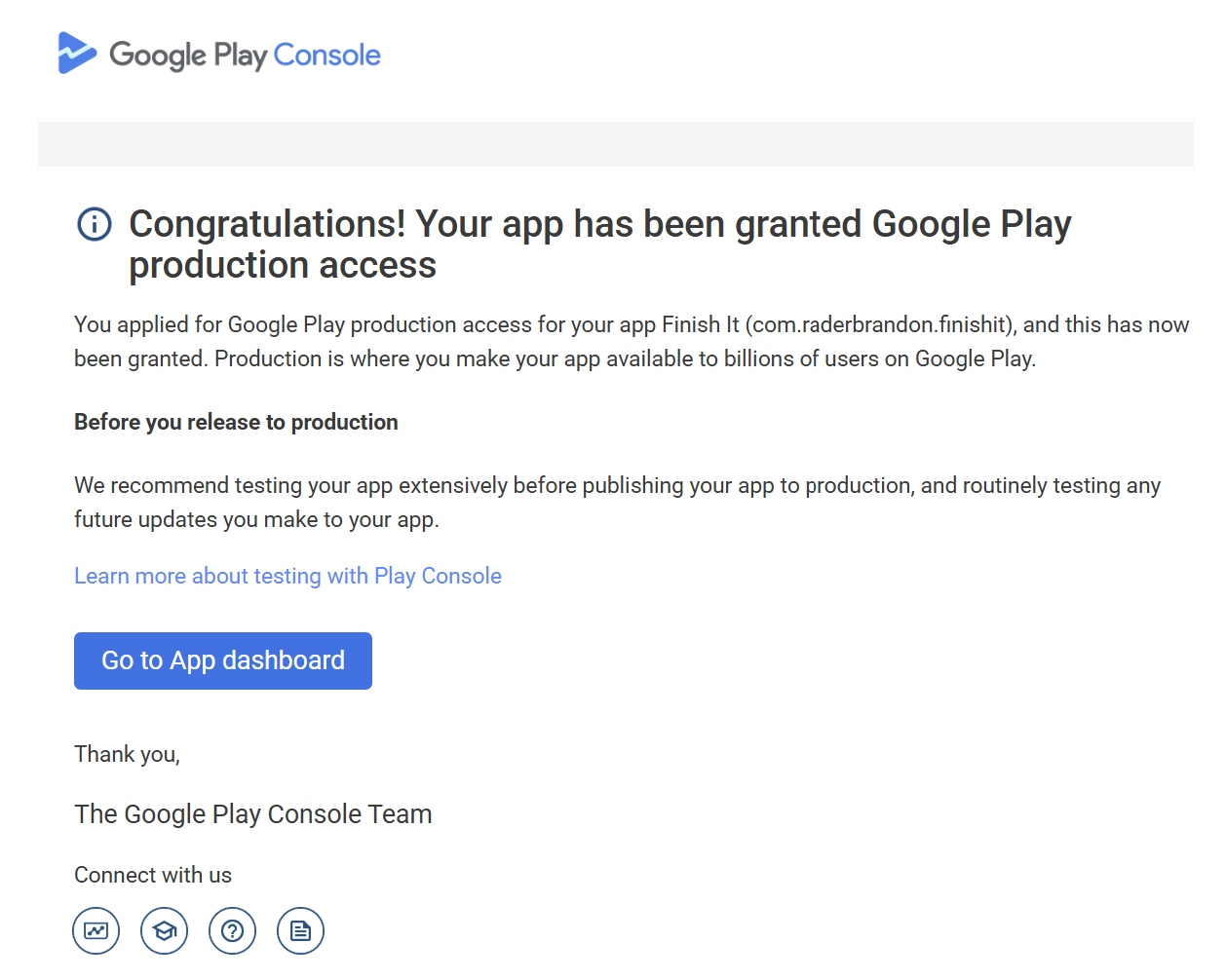
Verified Production Access
Quality QA Testing Reports
Clear, actionable reports with screenshots and evidence for every important issue found during testing.
Real Device Testing & Diagnostics
Real human testers use physical Android devices to test your app, verify real user flows, and provide clear testing evidence and professional QA reports.
Compliance Audit Passed
Get your Android build approved on the first try. We create an audit-ready compliance profile that proves thorough quality assurance.
Affordable Compliance Cycles
Transparent plans built to satisfy Google Play Console guidelines for your Android build.
Loading Packages
Please wait while we fetch the best options for your region...
Frequently Asked Questions
Everything you need to know about passing your closed testing requirements.