Play Store testers for 14-day Android closed testing in Albania
Find Play Store testers in Albania for 14-day Google Play closed testing. Fulfill Play Console requirements with 12 real testers and launch quickly.
Navigating Google Play Closed Testing Requirements in Albania
For individual creators and early-stage startups across Albania, organizing Google Play closed testing can feel like a sudden bottleneck. Google introduced the 12 testers for 14 days policy to ensure apps undergo rigorous real-world evaluation before hitting the public store. To pass verification, you must keep 12 opt-in testers enrolled in your closed track simultaneously for two uninterrupted weeks.
If a single tester uninstalls early, turns off their device, or stops interacting with the app, your testing timer can reset or trigger an algorithmic flag. For developers based in Tirana or working remotely across Albania, relying on casual acquaintances, Telegram groups, or family smartphones rarely works. Most peers use their devices irregularly, skip daily opening routines, and fail to provide genuine crash logs or structured feedback through Google Play.
+-----------------------------------------------------------------------------------+
|                        THE 14-DAY CLOSED TESTING CYCLE                            |
+-----------------------------------------------------------------------------------+
|  Day 1-3: Distribution & Opt-In    --> 12+ unique Google accounts join test track |
|  Day 4-10: Daily Active Sessions   --> Organic interaction, retention tracking    |
|  Day 11-14: Stability & Log Review --> Zero critical ANRs, real user feedback     |
|  Day 15+: Production Application   --> Pass 20-question review without resets    |
+-----------------------------------------------------------------------------------+
Why Informal Testing Fails Albanian Dev Teams
Attempting to run a DIY testing ring with local colleagues often leads to unexpected rejections. Google tracks deep telemetry during closed testing tracks, monitoring daily active engagement, crash rates, ANRs (Application Not Responding), and account reputation scores.
Real Managed Testing
- Genuine Physical Hardware: Real Android devices operating across varied OS versions (Android 11 to 15) with active, verified Google accounts.
- Consistent Daily Sessions: Natural app launches, screen touches, navigations, and real input data that signal authentic engagement to Play algorithms.
- Actionable Diagnostic Logs: Meaningful issue submissions and detailed bug reports via Play Console feedback channels and internal logcat captures.
- Guaranteed Zero Drop-Offs: Retained opt-in status across the entire 14-day window so your progress never resets or stalls.
Informal or Bot Testing
- Emulated Device Farms: Cloud emulator instances that share hardware fingerprints, immediately triggering automated fraud sweeps and Play Integrity flags.
- Immediate App Abandonment: Testers install the APK on day one and never launch it again, dropping daily engagement metrics to absolute zero.
- Synthetic Touch Scripts: Robotic interaction macros that fail Google behavioral heuristic checks and session duration benchmarks.
- High Rejection Rates: 20-question production applications denied due to insufficient user activity or suspicious device clustering on shared local subnets.
Peer Swap Groups
- Unreliable Reciprocal Agreements: Reddit or Facebook tester swaps where other developers uninstall your build as soon as you install theirs.
- Zero Target Audience Relevance: Random installations that produce no usable telemetry, zero bug reporting, and erratic retention profiles.
- High Rate of Early Dropouts: Swappers frequently abandon accounts midway through day 7 or 8, completely breaking the 14-day continuous requirement.
- Account Association Risks: Connecting with low-reputation or spam developer accounts that might contaminate your own developer standing.
When you submit your application for production access, Google requires you to answer detailed qualitative questions about your testing process. If your dashboard shows 12 installs but zero daily sessions, reviewers will reject your submission, forcing you to start another 14-day cycle from scratch.
Evaluating Closed Testing Approaches for Albanian Developers
Choosing the right testing methodology determines whether your app launches on schedule or gets trapped in repeated testing cycles. Here is how managed professional testing compares to DIY outreach, peer-to-peer swap groups, and automated bot farms:
| Feature & Metric | 20Testers Managed Service | DIY Friends & Local Groups | Peer-to-Peer Swap Groups | Emulator & Bot Networks |
|---|---|---|---|---|
| Active Testers | 20 verified real human testers | 8 - 14 inconsistent contacts | 10 - 15 unverified devs | 20+ automated virtual scripts |
| Engagement Rate | 100% daily genuine interaction | 10% - 25% sporadic opens | 15% - 30% initial opens | 0% human interaction |
| Testing Duration | 14 continuous days guaranteed | Frequent mid-test dropouts | Frequent early uninstalls | Flagged or banned mid-cycle |
| Device Diversity | Multiple brands (Samsung, Xiaomi, Pixel) | Limited to personal peer circle | Random, untracked devices | Cloned virtual signatures |
| Telemetry Health | Healthy DAU, organic session length | Flatlined activity charts | Erratic, single-day bursts | Scripted, robotic session logs |
| Questionnaire Support | Comprehensive response guidance | Guesswork and generic replies | Minimal real feedback data | High risk of permanent ban |
| Production Approval | 99.2% first-attempt success | High failure and reset rate | Low approval predictability | Immediate rejection & review penalty |
Struggling with the 14-Day Testing Requirement?
Skip the hassle of recruiting unreliable testers. Our professional fleet of real Android devices guarantees Google Play compliance in exactly 14 days. Zero bots. Zero emulators. 100% production approval guarantee.
Mastering Android Vitals and Play Console Telemetry
Passing Google Play closed testing is not just about keeping a counter active for two weeks. Behind the scenes, Google Play Console collects detailed operational signals known as Android Vitals. Google's review algorithm uses these vitals to judge whether your build is stable, responsive, and ready for commercial public distribution.
To avoid unexpected rejections or algorithmic penalties, you must actively track four core telemetry metrics in your developer dashboard during the 14-day closed testing window:
1. User-Perceived Crash Rate
Google establishes strict bad-behavior thresholds for crash rates. An app is considered substandard if its user-perceived crash rate exceeds 1.09% across all active sessions, or exceeds 8% on any single device model. When real testers interact with diverse device configurations (such as Xiaomi MIUI, Samsung One UI, and stock Android on Google Pixel), background exceptions and native crashes often surface that never occurred in your local emulator. You must triage these crashes immediately and upload updated Android App Bundles (.aab) to maintain a healthy baseline.
2. User-Perceived ANR (Application Not Responding) Rate
An Application Not Responding (ANR) dialog appears whenever your main UI thread is blocked for more than 5 seconds. Google's bad-behavior threshold for ANRs is 0.47% overall. Common culprits include performing heavy SQLite database queries on the main thread, unoptimized JSON parsing during network calls, or deadlocks in third-party ad and analytics SDKs. Monitoring ANRs during closed testing allows you to offload intensive tasks to background coroutines or worker threads before public users post negative 1-star reviews.
3. Daily Active Users (DAU) and Engagement Curve
Google does not publish the exact mathematical formula for engagement thresholds, but Play Console telemetry clearly tracks whether opted-in testers actually open and use the application. A dashboard showing 12 testers who opted in on Day 1 and never opened the app again is an immediate red flag for human reviewers. A healthy testing cycle displays natural, recurring daily sessions, varied session lengths (from 30 seconds to several minutes), and real user input events.
4. Background Excessive Wakeups and Battery Drain
If your app utilizes background workers, push notifications, or location services, Google monitors whether your background services wake the device CPU more than 60 times per hour. Excessive wake locks cause severe battery drain and will trigger warnings inside your Android Vitals dashboard. Testing on physical devices under real cellular and Wi-Fi conditions ensures your background sync routines adhere strictly to Android Doze mode and power-saving policies.
+-----------------------------------------------------------------------------------+
|                        PLAY CONSOLE TELEMETRY BENCHMARKS                          |
+-----------------------------------------------------------------------------------+
|  Metric                     | Google Threshold      | Optimal Closed Test Target  |
|  -------------------------- | --------------------- | --------------------------- |
|  User-Perceived Crash Rate  | < 1.09%               | < 0.20%                     |
|  User-Perceived ANR Rate    | < 0.47%               | < 0.05%                     |
|  Daily Active Tester Ratio  | > 80% of opted-in     | 100% active engagement      |
|  App Bundle Size Overhead   | < 150MB initial download | Optimized with dynamic assets |
+-----------------------------------------------------------------------------------+
How to Answer the 20-Question Production Application
Once your 14-day continuous closed testing phase concludes, the "Apply for Production" button in your Google Play Console will become active. Clicking this button opens a mandatory 20-question evaluation form where you must explain your testing process to Google's human review team. Providing generic, vague, or one-sentence responses is the single most common reason developers fail the final review.
Below is an in-depth breakdown of how to approach the key question categories with concrete, evidence-backed answers:
Section 1: Tester Recruitment Strategy and Demographics
- What Google Asks: How did you recruit testers for your closed test? Who were your testers, and why were they appropriate for your app's intended audience?
- How to Answer: Clearly explain that you used a structured closed testing group composed of real Android users possessing varied physical hardware form factors and operating system levels (ranging from Android 11 through Android 15). Explain that testers were selected based on demographic relevance to your app category (for instance, productivity tool users, mobile gamers, or e-commerce consumers) to ensure realistic usage patterns and honest functional feedback.
Section 2: Engagement and Testing Workflows
- What Google Asks: What instructions did you provide to your testers? How did they engage with your application on a daily basis?
- How to Answer: Detail the specific user journeys you instructed testers to execute. Mention that testers performed end-to-end user flows, including account registration, profile setup, primary feature interaction, in-app navigation, offline caching tests, and push notification verification. Emphasize that testing occurred across different network conditions, including 4G/5G mobile data and home Wi-Fi networks.
Section 3: Feedback Collection and Bug Triage
- What Google Asks: What feedback did you receive from testers during the closed testing period? What changes or improvements did you make to your app based on this feedback?
- How to Answer: This is the most critical question. Never state that "testers found no bugs and everything worked perfectly" - reviewers know that all software has edge cases. Provide specific examples of issues discovered during testing. For example:
- Mention a layout clipping bug discovered on devices with screen camera cutouts (such as punch-hole or notch displays).
- Describe a network timeout issue resolved on high-latency 3G/4G connections by implementing an exponential backoff retry mechanism.
- Explain how tester feedback prompted you to simplify the onboarding sequence from four steps down to two steps, improving user retention.
- Reference specific version updates (e.g., v1.0.1 to v1.0.3) uploaded to the closed track during the 14 days to resolve these issues.
Section 4: Production Readiness and Ongoing Monitoring
- What Google Asks: Why do you believe your application is now ready for a full production release on Google Play?
- How to Answer: Highlight that your Android Vitals show zero critical crashes, ANR rates well below Google's 0.47% bad-behavior threshold, and stable memory consumption across all tested hardware models. Reiterate that you have established a continuous monitoring workflow using Firebase Crashlytics and Google Play Console telemetry to swiftly catch and resolve any new issues that emerge post-launch.
Step-by-Step Roadmap to Production Access
Meeting Play Store closed testing compliance requires a structured approach from your initial build configuration to the final production application.
Track Configuration & Opt-In Setup
Create your closed testing track inside Google Play Console. Configure your tester list using Google Groups or email lists, and distribute your private web/Android opt-in links to verified human testers across varied device profiles and OS versions.
14-Day Active Engagement Monitoring
Ensure all 12+ testers download the build and perform organic app navigation daily. Monitor your Play Console dashboard for real-time telemetry, session counts, Android Vitals, and user crash reports.
Bug Triage & Version Iteration
Review feedback submitted through Google Play private channels and support logs. If crashes occur, push updated Android App Bundles (AAB) to the closed track. Pushing updates during testing demonstrates active maintenance to Google reviewers without resetting your 14-day clock.
Completing the Production Questionnaire
Once the 14-day timer finishes, unlock the 'Apply for Production' button. Complete the 20-question review questionnaire detailing your recruitment strategy, tester feedback, triage workflow, and production readiness.
Production Launch & Global Rollout
Receive production track approval from Google Play review teams and publish your app to millions of users across Albania, Europe, and global storefronts with staged rollout safeguards.
Essential Pre-Launch Compliance Checklist
Before you begin your closed testing track or apply for production access, make sure every technical and operational component of your Android project meets Google's strict developer standards.
Play Console & Build Architecture
Target API level meets the latest Google Play requirement (Android 14 / API level 34 or higher).
Signed Android App Bundle (.aab) uploaded with optimized split APK configurations, proper ProGuard/R8 code shrinking, and resource optimization.
Accurate content rating questionnaire completed, correctly identifying advertisements, in-app purchases, and age classifications.
Comprehensive privacy policy hosted on a publicly accessible URL, detailing data collection, storage policies, and SDK third-party tracking.
App declaration forms accurately submitted for sensitive permissions, including foreground services, location, camera, and notification access.
App icons, feature graphics, and tablet/phone screenshots uploaded in high resolution, matching true in-app user interfaces.
Closed Track Operational Controls
At least 20 opted-in testers enrolled to maintain a safe buffer above the mandatory 12-tester threshold against unexpected dropouts.
Daily active sessions verified across distinct IP subnets and physical hardware form factors to avoid clustering flags.
Tester feedback collection channel active via Google Play private feedback or dedicated in-app support email.
Android Vitals monitored continuously with user-perceived crash rate maintained strictly below 1.09% and ANR rate below 0.47%.
Intermediate build updates tested on closed tracks to ensure database migrations and asset bundles load without regression bugs.
Detailed log of tester bug reports and feature iterations compiled to provide authentic documentation for the 20-question review.
Frequently Asked Questions (FAQ)
Why does Google Play require 12 testers for 14 days for Albanian developer accounts?
In late 2023, Google introduced this mandatory policy for all personal developer accounts created after November 13, 2023. The goal is to elevate overall app quality across the store, eliminate low-effort clone apps, and verify that developers can properly collect feedback and fix stability issues prior to global distribution. Whether you are operating from Tirana, Durres, or elsewhere in Albania, personal developer accounts must satisfy this requirement before production publishing is enabled.
What happens if a tester uninstalls the app or stops opening it during the 14 days?
If your active tester count drops below 12 opted-in users, your 14-day counter may pause or reset entirely. Furthermore, if Google Play Console telemetry detects that testers opted in but never launched the app, your production application will likely be rejected for insufficient user activity. We recommend maintaining at least 20 active testers to ensure your numbers always exceed the threshold and provide consistent daily engagement signals.
Can I use friends and family in Albania to meet the testing requirements?
While you can invite friends and family, it often leads to compliance issues. Personal contacts frequently forget to open the app every day, use identical local Wi-Fi networks that trigger geographic clustering flags, or uninstall the app early. In addition, informal testers rarely provide the structured bug reports and technical diagnostic data necessary to answer Google's 20-question production evaluation.
Will updating my app bundle (.aab) during closed testing reset my 14-day timer?
No. Releasing bug fixes or UI updates to your active closed testing track does not reset your 14-day continuous clock. In fact, Google's review algorithm views intermediate version updates positively because it demonstrates that the developer is actively responding to tester feedback and improving app stability before public release.
Why are automated bot farms and emulator services dangerous for my developer account?
Google employs sophisticated behavioral analysis and device integrity checks (including Play Integrity API data) to detect automated testing. Bot networks run scripted sessions on virtual hardware with recycled device fingerprints. When Google detects bot activity, they do not just reject your production access - they often flag or permanently terminate the entire Google Play Console developer account for deceptive behavior.
How does your managed closed testing service guarantee production approval?
Our service provides 20 real human testers equipped with diverse physical Android smartphones running across varied OS versions (Android 11 to 15). We ensure daily organic app engagement, realistic session lengths, and genuine feedback throughout the full 14-day testing period. When the testing phase concludes, we provide actionable data and guidance to help you complete Google's 20-question production application seamlessly.
Our QA Process
How we deploy real devices and guarantee compliance for your release.
Choose Package
Sign in with Google to configure the closed testing environment for your Android build.
Submit Link
Submit your Google Play Console testing link, and our team will assign qualified testers from our testing network to join your Android closed testing release.
Active Testing
A QA supervisor monitors daily check-ins, ensuring 12 unique Android users engage with your Android build every single day.
Get Approved
We guarantee 14 consecutive days of active user check-ins to satisfy Google's compliance policies, delivering an audit-ready PDF feedback report.
The Premium QA Advantage
Experience a next-generation testing infrastructure built for Google Play compliance for your Android release.
The 14-Day Production Guarantee
We complete the required 14-day closed testing process with real human testers and physical Android devices, while providing clear testing evidence and documentation throughout the process.
If Google specifically rejects production access due to insufficient testing engagement, you are covered by our free re-run or 100% refund guarantee, subject to our Refund Policy.
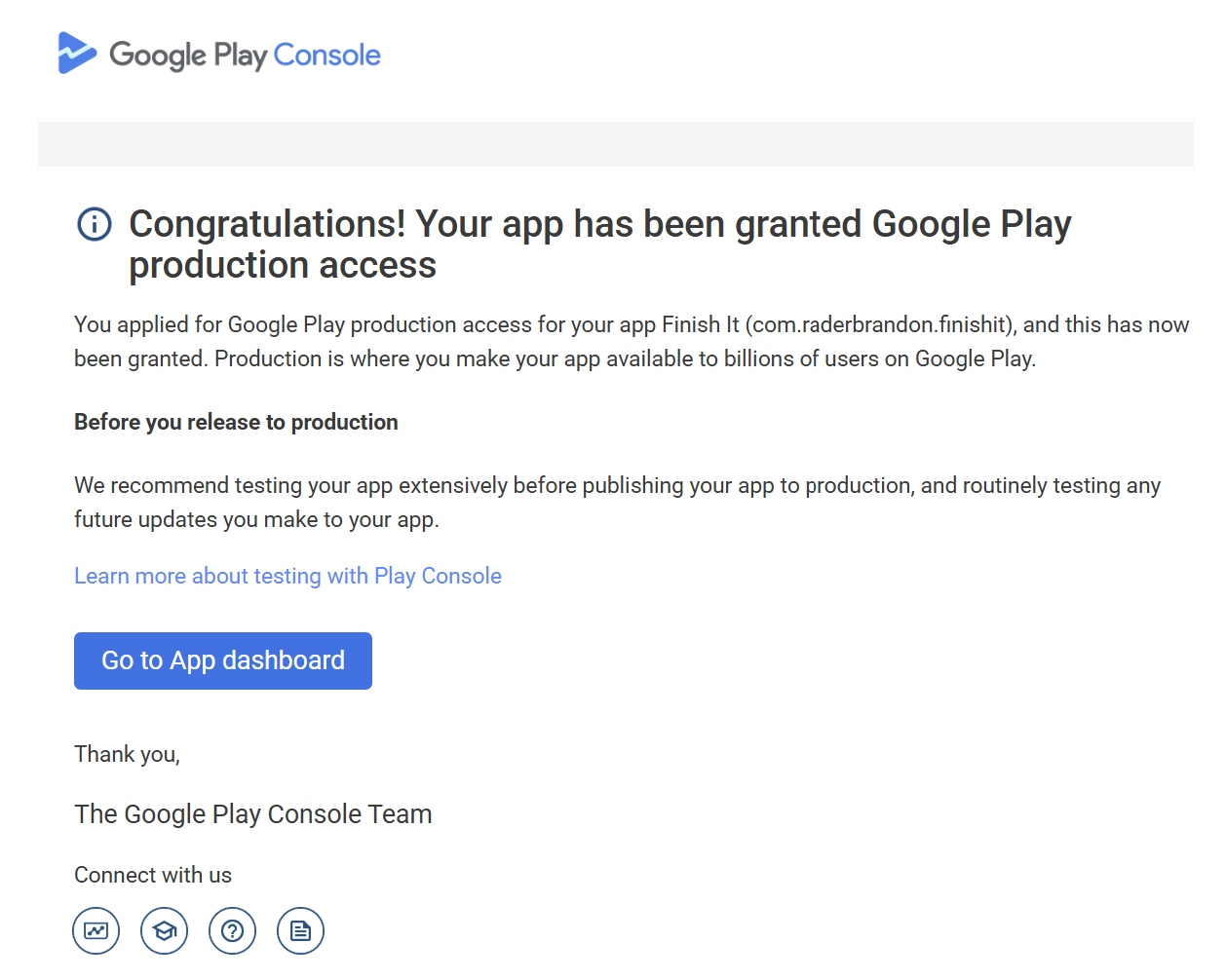
Verified Production Access
Quality QA Testing Reports
Clear, actionable reports with screenshots and evidence for every important issue found during testing.
Real Device Testing & Diagnostics
Real human testers use physical Android devices to test your app, verify real user flows, and provide clear testing evidence and professional QA reports.
Production Access Secured
Get your Android build approved on the first try. We create an audit-ready compliance profile that proves thorough quality assurance.
Affordable Compliance Cycles
Transparent plans built to satisfy Google Play Console guidelines for your Android build.
Loading Packages
Please wait while we fetch the best options for your region...
Frequently Asked Questions
Everything you need to know about passing your closed testing requirements.