Play Store testers for 14-day Android closed testing in Bahrain
Find Play Store testers in Bahrain for 14-day Google Play closed testing. Fulfill Play Console requirements with 12 real testers and launch quickly.
Mastering Closed Testing Compliance for Bahrain Developers
Google Play Closed Testing is now a mandatory quality filter designed to eliminate broken builds and unvetted accounts from the Play Store ecosystem. For developers based in Bahrain or engineering applications tailored for the GCC digital economy, satisfying this requirement involves managing dual-language Arabic and English UI components, local currency formatting (BHD), and regional network conditions across diverse Android hardware profiles.
Reaching production access requires far more than sharing a closed track URL with colleagues or casual contacts. If testers drop off midway through the testing cycle or fail to interact with your application build, Play Console telemetry algorithms flag your test as incomplete. Securing dedicated Play Store closed testing participants ensures that your opt-in count remains steady above the minimum threshold without sudden dropouts resetting your 14-day evaluation timer.
Bot Farms vs. Genuine Human Testers in Closed Testing
Attempting to bypass the 14-day closed testing phase with automated bot clicks, device farms, or virtual emulators is one of the quickest ways to receive a permanent production rejection. Google Play Console monitors nuanced runtime signals, including real battery level changes, accelerometer fluctuations, organic touch inputs, and authentic Google account trust scores. When synthetic traffic is detected, Google resets the testing counter to day zero and may place the developer console account under formal policy review.
Automated Bot Networks
- Cloud-hosted emulators sharing identical hardware identifiers and proxy networks.
- Zero organic touch gestures, synthetic session durations, and robotic navigation paths.
- Abrupt dropouts and silent uninstalls that break the mandatory 14-day retention requirement.
- High probability of production track rejection and developer account penalties.
Authentic Human Testers
- Real physical Android smartphones running varied OS versions (Android 11 through Android 15).
- Natural session lengths, active feature exploration, and genuine UI friction discovery.
- Continuous 14-day opt-in status backed by established, verified Google Play user accounts.
- Realistic Android Vitals telemetry and legitimate private feedback logs that pass Play review.
Genuine human testers provide the exact behavioral metrics that Google algorithms look for during the production application review. By launching your application across genuine Android devices, your team captures actionable bug reports, evaluates Arabic right-to-left (RTL) text mirroring under real screen densities, and establishes the steady engagement history required to gain production clearance.
| Feature / Criteria | Professional Managed Testing | Peer Exchange Groups | Automated Bot Services |
|---|---|---|---|
| Physical Device Verification | 100% genuine Android hardware across global OEMs | Unverified personal devices with high dropout rates | Scripted emulators with shared fingerprints |
| 14-Day Continuous Retention | Guaranteed active opt-ins with instant replacement | Frequent tester dropouts after 2 to 3 days | Abrupt disconnects that trigger compliance flags |
| Play Console Policy Compliance | Fully aligned with 2026 Google Play developer standards | Inconsistent telemetry and patchy activity logs | Direct violation of automated testing rules |
| Feedback & Bug Discovery | Structured feedback, crash diagnostics, and UX notes | Minimal, superficial, or missing feedback | Non-existent or machine-generated text |
| Production Track Approval Rate | High first-attempt pass rate on production access | Frequent review delays and 14-day counter resets | High risk of permanent account restrictions |
Struggling with the 14-Day Testing Requirement?
Skip the hassle of recruiting unreliable testers. Our professional fleet of real Android devices guarantees Google Play compliance in exactly 14 days. Zero bots. Zero emulators. 100% production approval guarantee.
Critical Play Console Telemetry and Android Vitals
When you apply for production track access after completing your 14-day closed testing period, Google Play reviewers do not merely check if 12 testers opted in. Automated systems examine comprehensive telemetry data collected in your Play Console dashboard throughout the entire evaluation cycle.
+-------------------------------------------------------------------+
|               Google Play Closed Testing Lifecycle                |
|                                                                   |
|  [App Bundle (AAB)] -> [Closed Track Setup] -> [12+ Active Testers]|
|                                                       |           |
|                                                       v           |
|  [Production Access Granted] <- [14 Days Continuous Engagement]   |
|                               (Vitals, Crashes, Daily Telemetry)  |
+-------------------------------------------------------------------+
Understanding what metrics Google tracks during this period helps you prepare a resilient release build that sails through the review process:
- Daily Active Opt-In State: Your closed testing track must maintain at least 12 continuously enrolled testers. If a tester leaves the program or uninstalls the build, your active count drops. Keeping a safety buffer of 15 to 20 testers ensures your track never dips below the legal minimum.
- Android Vitals & Crash Rates: Google measures your User-Perceived Crash Rate and ANR (Application Not Responding) rate against core platform thresholds. Your target should remain well below the 1.09% overall threshold and 0.47% per-device threshold during testing.
- Session Variance & Touch Depths: Authentic users open apps at irregular intervals, navigate between screens, scroll through lists, and test network-dependent features. This behavioral footprint cannot be replicated by automated scripts.
- Private Tester Feedback Logs: Google provides a dedicated feedback channel in the Play Store for closed track testers. Having testers submit legitimate notes about UI layouts, localization, or feature responsiveness provides qualitative proof of an active testing community.
Regional Optimization for Bahrain and GCC Android Releases
Publishing an application for users in Bahrain presents specific engineering considerations that should be actively validated during your 12 testers for 14 days closed testing phase. Testing your application under these real-world conditions prevents costly rollbacks after public release.
Arabic RTL Layouts and Bi-Directional Text Rendering
Arabic typography requires comprehensive right-to-left layout testing. During closed testing, verify that:
- UI containers, buttons, and navigation drawers mirror correctly without clipped Arabic strings.
- Bi-directional text containing mixed alphanumeric strings (such as Bahraini IBAN codes, phone numbers starting with
+973, or addresses in Manama) format in the proper reading direction. - Custom fonts like Cairo, Amiri, or Noto Sans Arabic render smoothly without overlapping layout elements on diverse screen aspect ratios.
Local Payment Integrations and Sandboxed Testing
Fintech and commerce applications targeting Bahrain often integrate with BenefitPay, local open banking APIs, or regional payment gateways like Tap and Checkout.com. During closed testing:
- Validate sandboxed payment flows and web-view handshakes on multiple Android OS levels.
- Ensure payment confirmation webhooks update your local room database or remote cloud state reliably without causing ANR pauses.
- Verify currency formatting handles Bahraini Dinar (BHD) three-decimal precision (e.g.,
BD 12.500) without mathematical rounding bugs.
Network Resiliency and Cross-Device Compatibility
While 5G and high-speed fiber connectivity are standard across Manama, Muharraq, and Riffa, applications must remain resilient when switching between mobile data and local Wi-Fi hotspots. Closed testers help verify that offline caching, image loading via Glide or Coil, and background work managers handle network transitions gracefully without dropping user session state.
Pre-Testing Technical Readiness
Ensure your Android App Bundle (AAB) is signed with Play App Signing and targets API Level 34 or higher in compliance with the latest Play Store policies.
Host a comprehensive privacy policy and ensure all declared dangerous permissions (such as location, camera, or background services) have corresponding in-app disclosures.
Integrate Firebase Crashlytics or Sentry to capture unhandled exceptions, memory leaks, and ANRs during your closed testing run in real time.
Closed Track Configuration & Tester Management
Create a closed testing track in Google Play Console, define your release name, and upload your signed release AAB build with detailed release notes.
Add your verified testers via a dedicated Google Group or direct email list, ensuring that tester emails match their active Play Store accounts.
Distribute the web opt-in (join on the web) and Android opt-in (join on Android) links, confirming all 12+ testers have accepted the invitation.
Step-by-Step Roadmap to Production Access
Navigating the Google Play Console closed testing workflow requires a structured, milestone-driven approach. Following this proven roadmap ensures your engineering team meets every Google Play requirement without encountering unexpected review delays.
Phase 1: Architecture & Closed Track Setup
Finalize your release candidate build in Android Studio, generate an optimized Android App Bundle, and configure your closed testing track inside Google Play Console. Define your testing countries, set up your opt-in email list or Google Group, and upload the build for initial Google automated pre-launch scanning.
Phase 2: Tester Onboarding & Verification
Distribute the opt-in URL to verified human testers with real Android devices. Confirm that at least 12 distinct testers accept the invitation, download the build directly from the Play Store, and launch the application to initiate baseline Play Console telemetry signals.
Phase 3: 14-Day Continuous Testing & Vitals Monitoring
Maintain active daily engagement across the full two-week period. Monitor your Android Vitals in Play Console daily to ensure zero critical crashes or excessive ANRs. Collect tester feedback through private Play Store channels and deploy patch updates to the closed track if critical bugs emerge.
Phase 4: Production Access Application
Once the 14-day continuous requirement is completed, the Play Console dashboard activates the 'Apply for Production' button. Complete the developer questionnaire detailing your testing methodology, feedback gathered, bug fixes deployed, and target audience readiness.
Phase 5: Public Production Launch
Upon review approval from Google's engineering team, your production track is unlocked. You can now publish your application to the live Google Play Store for users across Bahrain, the GCC, and international markets.
Best Practices for Answering the Production Access Questionnaire
When your 14 days of closed testing are complete, Google Play Console prompts you to answer a detailed questionnaire before approving production track access. Google's review team uses your answers to verify that your testing process was genuine and thorough.
Detailing Your Recruitment and Testing Strategy
Avoid generic one-line answers like "I asked my friends." Instead, provide a professional, structured overview of your testing framework:
- Tester Recruitment: Explain that you engaged a dedicated testing group with real Android hardware running diverse OS versions (Android 11 through Android 15) to evaluate device performance and UI consistency.
- Engagement Strategy: Describe how testers were instructed to explore key user journeys, including user authentication, payment processing, multilingual language switching, and offline data persistence.
Summarizing Feedback and Technical Improvements
Google looks for tangible proof that feedback led to meaningful code improvements. Detail specific optimizations your team implemented during the closed testing period:
- Mention specific UI bugs caught on particular aspect ratios or RTL layout mirroring issues resolved in Arabic mode.
- Highlight performance enhancements, such as optimizing database queries to reduce cold app startup latency.
- Describe how user feedback led to clearer error messages during network timeouts or payment gateway handshakes.
Frequently Asked Questions
Why does Google Play require 12 testers for 14 days in Bahrain?
Google Play enforces the 12 testers for 14 days rule on all personal developer accounts created after November 2023. The policy is designed to raise software quality across the Play Store by ensuring that apps undergo real-world testing on physical devices before reaching public users. This helps catch bugs, crashes, and usability issues early, ensuring a safe experience for users across Bahrain and worldwide.
What happens if a tester uninstalls the app during the 14-day period?
If a tester opts out or uninstalls the application and your active tester count falls below 12, Google Play Console may pause or reset the 14-day testing countdown. To avoid this setback, professional teams maintain a safety buffer of 15 to 20 active testers. This ensures that even if one or two individuals drop out, your track remains fully compliant above the minimum threshold throughout the entire two-week window.
Can I use automated emulators or bots to satisfy the closed testing requirement?
No. Google Play Console uses advanced telemetry algorithms to detect emulator farms, scripted interactions, identical IP ranges, and lack of real sensor data. Accounts caught using bot networks face immediate rejection of production track access, resets of the testing timeline, and potential suspension of the developer account under developer anti-abuse policies.
Do all 12 testers need to live physically in Bahrain?
Not necessarily, unless your application is geographically restricted exclusively to Bahrain in your Play Console track settings. As long as your closed testing track is configured to include the countries where your testers reside, genuine international testers with verified Google accounts can test the build. However, if you are testing localized features like BenefitPay or regional Arabic localization, having testers familiar with GCC standards provides superior UX feedback.
Can I push new updates to the closed track during the 14-day testing run?
Yes. Pushing updates and bug fixes to your closed testing track during the 14 days is encouraged by Google. It demonstrates an active development lifecycle where your team gathers feedback, fixes bugs, and improves stability. Updating your build does not reset your 14-day testing timer as long as your active tester opt-in count remains continuously above the 12-tester threshold.
How should I answer the Play Console production access questions after 14 days?
Provide clear, professional, and detailed answers that reflect genuine development activity. Describe how you recruited your testing cohort, the specific user journeys tested (e.g., authentication, RTL layouts, database synchronization), the feedback received through Play Store private channels, and the concrete bug fixes or performance optimizations deployed to resolve issues before requesting production release.
The Testing Pipeline
Your journey to Google Play production access, simplified and automated.
Sign In
Authenticate your account to initialize the 14-day QA fleet for your Android release.
Opt-In URL
Upload your testing link. We assign 12 verified users with real Android devices to download and test your Android release.
Testing Begins
A dedicated testing supervisor is assigned to monitor progress while testers engage with your Android app and provide feedback throughout the testing period.
Compliance Complete
Our lab maintains active installations for two weeks straight, ensuring a clean track record and providing a QA compliance log for your release.
Why Developers Trust Us
Satisfy your Play Store Console testing obligations with our managed physical device fleet tailored for Android builds.
The 14-Day Production Guarantee
We complete the required 14-day closed testing process with real human testers and physical Android devices, while providing clear testing evidence and documentation throughout the process.
If Google specifically rejects production access due to insufficient testing engagement, you are covered by our free re-run or 100% refund guarantee, subject to our Refund Policy.
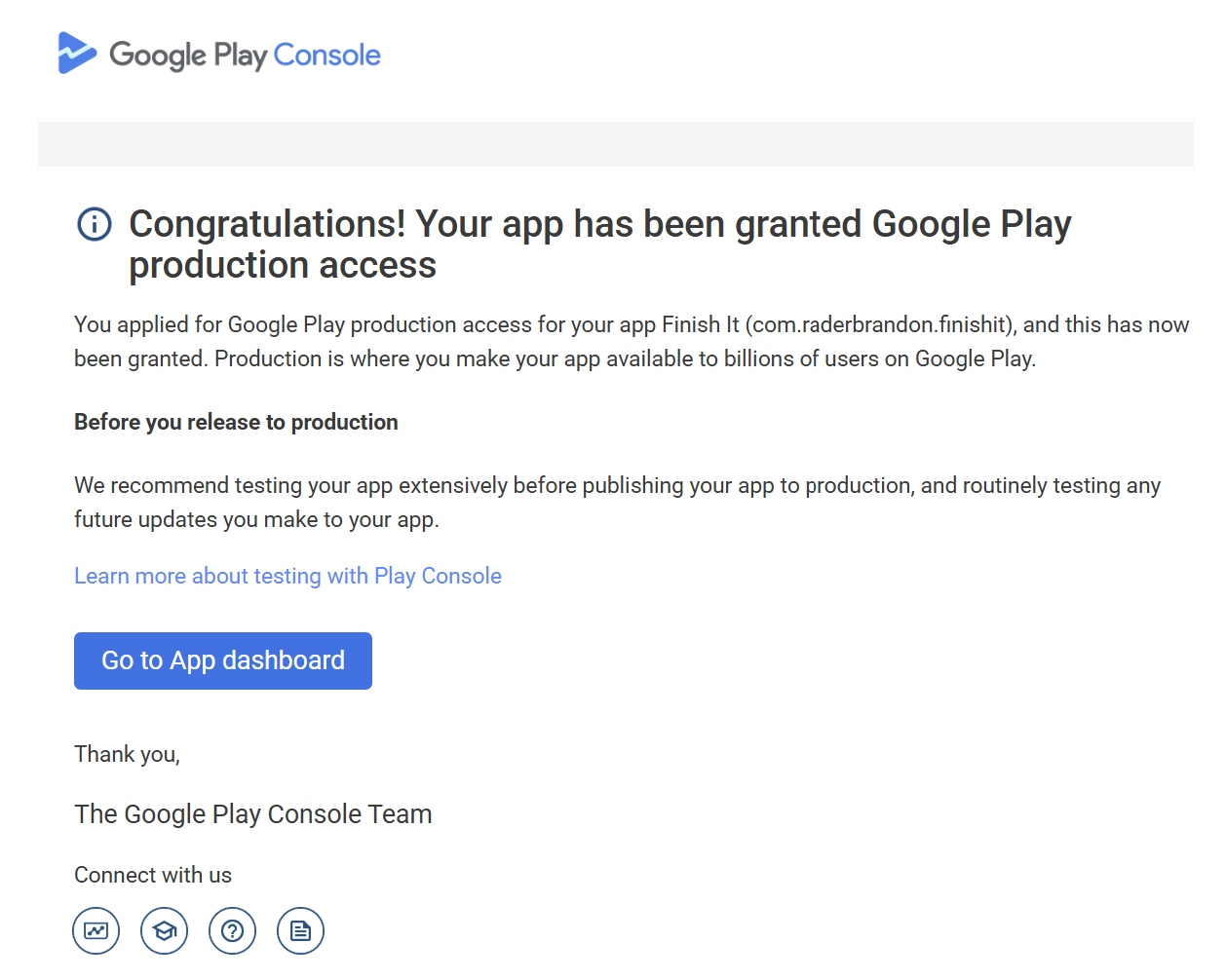
Verified Production Access
Quality QA Testing Reports
Clear, actionable reports with screenshots and evidence for every important issue found during testing.
Real Device Testing & Diagnostics
Real human testers use physical Android devices to test your app, verify real user flows, and provide clear testing evidence and professional QA reports.
Guaranteed App Approval
Our structured 14-day closed testing process is designed to meet Google Play's production requirements for your Android release.
Simple Closed Testing Pricing
Select the plan that fits your Android app complexity.
Loading Packages
Please wait while we fetch the best options for your region...
Frequently Asked Questions
Everything you need to know about passing your closed testing requirements.